CYLINDER BLOCK INSPECTION

-
INSPECT CYLINDER BLOCK FOR WARPAGE
-
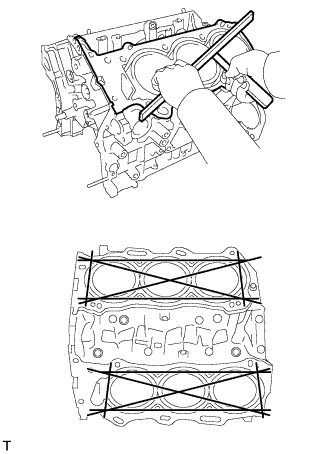
Using a precision straightedge and feeler gauge, measure the warpage of the contact surface of the cylinder head gasket.
Standard warpage 0 to 0.05 mm (0 to 0.00197 in.) Maximum warpage 0.07 mm (0.00276 in.) If the warpage is more than the maximum, replace the cylinder block sub-assembly.
-
-
INSPECT CYLINDER BORE
-
Visually check the cylinder for vertical scratches.
If necessary, replace the cylinder block sub-assembly.
-
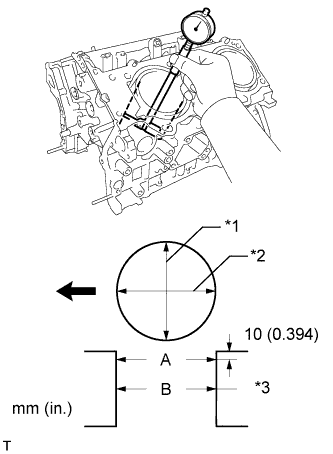
Text in Illustration *1 Thrust Direction *2 Axial Direction *3 Center 
Engine Front Using a cylinder gauge, measure the cylinder bore diameter at positions A and B in the thrust and axial directions.
Standard diameter 83.000 to 83.012 mm (3.2677 to 3.2682 in.) Maximum diameter 83.200 mm (3.2756 in.) If the average diameter of 4 positions is more than the maximum, replace the cylinder block sub-assembly.
-
-
INSPECT PISTON SUB-ASSEMBLY WITH PIN
-
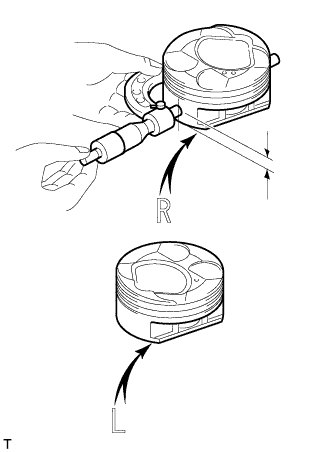
Using a micrometer, measure the piston diameter at right angles to the piston center line where the distance from the piston end is as specified.
Distance 14.3 mm (0.563 in.) Standard diameter 82.976 to 82.986 mm (3.2668 to 3.2672 in.) Minimum diameter 82.846 mm (3.2616 in.) If the piston diameter is less than the minimum, replace the piston sub-assembly with pin.
-
-
INSPECT PISTON OIL CLEARANCE
-
Measure the cylinder bore diameter in the thrust directions.
-
Subtract the piston diameter measurement from the cylinder bore diameter measurement.
Standard oil clearance 0.006 to 0.052 mm (0.000236 to 0.002047 in.) Maximum oil clearance 0.072 mm (0.002835 in.) If the oil clearance is more than the maximum, replace all the pistons. If necessary, replace the cylinder block sub-assembly.
-
-
INSPECT RING GROOVE CLEARANCE
-
Using a feeler gauge, measure the clearance between a new piston ring and the wall of the ring groove.
Standard Ring Groove Clearance Item Specified Condition No. 1 0.020 to 0.070 mm (0.000787 to 0.00276 in.) No. 2 0.030 to 0.070 mm (0.00118 to 0.00276 in.) Oil 0.020 to 0.070 mm (0.000787 to 0.00276 in.) If the clearance is not as specified, replace the piston sub-assembly with pin.
-
-
INSPECT PISTON PIN OIL CLEARANCE
-
Using a caliper gauge, measure the inside diameter of the piston pin hole.
Standard Piston Pin Hole Inside Diameter Mark Specified Condition A 21.998 to 22.001 mm (0.8661 to 0.8662 in.) B 22.002 to 22.004 mm (0.8662 to 0.8663 in.) C 22.005 to 22.007 mm (0.8663 to 0.8664 in.) -
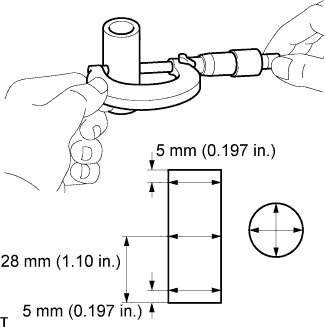
Using a micrometer, measure the piston pin diameter.
Standard Piston Pin Diameter Mark Specified Condition A 21.997 to 22.000 mm (0.8660 to 0.8661 in.) B 22.001 to 22.003 mm (0.8662 to 0.8663 in.) C 22.004 to 22.006 mm (0.8663 to 0.8664 in.) -
Subtract the piston pin diameter measurement from the piston pin hole diameter measurement.
Standard oil clearance -0.002 to 0.004 mm (-0.0000787 to 0.000158 in.) Maximum oil clearance 0.015 mm (0.000591 in.) If the oil clearance is more than the maximum, replace the piston sub-assembly with pin.
-
Using a caliper gauge, measure the inside diameter of the connecting rod small end bush.
Standard Bushing Inside Diameter Mark Specified Condition A 22.005 to 22.008 mm (0.86634 to 0.86645 in.) B 22.009 to 22.011 mm (0.86649 to 0.86657 in.) C 22.012 to 22.014 mm (0.86661 to 0.86669 in.) -
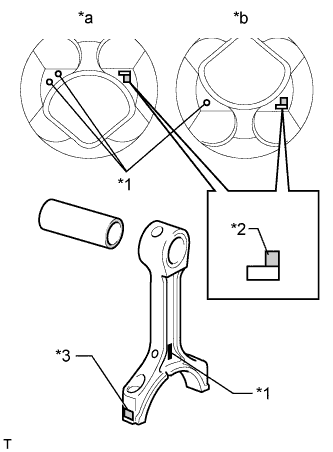
Text in Illustration *1 Front Mark *2 Piston Pin Hole Inside Diameter Mark *3 Connecting Rod Bushing Inside Diameter Mark *a Piston RH *b Piston LH Subtract the piston pin diameter measurement from the bushing inside diameter measurement.
Standard oil clearance 0.005 to 0.011 mm (0.000197 to 0.000433 in.) Maximum oil clearance 0.030 mm (0.00118 in.) If the oil clearance is more than the maximum, replace the connecting rod small end bush. If necessary, replace the connecting rod sub-assembly and piston sub-assembly with pin.
-
-
INSPECT CRANKSHAFT THRUST CLEARANCE
-
Install the main bearing cap Click here.
-
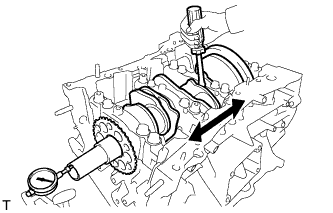
Using a dial indicator, measure the thrust clearance while prying the crankshaft back and forth with a screwdriver.
Standard thrust clearance 0.04 to 0.24 mm (0.00157 to 0.00945 in.) Maximum thrust clearance 0.30 mm (0.0118 in.) If the thrust clearance is more than the maximum, replace the thrust washers as a set. If necessary, replace the crankshaft.
Thrust washer thickness 2.43 to 2.48 mm (0.0957 to 0.0976 in.)
-
-
INSPECT PISTON RING END GAP
-
Insert the piston ring into the cylinder bore.
-
Using a piston, push the piston ring slightly beyond the bottom of the ring travel, 110 mm (4.33 in.) from the top of the cylinder block sub-assembly.
-
Using a feeler gauge, measure the end gap.
Standard End Gap Item Specified Condition No. 1 0.20 to 0.25 mm (0.00787 to 0.00984 in.) No. 2 0.35 to 0.40 mm (0.0138 to 0.0157 in.) Oil 0.10 to 0.20 mm (0.00394 to 0.00787 in.) Maximum End Gap Item Specified Condition No. 1 0.50 mm (0.0197 in.) No. 2 0.80 mm (0.0315 in.) Oil 0.65 mm (0.0256 in.) If the end gap is more than the maximum, replace the piston ring. If the end gap is more than the maximum even with a new piston ring, replace the cylinder block sub-assembly.
-
-
INSPECT CONNECTING ROD SUB-ASSEMBLY
-
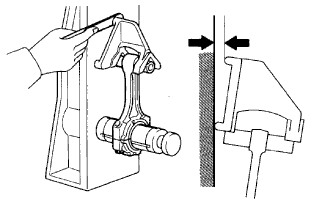
Using a rod aligner and feeler gauge, check the connecting rod alignment.
-
Check for out-of-alignment.
Maximum out-of-alignment 0.05 mm (0.00197 in.) per 100 mm (3.94 in.) If the out-of-alignment is more than the maximum, replace the connecting rod sub-assembly.
-
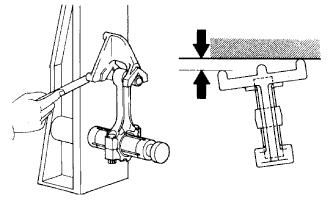
Check for twist.
Maximum twist 0.15 mm (0.00591 in.) per 100 mm (3.94 in.) If the twist is more than the maximum, replace the connecting rod sub-assembly.
-
-
-
INSPECT CONNECTING ROD BOLT
-
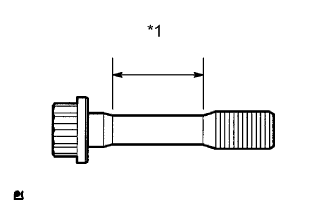
Text in Illustration *1 Measurement Area Using a vernier caliper, measure the diameter of the bolt at several points within the area shown in the illustration.
Standard diameter 7.2 to 7.3 mm (0.283 to 0.287 in.) Minimum diameter 7.0 mm (0.276 in.) If the diameter is less than the minimum, replace the bolt.
Tech Tips
-
Diameter measurements should be done at several points.
-
If the diameter is less than the minimum, replace the connecting rod bolt with a new one. Failure to do so may lead to engine damage.
-
If there is any thread deformation, replace the connecting rod bolt with a new one.
-
-
-
INSPECT CRANKSHAFT
-
Inspect runout.
-
Clean the crank journal.
-
Place the crankshaft on V-blocks.
-
Using a dial indicator, measure the runout at the center journal.
Maximum runout 0.06 mm (0.00236 in.) If the runout is more than the maximum, replace the crankshaft.
-
-
Inspect the main journals.
-
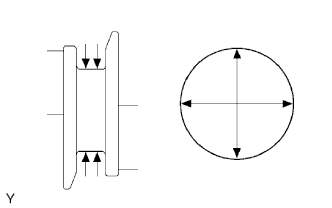
Using a micrometer, measure the diameter of each main journal.
Standard journal diameter 60.988 to 61.000 mm (2.4011 to 2.4016 in.) If the diameter is not as specified, check the oil clearance. If necessary, replace the crankshaft.
-
Check each main journal for taper and out-of-round as shown in the illustration.
Maximum taper and out-of-round 0.02 mm (0.000787 in.) If the taper and out-of-round is more than the maximum, replace the crankshaft.
-
-
Inspect the crank pins.
-
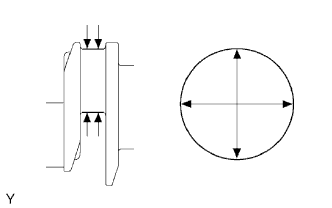
Using a micrometer, measure the diameter of each crank pin.
Standard crank pin diameter 47.992 to 48.000 mm (1.889 to 1.890 in.) If the diameter is not as specified, check the oil clearance. If necessary, replace the crankshaft.
-
Check each crank pin for taper and out-of-round as shown in the illustration.
Maximum taper and out-of-round 0.02 mm (0.000787 in.) If the taper and out-of-round is more than the maximum, replace the crankshaft.
-
-
-
INSPECT CRANKSHAFT OIL CLEARANCE
-
Check the crank journal and crankshaft bearing for pitting and scratches.
-
Install the crankshaft bearing Click here.
-
Place the crankshaft on the cylinder block.
-
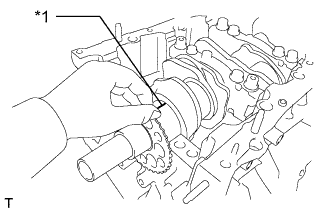
Text in Illustration *1 Plastigage Lay a strip of Plastigage across each journal.
-
Examine the front marks and numbers to install the crankshaft bearing caps on the cylinder block.
Tech Tips
A number is marked on each main bearing cap to indicate the installation position.
-
Install the main bearing caps Click here.
Note
Do not turn the crankshaft.
-
Remove the main bearing caps Click here.
-
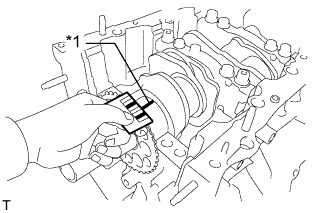
Text in Illustration *1 Plastigage Measure the Plastigage at its widest point.
Standard Oil Clearance Item Specified Condition No. 1, No. 4 Journal 0.026 to 0.047 mm (0.00102 to 0.00185 in.) No. 2, No. 3 Journal 0.032 to 0.053 mm (0.00126 to 0.00209 in.) Maximum Oil Clearance Item Specified Condition No. 1, No. 4 Journal 0.050 mm (0.00197 in.) No. 2, No. 3 Journal 0.060 mm (0.00236 in.) If the oil clearance is more than the maximum, replace the bearings. If necessary, replace the crankshaft.
Note
Completely remove the Plastigage after the measurement.
-
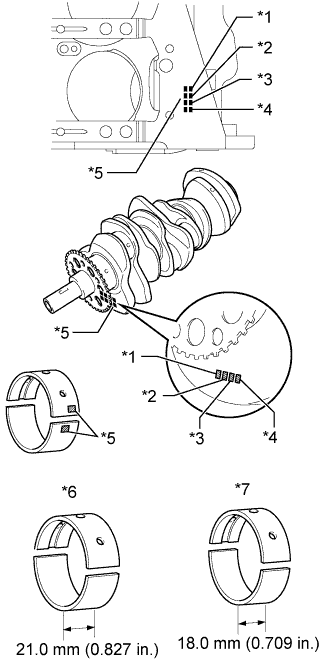
Text in Illustration *1 No. 1 *2 No. 2 *3 No. 3 *4 No. 4 *5 Number Mark *6 No. 1 and No. 4 Journal Bearing *7 No. 2 and No. 3 Journal Bearing If replacing a bearing, replace it with one having the same number. If the number of the bearing cannot be determined, select the correct bearing by adding together the numbers imprinted on the cylinder block and crankshaft, and then refer to the table below for the appropriate bearing number. There are 5 sizes of standard bearings, marked "1", "2", "3", "4" and "5" accordingly.
Journal Bearings Cylinder block + Crankshaft 0 - 5 6 - 11 12 - 17 18 - 23 24 - 28 Bearing to be used "1" "2" "3" "4" "5" Tech Tips
EXAMPLE: Cylinder block "11" + Crankshaft "06" = Total number 17 (Use bearing "3")
Standard Crankshaft Main Journal Diameter Mark Specified Condition "00" 60.999 to 61.000 mm (2.40153 to 2.40157 in.) "01" 60.998 to 60.999 mm (2.40149 to 2.40153 in.) "02" 60.997 to 60.998 mm (2.40145 to 2.40149 in.) "03" 60.996 to 60.997 mm (2.40141 to 2.40145 in.) "04" 60.995 to 60.996 mm (2.40137 to 2.40141 in.) "05" 60.994 to 60.995 mm (2.40133 to 2.40137 in.) "06" 60.993 to 60.994 mm (2.40129 to 2.40133 in.) "07" 60.992 to 60.993 mm (2.40126 to 2.40129 in.) "08" 60.991 to 60.992 mm (2.40122 to 2.40126 in.) "09" 60.990 to 60.991 mm (2.40118 to 2.40122 in.) "10" 60.989 to 60.990 mm (2.40114 to 2.40118 in.) "11" 60.988 to 60.989 mm (2.40110 to 2.40114 in.) Standard Upper Bearing Center Wall Thickness (No. 1 and No. 4 journal) Mark Specified Condition "1" 2.500 to 2.503 mm (0.09843 to 0.09854 in.) "2" 2.504 to 2.506 mm (0.09858 to 0.09866 in.) "3" 2.507 to 2.509 mm (0.09870 to 0.09878 in.) "4" 2.510 to 2.512 mm (0.09881 to 0.09890 in.) "5" 2.513 to 2.515 mm (0.09894 to 0.09902 in.) Standard Lower Bearing Center Wall Thickness (No. 1 and No. 4 journal) Mark Specified Condition "1" 2.478 to 2.481 mm (0.09756 to 0.09768 in.) "2" 2.482 to 2.484 mm (0.09772 to 0.09780 in.) "3" 2.485 to 2.487 mm (0.09783 to 0.09791 in.) "4" 2.488 to 2.490 mm (0.09795 to 0.09803 in.) "5" 2.491 to 2.493 mm (0.09807 to 0.09815 in.) Standard Upper Bearing Center Wall Thickness (No. 2 and No. 3 journal) Mark Specified Condition "1" 2.478 to 2.481 mm (0.09756 to 0.09768 in.) "2" 2.482 to 2.484 mm (0.09772 to 0.09780 in.) "3" 2.485 to 2.487 mm (0.09783 to 0.09791 in.) "4" 2.488 to 2.490 mm (0.09795 to 0.09803 in.) "5" 2.491 to 2.493 mm (0.09807 to 0.09815 in.) Standard Lower Bearing Center Wall Thickness (No. 2 and No. 3 journal) Mark Specified Condition "1" 2.500 to 2.503 mm (0.09843 to 0.09854 in.) "2" 2.504 to 2.506 mm (0.09858 to 0.09866 in.) "3" 2.507 to 2.509 mm (0.09870 to 0.09878 in.) "4" 2.510 to 2.512 mm (0.09881 to 0.09890 in.) "5" 2.513 to 2.515 mm (0.09894 to 0.09902 in.)
-
-
INSPECT CRANKSHAFT BEARING CAP SET BOLT
-
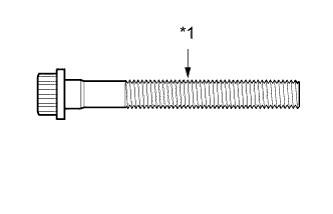
Text in Illustration *1 Measurement Point Using a vernier caliper, measure the diameter of the threads at the measurement point.
Standard diameter 10.8 to 11.0 mm (0.4252 to 0.4331 in.) Minimum diameter 10.7 mm (0.4213 in.) Measurement point (distance from the seat) 47 mm (1.85 in.) Tech Tips
-
If the diameter is less than the minimum, replace the crankshaft bearing cap set bolt. Failure to do so may lead to engine damage.
-
If there is any thread deformation, replace the cylinder head set bolt with a new one.
-
-
-
INSPECT NO. 1 OIL NOZZLE SUB-ASSEMBLY
-
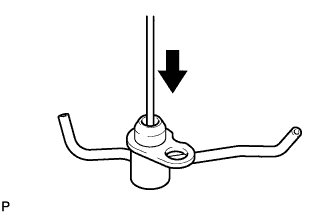
Push the check valve with a pin to check if it is stuck.
Tech Tips
If the check valve is stuck, replace the oil nozzle.
-
Push the check valve with a pin to check if it moves smoothly.
If the check valve does not move smoothly, clean or replace the oil nozzle.
-
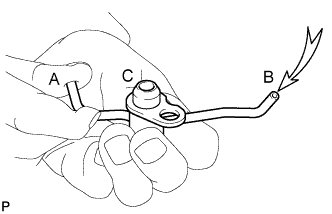
While covering A, blow air into B. Check that air does not leak through C. Perform the check again while covering B and blowing air into A.
If air leaks, clean or replace the oil nozzle.
-
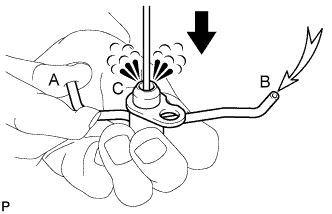
Push the check valve while covering A, and blow air into B. Check that air passes through C. Perform the check again while covering B, pushing the check valve and blowing air into A.
If air does not pass through C, clean or replace the oil nozzle.
-