TIRE AND WHEEL SYSTEM INSPECTION

-
INSPECT TIRES
-
Check the tires for wear and proper inflation pressure.
Cold Tire Inflation Pressure Tire Size 4 passengers or less 5 passengers Front
kPa (kgf/cm2, psi)
Rear
kPa (kgf/cm2, psi)
Front
kPa (kgf/cm2, psi)
Rear
kPa (kgf/cm2, psi)
215/60R16 95V 230 (2.3, 33) 230 (2.3, 33)*1
240 (2.4, 35)*2
270 (2.7, 39)*3
215/55R17 93V 230 (2.3, 33)*1, *2
240 (2.4, 35)*3
230 (2.3, 33) 230 (2.3, 33)*1
260 (2.6, 38)*2
290 (2.9, 42)*3
*1: For driving under 160 km/h (100 mph)
*2: For driving at 160 km/h (100 mph) to 180 km/h (112 mph)
*3: For driving at 180 km/h (112 mph) to 210 km/h (131 mph)
-
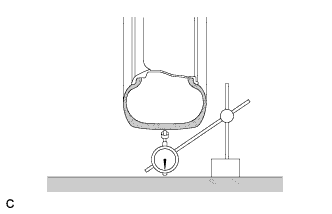
Using a dial indicator, check the runout of the tires.
Maximum tire runout 1.4 mm (0.0551 in.)
-
-
ROTATE TIRES
-

Rotate the tires as shown in the illustration.
Text in Illustration 
Front
-
-
INSPECT AND ADJUST WHEEL BALANCE
-
Inspect and adjust the off-the-car balance.
-
Steel wheel:
Maximum imbalance 8.0 g (0.0176 lb) -

Others (Non-steel wheel):
Maximum imbalance 8.0 g (0.0176 lb) Note
-
Use a cleaning detergent to remove dirt, oil and water from the surface where the balance weight is to be adhered.
-
Do not touch the adhesive surface of the tape.
-
Adhere a sticking type balance weight to the flat surface (A) shown in the illustration.
Width (A) 25 mm (0.984 in.) -
Push the balance weight securely with your finger to adhere it to the desired position.
-
Do not reuse balance weights.
Tech Tips
The inner side balance weight should be installed by clipping it to the rim.
-
-
-
-
INSPECT FRONT AXLE HUB BEARING
-
INSPECT REAR AXLE HUB BEARING