IGNITION SYSTEM ON-VEHICLE INSPECTION

-
PERFORM SPARK TEST
-
Check for DTCs Click here.
Note
If any DTC is output, perform troubleshooting procedures for that DTC.
-
Remove the ignition coil assemblies and spark plugs Click here.
-
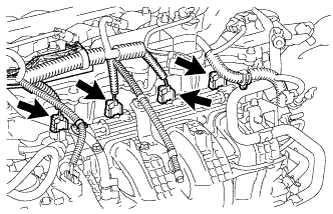
Disconnect the 4 injector connectors.
-
Install the spark plug into the ignition coil assembly, and then connect the ignition coil connector.
-
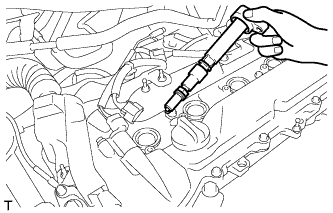
Ground the spark plug.
-
Check that spark occurs at each spark plug while the engine is being cranked.
Note
-
Be sure to ground the spark plugs when checking them.
-
Do not crank the engine for more than 2 seconds.
Cranking will stop if the engine switch is pushed again for models with cranking holding function.
-
If a spark plug has been struck or dropped, replace it.
-
If an ignition coil assembly has been struck or dropped, replace it.
Tech Tips
If spark does not occur for any cylinder, perform the following Inspect Ignition Coil and Spark Test procedure.
-
-
Connect the 4 fuel injector connectors.
-
Install the spark plugs and ignition coil assemblies Click here.
-
Check for DTCs Click here.
-
Clear the DTCs Click here.
-
-
INSPECT IGNITION COIL AND SPARK TEST
Tech Tips
Perform "Inspection After Repair" after replacing the spark plug and ignition coil assembly Click here.
-
Check that the wire harness side connector of the ignition coil assembly is securely connected.
Result Result Action NG Connect securely OK Go to next step -
Perform a spark test on each ignition coil assembly.
-
Replace the ignition coil assembly with a known good one.
-
Perform the spark test again.
Result Result Action NG Go to next step OK Replace ignition coil assembly
-
-
Perform a spark test on each spark plug.
-
Replace the spark plug with a known good one.
-
Perform the spark test again.
Result Result Action NG Inspect the ignition system Click here.
OK Replace spark plug
-
-
-
CHECK SPARK PLUG
Note
-
Do not use a wire brush for cleaning.
-
Do not adjust the electrode gap of a used spark plug.
Tech Tips
Perform "Inspection After Repair" after replacing the spark plug Click here.
-
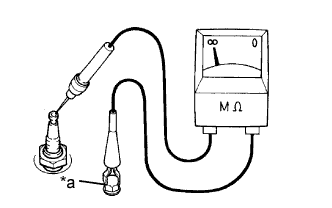
Text in Illustration *a Ground Check the electrode using a megohmmeter:
-
Using a megohmmeter, measure the insulation resistance.
Standard Insulation Resistance Tester Connection Condition Specified Condition Spark plug (terminal part) - Body ground Always 10 MΩ or higher Tech Tips
-
If the result is not as specified, clean the spark plug with a spark plug cleaner and measure the resistance again.
-
If a megohmmeter is not available, perform the following simple inspection instead.
-
-
-
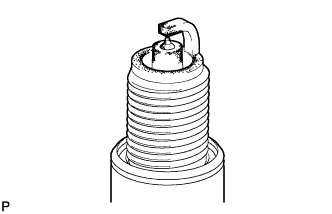
Alternative inspection method:
-
Quickly accelerate the engine to 4000 rpm 5 times.
-
Remove the spark plug Click here.
-
Visually check the spark plug.
If the electrode is dry, the spark plug is functioning properly. If the electrode is damp, proceed to the next step.
-
Install the spark plug Click here.
-
-
Check the spark plug for any damage to its thread and insulator.
If there is any damage, replace the spark plug.
Recommended Spark Plug Manufacturer Spark Plug Type DENSO SK16HR11 -
Reference:
-
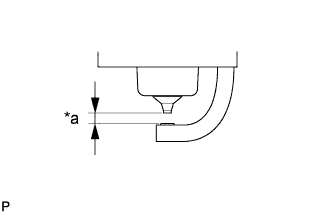
Text in Illustration *a Spark plug electrode gap Check the spark plug electrode gap.
Maximum electrode gap for a used spark plug 1.3 mm (0.0512 in.) If the gap is more than the maximum, replace the spark plug.
Note
Never attempt to adjust the gap of a used plug.
Electrode gap for a new spark plug 1.0 to 1.1 mm (0.0394 to 0.0433 in.)
-
-
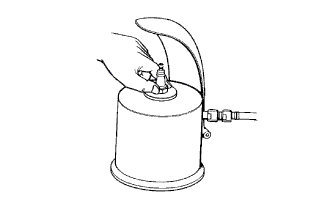
Clean the spark plugs.
If the electrode has traces of wet carbon, clean the electrode with a spark plug cleaner and then dry it.
Standard air pressure 588 kPa (6.0 kgf/cm2, 85 psi) Standard duration 20 seconds or less Tech Tips
Only use a spark plug cleaner when the electrode is free of oil. If the electrode has traces of oil, use gasoline to clean off the oil before using the spark plug cleaner.
-