WIRELESS DOOR LOCK CONTROL SYSTEM(w/o Entry and Start System) Only Wireless Control Function is Inoperative
DESCRIPTION
The door control receiver receives signals from the transmitter and sends these signals to the main body ECU (multiplex network body ECU). The main body ECU (multiplex network body ECU) then controls all doors by sending lock/unlock signals to each door.
WIRING DIAGRAM
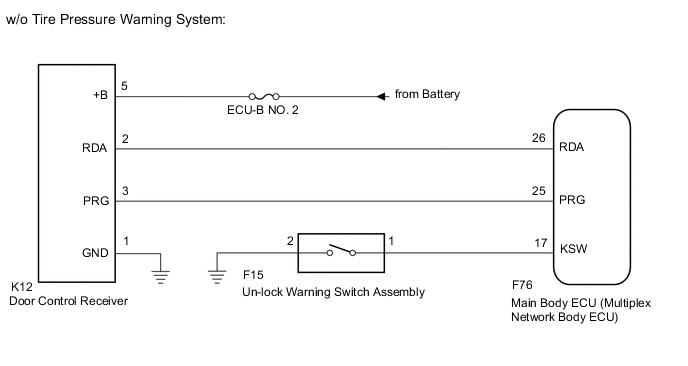
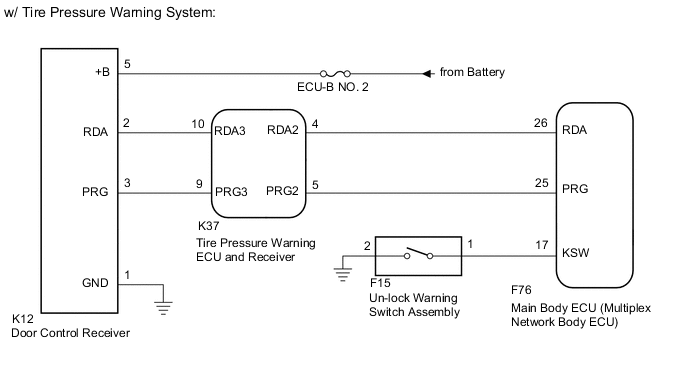
CAUTION / NOTICE / HINT
Note
-
Inspect the fuses for circuits related to this system before performing the following inspection procedure.
-
When replacing or inspecting the door control receiver and wire harness, do not change the position or length of the wire harness. If the wire harness is too close to the door control receiver, wireless function performance may be affected.
-
When replacing the tire pressure warning ECU and receiver, read the transmitter IDs stored in the old ECU using the GTS and write them down before removal.*
-
It is necessary to perform initialization after registration of the transmitter IDs into the tire pressure warning ECU and receiver if the tire pressure warning ECU and receiver has been replaced.*
-
for Initialization Click here
-
for Registration Click here
-
*: w/ Tire Pressure Warning System
PROCEDURE
-
CONFIRM VEHICLE SPECIFICATION
-
Confirm the vehicle specification.
Result Result Proceed to w/ Tire Pressure Warning System A w/o Tire Pressure Warning System B
B 
CHECK POWER DOOR LOCK OPERATION Click here
A 
-
-
CHECK FOR DTC (TIRE PRESSURE WARNING SYSTEM)
-
Clear the DTCs Click here.
-
Recheck for DTCs Click here.
OK DTCs are not output.
NG 
GO TO TIRE PRESSURE WARNING SYSTEM Click here
OK
-
-
CHECK POWER DOOR LOCK OPERATION
-
When the door control switch on the power window regulator master switch is operated, check that the locked doors unlock Click here.
OK Locked doors unlock.
NG
GO TO POWER DOOR LOCK CONTROL SYSTEM Click here
OK
-
-
CHECK KEY REMINDER WARNING SYSTEM
-
Check that the key reminder warning buzzer operates normally Click here.
OK Key reminder warning buzzer operates normally.
NG
GO TO KEY REMINDER WARNING SYSTEM Click here
OK
-
-
CHECK DOOR CONTROL TRANSMITTER MODULE
-
When another registered door control transmitter is used, check that the wireless door lock/unlock function operates normally.
OK Wireless door lock/unlock functions operate normally.
NG
CHECK WAVE ENVIRONMENT Click here
OK
-
-
INSPECT TRANSMITTER BATTERY (VOLTAGE)
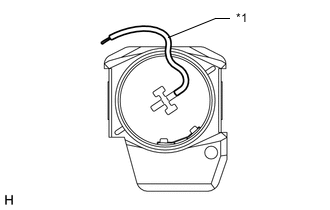
Text in Illustration *1 Wire
-
Remove the battery from the door control transmitter module that does not operate. Attach a lead wire (0.6 mm (0.0236 in.)) or less in diameter including wire sheath) with tape or equivalent to the negative terminal Click here.
Note
Do not wrap the lead wire around the terminal, wedge it between terminals, or solder it. The terminal may be deformed or damaged, and the battery will not be able to be installed correctly.
-
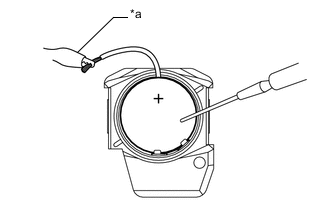
Text in Illustration *a GND Carefully pull the lead wire out from the position shown in the illustration and install the previously removed transmitter battery.
Note
When replacing the transmitter battery, before starting work, remove any static electricity that has built up by touching, for example, the vehicle to prevent the door control transmitter module set from being damaged.
-
Measure the voltage according to the value(s) in the table below.
Tech Tips
When measuring the battery voltage, press one of the transmitter switches.
Standard Voltage Tester Connection Condition Specified Condition Battery positive (+) - Battery negative (-) Ignition switch off, all doors closed and lock or unlock switch pushed 2.2 to 3.2 V
OK
REPLACE DOOR CONTROL TRANSMITTER MODULE Click here
NG
REPLACE TRANSMITTER BATTERY Click here
-
-
CHECK WAVE ENVIRONMENT
-
Bring the transmitter near the door control receiver, and perform a wireless operation check.
Tech Tips
-
When the transmitter is brought near the door control receiver, the possibility of wave interference decreases, and it can be determined if wave interference is causing the problem symptom.
-
If the inspection result is that the problem only occurs in certain locations or times of day, the possibility of wave interference is high. Also, added vehicle components may cause wave interference. If installed, remove them and perform the operation check.
Result Result Proceed to Wireless functions do not operate properly A Wireless functions operate properly B -
B
AFFECTED BY WAVE INTERFERENCE
A
-
-
SWITCH TO SELF DIAGNOSTIC MODE
-
Switch to self-diagnostic mode by operating the ignition key cylinder.
-
Make sure that the vehicle is in its initial condition. Then insert the key into the ignition key cylinder and remove it.
-
Within 5 seconds of removing the key, insert the key into the ignition key cylinder (ignition switch off). Then turn the ignition switch to ON and off.
-
Within 30 seconds of turning the ignition switch off, perform the following operation 9 times: turn the ignition switch to ON and off.
Note
If the system cannot enter self-diagnostic mode, the system returns to normal mode.
Tech Tips
-
Turning the ignition switch to ON after the above operations have been completed ends self-diagnostic mode.
-
Do not lock or unlock doors during self-diagnostic mode.
-
-
-
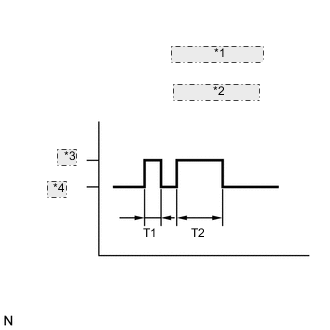
Interior Light Output *1 T1: 0.25 seconds *2 T2: 0.5 seconds *3 ON *4 OFF Check that the system has switched to self-diagnostic mode by checking the No. 1 room light assembly flash pattern.
OK Flash pattern is same as illustration on left.
NEXT
-
-
CHECK BY SELF DIAGNOSTIC MODE
-
Inspect the diagnosis outputs when the door control transmitter switch is held down. The diagnosis outputs can be checked by the flash patterns of the No. 1 room light assembly.
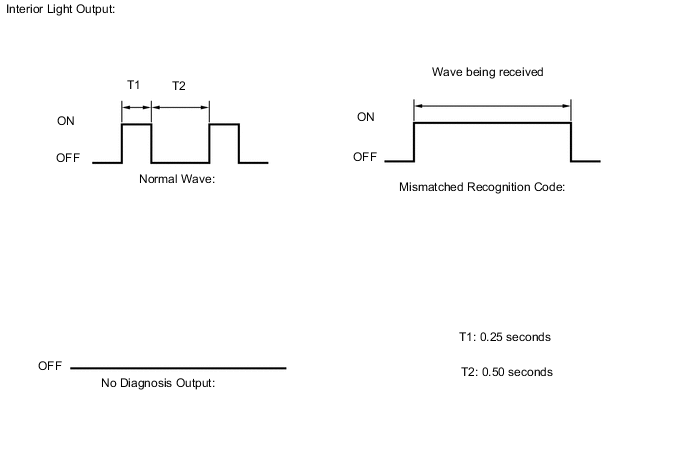
Result Result Proceed to Normal waves (light flash patterns) for LOCK and UNLOCK switches are output A Unmatching recognition code is output B No diagnosis outputs C
A
REPLACE MAIN BODY ECU (MULTIPLEX NETWORK BODY ECU) Click here
C
CHECK RESPONSE OF DOOR CONTROL RECEIVER (RESPONSE) Click here
B
-
-
REGISTER RECOGNITION CODE
-
Check that the system can be switched to rewrite mode or add mode, and that a recognition code can be registered.
OK Recognition code can be registered.
OK
END
NG
REPLACE DOOR CONTROL RECEIVER Click here
-
-
CHECK RESPONSE OF DOOR CONTROL RECEIVER (RESPONSE)
-
Prepare the door control transmitter from another vehicle.
-
Press and hold down the door control transmitter switch.
-
Check that an unmatching recognition code is output.
OK Unmatching recognition code is output.
OK
REPLACE DOOR CONTROL TRANSMITTER MODULE Click here
NG
-
-
INSPECT DOOR CONTROL RECEIVER (POWER SOURCE, GROUND)
-
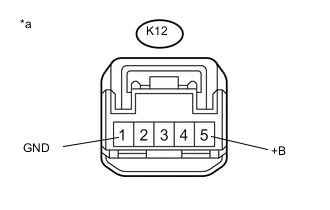
Text in Illustration *a Front view of wire harness connector
(to Door Control Receiver)
Disconnect the K12 door control receiver connector.
-
Measure the resistance and voltage according to the value(s) in the table below.
Standard Resistance Tester Connection Condition Specified Condition K12-1 (GND) - Body ground Always Below 1 Ω Standard Voltage Tester Connection Condition Specified Condition K12-5 (+B) - Body ground Always 11 to 14 V
NG
REPAIR OR REPLACE HARNESS OR CONNECTOR
OK
-
-
INSPECT DOOR CONTROL RECEIVER (OUTPUT)
-
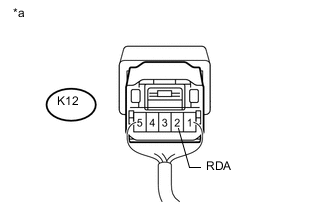
Text in Illustration *1 Front view of wire harness connector
(to Door Control Receiver)
Connect the K12 door control receiver connector.
-
Measure the voltage according to the value(s) in the table below.
Standard Voltage Tester Connection Switch Condition Specified Condition K12-2 (RDA) - Body ground Transmitter switch off → on (No key in ignition key cylinder, all doors closed) 6 V or higher → Below 1 V → 6 V or higher Result Result Proceed to OK (w/o Tire Pressure Warning System) A OK (w/ Tire Pressure Warning System) B NG C
B
CHECK HARNESS AND CONNECTOR (MAIN BODY ECU (MULTIPLEX 0NETWORK BODY ECU) - TIRE PRESSURE WARNING ECU AND RECEIVER) Click here
C
REPLACE DOOR CONTROL RECEIVER Click here
A
-
-
CHECK HARNESS AND CONNECTOR (MAIN BODY ECU (MULTIPLEX NETWORK BODY ECU) - DOOR CONTROL RECEIVER)
-
Disconnect the F76 main body ECU (multiplex network body ECU) connector.
-
Disconnect the K12 door control receiver connector.
-
Measure the resistance according to the value(s) in the table below.
Standard Resistance (Check for Open) Tester Connection Condition Specified Condition F76-26 (RDA) - K12-2 (RDA) Always Below 1 Ω F76-25 (PRG) - K12-3 (PRG) Always Below 1 Ω Standard Resistance (Check for Short) Tester Connection Condition Specified Condition F76-26 (RDA) or K12-2 (RDA) - Body ground Always 10 kΩ or higher F76-25 (PRG) or K12-3 (PRG) - Body ground Always 10 kΩ or higher
NG
REPAIR OR REPLACE HARNESS OR CONNECTOR
OK
-
-
REPLACE DOOR CONTROL RECEIVER
-
Replace the door control receiver with a new one Click here.
NEXT
-
-
REGISTER RECOGNITION CODE
-
Perform the Registration procedures Click here.
NEXT
-
-
CHECK DOOR CONTROL RECEIVER (OPERATION)
-
Check that the doors can be locked and unlocked by using the transmitter LOCK and UNLOCK switches.
OK Doors can be locked and unlocked with transmitter.
OK
END (DOOR CONTROL RECEIVER IS DEFECTIVE)
NG
REPLACE MAIN BODY ECU (MULTIPLEX NETWORK BODY ECU) Click here
-
-
CHECK HARNESS AND CONNECTOR (MAIN BODY ECU (MULTIPLEX 0NETWORK BODY ECU) - TIRE PRESSURE WARNING ECU AND RECEIVER)
-
Disconnect the F76 main body ECU (multiplex network body ECU) connector.
-
Disconnect the K37 tire pressure warning ECU and receiver connector.
-
Measure the resistance according to the value(s) in the table below.
Standard Resistance (Check for Open) Tester Connection Condition Specified Condition F76-26 (RDA) - K37-4 (RDA2) Always Below 1 Ω F76-25 (PRG) - K37-5 (PRG2) Always Below 1 Ω Standard Resistance (Check for Short) Tester Connection Condition Specified Condition F76-26 (RDA) or K37-4 (RDA2) - Body ground Always 10 kΩ or higher F76-25 (PRG) or K37-5 (PRG2) - Body ground Always 10 kΩ or higher
NG
REPAIR OR REPLACE HARNESS OR CONNECTOR
OK
-
-
CHECK HARNESS AND CONNECTOR (TIRE PRESSURE WARNING ECU AND RECEIVER - DOOR CONTROL RECEIVER)
-
Disconnect the K37 tire pressure warning ECU and receiver connector.
-
Disconnect the K12 door control receiver connector.
-
Measure the resistance according to the value(s) in the table below.
Standard Resistance (Check for Open) Tester Connection Condition Specified Condition K37-10 (RDA3) - K12-2 (RDA) Always Below 1 Ω K37-9 (PRG3) - K12-3 (PRG) Always Below 1 Ω Standard Resistance (Check for Short) Tester Connection Condition Specified Condition K37-10 (RDA3) or K12-2 (RDA) - Body ground Always 10 kΩ or higher K37-9 (PRG3) or K12-3 (PRG) - Body ground Always 10 kΩ or higher
NG
REPAIR OR REPLACE HARNESS OR CONNECTOR
OK
-
-
REPLACE DOOR CONTROL RECEIVER
-
Replace the door control receiver with a new one Click here.
NEXT
-
-
REGISTER RECOGNITION CODE
-
Perform the Registration procedures Click here.
NEXT
-
-
CHECK DOOR CONTROL RECEIVER (OPERATION)
-
Check that the doors can be locked and unlocked by using the transmitter LOCK and UNLOCK switches.
OK Doors can be locked and unlocked with transmitter.
OK
END (DOOR CONTROL RECEIVER IS DEFECTIVE)
NG
-
-
REPLACE TIRE PRESSURE WARNING ECU AND RECEIVER
-
Replace the tire pressure warning ECU and receiver with a new one Click here.
NEXT
-
-
REGISTER RECOGNITION CODE
-
Perform the Registration procedures Click here.
NEXT
-
-
CHECK DOOR CONTROL RECEIVER (OPERATION)
-
Check that the doors can be locked and unlocked by using the transmitter LOCK and UNLOCK switches.
OK Doors can be locked and unlocked with transmitter.
OK
END (TIRE PRESSURE WARNING ECU AND RECEIVER WAS DEFECTIVE)
NG
REPLACE MAIN BODY ECU (MULTIPLEX NETWORK BODY ECU) Click here
-