CAN COMMUNICATION SYSTEM Engine Stop and Start ECU Communication Stop Mode
DESCRIPTION
| Detection Item | Symptom | Trouble Area |
|---|---|---|
| Engine Stop and Start ECU Communication Stop Mode | Either condition is met:
|
|
* : for 1NR-FE
WIRING DIAGRAM
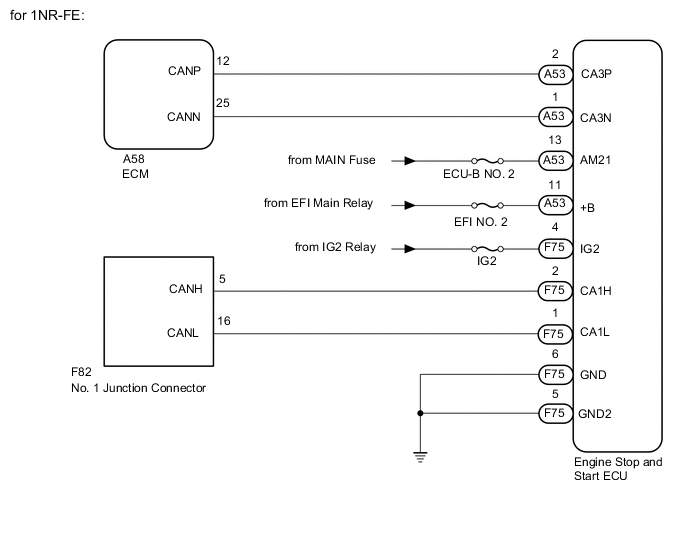
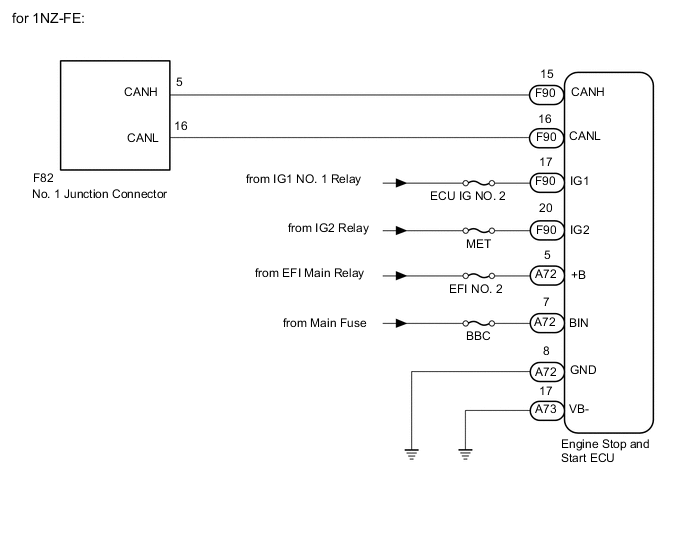
CAUTION / NOTICE / HINT
Note
-
Inspect the fuses for circuits related to this system before performing the following inspection procedure.
-
Turn the ignition switch off before measuring the resistances between CAN bus main wires and between CAN bus branch wires.
-
Turn the ignition switch off before inspecting CAN bus wires for a ground short.
-
After the ignition switch is turned off, check that the key reminder warning system are not operating.
-
Before measuring the resistance, leave the vehicle as is for at least 1 minute and do not operate the ignition switch, any other switches or the doors. If any doors need to be opened in order to check connectors, open the doors and leave them open.
Tech Tips
-
Operating the ignition switch, any other switches or a door triggers related ECU and sensor communication on the CAN. This communication will cause the resistance value to change.
-
Even after DTCs are cleared, if a DTC is stored again after driving the vehicle for a while, the malfunction may be occurring due to vibration of the vehicle. In such a case, wiggling the ECUs or wire harness while performing the inspection below may help determine the cause of the malfunction.
PROCEDURE
-
CHECK FOR OPEN IN CAN BUS WIRE (ENGINE STOP AND START ECU MAIN WIRE AND BRANCH WIRE)
-
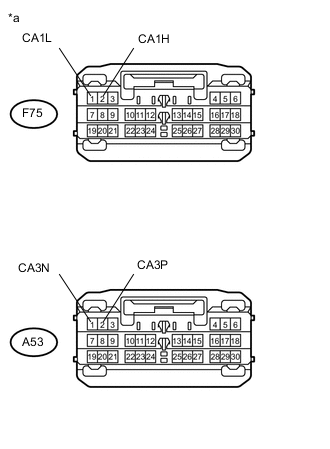
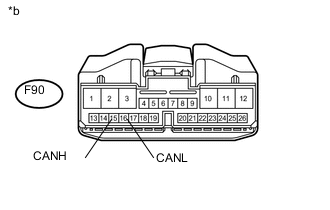
Disconnect the A53*1 and F75*1 or F90*2 engine stop and start ECU connectors.
Measure the resistance according to the value(s) in the table below.
Standard Resistance for V1 Bus Tester Connector Switch Condition Specified Condition F75-2 (CA1H) - F75-1 (CA1L)*1
F90-15 (CANH) - F90-16 (CANL)*2
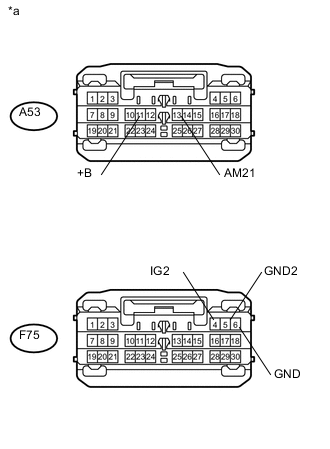
Ignition switch off 54 to 69 Ω Standard Resistance for Local Bus*1 Tester Connector Switch Condition Specified Condition A53-2 (CA3P) - A53-1 (CA3N) Ignition switch off 108 to 132 Ω Text in Illustration *a Front view of wire harness connector
(to Engine Stop and Start ECU)*1
*b Front view of wire harness connector
(to Engine Stop and Start ECU)*2
*1 : for 1NR-FE
*2 : for 1NZ-FE
NG 
REPAIR OR REPLACE CAN BUS MAIN WIRE OR BRANCH WIRE OR CONNECTOR (ENGINE STOP AND START ECU MAIN WIRE OR BRANCH WIRE)
OK 
-
-
CHECK HARNESS AND CONNECTOR (POWER SOURCE CIRCUIT)
-
Measure the voltage according to the value(s) in the table below.
Standard Voltage Tester Connection Switch Condition Specified Condition A53-13 (AM21) - Body ground*1
A72-7 (BIN) - Body ground*2
Always 11 to 14 V A53-11 (+B) - Body ground*1
A72-5 (+B) - Body ground*2
Always 11 to 14 V F75-4 (IG2) - Body ground*1
F90-17 (IG1) - Body ground*2
F90-20 (IG2) - Body ground*2
Ignition switch ON 11 to 14 V -
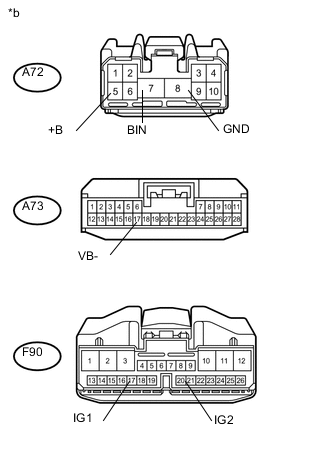
Text in Illustration *a Front view of wire harness connector
(to Engine Stop and Start ECU)*1
*b Front view of wire harness connector
(to Engine Stop and Start ECU)*2
Measure the resistance according to the value(s) in the table below.
Standard Resistance Tester Connection Condition Specified Condition F75-6 (GND) - Body ground*1
A72-8 (GND) - Body ground*2
Always Below 1 Ω F75-5 (GND2) - Body ground*1
A73-17 (VB-) - Body ground*2
Always Below 1 Ω Result Result Proceed to OK (for 1NR-FE) A OK (for 1NZ-FE) B NG C *1 : for 1NR-FE
*2 : for 1NZ-FE
A
REPLACE ENGINE STOP AND START ECU Click here
B
REPLACE ENGINE STOP AND START ECU Click here
C
REPAIR OR REPLACE HARNESS OR CONNECTOR (POWER SOURCE CIRCUIT)
-