CONTINUOUSLY VARIABLE TRANSAXLE SYSTEM, Diagnostic DTC:P2759
| DTC Code | DTC Name |
|---|---|
| P2759 | Torque Converter Clutch Pressure Control Solenoid Control Circuit Electrical (Shift Solenoid Valve SLU) |
DESCRIPTION
The ECM uses the lock-up control solenoids (SLU) to perform lock-up control in response to the driving conditions.
| DTC No. | DTC Detection Condition
|
Trouble Area |
|---|---|---|
| P2759 |
|
|
MONITOR DESCRIPTION
When an open or short in a shift solenoid valve (SLU) circuit is detected, the ECM determines there is a malfunction. The ECM will turn on the MIL and store this DTC.
WIRING DIAGRAM
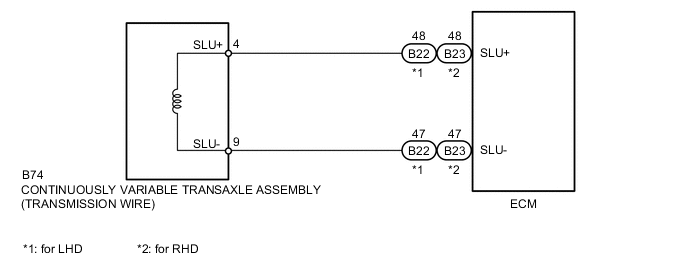
PROCEDURE
-
INSPECT CONTINUOUSLY VARIABLE TRANSAXLE ASSEMBLY (TRANSMISSION WIRE) (SHIFT SOLENOID VALVE SLU)
-
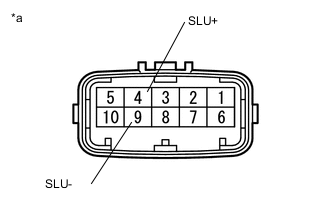
Text In Illustration *a Component without harness connected
(Continuously Variable Transaxle Assembly (Transmission Wire))
Disconnect the B74 transmission wire connector.
-
Measure the resistance according to the value(s) in the table below.
Standard Resistance Tester Connection Condition Specified Condition 4 (SLU+) - 9 (SLU-) 20°C (68°F) 5.1 to 5.5 Ω 4 (SLU+) - Body ground or other terminals Always 10 kΩ or higher 9 (SLU-) - Body ground or other terminals Always 10 kΩ or higher
NG 
REPLACE CONTINUOUSLY VARIABLE TRANSAXLE ASSEMBLY Click here
OK 
-
-
CHECK HARNESS AND CONNECTOR (TRANSMISSION WIRE - ECM)
-
Disconnect the B22 (for LHD) or B23 (for RHD) ECM connector.
-
Measure the resistance according to the value(s) in the table below.
Standard Resistance (Check for Open) (for LHD) Tester Connection Condition Specified Condition B22-47 (SLU-) - B22-48 (SLU+) 20°C (68°F) 5.0 to 5.6 Ω Standard Resistance (Check for Open) (for RHD) Tester Connection Condition Specified Condition B23-47 (SLU-) - B23-48 (SLU+) 20°C (68°F) 5.0 to 5.6 Ω Standard Resistance (Check for Short) (for LHD) Tester Connection Condition Specified Condition B22-47 (SLU-) - Body ground Always 10 kΩ or higher B22-48 (SLU+) - Body ground Always 10 kΩ or higher Standard Resistance (Check for Short) (for RHD) Tester Connection Condition Specified Condition B23-47 (SLU-) - Body ground Always 10 kΩ or higher B23-48 (SLU+) - Body ground Always 10 kΩ or higher
NG 
REPAIR OR REPLACE HARNESS OR CONNECTOR
OK
-
-
REPLACE ECM
-
Replace the ECM Click here.
NEXT
-
-
PERFORM INITIALIZATION
Note
-
Performing reset memory will clear the learned values of both the yaw rate sensor (deceleration sensor 0 point calibration) and CVT oil pressure (CVT oil pressure calibration). Make sure to perform reset memory, yaw rate sensor 0 point calibration and CVT oil pressure calibration when replacing any of the parts shown in the following table:
Replaced Part
-
Continuously variable transaxle assembly
-
ECM
-
Skid control computer (w/o VSC)
-
Oil pressure sensor
-
Deceleration sensor (w/o VSC)
-
Airbag sensor assembly (Yaw rate sensor) (w/ VSC)
-
-
After performing reset memory, always perform yaw rate sensor (deceleration sensor 0 point) calibration first, and then CVT oil pressure calibration.
-
Always perform 0 point calibration with the vehicle on level ground.
-
Do not shake or vibrate the vehicle during 0 point calibration.
-
Using the intelligent tester, perform reset memory, deceleration sensor 0 point calibration and CVT oil pressure calibration Click here.
-
Check that no DTC is stored.
NEXT
END
-
-
REPLACE CONTINUOUSLY VARIABLE TRANSAXLE ASSEMBLY
-
Replace the continuously variable transaxle assembly Click here.
NEXT
-
-
REPLACE INITIALIZATION
Note
-
Performing reset memory will clear the learned values of both the yaw rate sensor (deceleration sensor 0 point calibration) and CVT oil pressure (CVT oil pressure calibration). Make sure to perform reset memory, yaw rate sensor 0 point calibration and CVT oil pressure calibration when replacing any of the parts shown in the following table:
Replaced Part
-
Continuously variable transaxle assembly
-
ECM
-
Skid control computer (w/o VSC)
-
Oil pressure sensor
-
Deceleration sensor (w/o VSC)
-
Airbag sensor assembly (Yaw rate sensor) (w/ VSC)
-
-
After performing reset memory, always perform yaw rate sensor (deceleration sensor 0 point) calibration first, and then CVT oil pressure calibration.
-
Always perform 0 point calibration with the vehicle on level ground.
-
Do not shake or vibrate the vehicle during 0 point calibration.
-
Using the intelligent tester, perform reset memory, deceleration sensor 0 point calibration and CVT oil pressure calibration Click here.
-
Check that no DTC is stored.
NEXT
END
-