SFI SYSTEM, Diagnostic DTC:P0401
| DTC Code | DTC Name |
|---|---|
| P0401 | Exhaust Gas Recirculation Flow Insufficient Detected |
DESCRIPTION
The ECM lowers combustion chamber temperatures and reduces Nitrogen Oxide (Nox) emissions by recirculating an appropriate amount of exhaust gas to the combustion chambers according to the engine operating conditions. When all EGR activation conditions are met (based on sensor signals such as engine speed, coolant temperature, load signal, vehicle speed signal), the ECM turns on the stepper motor inside the EGR valve and linearly controls the opening angle of the EGR valve. The EGR gas temperature sensor detects the EGR gas temperature in the EGR valve and sends a signal to the ECM to confirm EGR valve operation. The ECM also sets a DTC if the difference between the coolant temperature and the EGR gas temperature exceeds the threshold value during EGR operation.
| DTC No. | DTC Detection Condition | Trouble Area |
|---|---|---|
| P0401 | When engine started and EGR valve operation beginning, EGR gas temperature value is less than the threshold value for 5 seconds. (2 trip detection logic) |
|
WIRING DIAGRAM
Refer to the DTC P0403 Click here.
CAUTION / NOTICE / HINT
Note
Inspect the fuses for circuits related to this system before performing the following inspection procedure.
Tech Tips
-
By using the Control the EGR Step Position Active Test, the operation of the EGR valve can be checked.
-
If the EGR valve is normal, the engine condition is as follows:
The engine idles steady while the EGR valve is fully closed. When the EGR valve is opened using the Active Test, the Data List values will change as shown in the table below.
-
Read freeze frame data using the intelligent tester. Freeze frame data records the engine condition when malfunctions are detected. When troubleshooting, freeze frame data can help determine if the vehicle was moving or stationary, if the engine was warmed up or not, if the air-fuel ratio was lean or rich, and other data from the time the malfunction occurred.
PROCEDURE
-
READ VALUE USING INTELLIGENT TESTER (EGR GAS TEMPERATURE)
-
Connect the intelligent tester to the DLC3.
-
Turn the ignition switch to the ON position and tester on.
-
Select the following menu items: Powertrain / Engine and ECT / Data List / EGR Gas Temperature.
-
Read the values displayed on the tester.
Result Result Proceed to 3 to 158°C (37.4 to 316.4°F) A Less than 3°C (37.4°F) B 158°C (316.4°F) or more B
B 
INSPECT EGR GAS TEMPERATURE SENSOR Click here
A 
-
-
PERFORM ACTIVE TEST USING INTELLIGENT TESTER (CONTROL THE EGR STEP POSITION)
-
Connect the intelligent tester to the DLC3.
-
Start the engine and tester on.
-
Select the following menu items: Powertrain / Engine and ECT / Active Test / Control the EGR Position / EGR Position.
Standard EGR Position Specified Condition 0% Normal engine speed 100% Engine idles roughly or stalls
NG
INSPECT EGR VALVE ASSEMBLY Click here
OK
-
-
INSPECT EGR GAS TEMPERATURE SENSOR
-
Inspect the EGR gas temperature sensor Click here.
NG 
REPLACE EGR GAS TEMPERATURE SENSOR Click here
OK
-
-
CHECK HARNESS AND CONNECTOR (ECM - EGR GAS TEMPERATURE SENSOR)
-
Disconnect the ECM connector.
-
Disconnect the EGR gas temperature sensor connector.
-
Measure the resistance according to the value(s) in the table below.
Standard resistance (Check for open) Tester Connection Condition Specified Condition B52-2 - B23-87 (THG) Always Below 1 Ω B52-1 - B23-119 (ETHG) Always Below 1 Ω Standard resistance (Check for short) Tester Connection Condition Specified Condition B52-2 or B23-87 (THG) - Body ground Always 10 kΩ or higher B52-1 or B23-119 (ETHG) - Body ground Always 10 kΩ or higher -
Reconnect the ECM connector.
-
Reconnect the EGR gas temperature sensor connector.
OK
REPLACE ECM Click here
NG
REPAIR OR REPLACE HARNESS OR CONNECTOR (ECM - EGR GAS TEMPERATURE SENSOR)
-
-
INSPECT EGR VALVE ASSEMBLY
-
Inspect the EGR valve assembly Click here.
NG
REPLACE EGR VALVE ASSEMBLY Click here
OK
-
-
CHECK HARNESS AND CONNECTOR (EGR VALVE POWER SOURCE CIRCUIT)
-
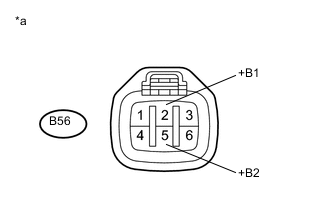
Text in Illustration *a Front view of wire harness connector
(to EGR Valve Assembly)
Disconnect the EGR valve connector.
-
Turn the ignition switch to ON.
-
Measure the voltage according to the value(s) in the table below.
Standard voltage Tester Connection Condition Specified Condition B56-2 (+B1) - Body ground Ignition switch ON 11 to 14 V B56-5 (+B2) - Body ground Ignition switch ON 11 to 14 V -
Reconnect the EGR valve connector.
NG
CHECK HARNESS AND CONNECTOR (EGR VALVE ASSEMBLY - NO. 1 INTEGRATION RELAY) Click here
OK
-
-
CHECK HARNESS AND CONNECTOR (ECM - EGR VALVE)
-
Disconnect the ECM connector.
-
Disconnect the EGR valve connector.
-
Measure the resistance according to the value(s) in the table below.
Standard resistance (Check for open) Tester Connection Condition Specified Condition B56-4 (EGR1) - B23-28 (EGR1) Always Below 1 Ω B56-3 (EGR2) - B23-27 (EGR2) Always Below 1 Ω B56-6 (EGR3) - B23-26 (EGR3) Always Below 1 Ω B56-1 (EGR4) - B23-25 (EGR4) Always Below 1 Ω Standard resistance (Check for short) Tester Connection Condition Specified Condition B56-4 (EGR1) or B23-28 (EGR1) - Body ground Always 10 kΩ or higher B56-3 (EGR2) or B23-27 (EGR2) - Body ground Always 10 kΩ or higher B56-6 (EGR3) or B23-26 (EGR3) - Body ground Always 10 kΩ or higher B56-1 (EGR4) or B23-25 (EGR4)- Body ground Always 10 kΩ or higher -
Reconnect the ECM connector.
-
Reconnect the EGR valve connector.
NG
REPAIR OR REPLACE HARNESS OR CONNECTOR (ECM - EGR VALVE)
OK
-
-
INSPECT EGR PIPE
-
Check the EGR pipe for leaks or blockage.
OK No leaks or blockage
NG
REPAIR OR REPLACE EGR PIPE
OK
-
-
INSPECT EGR VALVE (VISUALLY CHECK THROTTLE VALVE)
-
Remove the EGR valve Click here.
-
Check for contamination between the EGR valve and housing.
OK EGR valve is not contaminated with foreign objects. -
Reinstall the EGR valve Click here.
OK
REPLACE ECM Click here
NG
REPLACE EGR VALVE Click here
-
-
CHECK HARNESS AND CONNECTOR (EGR VALVE ASSEMBLY - NO. 1 INTEGRATION RELAY)
-
Disconnect the EGR valve connector.
-
Remove the No. 1 integration relay from the engine room main relay block.
-
Measure the resistance according to the value(s) in the table below.
Standard resistance (Check for open) Tester Connection Condition Specified Condition B56-2 (+B1) - 1E-4 Always Below 1 Ω B56-5 (+B2) - 1E-4 Always Below 1 Ω Standard resistance (Check for short) Tester Connection Condition Specified Condition B56-2 (+B1) or 1E-4 - Body ground Always 10 kΩ or higher B56-5 (+B2) or 1E-4 - Body ground Always 10 kΩ or higher -
Reconnect the EGR valve connector.
-
Reinstall the No. 1 integration relay.
OK
CHECK ECM POWER SOURCE CIRCUIT Click here
NG
REPAIR OR REPLACE HARNESS OR CONNECTOR (EGR VALVE ASSEMBLY - NO. 1 INTEGRATION RELAY)
-