SFI SYSTEM, Diagnostic DTC:P0120, P0121, P0122, P0123, P0220, P0222, P0223, P2135
| DTC Code | DTC Name |
|---|---|
| P0120 | Throttle / Pedal Position Sensor / Switch "A" Circuit Malfunction |
| P0121 | Throttle / Pedal Position Sensor / Switch "A" Circuit Range / Performance Problem |
| P0122 | Throttle / Pedal Position Sensor / Switch "A" Circuit Low Input |
| P0123 | Throttle / Pedal Position Sensor / Switch "A" Circuit High Input |
| P0220 | Throttle / Pedal Position Sensor / Switch "B" Circuit |
| P0222 | Throttle / Pedal Position Sensor / Switch "B" Circuit Low Input |
| P0223 | Throttle / Pedal Position Sensor / Switch "B" Circuit High Input |
| P2135 | Throttle / Pedal Position Sensor / Switch "A" / "B" Voltage Correlation |
DESCRIPTION
Tech Tips
These DTCs relate to the throttle position sensor.
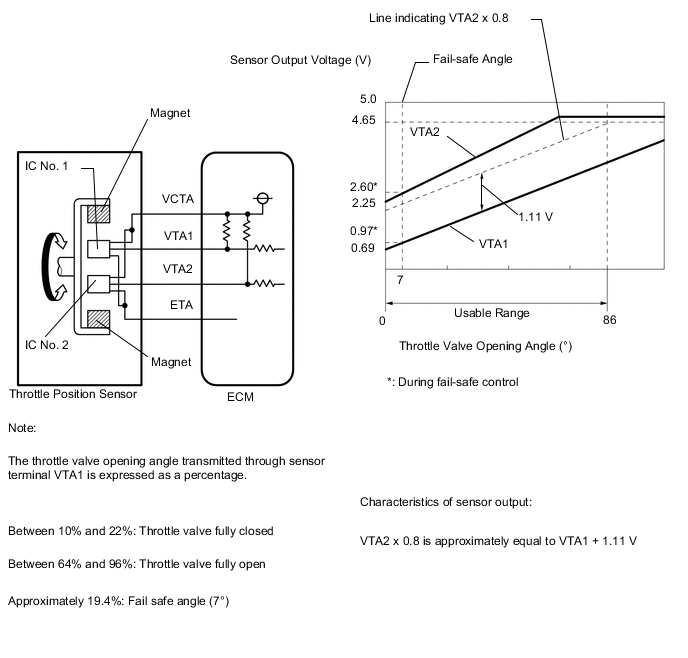
The throttle position sensor is mounted on the throttle with motor body assembly, and detects the opening angle of the throttle valve. This sensor is a non-contact type sensor. It uses Hall-effect elements in order to yield accurate signals even in extreme driving conditions, such as at high speeds as well as very low speeds.
The throttle position sensor has 2 sensor circuits, VTA1 and VTA2 each of which transmits a signal. VTA1 is used to detect the throttle valve angle and VTA2 is used to detect malfunctions in VTA1. The sensor signal voltages vary between 0 V and 5 V in proportion to the throttle valve opening angle, and are transmitted to the VTA1 and VTA2 terminals of the ECM.
As the valve closes, the sensor output voltage decreases and as the valve opens, the sensor output voltage increases. The ECM calculates the throttle valve opening angle according to these signals and controls the throttle actuator in response to driver inputs. These signals are also used in calculations such as air fuel ratio correction, power increase correction and fuel-cut control.
| DTC No. | DTC Detection Condition | Trouble Area |
|---|---|---|
| P0120 | Output voltage of VTA1 quickly fluctuates beyond the lower and upper malfunction thresholds for 2 seconds when the accelerator pedal is depressed (1 trip detection logic) |
|
| P0121 | Difference between VTA1 and VTA2 voltages is less than 0.8 V, or more than 1.6 V for 2 seconds (1 trip detection logic) |
|
| P0122 | Output voltage of VTA1 is 0.2 V or less for 2 seconds when the accelerator pedal is depressed (1 trip detection logic) |
|
| P0123 | Output voltage of VTA1 is 4.54 V or more for 2 seconds or more when the accelerator pedal is depressed (1 trip detection logic) |
|
| P0220 | Output voltage of VTA2 quickly fluctuates beyond both lower and upper malfunction thresholds for 2 seconds when the accelerator pedal is depressed (1 trip detection logic) |
|
| P0222 | Output voltage of VTA2 is 1.75 V or less for 2 seconds when the accelerator pedal is depressed (1 trip detection logic) |
|
| P0223 | Output voltage of VTA2 is 4.8 V or more, and VTA1 is between 0.2 V and 2.02 V for 2 seconds when the accelerator pedal is depressed (1 trip detection logic) |
|
| P2135 | Either of the following conditions is met (1 trip detection logic): (a) Difference between the output voltages of VTA1 and VTA2 is 0.02 V or less for 0.5 seconds or more (b) Output voltage of VTA1 is 0.2 V or less, and VTA2 is 1.75 V or less for 0.4 seconds or more |
|
Tech Tips
-
When any of these DTCs are stored, check the throttle valve opening angle by entering the following menus: Powertrain / Engine and ECT / Data List / All Data / Throttle Position No. 1 and Throttle Position No. 2.
-
Throttle Position No. 1 is the VTA1 signal, and Throttle Position No. 2 is the VTA2 signal.
Reference (Normal Condition) GTS Display Accelerator Pedal Fully Released Accelerator Pedal Fully Depressed Throttle Position No. 1 0.5 to 1.1 V 3.2 to 4.8 V Throttle Position No. 2 2.1 to 3.1 V 4.6 to 4.98 V
MONITOR DESCRIPTION
The ECM uses the throttle position sensor to monitor the throttle valve opening angle. There are several checks that the ECM performs to confirm that the throttle position sensor is operating properly.
-
A specific voltage difference is expected between the sensor terminals, VTA1 and VTA2, for each throttle valve opening angle. If the difference between VTA1 and VTA2 is incorrect, the ECM interprets this as a malfunction in the sensor and stores a DTC.
-
VTA1 and VTA2 each have a specific voltage range. If VTA1 or VTA2 is outside the normal operating range, the ECM interprets this as a malfunction in the sensor and stores a DTC.
-
VTA1 and VTA2 should never be close to the same voltage level. If VTA1 is within 0.02 V of VTA2, the ECM determines that there is a short circuit in the sensor and stores a DTC.
P0120, P0122, P0123, P0220, P0222, P0223 and P2135
-
This sensor transmits two signals: VTA1 and VTA2. VTA1 is used to detect the throttle opening angle and VTA2 is used to detect malfunctions in VTA1. The ECM performs several checks to confirm the proper operation of the throttle position sensor and VTA1.
For each throttle opening angle, a specific voltage difference is expected between the outputs of VTA1 and VTA2. If the output voltage difference between the two signals deviates from the normal operating range, the ECM interprets this as a malfunction of the throttle position sensor. The ECM illuminates the MIL and stores the DTC.
P0121
MONITOR STRATEGY
| Frequency of Operation | Continuous |
CONFIRMATION DRIVING PATTERN
-
Connect the GTS to the DLC3.
-
Turn the ignition switch to ON and turn the GTS on.
-
Clear the DTCs (even if no DTCs are stored, perform the clear DTC procedure).
-
Turn the ignition switch off and wait for at least 30 seconds.
-
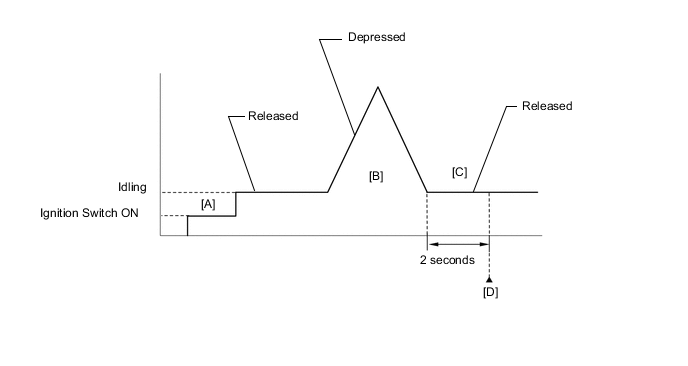
Turn the ignition switch to ON and turn the GTS on [A].
-
Start the engine.
-
With the vehicle stationary, fully depress and release the accelerator pedal [B].
-
Idle the engine for 2 seconds or more [C].
-
Enter the following menus: Powertrain / Engine and ECT / Trouble Codes [D].
-
Read the pending DTCs.
Tech Tips
-
If a pending DTC is output, the system is malfunctioning.
-
If a pending DTC is not output, perform the following procedure.
-
-
Enter the following menus: Powertrain / Engine and ECT / Utility / All Readiness.
-
Input the DTC: P0120, P0121, P0122, P0123, P0220, P0222, P0223 or P2135.
-
Check the DTC judgment result.
GTS Display Description NORMAL
-
DTC judgment completed
-
System normal
ABNORMAL
-
DTC judgment completed
-
System abnormal
INCOMPLETE
-
DTC judgment not completed
-
Perform driving pattern after confirming DTC enabling conditions
N/A
-
Unable to perform DTC judgment
-
Number of DTCs which do not fulfill DTC preconditions has reached ECU memory limit
Tech Tips
-
If the judgment result shows NORMAL, the system is normal.
-
If the judgment result shows ABNORMAL, the system has a malfunction.
-
If the judgment result shows INCOMPLETE or N/A, perform steps [B] through [D] again.
-
FAIL-SAFE
When any of these DTCs or other DTCs relating to Electronic Throttle Control System (ETCS) malfunctions are stored, the ECM enters fail-safe mode. During fail-safe mode, the ECM cuts the current to the throttle actuator, and the throttle valve is returned to a 7° throttle angle by the return spring. The ECM then adjusts the engine output by controlling the fuel injection (intermittent fuel-cut) and ignition timing, in accordance with the accelerator pedal angle, to allow the vehicle to continue operating at a minimal speed. If the accelerator pedal is depressed firmly and gently, the vehicle can be driven slowly. Fail-safe mode continues until a pass condition is detected, and the ignition switch is then turned off.
WIRING DIAGRAM
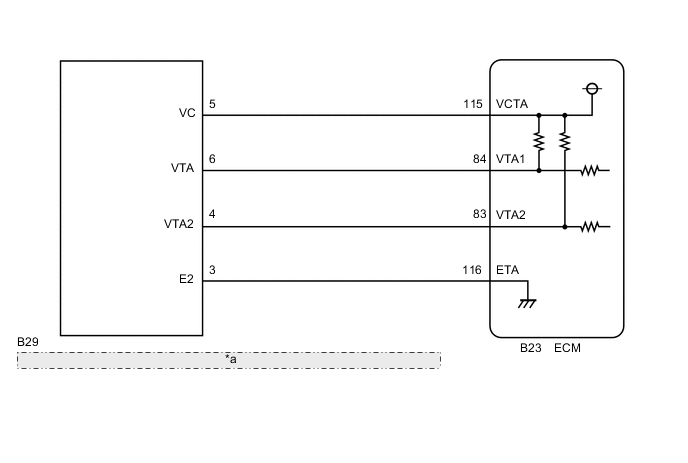
| *a | Throttle Position Sensor (Built into Throttle with Motor Body Assembly) |
CAUTION / NOTICE / HINT
Tech Tips
Read freeze frame data using the GTS. The ECM records vehicle and driving condition information as freeze frame data the moment a DTC is stored. When troubleshooting, freeze frame data can help determine if the vehicle was moving or stationary, if the engine was warmed up or not, if the air fuel ratio was lean or rich, and other data from the time the malfunction occurred.
PROCEDURE
-
READ VALUE USING GTS (THROTTLE POSITION)
-
Connect the GTS to the DLC3.
-
Turn the ignition switch to ON.
-
Turn the GTS on.
-
Enter the following menus: Powertrain / Engine and ECT / Data List / All Data / Throttle Position No. 1 and Throttle Position No. 2.
-
Read the values displayed on the GTS.
Result When Accelerator Pedal Released When Accelerator Pedal Depressed Trouble Area Proceed to Throttle Position No. 1 Throttle Position No. 2 Throttle Position No. 1 Throttle Position No. 2 0 to 0.2 V 0 to 0.2 V 0 to 0.2 V 0 to 0.2 V VCTA circuit open A 4.5 to 4.98 V 4.5 to 4.98 V 4.5 to 4.98 V 4.5 to 4.98 V ETA circuit open 0 to 0.2 V,
or 4.5 to 4.98 V
2.1 to 3.1 V
(Fail-safe)
0 to 0.2 V,
or 4.5 to 4.98 V
2.1 to 3.1 V
(Fail-safe)
VTA1 circuit open or ground short 0.6 to 1.4 V
(Fail-safe)
0 to 0.2 V,
or 4.5 to 4.98 V
0.6 to 1.4 V
(Fail-safe)
0 to 0.2 V,
or 4.5 to 4.98 V
VTA2 circuit open or ground short 0.5 to 1.1 V 2.1 to 3.1 V 3.2 to 4.8 V
(Not fail-safe)
4.6 to 4.98 V
(Not fail-safe)
Throttle position sensor circuit normal B Tech Tips
-
DTC P0121 is stored when the VTA1 and VTA2 output voltages are not consistent with the sensor characteristics. Therefore, check the Freeze Frame Data when this DTC is stored. Use the following formula to confirm the relative differences in voltage.
Characteristics Sensor Output VTA2 x 0.8 is approximately equal to VTA1 + 1.11 V VTA1: Throttle position No. 1 VTA2: Throttle position No. 2 -
If DTC P0121 is output, proceed to the "Check Harness and Connector (Throttle Position Sensor - ECM)".
-
B 
CHECK WHETHER DTC OUTPUT RECURS (THROTTLE POSITION SENSOR DTCS) Click here
A 
-
-
CHECK HARNESS AND CONNECTOR (THROTTLE POSITION SENSOR - ECM)
-
Disconnect the throttle with motor body assembly connector.
-
Disconnect the ECM connector.
-
Measure the resistance according to the value(s) in the table below.
Standard Resistance Tester Connection Condition Specified Condition B29-5 (VC) - B23-115 (VCTA) Always Below 1 Ω B29-6 (VTA) - B23-84 (VTA1) Always Below 1 Ω B29-4 (VTA2) - B23-83 (VTA2) Always Below 1 Ω B29-3 (E2) - B23-116 (ETA) Always Below 1 Ω B29-5 (VC) or B23-115 (VCTA) - Body ground Always 10 kΩ or higher B29-6 (VTA) or B23-84 (VTA1) - Body ground Always 10 kΩ or higher B29-4 (VTA2) or B23-83 (VTA2) - Body ground Always 10 kΩ or higher
NG 
REPAIR OR REPLACE HARNESS OR CONNECTOR
OK
-
-
INSPECT ECM (VC VOLTAGE)
-
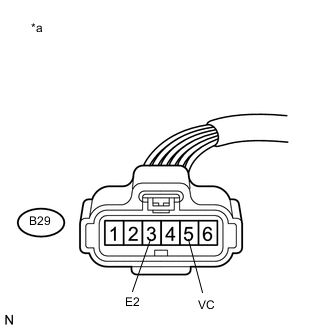
Text in Illustration *a Front view of wire harness connector
(to Throttle with Motor Body Assembly)
Disconnect the throttle with motor body assembly connector.
-
Turn the ignition switch to ON.
-
Measure the voltage according to the value(s) in the table below.
Standard Voltage Tester Connection Condition Specified Condition B29-5 (VC) - B29-3 (E2) Ignition switch ON 4.5 to 5.5 V
NG
REPLACE ECM Click here
OK
-
-
REPLACE THROTTLE WITH MOTOR BODY ASSEMBLY
-
Replace the throttle with motor body assembly Click here.
Tech Tips
Perform "Inspection After Repairs" after replacing the throttle with motor body assembly Click here.
NEXT
-
-
CHECK WHETHER DTC OUTPUT RECURS (THROTTLE POSITION SENSOR DTCS)
-
Connect the GTS to the DLC3.
-
Turn the ignition switch to ON.
-
Turn the GTS on.
-
Clear the DTCs Click here.
-
Turn the ignition switch off and wait for at least 30 seconds.
-
Turn the ignition switch to ON.
-
Turn the GTS on.
-
Drive the vehicle in accordance with the driving pattern described in Confirmation Driving Pattern.
-
Enter the following menus: Powertrain / Engine and ECT / Trouble Codes.
-
Read the DTCs.
Result Result Proceed to DTC P0120, P0121, P0122, P0123, P0220, P0222, P0223 and/or P2135 are output A DTC is not output B
A
REPLACE ECM Click here
B
END
-