SFI SYSTEM, Diagnostic DTC:P0014, P0015
| DTC Code | DTC Name |
|---|---|
| P0014 | Camshaft Position "B" - Timing Over-Advanced or System Performance (Bank 1) |
| P0015 | Camshaft Position "B" - Timing Over-Retarded (Bank 1) |
DESCRIPTION
Tech Tips
If DTC P0014 or P0015 is output, check the VVT (Variable Valve Timing) system.
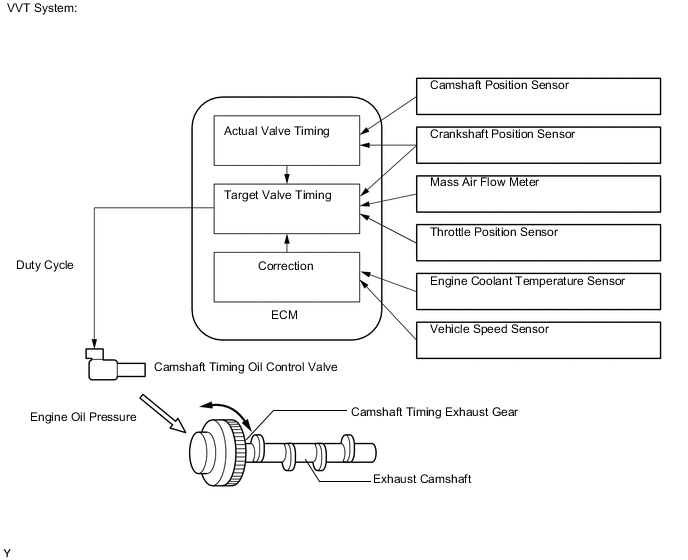
The Variable Valve Timing (VVT) system includes the ECM, camshaft timing oil control valve and VVT controller. The ECM sends a target duty cycle control signal to the camshaft timing oil control valve. This control signal regulates the oil pressure supplied to the VVT controller. Camshaft timing control is performed according to engine operating conditions such as the intake air volume, throttle valve position and engine coolant temperature. The ECM controls the camshaft timing oil control valve based on the signals transmitted by several sensors. The VVT controller regulates the exhaust camshaft angle using oil pressure through the camshaft timing oil control valve. As a result, the relative positions of the camshaft and crankshaft are optimized, the engine torque and fuel economy improve, and the exhaust emissions decrease under overall driving conditions. The ECM detects the actual exhaust valve timing using signals from the camshaft and crankshaft position sensors and performs feedback control. This is how the target exhaust valve timing is verified by the ECM.
| DTC No. | DTC Detection Condition | Trouble Area |
|---|---|---|
| P0014 | Exhaust valve timing is stuck at a certain value when in the advance range (2 trip detection logic). |
|
| P0015 | Exhaust valve timing is stuck at a certain value when in the retard range (1 trip detection logic). |
|
MONITOR DESCRIPTION
-
The ECM optimizes the exhaust valve timing using the VVT (Variable Valve Timing) system to control the exhaust camshaft. The VVT system includes the ECM, camshaft timing oil control valve and VVT controller.
-
The ECM sends a target duty cycle control signal to the camshaft timing oil control valve. This control signal regulates the oil pressure supplied to the VVT controller. The VVT controller can advance or retard the exhaust camshaft.
If the difference between the target and actual exhaust valve timing is large, and changes in actual exhaust valve timing are small, the ECM interprets this as a VVT controller being stuck and stores a DTC.
-
Example:
-
A DTC is stored when the following conditions 1 and 2 are met for 10 seconds or more:
-
1. It takes 5 seconds or more to change the valve timing by 5°CA.
-
2. After condition 1 is met, the camshaft timing oil control valve is forcibly activated 63 times or more (when the vehicle is idling, this takes approximately 100 seconds).
-
These DTCs indicate that the VVT controller cannot operate properly due to camshaft timing oil control valve malfunctions or the presence of foreign objects in the camshaft timing oil control valve.
CONFIRMATION DRIVING PATTERN
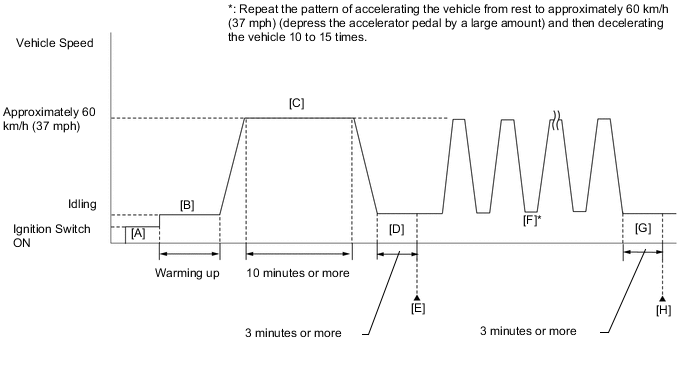
-
Connect the intelligent tester to the DLC3.
-
Turn the ignition switch to ON and turn the intelligent tester on.
-
Clear the DTCs (even if no DTCs are stored, perform the clear DTC operation).
-
Turn the ignition switch off and wait for at least 30 seconds.
-
Turn the ignition switch to ON and turn the intelligent tester on [A].
-
Start the engine and warm it up until the engine coolant temperature reaches 75°C (167°F) or higher [B].
-
Drive the vehicle at approximately 60 km/h (37 mph) for 10 minutes or more [C].
CAUTION:
When performing the confirmation driving pattern, obey all speed limits and traffic laws.
-
Idle the engine for 3 minutes or more [D].
-
Enter the following menus: Powertrain / Engine and ECT / DTC [E].
-
Read the pending DTCs.
Tech Tips
-
If a pending DTC is output, the system is malfunctioning.
-
If a pending DTC is not output, perform the following procedure.
-
-
Enter the following menus: Powertrain / Engine and ECT / Utility / All Readiness.
-
Input the DTC: P0014 or P0015.
-
Check the DTC judgment result.
Intelligent tester Display Description NORMAL
-
DTC judgment completed
-
System normal
ABNORMAL
-
DTC judgment completed
-
System abnormal
INCOMPLETE
-
DTC judgment not completed
-
Perform driving pattern after confirming DTC enabling conditions
UNKNOWN
-
Unable to perform DTC judgment
-
Number of DTCs which do not fulfill DTC preconditions has reached ECU memory limit
Tech Tips
-
If the judgment result shows NORMAL, the system is normal.
-
If the judgment result shows ABNORMAL, the system has a malfunction.
-
If the judgment result shows INCOMPLETE or UNKNOWN, perform steps [F] through [H].
-
-
Repeat the pattern of accelerating the vehicle from rest to approximately 60 km/h (37 mph) and then decelerating the vehicle 10 to 15 times [F].
CAUTION:
When performing the confirmation driving pattern, obey all speed limits and traffic laws.
Tech Tips
Depress the accelerator pedal by a large amount.
-
Idle the engine for 3 minutes or more [G].
-
Enter the following menus: Powertrain / Engine and ECT / DTC [H].
-
Read the pending DTCs.
Tech Tips
-
If a pending DTC is output, the system is malfunctioning.
-
If a pending DTC is not output, perform the following procedure.
-
-
Check the DTC judgment result again.
Tech Tips
-
If the judgment result shows NORMAL, the system is normal.
-
If the judgment result shows ABNORMAL, the system has a malfunction.
-
WIRING DIAGRAM
Refer to DTC P0013 Click here.
CAUTION / NOTICE / HINT
Tech Tips
| Timing Over-advanced (Valve Timing Out of Specified Range) |
Timing Over-retarded (Valve Timing Out of Specified Range) |
|---|---|
| P0014 | P0015 |
Read freeze frame data using the intelligent tester. Freeze frame data records the engine condition when malfunctions are detected. When troubleshooting, freeze frame data can help determine if the vehicle was moving or stationary, if the engine was warmed up or not, if the air-fuel ratio was lean or rich, and other data from the time the malfunction occurred.
PROCEDURE
-
CHECK FOR ANY OTHER DTCS OUTPUT (IN ADDITION TO DTC P0014 OR P0015)
-
Connect the intelligent tester to the DLC3.
-
Turn the ignition switch to ON.
-
Turn the intelligent tester on.
-
Enter the following menus: Powertrain / Engine and ECT / DTC.
-
Read the DTCs.
Result Result Proceed to P0014 or P0015 is output A P0014 or P0015 and other DTCs are output B Tech Tips
If any DTCs other than P0014 or P0015 are output, troubleshoot those DTCs first.
B 
GO TO DTC CHART Click here
A 
-
-
PERFORM ACTIVE TEST USING INTELLIGENT TESTER (OPERATE CAMSHAFT TIMING OIL CONTROL VALVE)
-
Connect the intelligent tester to the DLC3.
-
Start the engine.
-
Turn the intelligent tester on.
-
Warm up the engine.
-
Turn the A/C on.
-
Enter the following menus: Powertrain / Engine and ECT / Active Test / Control the VVT Exhaust Linear (Bank1).
-
Check the engine speed while operating the camshaft timing oil control valve using the intelligent tester.
OK Intelligent tester Operation Specified Condition 0% Normal engine speed 100% Engine idles roughly or stalls Tech Tips
Refer to "Data List / Active Test" [VVT Ex OCV Duty #1 and VVT Ex Chg Angle #1] Click here.
NG 
CHECK VALVE TIMING (CHECK FOR LOOSENESS IN TIMING CHAIN AND WHETHER TIMING CHAIN HAS JUMPED TOOTH) Click here
OK
-
-
CHECK WHETHER DTC OUTPUT RECURS (DTC P0014 OR P0015)
-
Connect the intelligent tester to the DLC3.
-
Turn the ignition switch to ON.
-
Turn the intelligent tester on.
-
Clear the DTCs Click here.
-
Warm up the engine.
-
Drive the vehicle in accordance with the driving pattern described in Confirmation Driving Pattern.
-
Read the output pending DTCs using the intelligent tester.
OK No pending DTC output.
OK
CHECK FOR INTERMITTENT PROBLEMS Click here
NG
-
-
CHECK VALVE TIMING (CHECK FOR LOOSENESS IN TIMING CHAIN AND WHETHER TIMING CHAIN HAS JUMPED TOOTH)
-
Remove the cylinder head cover.
-
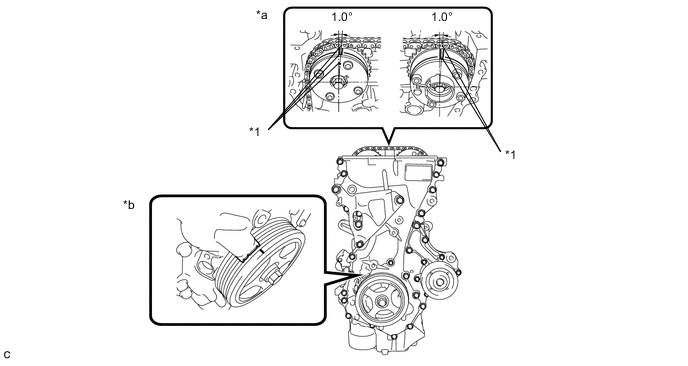
Turn the crankshaft pulley and align its groove with the "0" timing mark of the timing chain cover.
-
Check that the timing marks of the camshaft timing gear and camshaft timing exhaust gear are at the positions shown in the illustration.
Tech Tips
If the timing marks are not as shown, turn the crankshaft one revolution clockwise.
OK Timing marks on camshaft timing gear and camshaft timing exhaust gear are aligned as shown in the illustration. Text in Illustration *1 Alignment Mark *a Reference Camshaft Layout *b No. 1 Cylinder at TDC Compression
NG
ADJUST VALVE TIMING Click here
OK
-
-
INSPECT CAMSHAFT TIMING OIL CONTROL VALVE ASSEMBLY (FOR EXHAUST CAMSHAFT)
-
Inspect the camshaft timing oil control valve assembly Click here.
NG
REPLACE CAMSHAFT TIMING OIL CONTROL VALVE ASSEMBLY Click here
OK
-
-
INSPECT CAMSHAFT BEARING CAP OIL HOLE GASKET (OIL FILTER)
-
Remove the camshaft bearing cap oil hole gasket Click here.
-
Check that the filter is not clogged.
OK Filter is not clogged.
NG
CLEAN OR REPLACE OIL CONTROL VALVE FILTER
OK
-
-
REPLACE CAMSHAFT TIMING EXHAUST GEAR ASSEMBLY
-
Replace the camshaft timing exhaust gear assembly Click here.
NEXT
-
-
CHECK WHETHER DTC OUTPUT RECURS
-
Perform the Confirmation Driving Pattern.
OK No pending DTC is output and All Readiness is NORMAL. Tech Tips
DTC P0014 or P0015 is stored when foreign objects in the engine oil are caught in some parts of the system. These codes will remain stored even if the system returns to normal after a short time. These foreign objects are then captured by the oil filter, thus eliminating the source of the problem.
OK
END
NG
REPLACE ECM Click here
-