СИСТЕМА ЗАЖИГАНИЯ ПРОВЕРКА БЕЗ СНЯТИЯ С АВТОМОБИЛЯ
Информация добавлена 08-08-2017 
PROCEDURE
-
PERFORM SPARK TEST
-
Check for DTCs Click here.
Note
If any DTC is output, perform the troubleshooting procedures for that DTC.
-
Check if sparks occur.
-
Remove the 6 spark plugs Click here.
-
Install the spark plug to the ignition coil and connect the ignition coil connector.
-
Remove the engine room relay block cover.
-
Remove the circuit opening relay from the engine room relay block.
-
Ground the spark plug.
-
Visually check that sparks occur while the engine is being cranked.
Note
-
When performing the inspection, be sure to ground the hexagonal portion or the threaded portion of the spark plug.
-
Do not crank the engine for more than 2 seconds.
For vehicles with a cranking hold function, push the engine switch during cranking to stop cranking.
-
If an ignition coil assembly is struck or dropped, replace it with a new one.
-
If a spark plug is struck or dropped, replace it with a new one.
-
-
If sparks do not occur normally in 1 or more cylinders, perform the "Ignition Coil and Spark Test" below.
-
-
-
INSPECT IGNITION COIL AND SPARK PLUG
-
Spark test flowchart.
-
Check that the wire harness side connector of the ignition coil with igniter is securely connected.
Result Result Proceed to NG Connect securely OK Go to next step -
Perform a spark test on each ignition coil with igniter.
-
If there is a cylinder where sparks do not occur, replace its ignition coil with the ignition coil of a cylinder where sparks occur normally.
-
Crank the engine and visually check that sparks occur at the cylinder with the normally operating ignition coil.
Result Result Proceed to OK Replace ignition coil with igniter NG Go to next step
-
-
Check the power supply to the ignition coil with igniter.
-
Turn the engine switch on (IG).
-
Check that there is battery voltage at the ignition coil positive (+) terminal.
Result Result Proceed to OK Replace ignition coil with igniter NG Go to next step
-
-
Inspect the spark plug.
-
Replace the spark plug with a normal one.
-
Perform a spark test again.
Result Result Proceed to OK Replace spark plug NG Inspect the ignition system
-
-
-
Check the VVT sensor for intake side (See page ) and VVT sensor for exhaust side Click here.
-
Check the crankshaft position sensor Click here.
-
Install the 6 spark plugs Click here.
-
Install the circuit opening relay.
-
Install the engine room relay block cover.
-
-
INSPECT SPARK PLUG
Note
-
Do not use a wire brush for cleaning.
-
Do not attempt to adjust the electrode gap of a used spark plug.
-
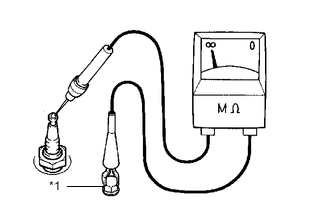
*1 Ground Check the electrode.
-
Using a megohmmeter, measure the insulation resistance.
Standard Insulation Resistance Tester Connection Condition Specified Condition Spark plug (terminal part) - Body ground Always 10 MΩ or higher If a megohmmeter is not available, perform the following simple inspection.
-
-
Alternative inspection method:
-
Start the engine.*
-
Quickly accelerate the engine to 4000 rpm 5 times.*
Note
*: Do not perform this step if P0300 (misfire detection) or a related DTC is stored.
-
Remove the spark plug.
-
Visually check the spark plug.
If the electrode is dry, the spark plug is functioning properly. If the electrode is damp, proceed to the next step.
-
-
Check the spark plug for any damage on its threads and insulator.
If there is damage, replace the spark plug. If not, reinstall the spark plug.
Recommended Spark Plug Manufacturer Product DENSO made SK20HR11 or SK16HR11 Note
When replacing a spark plug, replace it with the same type of spark plug that is installed on the vehicle.
-
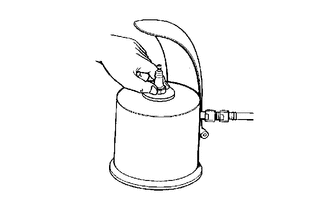
Clean the spark plugs.
-
Check the spark plug electrode gap.
Maximum electrode gap for used spark plug 1.3 mm (0.0512 in.) If the gap is more than the maximum, replace
Electrode gap for new spark plug 1.0 to 1.1 mm (0.0394 to 0.0433 in.)
-