AIR CONDITIONING SYSTEM SYSTEM DESCRIPTION
-
GENERAL
The air conditioning system has the following controls.
Control Outline Neural Network Control This control is capable of performing complex control by artificially simulating the information processing method of the nervous system of living organisms in order to establish a complex input or output relationship similar to that of a human brain. Pollen Removal Mode Control
-
Activated by the pollen removal mode switch operation.
-
Sends air which has passed through the clean air filter to the area around the upper part of the bodies of the driver and front passenger. This air has been filtered by the clean air filter in order to remove pollen.
Outlet Air Temperature Control Based on the temperature set by the temperature control switch, the neural network control calculates outlet air temperature based on input signals from various sensors. Blower Control Controls the blower motor in accordance with the airflow volume that has been calculated by the neural network control based on the input signals from various sensors. Automatically increases the blower level when the defroster is on. When the rear seat blower is operated, the blower level for the rear seats is linked with the blower level for the front seat to achieve optimum airflow. Air Outlet Control Automatically switches the air outlets in accordance with the outlet mode that has been calculated by the neural network control based on the input signals from various sensors. In accordance with the engine coolant temperature, ambient air temperature, amount of sunlight, required blower, outlet temperature, and vehicle speed conditions, this control automatically switches the blower outlet to foot and defroster mode to prevent the windows from becoming fogged up when the ambient air temperature is low. Air Inlet Control Automatically controls the air inlet control damper to help achieve the calculated outlet air temperature that is required. Drives the air inlet control servo motor according to the operation of the air inlet control switch and moves the dampers to the fresh or recirculation position. Electric Inverter Compressor Control The air conditioning amplifier assembly calculates the target speed of the compressor based on the target evaporator temperature (which is calculated by the room temperature sensor, outside temperature sensor, and the automatic light control sensor (solar sensor)) and the actual evaporator temperature that is detected by the evaporator temperature sensor in order to control the compressor speed. The air conditioning amplifier assembly calculates the target evaporator temperature, which includes corrections based on the room temperature sensor, outside temperature sensor, the automatic light control sensor (solar sensor), and evaporator temperature sensor. Accordingly, the air conditioning amplifier assembly controls the compressor speed to an extent that would not inhibit the proper cooling performance or defogging performance. Turns the air conditioning on automatically when the AUTO button is pressed when the blower is ON and the air conditioning is off. Decreases the compressor speed in order to ensure quietness when the vehicle is stopped or the engine is off. Defroster Control Defroster control logic is used to improve defroster performance. Rear Window Defogger Control
-
Switches the rear defogger and outside rear view mirror heaters on for 15 minutes when the rear defogger button is pressed.
-
Switches them off if the button is pressed while they are operating.
ECO Mode Control When the ECO switch is turned on, the air conditioning amplifier assembly limits the air conditioning system performance. Outside Temperature Indication Control Based on the signals from the ambient temperature sensor, this control calculates the outside temperature, this value is then corrected in air conditioning amplifier assembly, and shown on the multi information display or multi display. Anti-fog control If the air conditioning amplifier assembly judges that the windows are likely to become fogged based on the signal from the air conditioning thermistor assembly, anti-fog performance is ensured by only recirculation air to the extent that the windows will not become fogged. If the windows cannot be defogged only by the air inlet mode control, the system increases the air volume and/or switches the air outlets to help boost anti-fog performance. Diagnosis A Diagnostic Trouble Code (DTC) is stored in the memory when the air conditioning amplifier assembly detects a problem with the air conditioning system. -
-
NEURAL NETWORK CONTROL
-
In the previous automatic air conditioning systems, the air conditioning amplifier assembly determined the required outlet air temperature and blower air volume in accordance with the calculation formula that has been obtained based on information received from the sensors.
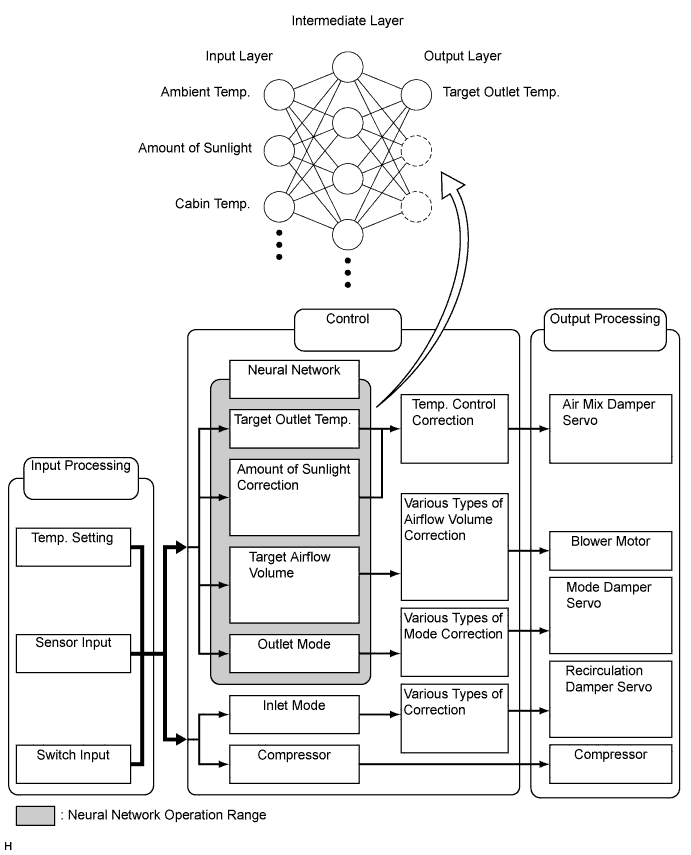
However, because the senses of a person are rather complex, a given temperature is sensed differently, depending on the environment in which the person is situated. For example, a given amount of solar radiation can feel comfortably warm in a cold climate, or extremely uncomfortable in a hot climate. Therefore, as a technique for effecting a higher level of control, a neural network has been adopted in the automatic air conditioning system. With this technique, the data that has been collected under varying environmental conditions is stored in the air conditioning amplifier assembly. The air conditioning amplifier assembly can then effect control to provide enhanced air conditioning comfort.
-
The neural network control consists of neurons in the input layer, intermediate layer and output layer. The input layer neurons process the input data of the outside temperature, the amount of sunlight, and the room temperature based on the outputs of the switches and sensors, and output them to the intermediate layer neurons. Based on this data, the intermediate layer neurons adjust the strength of the links among the neurons. The sum of these is then calculated by the output layer neurons in the form of the required outlet temperature, solar correction, target airflow volume and outlet mode control volume. Accordingly, the air conditioning amplifier assembly controls the servo motors and blower motor in accordance with the control volumes that have been calculated by the neural network control.
-
-
POLLEN REMOVAL MODE CONTROL
-
When the pollen removal mode switch is pressed, the pollen removal mode control is activated. Then, the air vent is switched to the FACE mode and recirculated pollen free air flows in the area around the upper part of the bodies of the driver and front passenger.
-
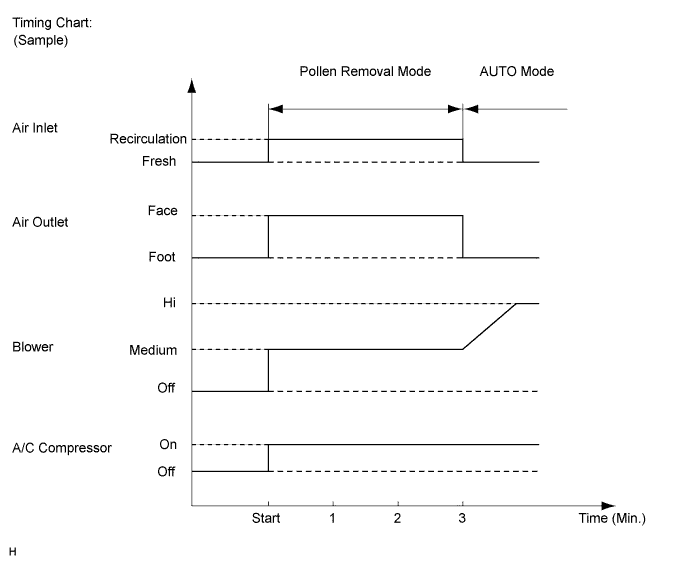
When the pollen removal mode switch signal is received by the air conditioning amplifier assembly, the air conditioning amplifier assembly controls the compressor with motor assembly, air inlet servo motor, air vent servo motor and blower motor as shown in the timing chart below.
-
This control usually operates for approximately 3 minutes. However, when the outside temperature is low, it will operate for approximately 1 minute.
-
After this control stops operating, the air conditioning amplifier assembly controls the air conditioning system using AUTO mode.
-
-
MODE POSITION AND DAMPER OPERATION
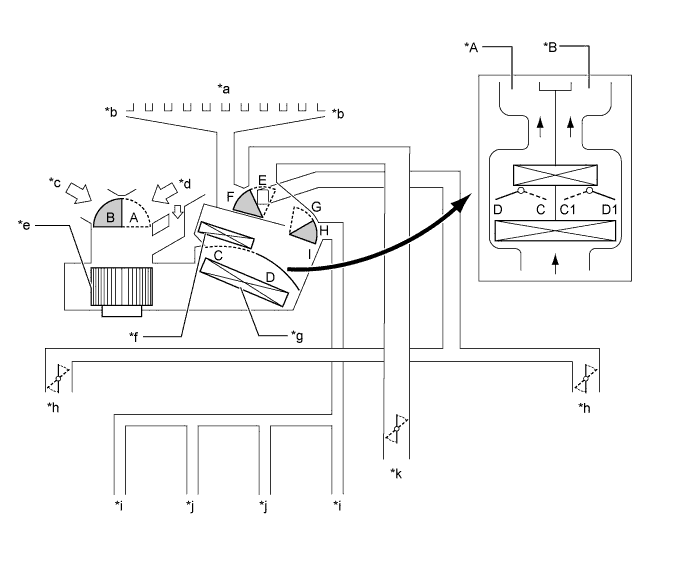
Text in Illustration *A To Driver Side *B To Front Passenger Side *a Center Defroster *b Side Defroster *c Fresh Air *d Recirculated Air *e Blower with Fan Motor Sub-assembly (Blower Motor) *f Heater Radiator Unit Sub-assembly *g Evaporator Sub-assembly *h Side Register *i Front Footwell Register Duct *j Rear Footwell Register Duct *k Center Register - -
-
Mode Position and Damper Operation
Functions of Main Dampers Control Damper Operation Position Damper Position Operation Air Inlet Control Damper FRESH A Allows fresh air to enter. RECIRCULATION B Causes internal air to recirculate. Air Mix Control Damper MAX COLD to MAX HOT Temperature Setting C - D
(C1 - D1)
Varies the mixture ratio of warm air and cool air in order to regulate the temperature continuously between hot and cold. Air Outlet Control Damper DEF

E, I Defrosts the windshield through the center defroster, side defrosters and side registers. FOOT/DEF

E, H Defrosts the windshield through the center defroster, side defrosters and side registers while air is also blown out from the front and rear footwell register ducts. FOOT

E, G Air blows out of the front and rear footwell register ducts, and side registers. In addition, air blows out slightly from the center defroster and side defrosters. BI-LEVEL

F, H Air blows out of the front center register, rear center register, side registers and front and rear footwell register ducts. FACE

F, I Air blows out of the front center register, rear center register and side registers.
-
-
AIR OUTLETS AND AIRFLOW VOLUME
-
Air Outlets and Airflow Volume
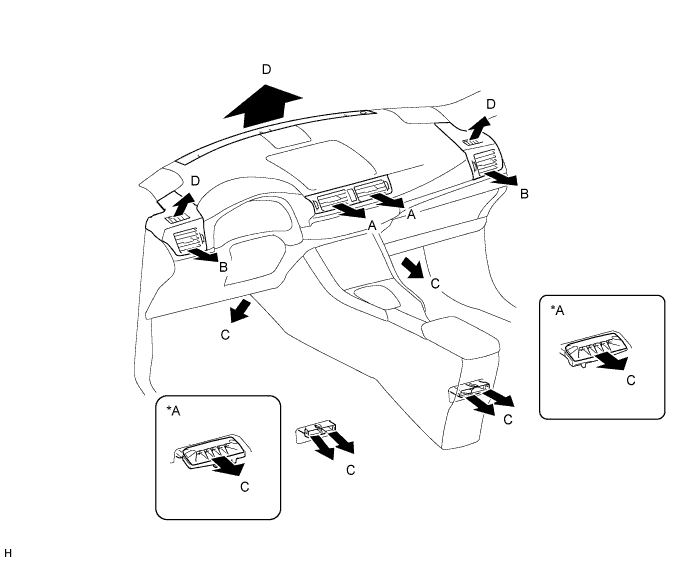
Text in Illustration *a w/ Stereo Component Amplifier Assembly - - Indication Mode Face Foot Def Ctr Side C D A B FACE 

B/L 
FOOT F/D 
DEF The size of each circle ○ indicates the ratio of airflow volume.
-
-
COMPRESSOR WITH MOTOR ASSEMBLY
-
General
Tech Tips
In order to ensure the proper insulation of the internal high-voltage portion of the compressor and the compressor housing, this vehicle has adopted a compressor oil (ND11) with a high level of insulation performance. Therefore, never use a compressor oil other than the ND11 type compressor oil or its equivalent.
-
Along with the installation of the hybrid unit on this vehicle, an electric inverter compressor that is driven by a motor is used. The basic construction and operation of this compressor are the same as the ordinary scroll compressor, except that it is driven by an electric motor.
-
The Air Conditioning (A/C) inverter is integrated with the compressor.
-
The electric motor is actuated by 3-phase alternating current (244.8 V) supplied by the A/C inverter. As a result, the air conditioning control system on this vehicle is actuated without depending on the operation of the engine, thus realizing a comfortable air conditioning system and low fuel consumption.
-
Due to the use of an electric inverter compressor, the compressor speed can be controlled at the required speed calculated by the air conditioning amplifier assembly. Thus, the cooling and dehumidification performance and power consumption have been optimized.
-
Low-moisture permeation hoses are used for the suction and discharge hoses at the compressor in order to minimize the entry of moisture into the refrigeration cycle.
-
The compressor uses high-voltage alternating current. If a short or open circuit occurs in the compressor wiring harness, the power management control ECU will cut off the A/C inverter circuit in order to stop the power supply to the compressor motor.
-
-
Compressor Speed Control
-
The air conditioning amplifier assembly calculates the target compressor speed based on the target evaporator temperature (calculated from the temperature control switch, room temperature sensor, ambient temperature sensor, and automatic light control sensor (solar sensor)) and the actual evaporator temperature detected by the evaporator temperature sensor. Then, the air conditioning amplifier assembly transmits the target speed to the power management control ECU. The power management control ECU controls the A/C inverter based on the target speed data in order to control the compressor to a speed that suits the operating condition of the air conditioning system.
-
The air conditioning amplifier assembly calculates the target evaporator temperature, which includes corrections based on the room temperature sensor, outside temperature sensor, automatic light control sensor (solar sensor), and evaporator temperature sensor. Accordingly, the air conditioning amplifier assembly controls the compressor speed to an extent that does not inhibit the proper cooling performance or defogging performance. As a result, comfort and low fuel consumption can be realized.
-
-
-
PTC HEATER (w/ PTC Heater Assembly)
-
General
-
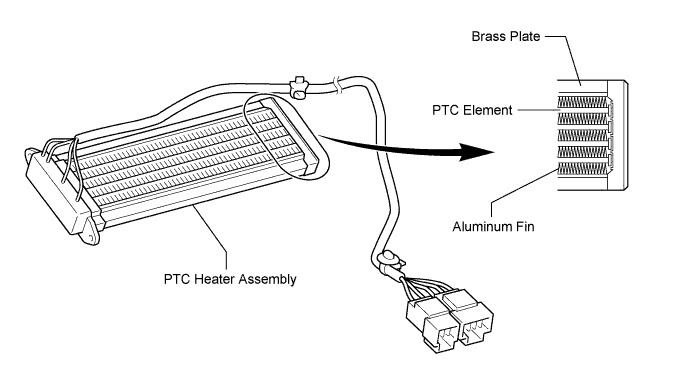
The PTC heater assembly is located above the heater core in the air conditioning unit.
-
The PTC heater assembly consists of a PTC element, aluminum fin, and brass plate. When current is applied to the PTC element, it generates heat to warm the air that passes through the unit.
-
-
PTC Heater Assembly Operating Conditions
-
The PTC heater assembly is turned on and off by the air conditioning amplifier assembly in accordance with the engine coolant temperature, ambient temperature, engine speed, temperature setting, and electrical load (generator power ratio).
-
-
-
EVAPORATOR TEMPERATURE SENSOR
The evaporator temperature sensor detects the temperature of the cool air immediately through the evaporator in the form of resistance changes, and outputs it to the air conditioning amplifier assembly.
-
ECO MODE CONTROL
-
Under the control of eco mode, the air conditioning amplifier assembly restricts the air conditioning system performance under specified conditions, thus improving fuel economy.
-
Eco mode control is activated when the ECO switch provided inside the combination switch assembly is pressed, and then restricts the air conditioning system performance as described below.
Control Outline Inside or Outside Air Switch Control Automatically switches the air inlet port to internal air circulation mode to reduce power consumption when the outside air temperature is equal to or higher than a predetermined temperature. Blower Level Control Sets the blower level in AUTO mode lower than normal, to suppress the power consumption. PTC Heater Control Stops the operation of PTC heater assembly and suppresses the power consumption. Heating Restriction Control Changes the air outlet temperature according to ECO switch operation during heating and increases the amount of engine-off time when the ECO switch is in the on state, thus improving fuel economy. Compressor Speed Restriction Control Restricts the maximum speed during cooling and reduces the power consumption.
-
-
BLOWER WITH FAN MOTOR SUB-ASSEMBLY (BLOWER MOTOR)
-
The blower motor has a built-in blower controller, and is controlled using duty control performed by the air conditioning amplifier assembly.
-
-
BUS CONNECTOR (AIR CONDITIONING HARNESS ASSEMBLY)
-
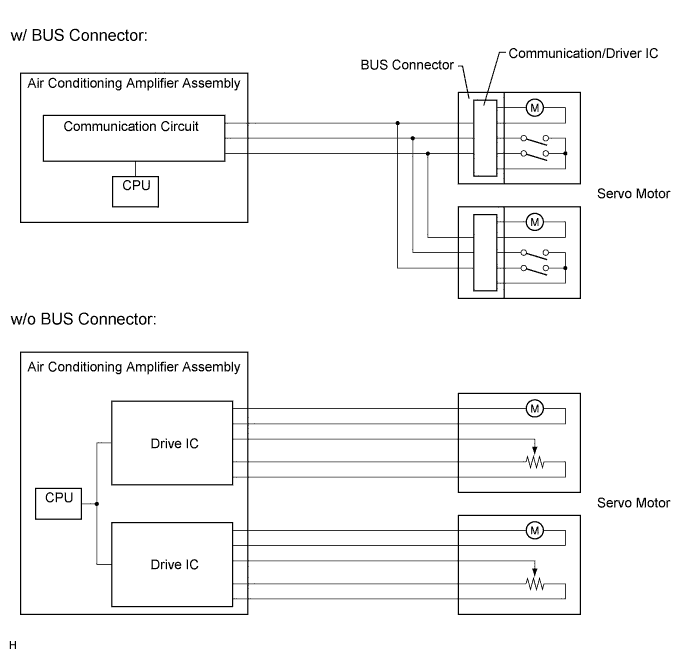
A BUS connector is used in the wire harness connection that connects the servo motor from the air conditioning amplifier assembly.
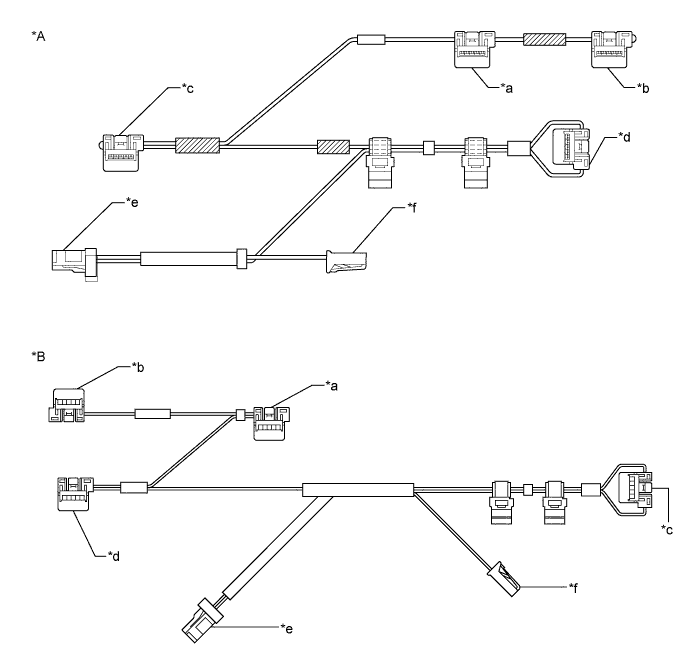
Text in Illustration *A for LHD *B for RHD *a Bus Connector (to Air Outlet Servo Motor) *b Bus Connector (to Air Inlet Servo Motor) *c Bus Connector (to Air Mix Servo Motor (for Front Passenger Side)) *d Bus Connector (to Air Mix Servo Motor (for Driver Side)) *e to Air Conditioning Amplifier Assembly *f to Evaporator Temperature Sensor -
Each BUS connector has a built-in communication/driver IC which communicates with each servo motor connector, actuates the servo motor, and has a position detection function. This enables bus communication for the servo motor wire harness, for a more lightweight construction and a reduced number of wires.
-
-
SERVO MOTOR
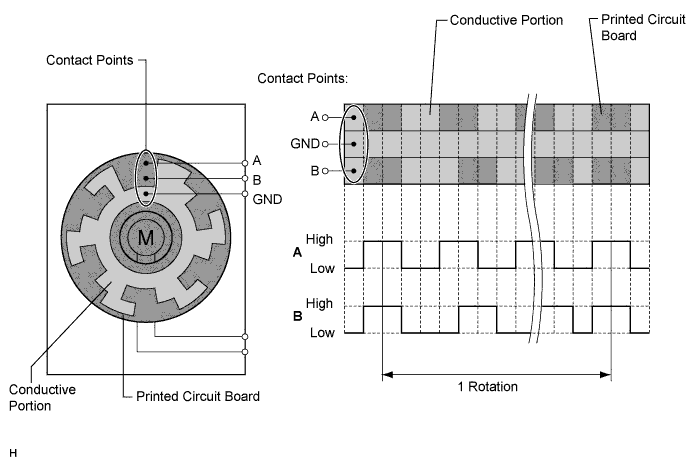
The pulse pattern type servo motor consists of a printed circuit board and a servo motor. The printed circuit board has 3 contact points, and can transmit 2 ON-OFF signals to the air conditioning amplifier assembly based on the difference of the pulse phases. The BUS connector can detect the damper position and movement direction with these signals.
-
ROOM TEMPERATURE SENSOR
The room temperature sensor detects the cabin temperature based on changes in the resistance of its built-in thermistor and sends a signal to the air conditioning amplifier assembly.
-
AMBIENT TEMPERATURE SENSOR
The ambient temperature sensor detects the outside temperature based on changes in the resistance of its built-in thermistor and sends a signal to the air conditioning amplifier assembly.
-
AUTOMATIC LIGHT CONTROL SENSOR (SOLAR SENSOR)
-
The automatic light control sensor (solar sensor) consists of a photo diode, 2 amplifier circuits for the solar sensor, and frequency converter circuit for the light control sensor.
-
The automatic light control sensor (solar sensor) detects (in the form of changes in the current that flows through the built-in photo diode) the changes in the amount of sunlight from the LH and RH sides (2 directions) and outputs these sunlight strength signals to the air conditioning amplifier assembly.
-
-
AIR CONDITIONING PRESSURE SENSOR
The air conditioning pressure sensor detects the refrigerant pressure and outputs it to the air conditioning amplifier assembly in the form of voltage changes.
-
AIR CONDITIONING THERMISTOR ASSEMBLY (GLASS TEMPERATURE SENSOR) (w/ AIR CONDITIONING THERMISTOR ASSEMBLY)
The glass temperature sensor detects the windshield glass temperature and outputs it to the air conditioning amplifier assembly in the form of resistance changes.
-
AIR CONDITIONING THERMISTOR ASSEMBLY (GLASS SURROUNDINGS TEMPERATURE SENSOR) (w/ AIR CONDITIONING THERMISTOR ASSEMBLY)
The glass surroundings temperature sensor detects the windshield glass surroundings temperature and outputs it to the air conditioning amplifier assembly in the form of resistance changes.
-
AIR CONDITIONING THERMISTOR ASSEMBLY (GLASS HUMIDITY SENSOR) (w/ AIR CONDITIONING THERMISTOR ASSEMBLY)
The glass humidity sensor detects the windshield humidity and outputs it to the air conditioning amplifier assembly in the form of voltage changes.