IGNITION SYSTEM ON-VEHICLE INSPECTION
-
PERFORM SPARK TEST
-
Check for DTCs Click here.
Note
If any DTC is present, perform troubleshooting in accordance with the procedure for that DTC.
-
Remove the ignition coils and spark plugs Click here.
-
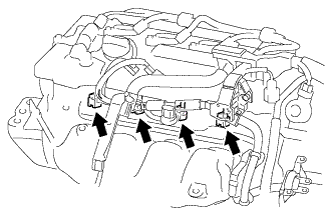
Disconnect the 4 fuel injector connectors.
-
Set the vehicle to inspection mode (Step 3) Click here.
-
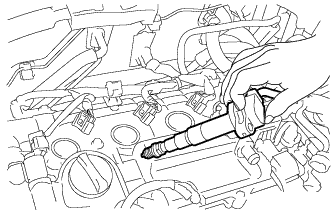
Install the spark plug into the ignition coil, and then connect the ignition coil connector. (Step 4)
-
Ground the spark plug. (Step 5)
-
Check that spark occurs while the engine is being cranked. (Step 6)
Note
-
Ground the spark plugs when checking them.
-
Replace any ignition coils that have been subjected to any physical impacts.
-
Do not crank the engine for more than 2 seconds.
Tech Tips
Repeat steps 3 to 6 for each spark plug and ignition coil.
If spark does not occur, perform the following procedure for the malfunctioning cylinder.
-
-
Connect the 4 fuel injector connectors.
-
Install the ignition coils and spark plugs Click here.
-
Check for DTCs Click here.
-
Clear the DTCs Click here.
-
-
INSPECT IGNITION COIL AND SPARK TEST
-
Check that the ignition coil connector is securely connected.
Result Result Action NG Connect securely OK Go to next step -
Perform a spark test.
-
Replace the ignition coil with a known good one.
-
Set the vehicle to inspection mode Click here.
-
Perform the spark test again.
Result Result Action NG Go to next step OK Replace ignition coil
-
-
Perform a spark test.
-
Replace the spark plug with a known good one.
-
Set the vehicle to inspection mode Click here.
-
Perform the spark test again.
Result Result Action NG Inspect the ignition system Click here
OK Replace the spark plug Note
-
If the ignition coil assembly has been struck or dropped, replace it.
-
If the spark plug has been struck or dropped, replace it.
-
-
-
-
INSPECT SPARK PLUG
-
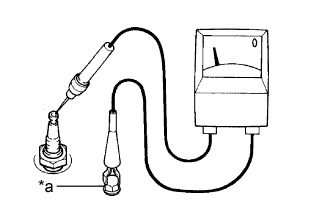
Text in Illustration *a Ground Check the electrode.
-
Using a megohmmeter, measure the resistance.
Standard Resistance 10 MΩ or more If the result is 10 MΩ or less, clean the plug and measure the resistance again.
Tech Tips
If a megohmmeter is not available, perform the following simple inspection instead.
-
-
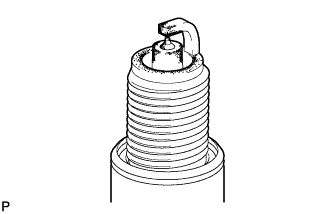
Alternative inspection method:
-
Quickly accelerate the engine to approximately 2500 rpm 5 times.
-
Remove each spark plug.
-
Visually check the spark plug.
If the electrode is dry, the spark plug is functioning properly. If the electrode is damp, proceed to the next step.
-
-
Check the spark plug for any damage to its threads and insulator.
If there is any damage, replace the spark plug.
Recommended Spark Plug Manufacturer Spark Plug Type DENSO SC20HR11 -
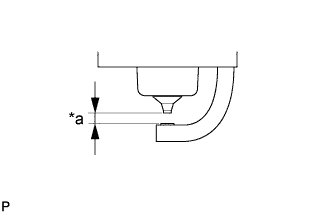
Text in Illustration *a Spark Plug Electrode Gap Check the spark plug electrode gap.
Maximum Electrode Gap for Used Spark Plug Electrode Gap 1.3 mm (0.0512 in.) If the gap is greater than the maximum, replace the spark plug.
Electrode Gap for New Spark Plug Electrode Gap 1.0 to 1.1 mm (0.0394 to 0.0433 in.) -
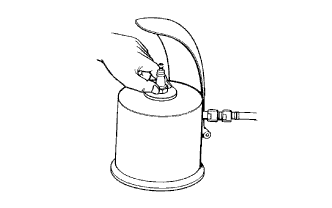
Clean the spark plugs.
If the electrode has traces of wet carbon, clean the electrode with a spark plug cleaner and then dry it.
Standard air pressure 588 kPa (6.0 kgf/cm2, 85 psi) Standard duration 20 seconds or less. Tech Tips
Only use the spark plug cleaner when the electrode is free of oil. If the electrode has traces of oil, use gasoline to clean off the oil before using the spark plug cleaner.
-