HYBRID CONTROL SYSTEM EV Drive Mode Switch Circuit
DESCRIPTION
The EV mode signal is sent to the power management control ECU (HV CPU). This signal is then transmitted from the power management control ECU (HV CPU) via CAN to the combination meter assembly to illuminate the EV indicator lamp.
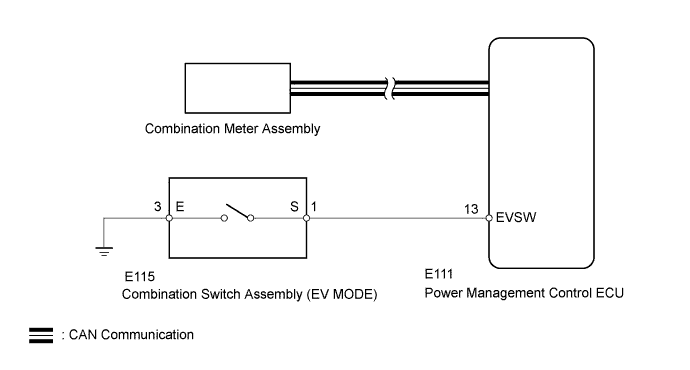
If any of the following conditions are not met, EV mode may not be turned on or the mode may be cancelled. (A buzzer sounds to indicate that the transition to EV mode is cancelled and a message is displayed on multi-information display.)
| EV Mode Entry Condition | Tester Display | Specified Condition |
|---|---|---|
| HV battery charge level | State of Charge | Approximately 50% or higher |
| Accelerator pedal position | Accelerator Degree | Below approximately 30% |
| Engine coolant temperature | Engine Coolant Temp | 0°C (32°F) or higher |
| HV battery temperature | Temp of Batt TB1 to TB6 | Between 10°C to 40°C (50°F to 104°F) |
| Vehicle speed (Varies depending on engine warm-up condition) |
- | Cold: 30 km/h (19 mph) or less Warmed-up: 45 km/h (28 mph) |
| Defroster | - | OFF |
| Cruise control | - | OFF |
| Win | Charge Control Value | Below -20000W |
| Wout | Discharge Control Value | 20000W or higher |
| Shift lever in N | - | Engine is not running |
INSPECTION PROCEDURE
PROCEDURE
-
ASK ABOUT VEHICLE CONDITION
-
Check if a buzzer sounded and a message was displayed on the multi-information display when attempting to enter EV mode.
Result Result Proceed to No buzzer sounded and no message was displayed on multi-information display. A A buzzer sounded and a message was displayed on multi-information display. B Tech Tips
If a buzzer sounds and a message is displayed on multi-information display, one or more of the EV mode entry conditions have not been met. Check that all of the EV mode entry conditions have been met before pressing the EV mode switch.
B 
COMPLETED
A 
-
-
READ VALUE USING INTELLIGENT TESTER (CAN BUS CHECK)
-
Connect the intelligent tester to the DLC3.
-
Turn the power switch on (IG).
-
Enter the following menus: System Select / CAN Bus Check.
Result Result Proceed to All of the ECUs and sensors that are currently connected to the CAN communication system are displayed. A None of the ECUs and sensors that are currently connected to the CAN communication system are displayed, or some of them are not displayed. B
B
GO TO CAN COMMUNICATION SYSTEM Click here
A
-
-
CHECK DTC OUTPUT (ALL)
-
Connect the intelligent tester to the DLC3.
-
Turn the power switch on (IG).
-
Check for DTCs of all system by following the prompts on the tester screen.
Result Result Proceed to No DTCs are output A DTCs are output B
B
GO TO DTC CHART
A
-
-
PERFORM ACTIVE TEST USING INTELLIGENT TESTER (COMBINATION METER)
-
Connect the intelligent tester to the DLC3.
-
Turn the power switch on (READY).
-
Enter the following menus: Body Electrical / Combination Meter / Active Test / Indicat. EV Mode.
-
Perform the "Indicat. EV Mode" Active Test.
OK The EV mode indicator lamp comes on or blinks. -
Turn the power switch off.
NG
REPLACE COMBINATION METER ASSEMBLY Click here
OK
-
-
READ VALUE USING INTELLIGENT TESTER (EV REQUEST, EV SWITCH)
-
Connect the intelligent tester to the DLC3.
-
Turn the power switch on (IG).
-
Enter the following menus: Powertrain / Hybrid Control / Data List / EV request.
-
Read the value displayed on the intelligent tester.
Tester Display Measurement Item/Range Normal Condition EV request EV mode transition availability/
ON or OFF
In EV mode: ON EV Switch EV mode switch condition/
ON or OFF
EV switch on: ON Result Result Proceed to The intelligent tester display changes according to the EV mode switch operation. A The intelligent tester display does not change according to the EV mode switch operation. B -
Turn the power switch off.
B 
CHECK COMBINATION SWITCH ASSEMBLY (EV MODE SWITCH) Click here
A 
CHECK FOR INTERMITTENT PROBLEMS Click here
-
-
CHECK COMBINATION SWITCH ASSEMBLY (EV MODE SWITCH)
-
Remove the combination switch assembly.
-
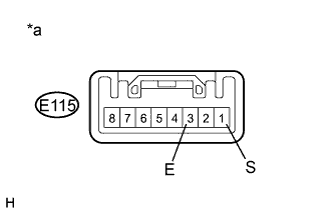
Text in Illustration *a Component without harness connected
(Combination Switch Assembly)
Measure the resistance according to the value(s) in the table below.
Standard Resistance Tester Connection Condition Specified Condition E115-1 (S) - E115-3 (E) EV switch operated Below 1 Ω E115-1 (S) - E115-3 (E) EV switch not operated 10 kΩ or higher -
Install the combination switch assembly.
NG
REPLACE COMBINATION SWITCH ASSEMBLY (EV SWITCH) Click here
OK
-
-
CHECK HARNESS AND CONNECTOR (COMBINATION SWITCH ASSEMBLY - BODY GROUND)
-
Disconnect connector E115 from the combination switch assembly.
-
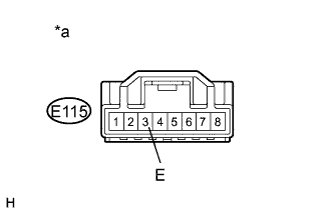
Text in Illustration *a Front view of wire harness connector
(to Combination Switch Assembly)
Measure the resistance according to the value(s) in the table below.
Standard Resistance Tester Connection Condition Specified Condition E115-3 (E) - Body ground Always Below 1 Ω -
Connect the combination switch assembly connector.
NG
REPAIR OR REPLACE HARNESS OR CONNECTOR
OK
-
-
CHECK HARNESS AND CONNECTOR (POWER MANAGEMENT CONTROL ECU - COMBINATION SWITCH ASSEMBLY)
-
Disconnect connector E111 from the power management control ECU.
-
Disconnect connector E115 from the combination switch assembly.
-
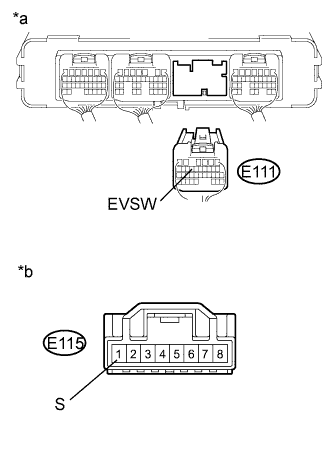
Text in Illustration *a Rear view of wire harness connector
(to Power Management Control ECU)
*b Front view of wire harness connector
(to Combination Switch Assembly)
Measure the resistance according to the value(s) in the table below.
Standard Resistance Tester Connection Condition Specified Condition E111-13 (EVSW) - E115-1 (S) Always Below 1 Ω E111-13 (EVSW) or E115-1 (S) - Body ground Always 10 kΩ or higher -
Connect the combination switch assembly connector.
-
Connect the power management control ECU connector.
NG
REPAIR OR REPLACE HARNESS OR CONNECTOR
OK
REPLACE POWER MANAGEMENT CONTROL ECU Click here
-