HYBRID CONTROL SYSTEM, Diagnostic DTC:P0AA6-526, P0AA6-611, P0AA6-612, P0AA6-613, P0AA6-614

| DTC Code | DTC Name |
|---|---|
| P0AA6-526 | Hybrid Battery Voltage System Isolation Fault |
| P0AA6-611 | Hybrid Battery Voltage System Isolation Fault |
| P0AA6-612 | Hybrid Battery Voltage System Isolation Fault |
| P0AA6-613 | Hybrid Battery Voltage System Isolation Fault |
| P0AA6-614 | Hybrid Battery Voltage System Isolation Fault |
DESCRIPTION
The power management control ECU monitors the battery smart unit and detects insulation malfunctions in the high-voltage system.
| DTC No. | INF Code | DTC Detection Condition | Trouble Area |
|---|---|---|---|
| P0AA6 | 526(*1) | Insulation resistance between the high-voltage circuit and the body has decreased.*2 |
|
| P0AA6 | 611 | Insulation resistance of the with motor compressor assembly has decreased.*3 | Compressor with motor assembly |
| P0AA6 | 612 | Insulation resistance of the HV battery area has decreased.*3 |
|
| P0AA6 | 613 | Insulation resistance of the transaxle area has decreased.*3 |
|
| P0AA6 | 614 | Insulation resistance of the high-voltage DC area has decreased.*3 |
|
Tech Tips
-
*1: INF code 526 is stored together with P0AA6.
-
*2: The insulation malfunction detection circuit in the battery voltage sensor monitors the insulation resistance between the high voltage circuits and body. If the insulation resistance decreases, the power management control ECU stores DTC P0AA6-526 and illuminates the MIL first.
-
*3: If the following operations are performed within the same trip after DTC P0AA6-526 is stored, just one of the related DTCs (P0AA6-611, 612, 613 or 614) will be stored.
-
Apply the parking brake firmly.
-
Wait for 1 minute or more with the vehicle stopped, the brake pedal firmly depressed, the power switch on (READY), drive (D) selected and the air conditioning system on (Lo/COOL MAX, blower speed HI), then turn the power switch off and wait for 1 minute or more.
-
If DTC P0AA6 is stored, the vehicle cannot start.
-
When measuring insulation resistance using a megohmmeter, measure the resistance while jiggling the high voltage wire harness.
WIRING DIAGRAM
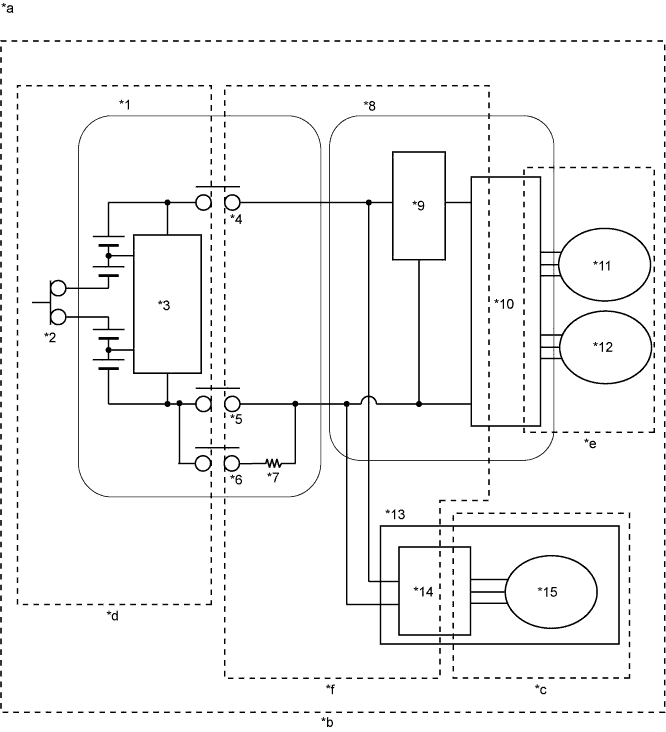
| *1 | HV Battery | *2 | Service Plug Grip |
| *3 | Battery Smart Unit | *4 | SMRB |
| *5 | SMRG | *6 | SMRP |
| *7 | System Main Resistor | *8 | Inverter with Converter Assembly |
| *9 | Boost Converter | *10 | Inverter |
| *11 | MG1 | *12 | MG2 |
| *13 | Compressor with Motor Assembly | *14 | A/C Inverter |
| *15 | A/C Motor | - | - |
| *a | High-voltage Areas | *b | INF Code 526 Vehicle Insulation Resistance Reduction Area |
| *c | INF Code 611 Air Conditioning Area | *d | INF Code 612 HV Battery Area |
| *e | INF Code 613 Transaxle Area | *f | INF Code 614 High Voltage Direct Current Area |
SYSTEM DESCRIPTION
Tech Tips
If a decrease in insulation resistance cannot be confirmed using a megohmmeter, check the Short Wave Highest Val in the Data List.
-
Characteristics of Short Wave Highest Value
-
The Data List item Short Wave Highest Val and insulation resistance have the relationship shown in the table below. Short Wave Highest Val decreases with a decrease in insulation resistance. However, in some cases, even though the insulation resistance of the vehicle is normal, Short Wave Highest Val may decrease. Therefore, check Short Wave Highest Val while considering the following.
-
Do not check until approximately 1 minute has passed after the power switch is turned on (IG) (*1).
-
Do not check when there is a difference between the system voltages (HV battery voltage, VL-Voltage before boosting, and VH-Voltage after boosting) (*2).
Short Wave Highest Value Trouble Area Neither condition (*1) nor (*2) is met and Short Wave Highest Val is approximately 0 V Since the insulation resistance is close to 0 Ω, there is a strong possibility of interference with a metal object. Neither condition (*1) nor (*2) is met and Short Wave Highest Val is between 0 and 5 V Since the insulation resistance is several hundred kiloohms, there is a strong possibility of the presence of fluid such as coolant.
-
-
-
How to Determine Part with Insulation Malfunction
-
Jiggle the high-voltage wire harness to check if the resistance to body ground changes with the position of the wire harness or force applied.
-
Repeat rotating and stopping of the MG1, MG2 and compressor with motor. Check that the Short Wave Highest Val does not decrease (for example if the motor stops with foreign matter forming a leak path) when the motor stops, or that the Short Wave Highest Val does not return to normal (for example if foreign matter moves away from the leak path) when the motor rotates.
-
Increase the temperature of MG1and MG2. Check if the Short Wave Highest Val decreases with the temperature increase.
-
-
Confirmation after Replacing Parts
-
After the repair, clear the DTCs and perform the following procedure to check that DTCs are not output. (Do not turn the power switch off during this inspection.)
-
Apply the parking brake and secure the wheels using chocks.
-
With the vehicle stationary, turn the power switch on (READY) with park (P) selected and wait for 60 seconds or more.
-
Turn the air conditioning system on (MAX COLD, blower speed HI).
-
While depressing the brake pedal without depressing the accelerator pedal, move the shift lever to D and wait for 5 minutes.
-
If step A is performed within the same trip after DTC P0AA6-526 is stored, the parts with insufficient insulation resistance will be determined, and a DTC (P0AA6-611, 612, 613 or 614) will be stored.
-
If no DTCs are output, proceed to the next step.
-
-
Drive the vehicle for approximately 5 minutes referring to the following freeze frame data items: "Vehicle Spd", "Shift Sensor Shift Pos", "Accel Pedal Pos #1", "Engine Revolution", "Engine Coolant Temp" and "Master Cylinder Ctrl Trq" (If the freeze frame data item "Vehicle Spd" is 6 mph (10 km/h) or less, drive the vehicle at 6 mph (10 km/h) or more.).
-
If step A is performed within the same trip after DTC P0AA6-526 is stored, the parts with insufficient insulation resistance will be determined, and a DTC (P0AA6-611, 612, 613 or 614) will be stored.
-
If no DTCs are output, insulation fault does not detected.
-
-
Wait for 1 minute or more with the vehicle stopped, the power switch on (READY), the shift lever in P and the air conditioning system on (Lo/COOL MAX, blower speed HI), then turn the power switch off and wait for 1 minute or more. (step A)
-
Tech Tips
If the DTC is not output again, check for driving conditions that would cause the Data List item "Short Wave Highest Val" to decrease.
-
INSPECTION PROCEDURE
CAUTION:
-
When troubleshooting P0AA6, be sure to wrap the tools with electrical tape. (It is very dangerous if high voltage is shorted to ground through the tools.)
-
Before inspecting the high-voltage system or disconnecting the low voltage connector of the inverter with converter assembly, take safety precautions such as wearing insulated gloves and removing the service plug grip to prevent electrical shocks. After removing the service plug grip, put it in your pocket to prevent other technicians from accidentally reconnecting it while you are working on the high-voltage system.
-
After disconnecting the service plug grip, wait for at least 10 minutes before touching any of the high-voltage connectors or terminals. After waiting for 10 minutes, check the voltage at the terminals in the inspection point in the inverter with converter assembly. The voltage should be 0 V before beginning work.
Tech Tips
Waiting for at least 10 minutes is required to discharge the high-voltage capacitor inside the inverter with converter assembly.
Tech Tips
When measuring insulation resistance using a megohmmeter, set the megohmmeter to 500 V.
PROCEDURE
-
CHECK DTC OUTPUT (HV)
-
Connect the intelligent tester to the DLC3.
-
Turn the power switch on (IG).
-
Enter the following menus: Powertrain / Hybrid Control / Trouble Codes.
-
Check if DTCs are output.
Result Result Proceed to P0AA6 only is output. A P0AA6 and P0A1D (power management control ECU malfunction) are output. B P0AA6 and P0AA7 (malfunction in the battery smart unit) are output. C P0AA6 and P0A1F (battery ECU malfunction) are output. D -
Turn the power switch off.
B 
GO TO DTC CHART (P0A1D) Click here
C
GO TO DTC CHART (P0AA7) Click here
D
GO TO DTC CHART (P0AFC) Click here
A 
-
-
CHECK INFORMATION CODE
-
Enter the following menus: Powertrain / Hybrid Control / Trouble Codes.
-
Access the freeze frame data of DTC P0AA6 and read the INF code.
Note
-
Information codes 611, 612, 613 and 614 are not stored with 526 simultaneously. If a drop in insulation resistance is detected and DTC P0AA6-526 is output, wait for 1 minute with power switch on (READY), drive (D) selected and the air conditioning system on within the same trip, then turn the power switch off and wait for 1 minute to determine the information code (611, 612, 613 or 614).
-
If only DTC P0AA6-526 is output, perform the diagnosis procedure for INF code 526 to inspect all the high voltage circuits.
Result Result Proceed to 526 (decrease in the insulation resistance of the high-voltage circuit) only is output. A 526 and 611 (decrease in the insulation resistance of the air conditioning area) are output. Refer to the troubleshooting procedures for P0AA6-611 (Heater and air conditioning system) Click here
526 and 612 (decrease in the insulation resistance of the battery area) are output. B 526 and 613 (decrease in the insulation resistance of the transaxle area) are output. C 526 and 614 (decrease in the insulation resistance of the high-voltage DC area) are output. D -
B 
CHECK HV BATTERY AREA Click here
C
CHECK INVERTER WITH CONVERTER ASSEMBLY Click here
D
CHECK HYBRID VEHICLE TRANSAXLE ASSEMBLY (MOTOR CABLE) Click here
A
-
-
CHECK HYBRID VEHICLE TRANSAXLE ASSEMBLY (MOTOR CABLE)
CAUTION:
Be sure to wear insulated gloves.
-
Turn the power switch off.
-
Check that the service plug grip is not installed.
Note
After removing the service plug grip, do not turn the power switch on (READY), unless instructed by the repair manual because this may cause a malfunction.
-
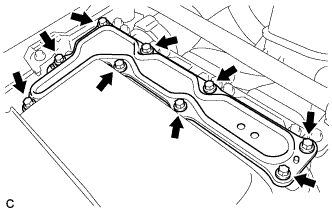
Remove the inverter terminal cover from the inverter with converter assembly.
Tech Tips
Make sure that no foreign objects have entered or contaminated the inverter with converter assembly.
-
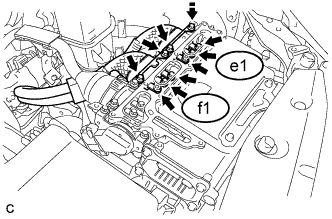
Disconnect the motor cable e1 and generator cable f1 from the inverter with converter assembly.
-
Connect the cable to the negative (-) auxiliary battery terminal.
Tech Tips
As the insulation resistance may vary when MG2 rotates, perform this inspection while rotating the front wheels.
-
Turn the power switch on (IG).
Note
Turning the power switch on (IG) with the service grip removed causes DTCs to be stored. Clear the DTCs after performing this inspection.
-
With the neutral (N) selected and lift up the vehicle.
-
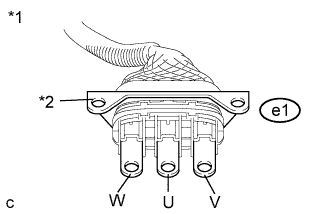
Text in Illustration *1 Motor Cable *2 Shielded Wire Ground Using a megohmmeter set to 500 V, measure the resistance according to the value(s) in the table below while rotating the front wheels 2 revolutions in the same direction simultaneously.
Note
-
Carefully perform this inspection as MG2 may generate current when the front wheels are rotated by hand.
-
Be sure to set the megohmmeter to 500 V when performing this test. Using a setting higher than 500 V can result in damage to the component being inspected.
Standard Resistance Tester Connection Switch Condition Specified Condition e1-3 (V) - Body ground and shielded wire ground Power switch off 100 MΩ or higher e1-2 (U) - Body ground and shielded wire ground Power switch off 100 MΩ or higher e1-1 (W) - Body ground and shielded wire ground Power switch off 100 MΩ or higher -
-
Lower the vehicle and push the P position switch.
-
Turn the power switch off.
-
Disconnect the cable from the negative (-) auxiliary battery terminal.
NG
CHECK MOTOR CABLE Click here
OK
-
-
CHECK HYBRID VEHICLE TRANSAXLE ASSEMBLY (GENERATOR CABLE)
CAUTION:
Be sure to wear insulated gloves.
-
Check that the service plug grip is not installed.
Note
After removing the service plug grip, do not turn the power switch on (READY), unless instructed by the repair manual because this may cause a malfunction.
-
Connect the cable to the negative (-) auxiliary battery terminal.
Tech Tips
As the insulation resistance may vary when MG1 rotates, perform this inspection while rotating the front wheels.
-
Turn the power switch on (IG).
Note
Turning the power switch on (IG) with the service grip removed causes DTCs to be stored. Clear the DTCs after performing this inspection.
-
With the neutral (N) selected and lift up the vehicle.
-
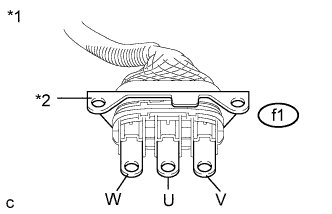
Text in Illustration *1 Generator Cable *2 Shielded Wire Ground Using a megohmmeter set to 500 V, measure the resistance according to the value(s) in the table below while rotating the front wheels 2 revolutions in the same direction simultaneously.
Note
-
Carefully perform this inspection as MG1 may generate current when the front wheels are rotated by hand.
-
Be sure to set the megohmmeter to 500 V when performing this test. Using a setting higher than 500 V can result in damage to the component being inspected.
Standard Resistance Tester Connection Switch Condition Specified Condition f1-3 (V) - Body ground and shielded wire ground Power switch off 100 MΩ or higher f1-2 (U) - Body ground and shielded wire ground Power switch off 100 MΩ or higher f1-1 (W) - Body ground and shielded wire ground Power switch off 100 MΩ or higher -
-
Lower the vehicle and push the P position switch.
-
Turn the power switch off.
-
Disconnect the cable from the negative (-) auxiliary battery terminal.
NG
CHECK GENERATOR CABLE Click here
OK
-
-
CHECK NO. 2 ENGINE WIRE
CAUTION:
Be sure to wear insulated gloves.
-
Check that the service plug grip is not installed.
Note
After removing the service plug grip, do not turn the power switch on (READY), unless instructed by the repair manual because this may cause a malfunction.
-
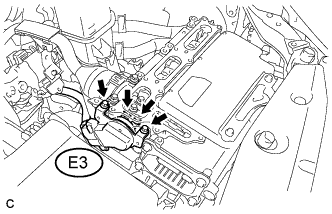
Disconnect the No. 2 engine wire (air conditioning harness) E3 from the inverter with converter assembly.
Tech Tips
Make sure that no foreign objects have entered or contaminated the connector of the No. 2 engine wire (air conditioning harness) E3.
-
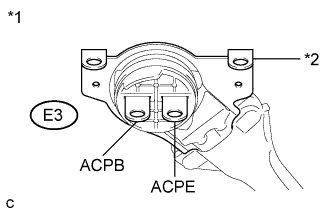
Text in Illustration *1 No. 2 Engine Wire
(Air Conditioning Harness)
*2 Shield Ground Using a megohmmeter set to 500 V, measure the resistance according to the value(s) in the table below.
Note
Be sure to set the megohmmeter to 500 V when performing this test. Using a setting higher than 500 V can result in damage to the component being inspected.
Standard Resistance Tester Connection Switch Condition Specified Condition E3-1 (ACPB) - Body ground and shield ground Power switch off 3 MΩ or higher E3-2 (ACPE) - Body ground and shield ground Power switch off 3 MΩ or higher
NG
CHECK NO. 2 ENGINE WIRE Click here
OK
-
-
CHECK INVERTER WITH CONVERTER ASSEMBLY
CAUTION:
Be sure to wear insulated gloves.
-
Check that the service plug grip is not installed.
Note
After removing the service plug grip, do not turn the power switch on (READY), unless instructed by the repair manual because this may cause a malfunction.
-
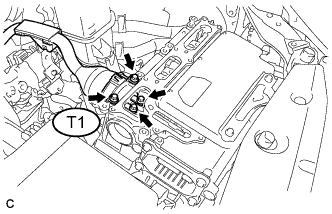
Disconnect the frame wire T1 from the inverter with converter assembly.
Tech Tips
Make sure that no foreign objects have entered or contaminated the connector of the frame wire T1.
-
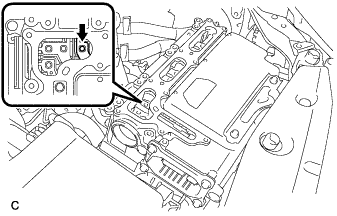
Using a megohmmeter set to 500 V, measure the resistance according to the value(s) in the table below.
Note
Be sure to set the megohmmeter to 500 V when performing this test. Using a setting higher than 500 V can result in damage to the component being inspected.
Standard Resistance Tester Connection Switch Condition Specified Condition High voltage terminal - Body ground Power switch off 1 MΩ or higher Tech Tips
Perform this inspection with the motor cable, generator cable and No. 2 engine wire (air conditioning harness) disconnected from the inverter with converter assembly.
NG
REFER TO REPLACE INVERTER WITH CONVERTER ASSEMBLY PARTS Click here
OK
-
-
CHECK FRAME WIRE
CAUTION:
Be sure to wear insulated gloves.
-
Check that the service plug grip is not installed.
Note
After removing the service plug grip, do not turn the power switch on (READY), unless instructed by the repair manual because this may cause a malfunction.
-
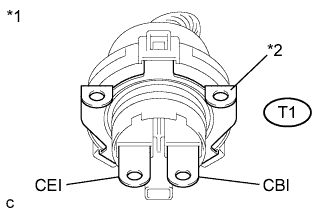
Text in Illustration *1 Frame Wire *2 Shield Ground Using a megohmmeter set to 500 V, measure the resistance according to the value(s) in the table below.
Note
Be sure to set the megohmmeter to 500 V when performing this test. Using a setting higher than 500 V can result in damage to the component being inspected.
Standard Resistance Tester Connection Switch Condition Specified Condition T1-1 (CEI) - Body ground and shield ground Power switch off 10 MΩ or higher T1-2 (CBI) - Body ground and shield ground Power switch off 10 MΩ or higher
NG
CHECK FRAME WIRE Click here
OK
-
-
CHECK HV BATTERY AREA
CAUTION:
Be sure to wear insulated gloves.
-
Turn the power switch off.
-
Check that the service plug grip is not installed.
Note
After removing the service plug grip, do not turn the power switch on (READY), unless instructed by the repair manual because this may cause a malfunction.
-
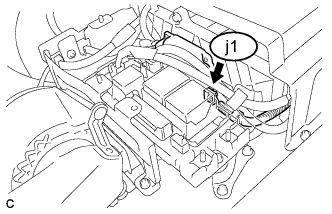
Disconnect connector j1 from the battery smart unit
Tech Tips
For the removal and installation procedures related to the battery smart unit connectors, Click here.
-
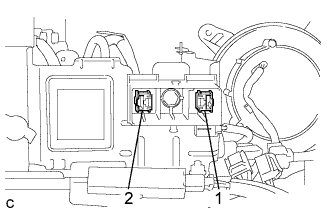
Using a megohmmeter set to 500 V, measure the resistance according to the value(s) in the table below.
Note
Be sure to set the megohmmeter to 500 V when performing this test. Using a setting higher than 500 V can result in damage to the component being inspected.
Standard Resistance Tester Connection Switch Condition Specified Condition 1 - Body ground Power switch off 10 MΩ or higher 2 - Body ground Power switch off 10 MΩ or higher
NG
CHECK HYBRID BATTERY JUNCTION BLOCK Click here
OK 
REPLACE BATTERY SMART UNIT Click here
-
-
CHECK INVERTER WITH CONVERTER ASSEMBLY
CAUTION:
Be sure to wear insulated gloves.
-
Turn the power switch off.
-
Check that the service plug grip is not installed.
Note
After removing the service plug grip, do not turn the power switch on (READY), unless instructed by the repair manual because this may cause a malfunction.
-
Remove the inverter terminal cover from the inverter with converter assembly.
Tech Tips
Make sure that no foreign objects have entered or contaminated the inverter with converter assembly.
-
Disconnect the motor cable e1 and generator cable f1 from the inverter with converter assembly.
-
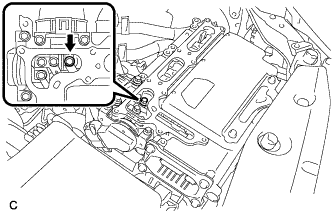
Using a megohmmeter set to 500 V, measure the resistance according to the value(s) in the table below.
Note
Be sure to set the megohmmeter to 500 V when performing this test. Using a setting higher than 500 V can result in damage to the component being inspected.
Standard Resistance Tester Connection Switch Condition Specified Condition High voltage terminal - Body ground Power switch off 1 MΩ or higher Result Result Proceed to NG A OK B
B
CHECK MOTOR CABLE Click here
A
REPLACE POWER MODULE INTELLIGENT TRANSISTOR KIT Click here
-
-
CHECK HYBRID VEHICLE TRANSAXLE ASSEMBLY (MOTOR CABLE)
CAUTION:
Be sure to wear insulated gloves.
-
Turn the power switch off.
-
Check that the service plug grip is not installed.
Note
After removing the service plug grip, do not turn the power switch on (READY), unless instructed by the repair manual because this may cause a malfunction.
-
Remove the inverter terminal cover from the inverter with converter assembly.
Tech Tips
Make sure that no foreign objects have entered or contaminated the inverter with converter assembly.
-
Disconnect the motor cable e1 and generator cable f1 from the inverter with converter assembly.
-
Connect the cable to the negative (-) auxiliary battery terminal.
Tech Tips
As the insulation resistance may vary when MG2 rotates, perform this inspection while rotating the front wheels.
-
Turn the power switch on (IG).
Note
Turning the power switch on (IG) with the service grip removed causes DTCs to be stored. Clear the DTCs after performing this inspection.
-
With the neutral (N) selected and lift up the vehicle.
-
Text in Illustration *1 Motor Cable *2 Shielded Wire Ground Using a megohmmeter set to 500 V, measure the resistance according to the value(s) in the table below while rotating the front wheels 2 revolutions in the same direction simultaneously.
Note
-
Carefully perform this inspection as MG2 may generate current when the front wheels are rotated by hand.
-
Be sure to set the megohmmeter to 500 V when performing this test. Using a setting higher than 500 V can result in damage to the component being inspected.
Standard Resistance Tester Connection Switch Condition Specified Condition e1-3 (V) - Body ground and shielded wire ground Power switch off 100 MΩ or higher e1-2 (U) - Body ground and shielded wire ground Power switch off 100 MΩ or higher e1-1 (W) - Body ground and shielded wire ground Power switch off 100 MΩ or higher -
-
Lower the vehicle and push the P position switch.
-
Turn the power switch off.
-
Disconnect the cable from the negative (-) auxiliary battery terminal.
NG
CHECK MOTOR CABLE Click here
OK
-
-
CHECK HYBRID VEHICLE TRANSAXLE ASSEMBLY (GENERATOR CABLE)
CAUTION:
Be sure to wear insulated gloves.
-
Check that the service plug grip is not installed.
Note
After removing the service plug grip, do not turn the power switch on (READY), unless instructed by the repair manual because this may cause a malfunction.
-
Connect the cable to the negative (-) auxiliary battery terminal.
Tech Tips
As the insulation resistance may vary when MG1 rotates, perform this inspection while rotating the front wheels.
-
Turn the power switch on (IG).
Note
Turning the power switch on (IG) with the service grip removed causes DTCs to be stored. Clear the DTCs after performing this inspection.
-
With the neutral (N) selected and lift up the vehicle.
-
Text in Illustration *1 Generator Cable *2 Shielded Wire Ground Using a megohmmeter set to 500 V, measure the resistance according to the value(s) in the table below while rotating the front wheels 2 revolutions in the same direction simultaneously.
Note
-
Carefully perform this inspection as MG1 may generate current when the front wheels are rotated by hand.
-
Be sure to set the megohmmeter to 500 V when performing this test. Using a setting higher than 500 V can result in damage to the component being inspected.
Standard Resistance Tester Connection Switch Condition Specified Condition f1-3 (V) - Body ground and shielded wire ground Power switch off 100 MΩ or higher f1-2 (U) - Body ground and shielded wire ground Power switch off 100 MΩ or higher f1-1 (W) - Body ground and shielded wire ground Power switch off 100 MΩ or higher -
-
Lower the vehicle and push the P position switch.
-
Turn the power switch off.
-
Disconnect the cable from the negative (-) auxiliary battery terminal.
NG
CHECK GENERATOR CABLE Click here
OK
-
-
CHECK HIGH VOLTAGE DIRECT CURRENT AREA
CAUTION:
Be sure to wear insulated gloves.
-
Turn the power switch off.
-
Check that the service plug grip is not installed.
Note
After removing the service plug grip, do not turn the power switch on (READY), unless instructed by the repair manual because this may cause a malfunction.
-
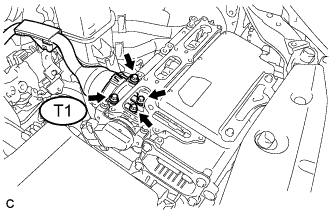
Disconnect the frame wire T1 from the inverter with converter assembly.
Tech Tips
Make sure that no foreign objects have entered or contaminated the connector of the frame wire T1.
-
Text in Illustration *1 Frame Wire *2 Shield Ground Using a megohmmeter set to 500 V, measure the resistance according to the value(s) in the table below.
Note
Be sure to set the megohmmeter to 500 V when performing this test. Using a setting higher than 500 V can result in damage to the component being inspected.
Standard Resistance Tester Connection Switch Condition Specified Condition T1-1 (CEI) - Body ground and shield ground Power switch off 10 MΩ or higher T1-2 (CBI) - Body ground and shield ground Power switch off 10 MΩ or higher
NG
CHECK FRAME WIRE Click here
OK
-
-
CHECK NO. 2 ENGINE WIRE
CAUTION:
Be sure to wear insulated gloves.
-
Check that the service plug grip is not installed.
Note
After removing the service plug grip, do not turn the power switch on (READY), unless instructed by the repair manual because this may cause a malfunction.
-
Disconnect the No. 2 engine wire (air conditioning harness) E3 from the inverter with converter assembly.
-
Text in Illustration *1 No. 2 Engine Wire
(Air Conditioning Harness)
*2 Shield Ground Using a megohmmeter set to 500 V, measure the resistance according to the value(s) in the table below.
Note
Be sure to set the megohmmeter to 500 V when performing this test. Using a setting higher than 500 V can result in damage to the component being inspected.
Standard Resistance Tester Connection Switch Condition Specified Condition E3-1 (ACPB) - Body ground and shield ground Power switch off 3 MΩ or higher E3-2 (ACPE) - Body ground and shield ground Power switch off 3 MΩ or higher
NG
CHECK NO. 2 ENGINE WIRE Click here
OK
REFER TO REPLACE INVERTER WITH CONVERTER ASSEMBLY PARTS Click here
-
-
CHECK NO. 2 ENGINE WIRE
CAUTION:
Be sure to wear insulated gloves.
-
Check that the service plug grip is not installed.
Note
After removing the service plug grip, do not turn the power switch on (READY), unless instructed by the repair manual because this may cause a malfunction.
-
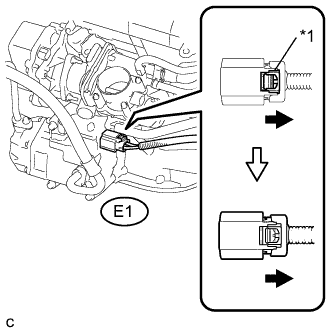
Text in Illustration *1 Green Lock Disconnect the No. 2 engine wire (air conditioning harness) E1 from the compressor with motor assembly.
-
Text in Illustration *1 No. 2 Engine Wire
(Air Conditioning Harness)
*2 Shield Ground Using a megohmmeter set to 500 V, measure the resistance according to the value(s) in the table below.
Note
Be sure to set the megohmmeter to 500 V when performing this test. Using a setting higher than 500 V can result in damage to the component being inspected.
Standard Resistance Tester Connection Switch Condition Specified Condition E3-1 (ACPB) - Body ground and shield ground Power switch off 10 MΩ or higher E3-2 (ACPE) - Body ground and shield ground Power switch off 10 MΩ or higher
NG
REPLACE NO. 2 ENGINE WIRE
OK
AIR CONDITIONING SYSTEM (P0AA6-611) Click here
-
-
CHECK FRAME WIRE
CAUTION:
Be sure to wear insulated gloves.
-
Check that the service plug grip is not installed.
Note
After removing the service plug grip, do not turn the power switch on (READY), unless instructed by the repair manual because this may cause a malfunction.
-
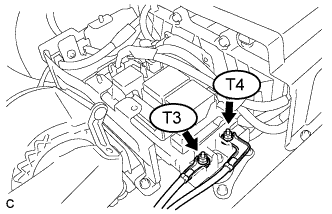
Standard Resistance Tester Connection Switch Condition Specified Condition T4-1 (CBI) - Body ground and shield ground Power switch off 10 MΩ or higher T3-1 (CEI) - Body ground and shield ground Power switch off 10 MΩ or higher Text in Illustration *1 Shield Ground Disconnect the frame wire T4 and T3 from the hybrid battery junction block.
Tech Tips
For the removal and installation procedures related to the frame wire, Click here.
-
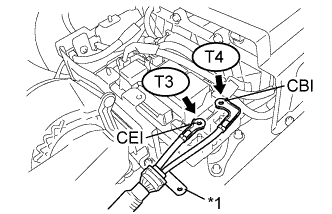
Text in Illustration *1 Shield Ground Using a megohmmeter set to 500 V, measure the resistance according to the value(s) in the table below.
Note
Be sure to set the megohmmeter to 500 V when performing this test. Using a setting higher than 500 V can result in damage to the component being inspected.
Standard Resistance Tester Connection Switch Condition Specified Condition T4-1 (CBI) - Body ground and shield ground Power switch off 10 MΩ or higher T3-1 (CEI) - Body ground and shield ground Power switch off 10 MΩ or higher Text in Illustration *1 Shield Ground
NG
REPLACE FRAME WIRE Click here
OK
REPLACE HYBRID BATTERY JUNCTION BLOCK Click here
-
-
CHECK HYBRID BATTERY JUNCTION BLOCK
CAUTION:
Be sure to wear insulated gloves.
-
Check that the service plug grip is not installed.
Note
After removing the service plug grip, do not turn the power switch on (READY), unless instructed by the repair manual because this may cause a malfunction.
-
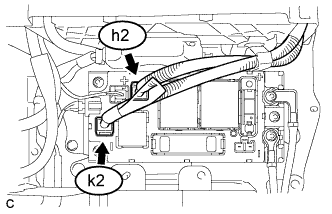
Disconnect the high voltage cable connector of the HV battery h2 and k2 from the hybrid battery junction block.
-
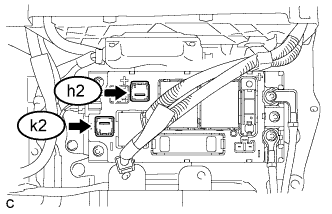
Using a megohmmeter set to 500 V, measure the resistance according to the value(s) in the table below.
Note
Be sure to set the megohmmeter to 500 V when performing this test. Using a setting higher than 500 V can result in damage to the component being inspected.
Standard Resistance Tester Connection Switch Condition Specified Condition k2-1 - Hybrid Battery Carrier Panel Power switch off 10 MΩ or higher h2-1 - Hybrid Battery Carrier Panel Power switch off 10 MΩ or higher
NG
REPLACE HYBRID BATTERY JUNCTION BLOCK Click here
OK
REPLACE HV BATTERY Click here
-
-
CHECK MOTOR CABLE
CAUTION:
Be sure to wear insulated gloves.
-
Turn the power switch off.
-
Check that the service plug grip is not installed.
Note
After removing the service plug grip, do not turn the power switch on (READY), unless instructed by the repair manual because this may cause a malfunction.
-
Disconnect the motor cable from the hybrid vehicle transaxle assembly Click here.
-
Text in Illustration *1 Motor Cable *2 Shield Ground Using a megohmmeter set to 500 V, measure the resistance according to the value(s) in the table below.
Note
Be sure to set the megohmmeter to 500 V when performing this test. Using a setting higher than 500 V can result in damage to the component being inspected.
Standard Resistance Tester Connection Switch Condition Specified Condition e1-3 (V) - Body ground and shield ground Power switch off 100 MΩ or higher e1-2 (U) - Body ground and shield ground Power switch off 100 MΩ or higher e1-1 (W) - Body ground and shield ground Power switch off 100 MΩ or higher
NG
REPLACE MOTOR CABLE Click here
OK
REPLACE HYBRID VEHICLE TRANSAXLE ASSEMBLY Click here
-
-
CHECK GENERATOR CABLE
CAUTION:
Be sure to wear insulated gloves.
-
Check that the service plug grip is not installed.
Note
After removing the service plug grip, do not turn the power switch on (READY), unless instructed by the repair manual because this may cause a malfunction.
-
Disconnect the generator cable from the hybrid vehicle transaxle assembly Click here.
-
Text in Illustration *1 Generator Cable *2 Shield Ground Using a megohmmeter set to 500 V, measure the resistance according to the value(s) in the table below.
Note
Be sure to set the megohmmeter to 500 V when performing this test. Using a setting higher than 500 V can result in damage to the component being inspected.
Standard Resistance Tester Connection Switch Condition Specified Condition f1-3 (V) - Body ground and shield ground Power switch off 100 MΩ or higher f1-2 (U) - Body ground and shield ground Power switch off 100 MΩ or higher f1-1 (W) - Body ground and shield ground Power switch off 100 MΩ or higher
NG
REPLACE GENERATOR CABLE Click here
OK
REPLACE HYBRID VEHICLE TRANSAXLE ASSEMBLY Click here
-
-
CHECK MOTOR CABLE
CAUTION:
Be sure to wear insulated gloves.
-
Turn the power switch off.
-
Check that the service plug grip is not installed.
Note
After removing the service plug grip, do not turn the power switch on (READY), unless instructed by the repair manual because this may cause a malfunction.
-
Disconnect the motor cable from the hybrid vehicle transaxle assembly Click here.
-
Text in Illustration *1 Motor Cable *2 Shield Ground Using a megohmmeter set to 500 V, measure the resistance according to the value(s) in the table below.
Note
Be sure to set the megohmmeter to 500 V when performing this test. Using a setting higher than 500 V can result in damage to the component being inspected.
Standard Resistance Tester Connection Switch Condition Specified Condition e1-3 (V) - Body ground and shield ground Power switch off 100 MΩ or higher e1-2 (U) - Body ground and shield ground Power switch off 100 MΩ or higher e1-1 (W) - Body ground and shield ground Power switch off 100 MΩ or higher
NG
REPLACE MOTOR CABLE Click here
OK
-
-
CHECK GENERATOR CABLE
CAUTION:
Be sure to wear insulated gloves.
-
Check that the service plug grip is not installed.
Note
After removing the service plug grip, do not turn the power switch on (READY), unless instructed by the repair manual because this may cause a malfunction.
-
Disconnect the generator cable from the hybrid vehicle transaxle assembly Click here.
-
Text in Illustration *1 Generator Cable *2 Shield Ground Using a megohmmeter set to 500 V, measure the resistance according to the value(s) in the table below.
Note
Be sure to set the megohmmeter to 500 V when performing this test. Using a setting higher than 500 V can result in damage to the component being inspected.
Standard Resistance Tester Connection Switch Condition Specified Condition f1-3 (V) - Body ground and shield ground Power switch off 100 MΩ or higher f1-2 (U) - Body ground and shield ground Power switch off 100 MΩ or higher f1-1 (W) - Body ground and shield ground Power switch off 100 MΩ or higher
NG
REPLACE GENERATOR CABLE Click here
OK
REPLACE HYBRID VEHICLE TRANSAXLE ASSEMBLY Click here
-