SFI SYSTEM (w/ EGR System), Diagnostic DTC:P0335

| DTC Code | DTC Name |
|---|---|
| P0335 | Crankshaft Position Sensor "A" Circuit |
DESCRIPTION
The crankshaft position sensor system consists of a crankshaft position sensor plate and a pickup coil.
The sensor plate has 34 teeth and is installed on the crankshaft. The pickup coil is made of wound copper wire, an iron core and magnet. The sensor plate rotates and, as each tooth passes by the pickup coil, a pulse signal is created. The pickup coil generates 34 signals per engine revolution. Based on these signals, the ECM calculates the crankshaft position and engine speed. Using these calculations, the fuel injection time and ignition timing are controlled.
| DTC No. | DTC Detection Condition | Trouble Area |
|---|---|---|
| P0335 | When either of following conditions are met: (1 trip detection logic)
|
|
-
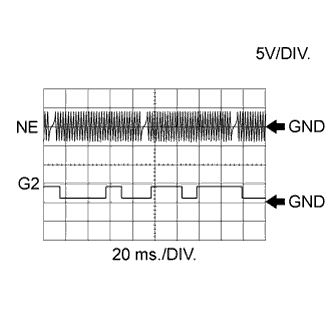
Reference: Inspection using an oscilloscope.
Tech Tips
-
The correct waveform is as shown.
-
G2+ is camshaft position sensor signals, and NE+ is the crankshaft position sensor signal.
-
A failure of the ground for the shielding of the wiring may result in noisy waveforms.
ECM Terminal Name Between NE+ and NE-
Between G2+ and G2-
Tester Range 5 V/DIV., 20 ms./DIV. Condition Idling with warm engine -
WIRING DIAGRAM
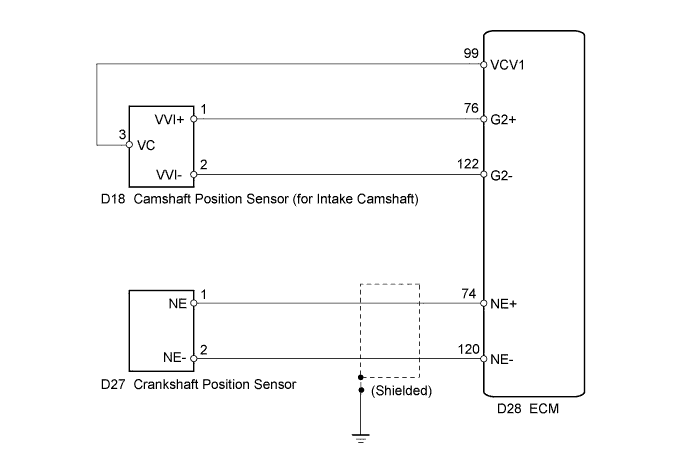
INSPECTION PROCEDURE
Tech Tips
-
If no problem is found through this diagnostic troubleshooting procedure, troubleshoot the engine mechanical systems.
-
Check the engine speed. The engine speed can be checked using the intelligent tester. To check, follow the operation below:
-
Connect the intelligent tester to the DLC3.
-
Turn the power switch on (IG) and turn the tester on.
-
Put the engine in inspection mode Click here.
-
Start the engine.
-
Enter the following menus: Powertrain / Engine and ECT / Data List / Engine Speed.
-
The engine speed may be indicated as zero despite the engine rotating normally. This is caused by a lack of NE signals from the crankshaft position sensor. Alternatively, the engine speed may be indicated as lower than the actual engine speed if the crankshaft position sensor output voltage is insufficient.
-
Read freeze frame data using the intelligent tester. The ECM records vehicle and driving condition information as freeze frame data the moment a DTC is stored. When troubleshooting, freeze frame data can be helpful in determining whether the vehicle was running or stopped, whether the engine was warmed up or not, whether the air fuel ratio was lean or rich, as well as other data recorded at the time of a malfunction.
PROCEDURE
-
READ VALUE USING INTELLIGENT TESTER (ENGINE SPEED)
-
Connect the intelligent tester to the DLC3.
-
Turn the power switch on (IG).
-
Turn the tester on.
-
Put the engine in inspection mode Click here.
-
Enter the following menus: Powertrain / Engine and ECT / Data List / Engine Speed.
-
Start the engine.
-
Read the values displayed on the tester while the engine is running.
OK Correct values are displayed. Tech Tips
-
To check the engine speed change, display the graph on the intelligent tester.
-
If the engine does not start, check the engine speed while cranking.
-
If the engine speed indicated on the tester remains at zero (0), there may be an open or short in the crankshaft position sensor circuit.
-
NG 
INSPECT CRANKSHAFT POSITION SENSOR (RESISTANCE) Click here
OK 
CHECK FOR INTERMITTENT PROBLEMS Click here
-
-
INSPECT CRANKSHAFT POSITION SENSOR (RESISTANCE)
-
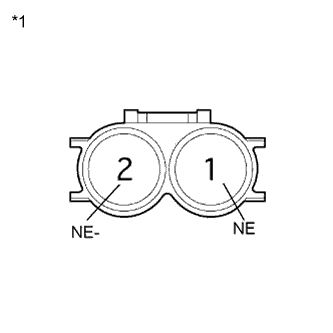
Text in Illustration *1 Component without harness connected
(Crankshaft Position Sensor)
Disconnect the crankshaft position sensor connector.
-
Measure the resistance according to the value(s) in the table below.
Standard Resistance Tester Connection Condition Specified Condition 1 (NE) - 2 (NE-) Cold 1630 to 2740 Ω 1 (NE) - 2 (NE-) Hot 2065 to 3225 Ω Tech Tips
"Cold" and "Hot" mean the temperature of the coils themselves. "Cold" is from -10 to 50°C (14 to 122°F) and "Hot" is from 50 to 100°C (122 to 212°F).
If the resistance is not as specified, replace the sensor.
-
Reconnect the crankshaft position sensor connector.
NG 
REPLACE CRANKSHAFT POSITION SENSOR Click here
OK 
-
-
CHECK HARNESS AND CONNECTOR (CRANKSHAFT POSITION SENSOR - ECM)
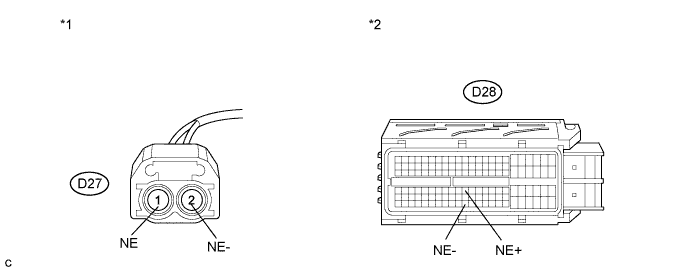
-
Disconnect the crankshaft position sensor connector.
-
Disconnect the ECM connector.
-
Measure the resistance according to the value(s) in the table below.
Standard Resistance (Check for Open) Tester Connection Condition Specified Condition D27-1 (NE) - D28-74 (NE+) Always Below 1 Ω D27-2 (NE-) - D28-120 (NE-) Always Below 1 Ω Standard Resistance (Check for Short) Tester Connection Condition Specified Condition D27-1 (NE) or D28-74 (NE+) - Body ground Always 10 kΩ or higher D27-2 (NE-) or D28-120 (NE-) - Body ground Always 10 kΩ or higher Text in Illustration *1 Front view of wire harness connector
(to Crankshaft Position Sensor)
*2 Front view of wire harness connector
(to ECM)
-
Reconnect the crankshaft position sensor connector.
-
Reconnect the ECM connector.
NG
REPAIR OR REPLACE HARNESS OR CONNECTOR (CRANKSHAFT POSITION SENSOR - ECM)
OK
-
-
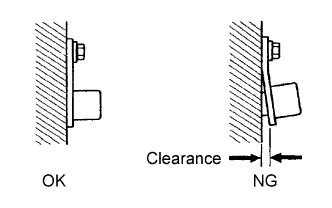
CHECK SENSOR INSTALLATION (CRANKSHAFT POSITION SENSOR)
-
Check the crankshaft position sensor installation.
OK Sensor is installed correctly.
NG
SECURELY REINSTALL SENSOR Click here
OK
-
-
INSPECT NO. 1 CRANKSHAFT POSITION SENSOR PLATE (TEETH OF SENSOR PLATE)
-
Check the teeth of the No. 1 crankshaft position sensor plate Click here.
OK Sensor plate does not have any cracks or deformation.
NG
REPLACE NO. 1 CRANKSHAFT POSITION SENSOR PLATE Click here
OK
-
-
REPLACE CRANKSHAFT POSITION SENSOR
-
Replace the crankshaft position sensor Click here.
NEXT
-
-
CHECK WHETHER DTC OUTPUT RECURS
-
Connect the intelligent tester to the DLC3.
-
Turn the power switch on (IG).
-
Turn the tester on.
-
Clear the DTCs Click here.
-
Put the engine in inspection mode Click here.
-
Start the engine and wait for 20 seconds.
-
Enter the following menus: Powertrain / Engine and ECT / DTC.
-
Read the DTCs.
Result Result Proceed to DTC is not output A DTC P0335 is output B Tech Tips
If the engine does not start, replace the ECM.
B
REPLACE ECM Click here
A
END
-