AIR CONDITIONING SYSTEM PRECAUTION
-
PRECAUTION FOR DISCONNECTING CABLE FROM NEGATIVE AUXILIARY BATTERY TERMINAL
Note
When disconnecting the cable from the negative (-) auxiliary battery terminal, initialize the following systems after the cable is reconnected.
System Name See Procedure Power Door Lock Control System Intelligent Parking Assist System -
GENERAL PRECAUTION
-
While using the auxiliary battery during inspection, do not bring the positive (+) and negative (-) tester probes too close to each other as a short circuit may occur.
-
-
PRECAUTIONS WHEN USING GTS
-
When using the GTS with the power switch off to troubleshoot:
Connect the GTS to the vehicle, and turn a courtesy light switch on and off at 1.5-second intervals until communication between the GTS and vehicle begins.
-
After all DTCs are cleared, check if the malfunction occurs again 6 seconds after the power switch is turned on (IG).
-
-
DO NOT HANDLE REFRIGERANT IN ENCLOSED AREA OR NEAR OPEN FLAME
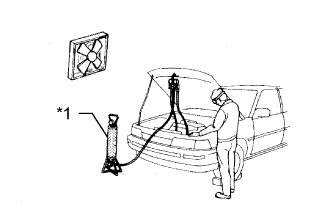
Text in Illustration *1 Charging Cylinder -
ALWAYS WEAR EYE PROTECTION
-
BE CAREFUL NOT TO GET LIQUID REFRIGERANT IN YOUR EYES OR ON YOUR SKIN
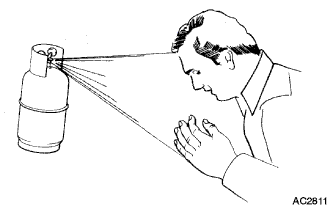
If liquid refrigerant gets in your eyes or on your skin:
-
Wash the area with lots of cold water.
CAUTION:
Do not rub your eyes or skin.
-
Apply clean petroleum jelly to the skin.
-
Go immediately to a hospital or see a physician for professional treatment.
-
-
NEVER HEAT CONTAINER OR EXPOSE THE CONTAINER TO AN OPEN FLAME
-
BE CAREFUL NOT TO DROP CONTAINER OR APPLY PHYSICAL SHOCKS TO IT
-
DO NOT OPERATE COMPRESSOR WITHOUT ENOUGH REFRIGERANT IN AIR CONDITIONING SYSTEM
If there is not enough refrigerant in the A/C system, oil lubrication will be insufficient and the compressor may be damaged.
Necessary care should be taken to avoid this.
-
DO NOT OPEN HIGH PRESSURE MANIFOLD VALVE WHILE COMPRESSOR IS OPERATING
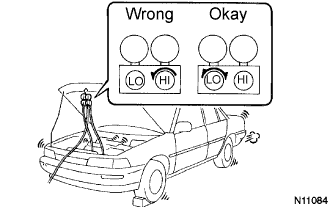
-
Open and close only the low pressure valve.
If the high pressure valve is opened, refrigerant will flow in the reverse direction causing the charging cylinder to rupture.
-
-
BE CAREFUL NOT TO OVERCHARGE SYSTEM WITH REFRIGERANT
If refrigerant is overcharged, it causes problems such as insufficient cooling, poor fuel economy, engine overheating, etc.
-
DO NOT OPERATE COMPRESSOR WITHOUT REFRIGERANT
CAUTION:
Doing so may damage the inside of the compressor because the compressor parts always move regardless of whether the A/C system is turned on or off.
-
PRECAUTIONS TO BE OBSERVED WHILE SERVICING
CAUTION:
Always use insulated gloves and remove the service plug grip before beginning inspection, as inspection of the A/C system requires disconnecting high voltage connectors.
Note
-
Only use ND-OIL 11 for the electric inverter compressor of the air conditioning system. Using other compressor oils may be dangerous, as they may conduct electricity.
-
Electrical insulation performance may decrease significantly if even a small amount of oil other than ND-OIL 11 is used (or enters) in the refrigeration cycle, causing a DTC to be output.
-
If other oil is accidentally used and a DTC is output, collect the compressor oil in the compressor and replace it with ND-OIL 11 to increase the ND-OIL 11 ratio amount.
-
Replace the main components (evaporator, condenser, and compressor) if a large amount of oil other than ND-OIL 11 enters the system. Failing to do so may cause electrical insulation performance to remain low, causing a DTC to be output.
-
-
SUPPLEMENTAL RESTRAINT SYSTEM (SRS)
-
This vehicle is equipped with a Supplemental Restraint System (SRS) such as the driver, front passenger, side and curtain shield airbags. Failure to carry out service operations in the correct sequence could cause the SRS to unexpectedly deploy during servicing, possibly leading to a serious accident. Before servicing (including removal or installation of parts, inspection or replacement), be sure to read the precautionary notices Click here.
-
-
PRECAUTIONS WHEN WORKING
-
Vehicles with the remote climate control system have the following risks that it is necessary to be aware of when performing repairs. Therefore, make sure to handle the key (electrical transmitter) carefully so that the remote climate control system is not operated unexpectedly.
Risks The electrical fan and other items in the engine compartment may operate resulting in various hazards. The wipers may operate if the wiper switch is in the on position when the remote climate control system is activated. If this occurs, there is the potential for damage to the glass, wipers or injury. When the light control switch is in the tail, head or AUTO position, the headlights may turn on. Short circuits may occur if electrical inspections are being performed when the remote climate control system is turned on, because the IG circuit is powered at this time. CAUTION:
Failure to take proper care with the key (electrical transmitter) may cause the system to be accidentally operated. This can lead to an accident and damage to parts or a serious injury.
Tech Tips
Make sure to store the key (electrical transmitter) in a box with the switch side facing up, and place the box where it can be monitored so that no one cannot operate the remote A/C switch.
-