PLUG-IN CHARGE CONTROL SYSTEM, Diagnostic DTC:P0D3E-234
| DTC Code | DTC Name |
|---|---|
| P0D3E-234 | On-Board Charger Input AC Voltage Sensor Range / Performance |
DESCRIPTION
A VAC sensor (AC input voltage sensor) is located inside the electric vehicle charger assembly. It detects AC power circuit voltage and sends signals to the plugin charge control ECU assembly.
The plugin charge control ECU assembly judges the type of AC input power source voltage based on the signal from the VAC sensor and determines output power required from the electric vehicle charger assembly. At the same time, it detects errors in the input AC power circuit of the electric vehicle charger assembly.
The plugin charge control ECU assembly monitors and detects errors in the VAC sensor signal line.
Tech Tips
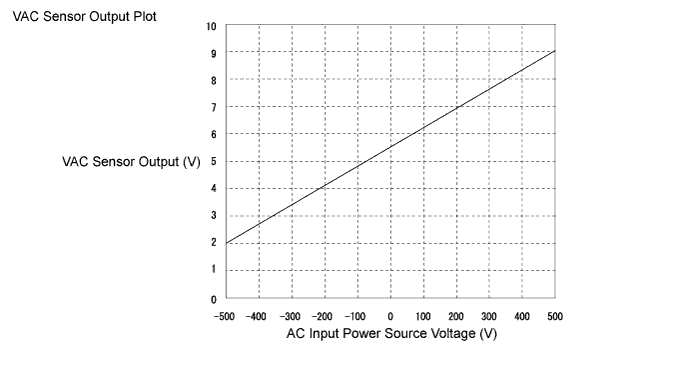
The VAC sensor output plot represents characteristics of the VAC sensor itself. The measurement target of the VAC sensor is AC voltage. The values shown may be different from the actual measurement values of the VAC terminal depending on the method and conditions of measurement.
| DTC No. | INF Code | DTC Detection Condition | Trouble Area |
|---|---|---|---|
| P0D3E | 234 | VAC sensor (AC input voltage sensor) offset value*, judged internally by the electric vehicle charger assembly, is too large. *:variation in the base value |
|
| DTC No. | INF Code | Data List |
|---|---|---|
| P0D3E | 234 |
|
*1: This is the VAC sensor output voltage when AC input power source voltage is not applied.
For example, if the Data List item "On-Board Charger Input Voltage" drops during plug-in charging and then "On-Board Charger Input Voltage" indicates a large negative value when the electric vehicle charger cable assembly is disconnected (this offset amount is displayed as "On-Board Charger Input Voltage Sensor Offset"), it can be determined that the cause of low "On-Board Charger Input Voltage" exists on the vehicle side.
WIRING DIAGRAM
Refer to the wiring diagram for DTC P0D3F-235 Click here.
INSPECTION PROCEDURE
CAUTION:
-
Before inspecting the high-voltage system or disconnecting the low voltage connector of the inverter with converter assembly or electric vehicle charger assembly, turn the power switch off. Also, take safety precautions such as wearing insulated gloves and removing the service plug grip to prevent electrical shocks. After removing the service plug grip, put it in your pocket to prevent other technicians from accidentally reconnecting it while you are working on the high-voltage system.
-
After removing the service plug grip, wait for at least 10 minutes before touching any of the high-voltage connectors or terminals. After waiting for 10 minutes, check the voltage at the terminals in the inspection point in the inverter with converter assembly. The voltage should be 0 V before beginning work Click here.
Tech Tips
Waiting for at least 10 minutes is required to discharge the high-voltage capacitor inside the inverter with converter assembly and electric vehicle charger assembly.
Note
After turning the power switch off, waiting time may be required before disconnecting the cable from the negative (-) auxiliary battery terminal. Therefore, make sure to read the disconnecting the cable from the negative (-) auxiliary battery terminal notices before proceeding with work Click here.
Tech Tips
-
The items "On-Board Charger Input Voltage" and "On-Board Charger Input Voltage Sensor Offset" in the freeze frame data and Data List are helpful for performing diagnosis.
-
After the repair, check that the Data List item "State of Charge (All Bat)" is 70% or less, then plug-in charge the vehicle for 1 minute or more and check that DTCs are not output.
PROCEDURE
-
CHECK DTC OUTPUT (PLUG-IN CONTROL)
-
Connect the GTS to the DLC3.
-
Turn the power switch on (IG).
-
Enter the following menus: Powertrain / Plug-in Control / Trouble Codes.
-
Check if DTCs are output.
Result Result Proceed to Only P0D3E-234 is output or P0D3E-234 and DTCs other than the ones in the table below are also output. A Any of the following DTCs are also output. B DTC No. Relevant Diagnosis P0D3F-235 On-Board Charger Input AC Voltage Sensor Circuit Low P0D40-236 On-Board Charger Input AC Voltage Sensor Circuit High Tech Tips
P0D3E-234 may be output due to a malfunction which causes the DTCs in the table above to be output. In this case, first troubleshoot the output DTCs in the table above. Then, perform a reproduction test to check that no DTCs are output.
-
Turn the power switch off.
B 
GO TO DTC CHART (PLUG-IN CHARGE CONTROL SYSTEM) Click here
A 
-
-
CHECK ELECTRIC VEHICLE CHARGER ASSEMBLY (CHECK FOR OPEN (CGND CIRCUIT))
CAUTION:
Be sure to wear insulated gloves.
-
Check that the service plug grip is not installed.
Note
After removing the service plug grip, do not turn the power switch on (READY), unless instructed by the repair manual because this may cause a malfunction.
-
Disconnect the z12 plugin charge control ECU assembly connector.
-
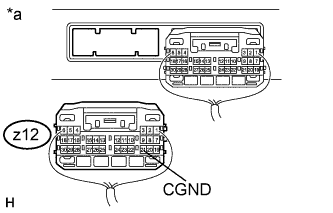
Text in Illustration *a Rear view of wire harness connector
(to Plugin Charge Control ECU Assembly)
Measure the resistance according to the value(s) in the table below.
Standard Resistance Tester Connection Condition Specified Condition z12-21 (CGND) - Body ground Power switch off Below 1.5 Ω -
Reconnect the z12 plugin charge control ECU assembly connector.
NG
REPLACE ELECTRIC VEHICLE CHARGER ASSEMBLY Click here
OK
-
-
CHECK ELECTRIC VEHICLE CHARGER ASSEMBLY (VAC SENSOR OUTPUT VOLTAGE)
CAUTION:
Be sure to wear insulated gloves.
-
Check that the service plug grip is not installed.
Note
After removing the service plug grip, do not turn the power switch on (READY), unless instructed by the repair manual because this may cause a malfunction.
-
Disconnect the z12 plugin charge control ECU assembly connector.
-
Connect the cable to the negative (-) auxiliary battery terminal.
-
Turn the power switch on (IG).
-
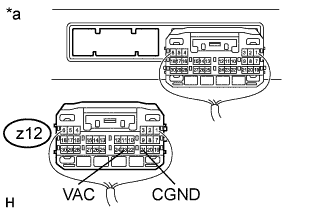
Text in Illustration *a Rear view of wire harness connector
(to Plugin Charge Control ECU Assembly)
Measure the voltage according to the value(s) in the table below.
Standard Voltage Tester Connection Condition Specified Condition z12-23 (VAC) - z12-21 (CGND) Power switch on (IG) 5.0 to 6.0 V Tech Tips
-
Turning the power switch on (IG) with the plugin charge control ECU assembly connector disconnected causes other DTCs to be stored. Clear the DTCs after performing this inspection.
-
The items "On-Board Charger Input Voltage" and "On-Board Charger Input Voltage Sensor Offset" in the freeze frame data and Data List are helpful for performing diagnosis.
-
Referring to the VAC Sensor Output Plot graph for this DTC, compare the Data List value and the VAC sensor output voltage.
-
-
Turn the power switch off.
-
Disconnect the cable from the negative (-) auxiliary battery terminal.
-
Reconnect the z12 plugin charge control ECU assembly connector.
NG
REPLACE ELECTRIC VEHICLE CHARGER ASSEMBLY Click here
OK 
REPLACE PLUGIN CHARGE CONTROL ECU ASSEMBLY Click here
-