HYBRID BATTERY SYSTEM, Diagnostic DTC:P0ABF-123, P0AC1-123, P0AC2-123, P0B10-123, P0B11-123
| DTC Code | DTC Name |
|---|---|
| P0ABF-123 | Hybrid Battery Pack Current Sensor Circuit |
| P0AC1-123 | Hybrid Battery Pack Current Sensor Circuit Low |
| P0AC2-123 | Hybrid Battery Pack Current Sensor Circuit High |
| P0B10-123 | Hybrid Battery Pack Current Sensor "B" Circuit Low |
| P0B11-123 | Hybrid Battery Pack Current Sensor "B" Circuit High |
DESCRIPTION
-
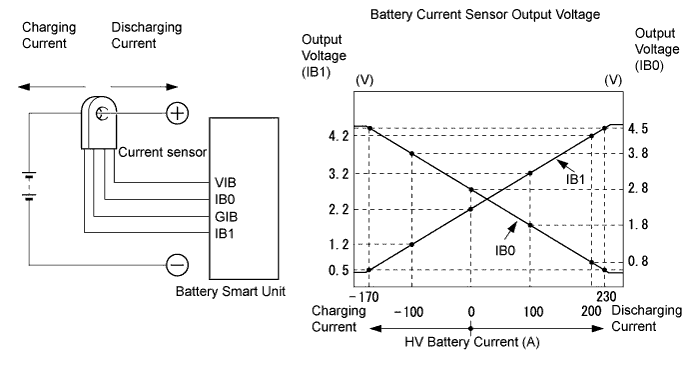
A battery current sensor, which is mounted on the positive cable side of each hybrid battery junction block assembly, detects the current flowing to or from the battery pack. The battery current sensor sends a voltage, which varies between 0 and 5 V in proportion to the amperage, to the IB0 terminal of the battery smart unit. Similarly, it sends a voltage, which varies between 0 and 5 V in inverse proportion to the amperage, into the IB1 terminal of the battery smart unit. When the voltage of the IB0 terminal is below 2.8 V and the voltage of the IB1 terminal is above 2.2 V, this indicates that the HV battery is being discharged. Meanwhile, when the voltage of the IB0 terminal is above 2.8 V and the voltage of the IB1 terminal is below 2.2 V, this indicates that the HV battery is being charged. The battery smart unit sends the signals from its IB0 and IB1 terminals to the power management control ECU. The power management control ECU determines the charging and discharging amperage of the HV battery based on the received signals and calculates the SOC of the HV battery using the cumulative amperage value.
| DTC No. | INF Code | DTC Detection Condition | Trouble Area |
|---|---|---|---|
| P0ABF | 123 | When the battery current sensor is abnormal (1 trip detection) |
|
| P0AC1 | |||
| P0AC2 | |||
| P0B10 | |||
| P0B11 |
INSPECTION PROCEDURE
CAUTION:
-
Before inspecting the high-voltage system or disconnecting the low voltage connector of the inverter with converter assembly or electric vehicle charger assembly, turn the power switch off. Also, take safety precautions such as wearing insulated gloves and removing the service plug grip to prevent electrical shocks. After removing the service plug grip, put it in your pocket to prevent other technicians from accidentally reconnecting it while you are working on the high-voltage system.
-
After removing the service plug grip, wait for at least 10 minutes before touching any of the high-voltage connectors or terminals. After waiting for 10 minutes, check the voltage at the terminals in the inspection point in the inverter with converter assembly. The voltage should be 0 V before beginning work Click here.
Tech Tips
Waiting for at least 10 minutes is required to discharge the high-voltage capacitor inside the inverter with converter assembly and electric vehicle charger assembly.
-
When disposing of HV batteries and hybrid vehicle supply stack sub-assemblies, make sure to return them through an authorized collection agent who is capable of handling them safely. If they are returned via the manufacturer specified route, they will be returned properly and in a safe manner by an authorized collection agent.
-
Before returning the HV battery, make sure to perform recovery inspection Click here.
-
Before returning the hybrid vehicle supply stack sub-assembly, make sure to perform recovery inspection Click here.
-
Make a note of the output DTCs as some of them may be necessary for recovery inspection of the HV battery and hybrid vehicle supply stack sub-assemblies.
Note
After turning the power switch off, waiting time may be required before disconnecting the cable from the negative (-) auxiliary battery terminal. Therefore, make sure to read the disconnecting the cable from the negative (-) auxiliary battery terminal notices before proceeding with work Click here.
Tech Tips
If a short to +B occurs in the battery current sensor or intake air temperature sensor, the following DTCs may be output simultaneously.
| DTC No. | Relevant Diagnosis |
|---|---|
| P0ABF-123 | Hybrid Battery Pack Current Sensor Circuit |
| P0A9E-123 | Hybrid Battery Temperature Sensor "A" Circuit High |
| P0AC8-123 | Hybrid Battery Temperature Sensor "B" Circuit High |
| P0ACD-123 | Hybrid Battery Temperature Sensor "C" Circuit High |
| P0AEB-123 | Hybrid Battery Temperature Sensor "D" Circuit High |
| P0BC5-123 | Hybrid Battery Temperature Sensor "E" Circuit High |
| P0C36-123 | Hybrid Battery Temperature Sensor "F" Circuit High |
| P0AAF-123 | Hybrid Battery Pack Air Temperature Sensor "A" Circuit High |
| P0AB4-123 | Hybrid Battery Pack Air Temperature Sensor "B" Circuit High |
PROCEDURE
-
CHECK DTC OUTPUT (HYBRID CONTROL)
-
Connect the GTS to the DLC3.
-
Turn the power switch on (IG).
-
Enter the following menus: Powertrain / Hybrid Control / Trouble Codes.
-
Read output DTCs Click here.
Result Result Proceed to P0AFC-123 is not output. A P0AFC-123 is also output. B -
Disconnect the GTS from the DLC3.
B 
GO TO DTC CHART (P0AFC-123) Click here
A 
-
-
CHECK HARNESS AND CONNECTOR (AM AND IGCT VOLTAGE)
CAUTION:
Be sure to wear insulated gloves.
-
Check that the service plug grip is not installed.
Note
After removing the service plug grip, do not turn the power switch on (READY), unless instructed by the repair manual because this may cause a malfunction.
-
Remove the No. 1 hybrid vehicle battery shield panel Click here.
-
Remove the No. 1 hybrid battery intake duct Click here.
-
Connect the cable to the negative (-) auxiliary battery terminal.
-
Turn the power switch on (IG).
-
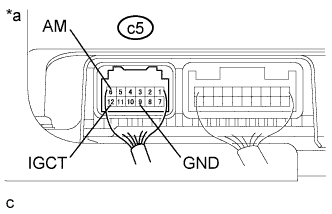
Text in Illustration *a Component with harness connected
(Battery Smart Unit)
Measure the voltage according to the value(s) in the table below.
Standard Voltage Tester Connection Condition Specified Condition c5-6 (AM) - c5-9 (GND) Power switch off 8.6 V or more c5-12 (IGCT) - c5-9 (GND) Power switch on (IG) 8.6 V or more Note
Turning the power switch on (IG) with the service grip removed causes other DTCs to be stored. Clear the DTCs after performing this inspection.
Tech Tips
As there might be an intermittent malfunction in the battery smart unit power source circuit, inspect the following even if the measured voltage is as specified:
-
Installation condition of fuse(s) (before removing fuse(s)) (IGCT circuit)
-
Fuse condition (before and after removing fuse(s)) (IGCT circuit)
-
Connection condition of connectors (IGCT circuit)
-
Wire harness condition (IGCT circuit)
-
Wire harness condition (GND circuit)
-
-
Turn the power switch off.
-
Disconnect the cable from the negative (-) auxiliary battery terminal.
-
Install the No. 1 hybrid battery intake duct.
-
Install the No. 1 hybrid vehicle battery shield panel.
NG
CHECK POWER SOURCE CIRCUIT
OK
-
-
CHECK HARNESS AND CONNECTOR (HYBRID BATTERY JUNCTION BLOCK ASSEMBLY - BATTERY SMART UNIT)
CAUTION:
Be sure to wear insulated gloves.
-
Check that the service plug grip is not installed.
Note
After removing the service plug grip, do not turn the power switch on (READY), unless instructed by the repair manual because this may cause a malfunction.
-
Remove the No. 1 hybrid battery intake duct Click here.
-
Remove the No. 1 hybrid vehicle battery shield panel Click here.
-
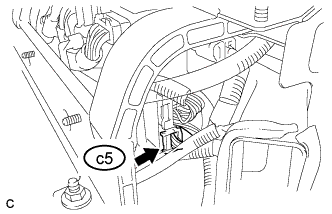
Disconnect only the c5 battery smart unit connector.
-
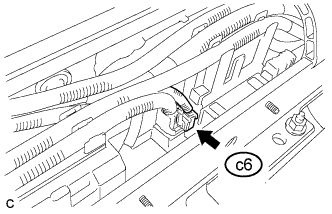
Disconnect the c6 battery current sensor connector from the hybrid battery junction block assembly.
-
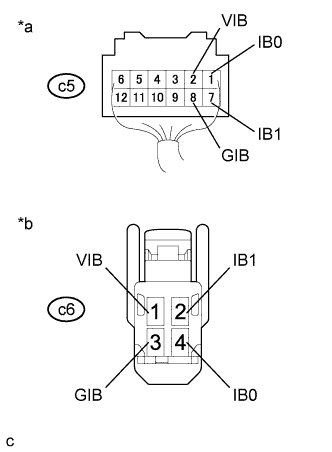
Text in Illustration *a Rear view of wire harness connector
(to Battery Smart Unit)
*b Front view of wire harness connector
(to Hybrid Battery Junction Block Assembly)
Measure the resistance according to the value(s) in the tables below.
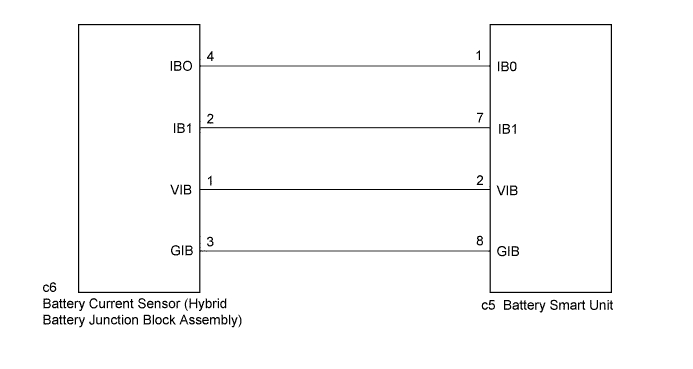
Standard Resistance (Check for Open) Tester Connection Condition Specified Condition c5-7 (IB1) - c6- 2 (IB1) Power switch off Below 1 Ω c5-8 (GIB) - c6- 3 (GIB) Power switch off Below 1 Ω c5-1 (IB0) - c6- 4 (IB0) Power switch off Below 1 Ω c5-2 (VIB) - c6- 1 (VIB) Power switch off Below 1 Ω Standard Resistance (Check for Short) Tester Connection Condition Specified Condition c5-7 (IB1) or c6- 2 (IB1) - Body ground and other terminals Power switch off 10 kΩ or higher c5-8 (GIB) or c6- 3 (GIB) - Body ground and other terminals Power switch off 10 kΩ or higher c5-1 (IB0) or c6- 4 (IB0) - Body ground and other terminals Power switch off 10 kΩ or higher c5-2 (VIB) or c6- 1 (VIB) - Body ground and other terminals Power switch off 10 kΩ or higher -
Reconnect the c5 battery smart unit connector.
-
Reconnect the c6 battery current sensor connector to the hybrid battery junction block assembly.
-
Install the No. 1 hybrid battery intake duct.
-
Install the No. 1 hybrid vehicle battery shield panel.
NG
REPAIR HARNESS OR CONNECTOR OR REPLACE HV BATTERY
OK
-
-
CHECK BATTERY SMART UNIT (VIB VOLTAGE)
CAUTION:
Be sure to wear insulated gloves.
-
Check that the service plug grip is not installed.
Note
After removing the service plug grip, do not turn the power switch on (READY), unless instructed by the repair manual because this may cause a malfunction.
-
Remove the No. 1 hybrid vehicle battery shield panel Click here.
-
Remove the No. 1 hybrid battery intake duct Click here.
-
Connect the cable to the negative (-) auxiliary battery terminal.
-
Turn the power switch on (IG).
-
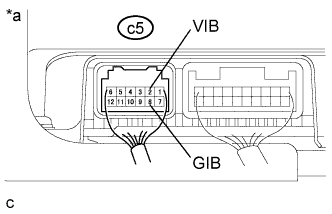
Text in Illustration *a Component with harness connected
(Battery Smart Unit)
Measure the voltage according to the value(s) in the table below.
Standard Voltage Tester Connection Condition Specified Condition c5-2 (VIB) - c5-8 (GIB) Power switch on (IG) 4.6 to 5.4 V Note
Turning the power switch on (IG) with the service grip removed causes other DTCs to be stored. Clear the DTCs after performing this inspection.
-
Turn the power switch off.
-
Disconnect the cable from the negative (-) auxiliary battery terminal.
-
Install the No. 1 hybrid battery intake duct.
-
Install the No. 1 hybrid vehicle battery shield panel.
NG
REPLACE BATTERY SMART UNIT Click here
OK
-
-
CHECK BATTERY SMART UNIT
CAUTION:
Be sure to wear insulated gloves.
-
Check that the service plug grip is not installed.
Note
After removing the service plug grip, do not turn the power switch on (READY), unless instructed by the repair manual because this may cause a malfunction.
-
Remove the No. 1 hybrid vehicle battery shield panel Click here.
-
Connect the cable to the negative (-) auxiliary battery terminal.
-
Turn the power switch on (IG).
-
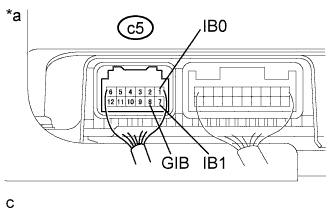
Text in Illustration *a Component with harness connected
(Battery Smart Unit)
Measure the voltage according to the value(s) in the table below.
Standard Voltage Tester Connection Condition Specified Condition c5-7 (IB1) - c5-8 (GIB) Power switch on (IG) 2.16 to 2.24 V c5-1 (IB0) - c5-8 (GIB) Power switch on (IG) 2.76 to 2.84 V Note
Turning the power switch on (IG) with the service grip removed causes other DTCs to be stored. Clear the DTCs after performing this inspection.
-
Turn the power switch off.
-
Disconnect the cable from the negative (-) auxiliary battery terminal.
-
Install the No. 1 hybrid vehicle battery shield panel.
NG
REPLACE HYBRID BATTERY JUNCTION BLOCK ASSEMBLY Click here
OK 
REPLACE BATTERY SMART UNIT Click here
-