ENGINE INSPECTION

-
INSPECT ENGINE COOLANT
-
Remove the radiator cap.
CAUTION:
Do not remove the radiator cap while the engine and radiator are still hot. Pressurized, hot engine coolant and steam may be released and cause serious burns.
-
Check if there are excessive deposits of rust or scale around the radiator cap and radiator filler hole. Also, the coolant should be free of oil.
If excessively dirty, replace the coolant.
-
Install the radiator cap.
-
-
INSPECT ENGINE OIL
-
Check the oil for deterioration, water contamination, discoloring or thinning.
-
If the oil quality is visibly poor, replace the oil.
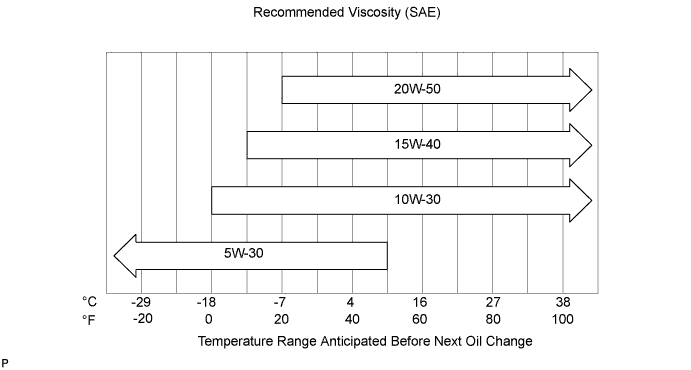
Oil grade 20W-50 and 15W-40 - API grade SL, SM or SN multigrade engine oil 10W-30 and 5W-30 - API grade SL "Energy-Conserving", SM "Energy-Conserving", SN "Resource- Conserving" or ILSAC multigrade engine oil
-
-
INSPECT BATTERY
Note
If the battery is weak or if the engine is difficult to start, perform the following procedures.
-
Check the battery for damage and deformation. If severe damage, deformation or leakage is found, replace the battery.
-
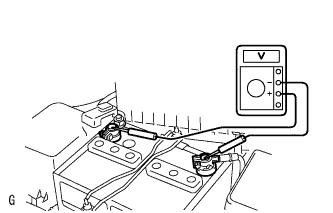
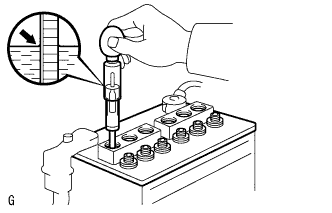
Check the electrolyte quantity of each cell.
For maintenance-free batteries:
-
If the electrolyte quantity is below the lower line, replace the battery.
-
If the electrolyte quantity is above the lower line, check the battery voltage when cranking the engine. If the voltage is less than 9.6 V, recharge or replace the battery.
Tech Tips
Before checking the battery voltage, turn off all the electrical systems (headlight, blower motor, rear defogger, etc.).
For non-maintenance-free batteries:
-
If the electrolyte quantity is below the lower line, add distilled water to each cell. Then, recharge the battery and check the electrolyte's specific gravity.
Standard electrolyte's specific gravity 1.25 to 1.29 at 20°C (68°F)
-
If the electrolyte quantity is above the lower line, check the battery voltage when cranking the engine. If the voltage is less than 9.6 V, recharge or replace the battery.
Tech Tips
Before checking the battery voltage, turn off all the electrical systems (headlight, blower motor, rear defogger, etc.).
-
-
-
CHECK AIR CLEANER FILTER
-
Remove the air filter.
-
Visually check that the air filter is not excessively damaged or oily.
-
If necessary, replace the air filter.
-
-
INSPECT DRIVE BELT
-
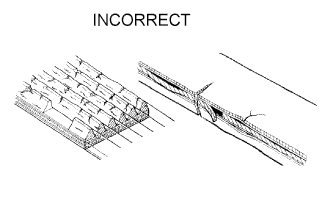
Visually check the drive belt for excessive wear, frayed cords, etc.
If any defect is found, replace the drive belt.
Tech Tips
Cracks on the rib side of a drive belt are considered acceptable. If the drive belt has chunks missing from the ribs, it should be replaced.
-
-
INSPECT V-RIBBED BELT TENSIONER
-
Check that nothing gets caught in the tensioner by turning it clockwise and counterclockwise.
If a malfunction exists, replace the tensioner.
-
-
INSPECT IGNITION TIMING
-
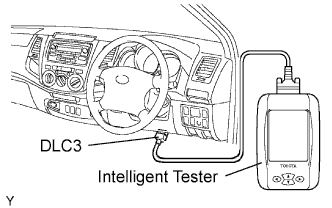
When using intelligent tester:
Check the ignition timing.
-
Connect the intelligent tester to the DLC3.
Tech Tips
Refer to the intelligent tester operator's manual for further details.
Standard ignition timing 7 to 24°BTDC @ idle (Transmission in neutral position) -
Disconnect the intelligent tester from the DLC3.
-
-
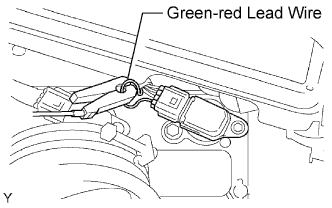
When not using intelligent tester:
Check the ignition timing.
-
Remove the air cleaner cap.
-
Connect the tester probe of a timing light to the green-red lead wire of the ignition coil connector of the No. 1 cylinder.
-
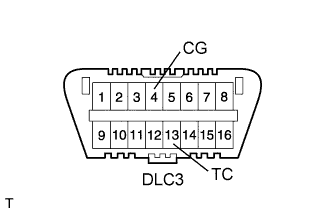
Using SST, connect terminals 13 (TC) and 4 (CG) of the DLC3.
- SST
- 09843-18040
-
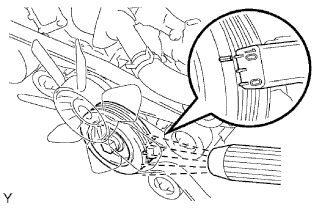
Using the timing light, check the ignition timing.
Standard ignition timing 10 +-2° BTDC @ idle (Transmission in neutral position) -
Remove SST from the DLC3.
-
Check the ignition timing.
Standard ignition timing 7 to 24° BTDC @ idle (Transmission in neutral position) -
Disconnect the timing light from the engine.
-
Install the air cleaner cap.
-
-
-
INSPECT IDLE SPEED
-
When using intelligent tester:
Check the idle speed.
-
Connect the intelligent tester to the DLC3.
Tech Tips
Refer to the intelligent tester operator's manual for further details.
-
Switch the air conditioning OFF.
-
Race the engine at 2,500 rpm for approximately 90 seconds.
-
Check the idle speed.
Standard idle speed 700 +-50 rpm (Transmission in neutral position) If the idle speed is not as specified, check the air intake system.
-
Disconnect the intelligent tester from the DLC3.
-
-
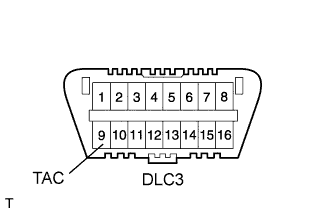
When not using intelligent tester:
Check the idle speed.
-
Using SST, connect the tachometer probe to terminal 9 (TAC) of the DLC3.
- SST
- 09843-18030
-
Switch the air conditioning OFF.
-
Race the engine speed at 2,500 rpm for approximately 90 seconds.
-
Check the idle speed.
Standard idle speed 700 +-50 rpm (Transmission in neutral position) If the idle speed is not as specified, check the air intake system.
-
Disconnect the tachometer from the DLC3.
-
-
-
INSPECT COMPRESSION
-
Remove the V-bank cover.
-
Remove the air cleaner assembly.
-
Remove the intake air surge tank.
-
Remove the 6 ignition coils.
-
Remove the 6 spark plugs.
-
Disconnect the 6 injector connectors.
-
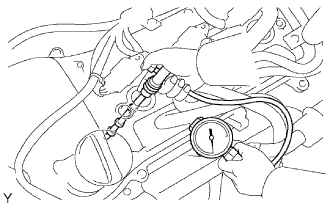
Inspect the cylinder compression pressure.
-
Insert a compression gauge into the spark plug hole.
-
Fully open the throttle.
-
While cranking the engine, measure the compression pressure.
Tech Tips
Always use a fully charged battery to obtain an engine speed of 250 rpm or more.
-
Repeat the steps above for each cylinder.
Note
This measurement must be done as quickly as possible.
Standard compression pressure 1,300 kPa (13.3 kgf/cm2, 189 psi) or more Minimum pressure 1,000 kPa (10.2 kgf/cm2, 145 psi) Difference between each cylinder 100 kPa (1.0 kgf/cm2, 15 psi) or less -
If the cylinder compression in one or more cylinders is low, pour a small amount of engine oil into the cylinder through the spark plug hole and repeat steps above for cylinders with low compression.
Tech Tips
-
If adding oil helps the compression, it is likely that the piston rings and / or cylinder bore are worn or damaged.
-
If pressure stays low, a valve may be sticking, seating may be improper, or there may be leakage in the gasket.
-
-
-
Connect the 6 injector connectors.
-
Install the 6 spark plugs.
-
Install the 6 ignition coils.
-
Install the intake air surge tank.
-
Install the air cleaner assembly.
-
Install the V-bank cover.
-
-
INSPECT CO/HC
Tech Tips
This check is for determining whether or not the idle CO/HC complies with regulations.
-
Start the engine.
-
Keep the engine speed at 2,500 rpm for approximately 180 seconds.
-
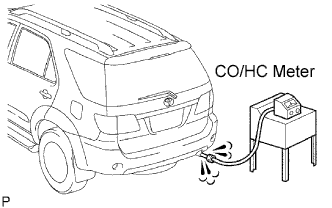
Insert a CO/HC meter testing probe at least 40 cm (1.3 ft.) into the tailpipe during idling.
-
Immediately check CO/HC concentration at idle and/or 2,500 rpm.
Tech Tips
When performing the 2 mode (2,500 rpm and idle) test, check that the CO/HC concentration complies with local regulations.
If the CO/HC concentration does not comply with regulations, troubleshoot in the order given below.
-
Check the A/F sensor operation and heated oxygen sensor operation.
-
See the table below for possible causes, then inspect and correct the applicable causes if necessary.
CO HC Symptom Causes Normal High Rough idle 1. Faulty ignitions:
-
Incorrect timing
-
Plugs are contaminated, shorted, or gaps are defective
2. Incorrect valve clearance
3. Leaky intake and exhaust valves
4. Leaky cylinder
Low High Rough idle
(Fluctuating HC reading)
1. Vacuum leaks:
-
PCV hose
-
Intake manifold
-
Throttle body
2. Lean mixture causing misfire
High High Rough idle
(Black smoke from exhaust)
1. Restricted air filter
2. Faulty SFI system:
-
Faulty pressure regulator
-
Defective ECT sensor
-
Faulty ECM
-
Faulty injector
-
Faulty throttle position sensor
-
Faulty MAF sensor
-
-
-