SFI SYSTEM, Diagnostic DTC:P2102, P2103

| DTC Code | DTC Name |
|---|---|
| P2102 | Throttle Actuator Control Motor Circuit Low |
| P2103 | Throttle Actuator Control Motor Circuit High |
DESCRIPTION
The throttle actuator is operated by the ECM and it opens and closes the throttle valve.
The opening angle of the throttle valve is detected by the throttle position sensor, which is mounted on the throttle body. The sensor provides feedback to the ECM for controlling the throttle actuator, which adjusts the throttle valve opening in response to driving conditions.
If this DTC is detected, the ECM shuts down the power for the throttle actuator, and the throttle valve is locked at a predetermined opening angle by the return spring. Also, all electronically controlled throttle operations are canceled until the system returns to normal and the ignition switch is turned OFF.
Tech Tips
This Electronic Throttle Control System (ETCS) does not use a throttle cable.
| DTC No. | DTC Detection Condition | Trouble Area |
|---|---|---|
| P2102 | Conditions (a) and (b) continue for 2.0 seconds (1 trip detection logic): (a) Throttle actuator output duty ratio is 80% or more (b) Throttle actuator current is 0.5 A or less |
|
| P2103 | Throttle actuator current is 7 A or more for 0.6 seconds (1 trip detection logic) |
|
MONITOR DESCRIPTION
The ECM monitors the flow of electrical current through the electronic throttle actuator, and detects malfunctions or open circuits in the throttle actuator based on the electrical current. When the current deviates from the standard values, the ECM concludes that there is a fault in the throttle actuator. Or, if the throttle valve is not functioning properly (for example, stuck ON), the ECM concludes that there is a fault illuminates the Malfunction Indicator Lamp (MIL) and sets a DTC.
FAIL-SAFE
If the ETCS is malfunctioning, the ECM cuts off the current to the throttle actuator. The throttle control valve returns to a predetermined throttle position (approximately 6°) by the force of the return spring.
Then, required engine power is calculated using the ignition timing and accelerator pedal position. The engine is controlled by intermittent fuel-cut.
If the accelerator pedal is depressed firmly and slowly, the vehicle can be driven at minimum speed. If the accelerator pedal is depressed quickly, the vehicle may speed up and slow down erratically.
WIRING DIAGRAM
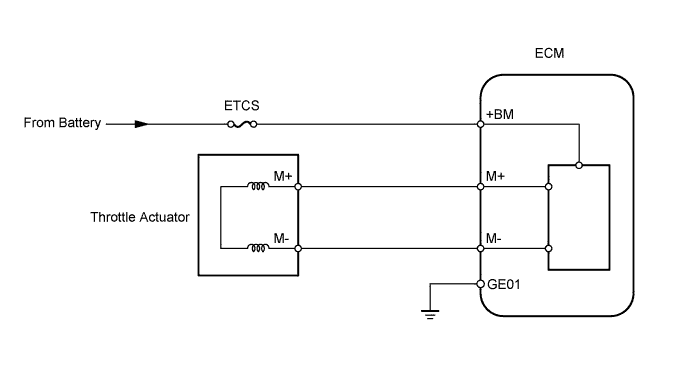
INSPECTION PROCEDURE
Tech Tips
Read freeze frame data using the intelligent tester. Freeze frame data records the engine conditions when a malfunction is detected. When troubleshooting, freeze frame data can help determine if the vehicle was running or stopped, if the engine was warmed up or not, if the air fuel ratio was lean or rich, and other data from the time the malfunction occurred.
PROCEDURE
-
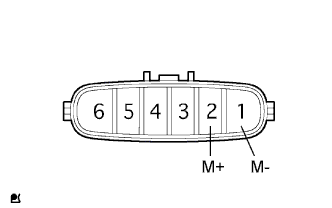
INSPECT THROTTLE BODY (RESISTANCE OF THROTTLE ACTUATOR)
-
Disconnect the T1 throttle body connector.
-
Measure the motor resistance of throttle actuator.
Standard resistance Tester Connection Condition Specified Condition 2 (M+) - 1 (M-) 20°C (68°F) 0.3 to 100 Ω
NG 
REPLACE THROTTLE BODY
OK 
-
-
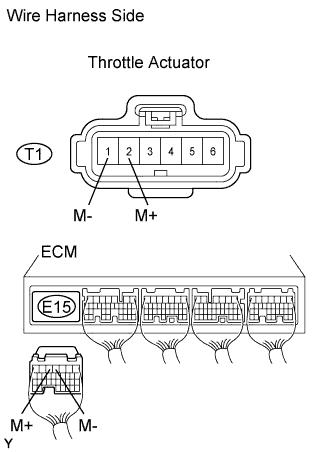
CHECK WIRE HARNESS (THROTTLE ACTUATOR - ECM)
-
Disconnect the T1 throttle body connector.
-
Disconnect the E15 ECM connector.
-
Measure the resistance of the wire harness side connectors.
Standard resistance Tester Connection Specified Condition T1-2 (M+) - E15-5 (M+) Below 1 Ω T1-1 (M-) - E15-4 (M-) Below 1 Ω T1-2 (M+) or E15-5 (M+) - Body ground 10 kΩ or higher T1-1 (M-) or E15-4 (M-) - Body ground 10 kΩ or higher
NG
REPAIR OR REPLACE HARNESS AND CONNECTOR
OK
-
-
INSPECT THROTTLE BODY
-
Visually check for foreign objects between the throttle valve and housing. Also, check that the valve can open and close and smoothly.
OK Throttle valve is not contaminated with foreign objects and moves smoothly.
NG
REMOVE FOREIGN OBJECT AND CLEAN THROTTLE BODY
OK 
REPLACE ECM
-