SFI SYSTEM, Diagnostic DTC:P0136, P0137, P0138, P0156, P0157, P0158

| DTC Code | DTC Name |
|---|---|
| P0136 | Oxygen Sensor Circuit Malfunction (Bank 1 Sensor 2) |
| P0137 | Oxygen Sensor Circuit Low Voltage (Bank 1 Sensor 2) |
| P0138 | Oxygen Sensor Circuit High Voltage (Bank 1 Sensor 2) |
| P0156 | Oxygen Sensor Circuit Malfunction (Bank 2 Sensor 2) |
| P0157 | Oxygen Sensor Circuit Low Voltage (Bank 2 Sensor 2) |
| P0158 | Oxygen Sensor Circuit High Voltage (Bank 2 Sensor 2) |
DESCRIPTION
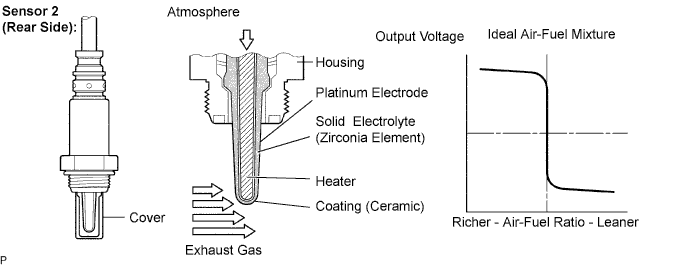
The heated oxygen sensor is a planar type. Compared to the conventional type, the sensor and heater portions are narrower. The heat of the heater is conducted to the zirconia element through the alumina, accelerating sensor activation.
To obtain a high purification rate of carbon monoxide (CO), hydrocarbon (HC) and nitrogen oxide (NOx) in the exhaust gas, a Three-Way Catalytic Converter (TWC) is used. For the most efficient use of the three-way catalytic converter, the air fuel ratio must be precisely controlled so that it is always close to the stoichiometric air fuel ratio.
The heated oxygen sensor has the characteristic whereby its output voltage changes suddenly in the vicinity of the stoichiometric air fuel ratio. This is used to detect the oxygen concentration in the exhaust gas and provide the ECM with feedback control the air fuel ratio.
When the air fuel ratio becomes lean, the oxygen concentration in the exhaust gas increases. And the heated oxygen sensor informs the ECM of the lean condition (small electromotive force: Less than 0.45 V).
When the air fuel ratio is richer than the stoichiometric air fuel ratio, the oxygen concentration in the exhaust gas is reduced. And the heated oxygen sensor informs the ECM of the rich condition (large electromotive force: More than 0.45 V). The ECM judges by the electromotive force from the heated oxygen sensor whether the air fuel ratio is rich or lean and controls the injection time accordingly. If the malfunction of the heated oxygen sensor causes an output of abnormal electromotive force, the ECM becomes unable to perform the accurate air fuel ratio control.
The heated oxygen sensors include a heater which heats the zirconia element. The heater is controlled by the ECM. When the intake air volume is low (the temperature of the exhaust gas is low), current flows to the heater in order to heat the sensor for accurate oxygen concentration detection.
| DTC No. | DTC Detection Condition | Trouble Area |
|---|---|---|
| P0136 P0156 |
During active control, heated oxygen sensor output voltage is 0.2 to 0.6 V |
|
| P0136 P0156 |
(a) and (b) are met for more than 90 seconds (a) Estimated rear oxygen sensor temperature is less than 800°C (1,472°F) (b) Rear oxygen sensor impedance is less than 5 Ω |
|
| P0137 P0157 |
During active control, heated oxygen sensor output voltage is less than 0.2 V | |
| P0137 P0157 |
(a) and (b) are met for more than 90 seconds (a) Estimated rear oxygen sensor temperature is less than 450°C (842°F) (b) Rear oxygen sensor impedance is more than 15 kΩ |
|
| P0138 P0158 |
During active control, heated oxygen sensor output voltage is more than 0.6 V | |
| P0138 P0158 |
Rear oxygen sensor output voltage is 1.2 V or higher for more than 30 seconds |
Tech Tips
-
Bank 1 refers to the bank that includes the No. 1 cylinder.
-
Bank 2 refers to the bank that does not include the No. 1 cylinder.
-
Sensor 2 refers to the sensor farther away from the engine assembly.
WIRING DIAGRAM
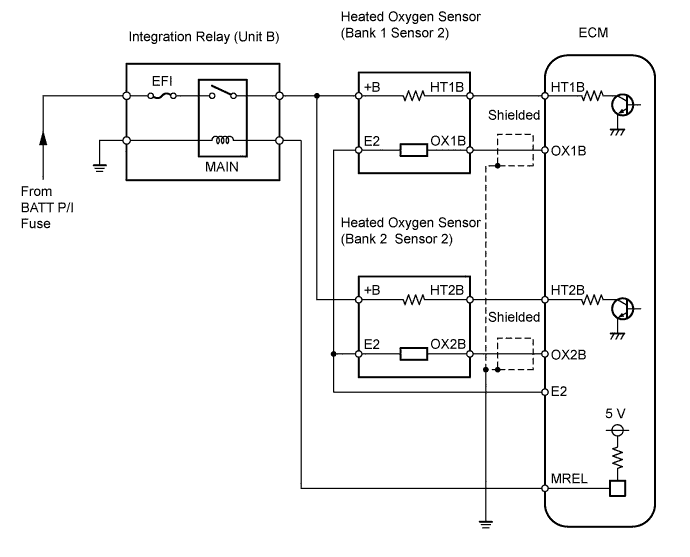
CONFIRMATION DRIVING PATTERN
Tech Tips
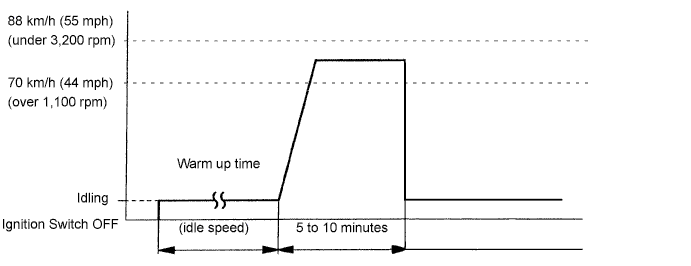
Performing this confirmation pattern will activate the DTC detection (P0136) of the ECM. This is very useful for verifying the completion of a repair.
-
(a) Clear the DTC Click here.
-
(b) Using the tester, change the ECM from normal mode to check mode Click here.
-
(c) Start the engine and warm it up with all the accessory switches OFF.
-
(d) Deactivate the inspection mode and drive the vehicle at 70 to 120 km/h (44 to 70 mph) for 5 to 10 minutes.
-
(e) Read DTCs.
Note
If the conditions in this test are not strictly followed, no malfunction will be detected.
INSPECTION PROCEDURE
-
(a) Connect the intelligent tester to the DLC3.
Tech Tips
It is possible the malfunctioning area can be found using the Active Test "Control the injection volume for A/F sensor" operation. The Active Test can determine if the heated oxygen sensor or other potential trouble areas are malfunctioning or not.
The injection volume can be switched to -12.5% (decrease) or +25% (increase) by the Active Test.
The Active Test procedure enables a technician to check and graph the output voltage of the heated oxygen sensors.
-
(b) Turn the ignition switch ON.
-
(c) Warm up the engine with the engine speed at 2,500 rpm for approximately 90 seconds.
-
(d) Enter the following menus: Powertrain / Engine and ECT / Active Test / Control the injection volume for A/F sensor.
-
(e) Perform the Active Test while the engine is idling.
| Standard voltage | ||||||||||||||||||||
|---|---|---|---|---|---|---|---|---|---|---|---|---|---|---|---|---|---|---|---|---|
|
Note
The A/F sensor output has a few seconds of delay and the heated oxygen sensor output has approximately 20 seconds of delay.
| Case | A/F Sensor (Sensor 1) Output Voltage | HO2 Sensor (Sensor 2) Output Voltage | Main Suspected Trouble Area |
|---|---|---|---|
| 1 |   |
 |
- |
| 2 |  |
|
|
| 3 | |
|
|
| 4 | |
|
|
The following "Control the injection volume for A/F sensor" procedure enables the technician to check and graph the output voltage of both A/F sensor and heated oxygen sensor.
Tech Tips
-
Read freeze frame data using the intelligent tester. Freeze frame data records the engine conditions when a malfunction is detected. When troubleshooting, freeze frame data can help determine if the vehicle was running or stopped, if the engine was warmed up or not, if the air fuel ratio was lean or rich, and other data from the time the malfunction occurred.
-
A low A/F sensor voltage could be caused by a rich air fuel mixture. Check the conditions that would cause the engine to run with a rich air fuel mixture.
-
A high A/F sensor voltage could be caused by a lean air fuel mixture. Check the conditions that would cause the engine to run with a lean air fuel mixture.
-
Sensor 2 refers to the sensor mounted behind the Three-Way Catalytic Converter (TWC) and located far from the engine assembly.
PROCEDURE
-
CHECK OTHER DTC OUTPUT (BESIDES DTC P0136, P0137, P0138, P0156, P0157 AND/OR P0158)
-
Connect the intelligent tester to the DLC3.
-
Turn the ignition switch ON and turn the tester ON.
-
Enter the following menus: Powertrain / Engine and ECT / DTC.
-
Read the DTCs.
Result Display (DTC output) Proceed to Only P0136, P0137, P0138, P0156, P0157 and/or P0158 are output A P0136, P0137, P0138, P0156, P0157 and/or P0158 and other DTCs are output B Tech Tips
If any other codes besides P0136, P0137, P0138, P0156, P0157 and/or P0158 are output, perform troubleshooting for those DTCs first.
B 
GO TO RELEVANT DTC CHART
A 
-
-
READ VALUE USING INTELLIGENT TESTER (OUTPUT VOLTAGE OF HEATED OXYGEN SENSOR)
-
After warming up the engine, race the engine at 2,500 rpm for 3 minutes.
-
Read the output voltage of the heated oxygen sensor when the engine is suddenly raced.
Tech Tips
Quickly perform racing to 4,000 rpm 3 times by using the accelerator pedal.
Standard voltage Alternates between 0.4 V or less and 0.5 V or more.
OK 
PERFORM CONFIRMATION DRIVING PATTERN Click here
NG
-
-
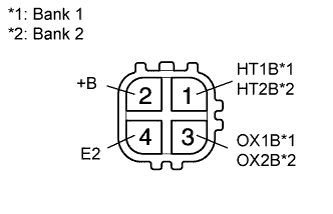
INSPECT HEATED OXYGEN SENSOR (HEATER RESISTANCE)
-
Disconnect the H12 and H13 heated oxygen sensor connectors.
-
Measure the resistance of the sensor.
Standard resistance Bank 1 Sensor 2 Tester Connection Condition Specified Condition 1 (HT1B) - 2 (+B) 20°C (68°F) 11 to 16 Ω 1 (HT1B) - 4 (E2) - 10 kΩ or higher Bank 2 Sensor 2 Tester Connection Condition Specified Condition 1 (HT2B) - 2 (+B) 20°C (68°F) 11 to 16 Ω 1 (HT2B) - 4 (E2) - 10 kΩ or higher
NG
REPLACE HEATED OXYGEN SENSOR
OK
-
-
INSPECT INTEGRATION NO.1 RELAY (MAIN RELAY)
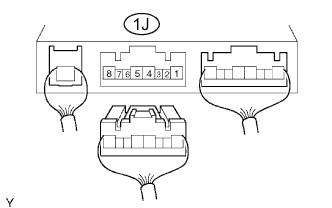
-
Disconnect the integration relay from the engine room junction block.
-
Measure the voltage of the MAIN relay.
Standard resistance Tester Connection Condition Specified Condition 1J-5 - Body ground Ignition switch ON 10 to 14 V
NG
REPLACE INTEGRATION NO.1 RELAY
OK
-
-
CHECK WIRE HARNESS (HEATED OXYGEN SENSOR - ECM)
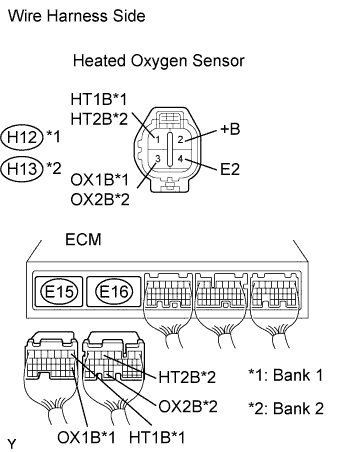
-
Disconnect the H12 and H13 connectors.
-
Disconnect the E15 and E16 ECM connectors.
-
Measure the resistance of the wire harness side connectors.
Standard resistance Bank 1 Sensor 2 Tester Connection Specified Condition H12-1 (HT1B) - E15-1 (HT1B) Below 1 Ω H12-3 (OX1B) - E15-18 (OX1B) Below 1 Ω H12-1 (HT1B) or E15-1 (HT1B) - Body ground 10 kΩ or higher H12-3 (OX1B) or E15-18 (OX1B) - Body ground 10 kΩ or higher Bank 2 Sensor 2 Tester Connection Specified Condition BH13-1 (HT2B) - E16-5 (HT2B) Below 1 Ω H13-3 (OX2B) - E16-33 (OX2B) Below 1 Ω H13-1 (HT2B) or E16-5 (HT2B) - Body ground 10 kΩ or higher H13-3 (OX2B) or E16-33 (OX2B) - Body ground 10 kΩ or higher
NG
REPAIR OR REPLACE HARNESS AND CONNECTOR
OK 
REPLACE HEATED OXYGEN SENSOR
-
-
PERFORM CONFIRMATION DRIVING PATTERN
Tech Tips
Clear all DTCs prior to performing the confirmation driving pattern.
NEXT
-
READ OUTPUT DTC (DTC P0136 AND/OR P0156 ARE OUTPUT AGAIN)
-
Connect the intelligent tester to the DLC3.
-
Turn the ignition switch ON and turn the tester ON.
-
Enter the following menus: Powertrain / Engine and ECT / DTC.
-
Read the DTCs.
Result Display (DTC output) Proceed to P0136 and/or P0156 are not output again A P0136 and/or P0156 are output again B
B
REPLACE HEATED OXYGEN SENSOR
A
CHECK FOR INTERMITTENT PROBLEMS
-