METER / GAUGE SYSTEM, Diagnostic DTC:B1500
| DTC Code | DTC Name |
|---|---|
| B1500 | Fuel Sender Open Detected |
DESCRIPTION
This DTC is output when the combination meter assembly detects a fuel sender gauge malfunction.
| DTC No. | DTC Detection Condition | Trouble Area |
|---|---|---|
| B1500 | When combination meter detects fuel sender gauge malfunction |
|
WIRING DIAGRAM
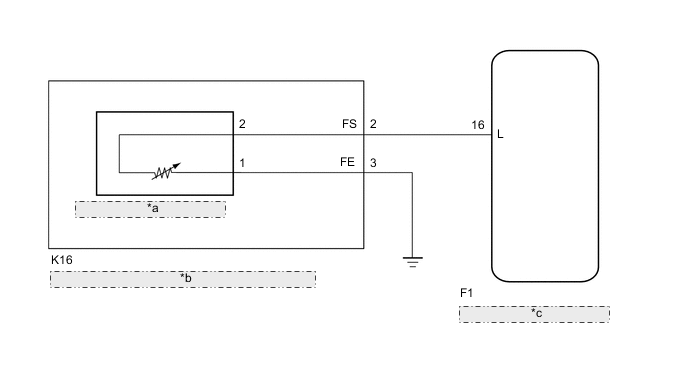
| *a | Fuel Sender Gauge Assembly |
| *b | Fuel Suction with Pump and Gauge Tube Assembly |
| *c | Combination Meter Assembly |
PROCEDURE
-
PERFORM ACTIVE TEST USING GTS (FUEL METER OPERATION)
-
Connect the GTS to the DLC3.
-
Turn the ignition switch to ON (IG).
-
Turn the GTS on.
-
Enter the following menus: Body Electrical / Combination Meter / Active Test.
-
According to the display on the GTS, perform the Active Test.
Combination Meter Tester Display Test Part Control Range Diagnostic Note Fuel Meter Operation Fuel gauge OFF, Empty, 1/2, Full Vehicle is stopped and the engine idling OK Fuel receiver gauge indication is normal.
NG 
REPLACE COMBINATION METER ASSEMBLY Click here
OK 
-
-
READ VALUE USING GTS (FUEL INPUT)
-
Connect the GTS to the DLC3.
-
Turn the ignition switch to ON (IG).
-
Turn the GTS on.
-
Enter the following menus: Body Electrical / Combination Meter / Data List.
-
According to the display on the GTS, read the Data List.
Combination Meter Tester Display Measurement Item/Range Normal Condition Diagnostic Note Fuel Input Fuel sender gauge input/
Min.: 0
Max.: 127.5
Fuel sender input value Unit: Liter OK Fuel value displayed on the GTS is approximately the same as needle indication.
OK
REPLACE COMBINATION METER ASSEMBLY Click here
NG
-
-
INSPECT FUEL SENDER GAUGE ASSEMBLY
-
Remove the fuel sender gauge assembly Click here.
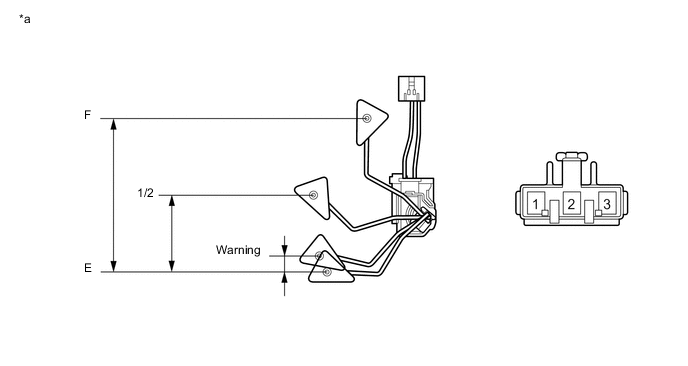
Text in Illustration *a Component without harness connected
(Fuel Sender Gauge Assembly)
- -
-
Check that the float moves smoothly between F and E.
-
Measure the resistance according to the value(s) in the table below.
Standard Resistance Tester Connection Float Level Float Position (mm (in.)) Specified Condition 1 - 2 F 158.7 to 166.7 (6.248 to 6.563) 12.0 to 18.0 Ω 1/2 79.2 to 83.2 (3.118 to 3.276) 214.7 Ω Warning 15.2 to 19.2 (0.598 to 0.756) 366.4 Ω E 0 (0) 405.0 to 415.0 Ω
-
-
Reinstall the fuel sender gauge assembly.
NG
REPLACE FUEL SENDER GAUGE ASSEMBLY Click here
OK
-
-
INSPECT FUEL SUCTION WITH PUMP AND GAUGE TUBE ASSEMBLY
-
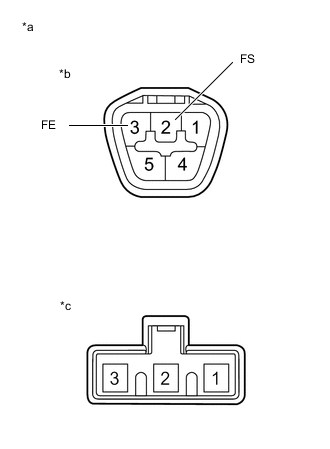
Text in Illustration *a Component without harness connected
(Fuel Suction with Pump and Gauge Tube Assembly)
*b Connector A *c Connector B Remove the fuel suction with pump and gauge tube assembly Click here.
-
Measure the resistance according to the value(s) in the table below.
Standard Resistance Tester Connection Condition Specified Condition A-2 (FS) - B-2 Always Below 1 Ω A-3 (FE) - B-1 Always Below 1 Ω -
Reinstall the fuel suction with pump and gauge assembly.
NG
REPLACE FUEL SUCTION WITH PUMP AND GAUGE TUBE ASSEMBLY Click here
OK
-
-
CHECK HARNESS AND CONNECTOR (COMBINATION METER ASSEMBLY - FUEL SUCTION WITH PUMP AND GAUGE TUBE ASSEMBLY)
-
Disconnect the F1 combination meter assembly connector.
-
Disconnect the K16 fuel suction with pump and gauge tube assembly connector.
-
Measure the resistance according to the value(s) in the table below.
Standard Resistance Tester Connection Condition Specified Condition F1-16 (L) - K16-2 (FS) Always Below 1 Ω F1-16 (L) - Body ground Always 10 kΩ or higher K16-3 (FE) - Body ground Always Below 1 Ω -
Reconnect the fuel suction with pump and gauge tube assembly connector.
-
Reconnect the combination meter assembly connector.
OK
REPLACE COMBINATION METER ASSEMBLY Click here
NG
REPAIR OR REPLACE HARNESS OR CONNECTOR
-