PUSH-BUTTON START Power Source Mode does not Change to ON (IG)
DESCRIPTION
If the power switch is pressed with the electrical key transmitter sub-assembly in the cabin, the certification ECU (smart key ECU assembly) receives a signal and changes the power source mode.
Tech Tips
When the cable is disconnected and reconnected to the negative (-) auxiliary battery terminal, the power source mode returns to the state it was in before the cable was disconnected.
| Problem Symptom | Data List Item | Active Test Item |
|---|---|---|
| Power source mode does not change to on (IG) but does change to on (ACC) |
Power Source Control |
- |
WIRING DIAGRAM
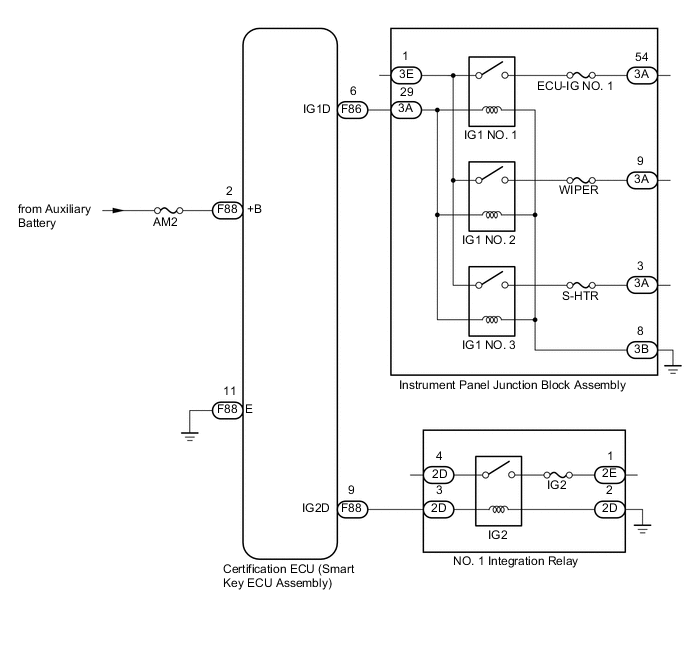
CAUTION / NOTICE / HINT
Note
-
When using the GTS with the vehicle power switch off, connect the GTS to the vehicle and turn a courtesy light switch on and off at intervals of 1.5 seconds or less until communication between the GTS and the vehicle begins. Then select the Model Code "KEY REGIST" under manual mode and enter the following menus: Body Electrical / Entry & Start(CAN). While using the GTS, periodically turn a courtesy light switch on and off at intervals of 1.5 seconds or less to maintain communication between the GTS and the vehicle.
-
The push-button start system uses multiplex communication. First perform the inspections in "How to Proceed with Troubleshooting" to confirm that there are no communication malfunctions before proceeding with troubleshooting Click here.
-
Before replacing the certification ECU (smart key ECU assembly) or electrical key transmitter sub-assembly, refer to the push-button start system precaution Click here.
-
Make sure that no DTCs are output. If any DTCs are output, proceed to the Diagnostic Trouble Code Chart Click here.
-
If the push-button start system is disabled through the customize function, enable the system before performing troubleshooting Click here.
-
After completing repairs, confirm that the problem does not reoccur.
-
Inspect the fuses of circuits related to this system before performing the following inspection procedure.
PROCEDURE
-
CHECK HARNESS AND CONNECTOR (CERTIFICATION ECU (SMART KEY ECU ASSEMBLY) - NO. 1 INTEGRATION RELAY
-
Disconnect the F88 certification ECU (smart key ECU assembly) connector.
-
Disconnect the 2D and 2E No. 1 integration relay connectors.
-
Measure the resistance according to the value(s) in the table below.
Standard Resistance Tester Connection Condition Specified Condition F88-9 (IG2D) - 2D-3 Always Below 1 Ω 2D-2 - Body ground Always Below 1 Ω F88-9 (IG2D) or 2D-3 - Body ground Always 10 kΩ or higher
NG 
REPAIR OR REPLACE HARNESS OR CONNECTOR
OK 
-
-
INSPECT NO. 1 INTEGRATION RELAY (IG2 RELAY)
-
Inspect the No. 1 integration relay Click here.
NG
REPLACE NO. 1 INTEGRATION RELAY Click here
OK
-
-
CHECK HARNESS AND CONNECTOR (CERTIFICATION ECU (SMART KEY ECU ASSEMBLY) - INSTRUMENT PANEL JUNCTION BLOCK ASSEMBLY)
-
Disconnect the F86 certification ECU (smart key ECU assembly) connector.
-
Disconnect the 3A and 3B instrument panel junction block assembly connectors.
-
Measure the resistance according to the value(s) in the table below.
Standard Resistance Tester Connection Condition Specified Condition F86-6 (IG1D) - 3A-29 Always Below 1 Ω 3B-8 - Body ground Always Below 1 Ω F86-6 (IG1D) and 3A-29 - Body ground Always 10 kΩ or higher
NG
REPAIR OR REPLACE HARNESS OR CONNECTOR
OK
-
-
INSPECT INSTRUMENT PANEL JUNCTION BLOCK ASSEMBLY (IG1 NO. 1, IG1 NO. 2 AND IG1 NO. 3 RELAY)
-
Remove the instrument panel junction block assembly Click here.
-
Remove the main body ECU from the instrument panel junction block assembly Click here.
-
Measure the resistance according to the value(s) in the table below.
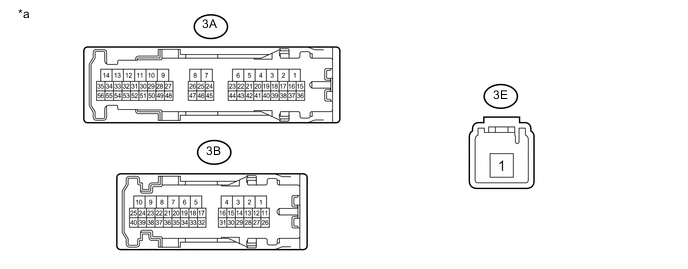
Text in Illustration *a Component without harness connected
(Instrument Panel Junction Block Assembly)
- - Standard Resistance Tester Connection Condition Specified Condition 3E-1 - 3A-54
(IG1 NO. 1 relay)
Auxiliary battery voltage not applied to terminals 3A-29 and 3B-8 10 kΩ or higher Auxiliary battery voltage applied to terminals 3A-29 and 3B-8 Below 1 Ω 3E-1 - 3A-9
(IG1 NO. 2 relay)
Auxiliary battery voltage not applied to terminals 3A-29 and 3B-8 10 kΩ or higher Auxiliary battery voltage applied to terminals 3A-29 and 3B-8 Below 1 Ω 3E-1 - 3A-3
(IG1 NO. 3 relay)
Auxiliary battery voltage not applied to terminals 3A-29 and 3B-8 10 kΩ or higher Auxiliary battery voltage applied to terminals 3A-29 and 3B-8 Below 1 Ω
NG
REPLACE INSTRUMENT PANEL JUNCTION BLOCK ASSEMBLY Click here
OK
-
-
INSPECT CERTIFICATION ECU (SMART KEY ECU ASSEMBLY)
-
Reconnect the F86 and F88 certification ECU (smart key ECU assembly) connectors.
-
Measure the voltage according to the value(s) in the table below.
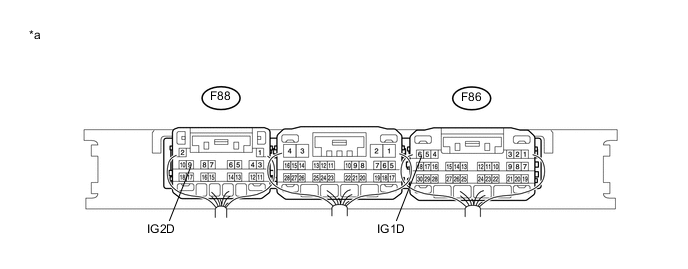
Standard Voltage Tester Connection Switch Condition Specified Condition F88-9 (IG2D) - Body ground Power switch on (ACC) → Power switch on (IG) 1 V or less → 9 V or higher F86-6 (IG1D) - Body ground Power switch on (ACC) → Power switch on (IG) 1 V or less → 9 V or higher Text in Illustration *a Component with harness connected
(Certification ECU (Smart Key ECU Assembly))
OK
CHECK RELAY CONTACT SIDE CIRCUIT
NG
REPLACE CERTIFICATION ECU (SMART KEY ECU ASSEMBLY)
-