BRAKE FLUID REPLACEMENT
CAUTION / NOTICE / HINT
Note
-
Perform fluid replacement with the shift lever in P and the parking brake applied.
-
As brake fluid may overflow when replacing brake fluid, do not stand the fluid can on the reservoir inlet.
-
Perform fluid replacement while maintaining the brake fluid level between the MIN and MAX lines on the brake fluid reservoir.
-
Replacing brake fluid will be difficult if the following occurs:
-
The brake actuator hose (the hose between the brake booster pump assembly and brake fluid reservoir) is higher than the fluid level and air enters the hose.
-
During the fluid replacement procedure, air enters the brake booster pump assembly while the pump motor is operating.
-
While performing fluid replacement, the accumulator pressure drop may cause a buzzer to sound. As there is no problem, continue with the fluid replacement.
-
During fluid replacement, DTCs for pressure sensor malfunctions, etc. may be stored. After fluid replacement and if instructed in the procedures, clear the DTCs.
-
Do not allow brake fluid to adhere to any painted surface such as the vehicle body. If brake fluid leaks onto any painted surface, immediately clean it off.
Tech Tips
There are 2 ways of brake fluid replacement: using the GTS or not using the GTS.
PROCEDURE
-
REMOVE CENTER COWL TOP VENTILATOR LOUVER (for LHD)
-
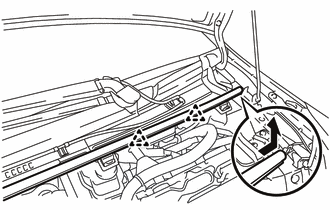
Disengage the 2 clips and slide the hood to cowl top seal as shown in the illustration.
-
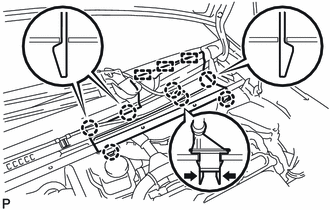
Disengage the 2 claws to separate the washer hose joint.
Note
To prevent washer fluid from contaminating the brake master cylinder reservoir, do not separate the washer hose.
-
Disengage the 5 claws and 3 guides to remove the center cowl top ventilator louver.
-
-
REMOVE CENTER COWL TOP VENTILATOR LOUVER (for RHD)
-
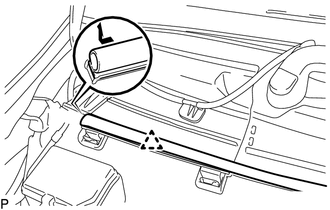
Disengage the clip and slide the hood to cowl top seal as shown in the illustration.
-
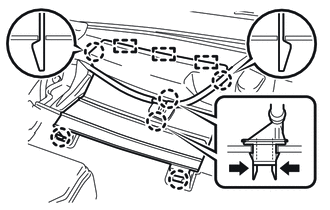
Disengage the 2 claws to separate the washer hose joint.
Note
To prevent washer fluid from contaminating the brake master cylinder reservoir, do not separate the washer hose.
-
Disengage the 4 claws and 3 guides to remove the center cowl top ventilator louver.
-
-
REPLACE BRAKE FLUID (when Using the GTS)
Note
-
Add brake fluid carefully and check that the fluid level remains between the MIN and MAX lines on the brake fluid reservoir.
-
Do not stand the fluid can on the reservoir inlet. Doing so will cause brake fluid to overflow.
-
Remove the brake master cylinder reservoir filler cap assembly.
-
Add brake fluid into the reservoir between the MAX and MIN lines on the brake fluid reservoir.
Brake fluid SAE J1704 or FMVSS No. 116 DOT4 Note
Do not remove the filter from the brake master cylinder reservoir and be sure to fill with new brake fluid to avoid any potential contamination of the brake system. Contamination, for example by dirt particles or mineral oil, could lead to functional brake problems.
-
Connect the GTS to the DLC3 and turn the ignition switch to ON (IG).
-
Turn the GTS on and enter the following menus: Chassis / ABS/VSC/TRC / Utility / Air Bleeding.
-
Select "Usual air bleeding" on the GTS display, and replace the brake fluid following the instructions on the GTS.
Tech Tips
It is not necessary to disconnect the reservoir level switch connector.
-
After replacing brake fluid, tighten each bleeder plug.
- Torque:
- Front bleeder plug (w/ Anti-lattle Spring)
- 17 N*m { 173 kgf*cm, 13 ft.*lbf }
- Front bleeder plug (w/o Anti-lattle Spring)
- 8.3 N*m { 85 kgf*cm, 73 in.*lbf }
- Rear bleeder plug
- 14 N*m { 143 kgf*cm, 10 ft.*lbf }
-
Install the brake master cylinder reservoir filler cap assembly.
-
Clear the DTCs Click here.
-
Turn the GTS off and turn the ignition switch off.
-
Inspect for brake fluid leaks.
-
-
REPLACE BRAKE FLUID (when Not Using the GTS)
Note
-
Performing the following procedure will enable ECB* Invalid Mode without using the GTS.
-
ECB* Invalid Mode allows the brake fluid to be replaced without using the GTS.
-
The brake warning light / yellow will blink to indicate when ECB* Invalid Mode is enabled.
-
Be sure to inspect that the brake warning light / yellow is blinking while replacing the brake fluid.
-
When one of the following conditions is met, ECB* Invalid Mode is cancelled, and DTCs may be stored. Do not cancel ECB* Invalid Mode while replacing brake fluid.
The shift lever is moved to any other position from P. The ignition switch is turned ON (READY). The ignition switch is turned off. The parking brake is released. The vehicle speed is not 0 km/h (0 mph). -
Do not rotate the front disc or rear drum while ECB* Invalid Mode is enabled. If the front disc or rear drum is rotated, ECB* Invalid Mode may be cancelled.
-
When replacing the brake fluid from the brake line, do not depress the brake pedal to operate the brake booster pump assembly for more than 100 seconds. If the brake booster pump assembly is operated for more than 100 seconds, ECB* Invalid Mode is automatically finished and DTCs may be stored.
-
Add brake fluid carefully and check that the fluid level remains between the MIN and MAX lines on the brake fluid reservoir.
-
Do not stand the fluid can on the reservoir inlet. Doing so will cause brake fluid to overflow.
*: Electronically Controlled Brake System
-
Remove all 4 wheels.
-
Enable ECB* Invalid Mode.
*: Electronically Controlled Brake System
-
Perform the procedure listed below in 1 minute.
-
Turn the ignition switch to ON (IG) with the shift lever in P and the parking brake applied.
-
Move the shift lever to N and then depress the brake pedal more than 8 times in 5 seconds.
-
Move the shift lever to P and then depress the brake pedal more than 8 times in 5 seconds.
-
Move the shift lever to N and then depress the brake pedal more than 8 times in 5 seconds.
-
Move the shift lever to P.
-
-
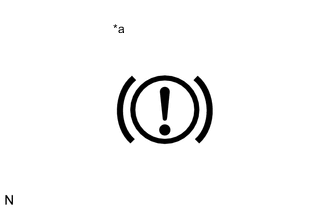
Text in Illustration *a Brake Warning Light / Yellow Check that the brake warning light / yellow is blinking.
-
-
Replace the brake fluid.
-
Add brake fluid into the reservoir between the MAX and MIN lines on the brake fluid reservoir.
Brake fluid SAE J1704 or FMVSS No. 116 DOT4 Note
Do not remove the filter from the brake master cylinder reservoir and be sure to fill with new brake fluid to avoid any potential contamination of the brake system. Contamination, for example by dirt particles or mineral oil, could lead to functional brake problems.
-
Connect a vinyl tube to the bleeder plug of the front disc brake cylinder assembly RH.
-
Depress the brake pedal several times, and then loosen the bleeder plug with the pedal depressed.*1
-
When fluid stops coming out, tighten the bleeder plug, and then release the brake pedal.*2
-
Repeat *1 and *2 until all the air in the brake fluid is completely bled out and new brake fluid comes out.
-
Tighten the bleeder plug completely.
- Torque:
- Front bleeder plug (w/ Anti-lattle Spring)
- 17 N*m { 173 kgf*cm, 13 ft.*lbf }
- Front bleeder plug (w/o Anti-lattle Spring)
- 8.3 N*m { 85 kgf*cm, 73 ft.*lbf }
-
Replace the brake fluid from the front disc brake cylinder assembly LH using the same procedure as for the RH side.
-
Connect a vinyl tube to the bleeder plug of the rear disc brake cylinder assembly LH.
-
Loosen the bleeder plug while depressing and holding the brake pedal, and replace the brake fluid with the brake booster pump assembly and solenoid operating.*3
Note
-
Be sure to keep the brake pedal depressed.
-
Do not depress the brake pedal to operate the brake booster pump assembly for more than 100 seconds. When performing this procedure continuously, release the brake pedal to stop the brake booster pump assembly operating and depress the brake pedal again.
-
-
Tighten the bleeder plug, then release the brake pedal.*4
-
Repeat *3 and *4 until all the air in the brake fluid is completely bled out and new brake fluid comes out.
-
Tighten the bleeder plug completely.
- Torque:
- 14 N*m { 143 kgf*cm, 10 ft.*lbf }
-
Replace the brake fluid from the rear disc brake cylinder assembly RH using the same procedure as for the LH side.
-
Turn the ignition switch off.
-
-
Inspect for brake fluid leaks.
-
Adjust the brake fluid level in the reservoir Click here.
-
Install the brake master cylinder reservoir filler cap.
-
Install the 4 wheels.
- Torque:
- 103 N*m { 1050 kgf*cm, 76 ft.*lbf }
-
-
INSTALL CENTER COWL TOP VENTILATOR LOUVER (for LHD)
-
Engage the 3 guides and 5 claws to install the center cowl top ventilator louver.
-
Engage the 2 claws to install the washer hose joint.
-
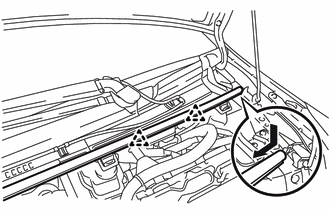
Engage the 2 clips and slide the hood to cowl top seal as shown in the illustration.
-
-
INSTALL CENTER COWL TOP VENTILATOR LOUVER (for RHD)
-
Engage the 3 guides and 4 claws to install the center cowl top ventilator louver.
-
Engage the 2 claws to install the washer hose joint.
-
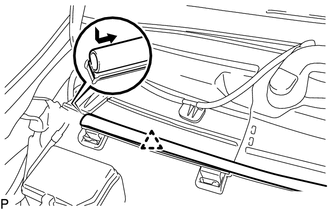
Engage the clip and slide the hood to cowl top seal as shown in the illustration.
-