ELECTRONICALLY CONTROLLED BRAKE SYSTEM Brake Warning Light Remains ON
DESCRIPTION
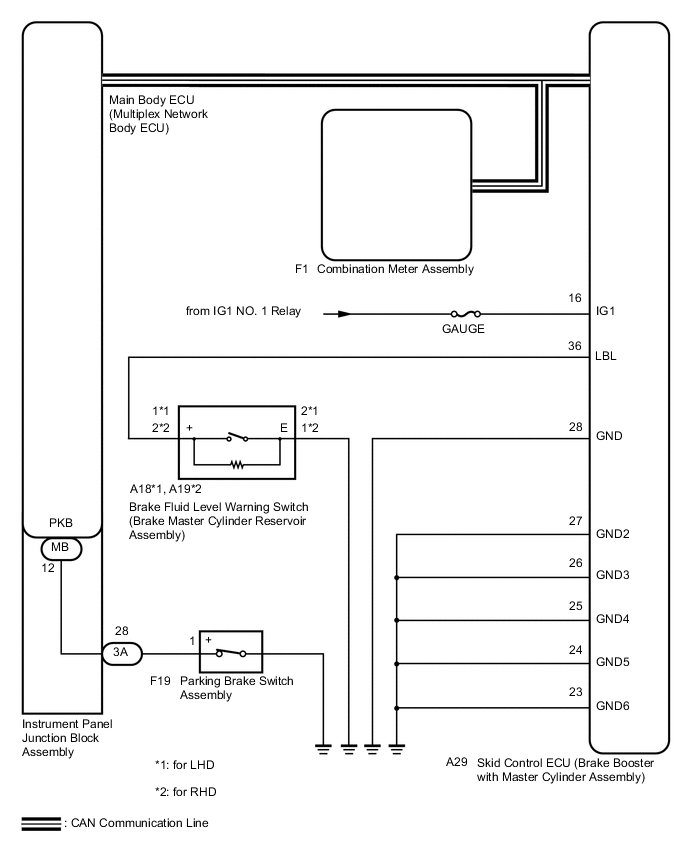
The skid control ECU (brake booster with master cylinder assembly) is connected to the combination meter assembly via CAN communication.
If any of the following is detected, the brake warning light / red (malfunction) remains on:
-
The skid control ECU (brake booster with master cylinder assembly) connector is disconnected from the brake booster with master cylinder assembly.
-
The brake fluid level is insufficient.
-
The parking brake is applied.
-
EBD operation has been disabled.
WIRING DIAGRAM
CAUTION / NOTICE / HINT
Note
-
When replacing the skid control ECU (brake booster with master cylinder assembly), perform initialization and calibration of the linear solenoid valve Click here.
-
Inspect the fuses for circuits related to this system before performing the following inspection procedure.
PROCEDURE
-
CHECK DTC
-
Check if ABS, VSC and/or electronically controlled brake system DTCs are output Click here.
Result Result Proceed to DTC is not output. A DTC is output. B
B 
REPAIR CIRCUITS INDICATED BY OUTPUT DTCS Click here
A 
-
-
CHECK CAN COMMUNICATION SYSTEM
-
Check if a CAN communication system DTC is output Click here.
Result Result Proceed to DTC is not output. A DTC is output. B
B
INSPECT CAN COMMUNICATION SYSTEM Click here
A
-
-
CHECK IF SKID CONTROL ECU CONNECTOR IS SECURELY CONNECTED
-
Check if the skid control ECU (brake booster with master cylinder assembly) connector is securely connected.
OK The connector is securely connected.
NG
CONNECT CONNECTOR TO ECU CORRECTLY
OK
-
-
CHECK AUXILIARY BATTERY
-
Check the auxiliary battery voltage.
Standard Voltage Tester Connection Switch Condition Specified Condition Auxiliary battery Ignition switch ON (IG) 11 to 14 V Auxiliary battery Ignition switch ON (READY) 11 to 15.5 V
NG
CHARGE OR REPLACE AUXILIARY BATTERY
OK
-
-
CHECK HARNESS AND CONNECTOR (IG1 TERMINAL)
-
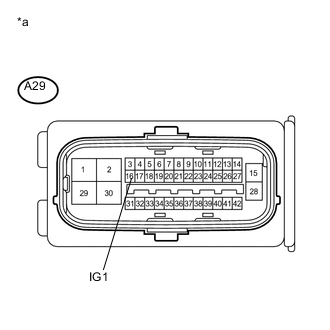
Text in Illustration *a Front view of wire harness connector
(to Skid Control ECU (Brake Booster with Master Cylinder Assembly))
Disconnect the skid control ECU (brake booster with master cylinder assembly) connector.
-
Turn the ignition switch to ON (IG).
-
Measure the voltage according to the value(s) in the table below.
Standard Voltage Tester Connection Switch Condition Specified Condition A29-16 (IG1) - Body ground Ignition switch ON (IG) 11 to 14 V
NG
REPAIR OR REPLACE HARNESS OR CONNECTOR (IG1 CIRCUIT)
OK
-
-
CHECK HARNESS AND CONNECTOR (GND TERMINAL)
-
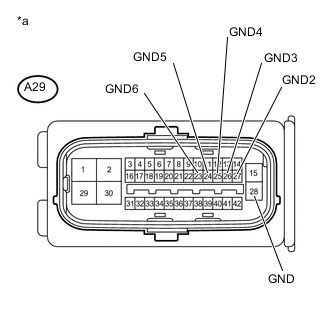
Text in Illustration *a Front view of wire harness connector
(to Skid Control ECU (Brake Booster with Master Cylinder Assembly))
Turn the ignition switch off.
-
Measure the resistance according to the value(s) in the table below.
Standard Resistance Tester Connection Condition Specified Condition A29-28 (GND) - Body ground Always Below 1 Ω A29-27 (GND2) - Body ground Always Below 1 Ω A29-26 (GND3) - Body ground Always Below 1 Ω A29-25 (GND4) - Body ground Always Below 1 Ω A29-24 (GND5) - Body ground Always Below 1 Ω A29-23 (GND6) - Body ground Always Below 1 Ω
NG
REPAIR OR REPLACE HARNESS OR CONNECTOR (GND CIRCUIT)
OK
-
-
READ VALUE USING GTS (PARKING BRAKE SWITCH ASSEMBLY)
-
Reconnect the skid control ECU (brake booster with master cylinder assembly) connector.
-
Connect the GTS to the DLC3.
-
Turn the ignition switch to ON (IG).
-
Select the Data List on the GTS Click here.
ABS/VSC/TRC Tester Display Measurement Item/Range Normal Condition Diagnostic Note Parking Brake SW Parking brake switch assembly / ON or OFF ON: Parking brake applied
OFF: Parking brake released
- -
Using the GTS, check if the switch condition on the GTS changes according to parking brake operation.
OK The GTS displays ON or OFF according to parking brake operation.
NG 
INSPECT PARKING BRAKE SWITCH ASSEMBLY Click here
OK
-
-
INSPECT COMBINATION METER ASSEMBLY
-
Turn the ignition switch off.
-
Perform the Active Test of the combination meter assembly (meter CPU) using the GTS Click here.
-
Check the combination meter assembly.
OK The brake warning light / red (malfunction) turns on or off in accordance with GTS operation. Result Result Proceed to OK (for LHD) A OK (for RHD) B NG C Tech Tips
If troubleshooting has been carried out according to Problem Symptoms Table, refer back to the table and proceed to the next step before replacing the part Click here.
A
REPLACE BRAKE BOOSTER WITH MASTER CYLINDER ASSEMBLY Click here
B
REPLACE BRAKE BOOSTER WITH MASTER CYLINDER ASSEMBLY Click here
C
REPLACE COMBINATION METER ASSEMBLY Click here
-
-
INSPECT PARKING BRAKE SWITCH ASSEMBLY
-
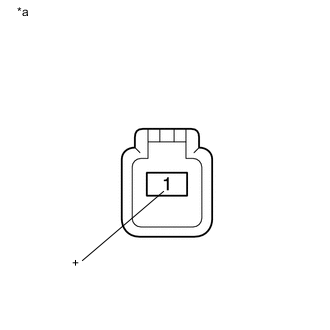
Text in Illustration *a Component without harness connected
(Parking Brake Switch Assembly)
Turn the ignition switch off.
-
Disconnect the parking brake switch assembly connector.
-
Measure the resistance according to the value(s) in the table below.
Standard Resistance Tester Connection Switch Condition Specified Condition 1 (+) - Body ground Parking brake switch assembly ON
(Switch pin free)
Below 1 Ω 1 (+) - Body ground Parking brake switch assembly OFF
(Switch pin pushed in)
10 kΩ or higher
NG
REPLACE PARKING BRAKE SWITCH ASSEMBLY Click here
OK
-
-
CHECK HARNESS AND CONNECTOR (MAIN BODY ECU (MULTIPLEX NETWORK BODY ECU) - PARKING BRAKE SWITCH ASSEMBLY)
-
Disconnect the 3A main body ECU (multiplex network body ECU) connector.
-
Measure the resistance according to the value(s) in the table below.
Standard Resistance Tester Connection Condition Specified Condition 3A-28 - F19-1 (+) Always Below 1 Ω 3A-28 - Body ground Always 10 kΩ or higher Tech Tips
If troubleshooting has been carried out according to Problem Symptoms Table, refer back to the table and proceed to the next step before replacing the part Click here.
NG
REPAIR OR REPLACE HARNESS OR CONNECTOR
OK
-
-
CHECK HARNESS AND CONNECTOR (INSTRUMENT PANEL JUNCTION BLOCK-MAIN BODY ECU (MULTIPLEX NETWORK BODY ECU))
-
Remove the main body ECU (multiplex network body ECU) from the instrument panel junction block assembly.
-
Measure the resistance according to the value(s) in the table below.
Standard Resistance Tester Connection Condition Specified Condition 3A-28 - MB-12 (PKB) Always Below 1 Ω 3A-28 - Body ground Always 10 kΩ or higher
OK
REPLACE MAIN BODY ECU (MULTIPLEX NETWORK BODY ECU) Click here
NG
REPLACE INSTRUMENT PANEL JUNCTION BLOCK ASSEMBLY
-