HYBRID CONTROL SYSTEM, Diagnostic DTC:P2120-152, P2121-106, P2122-104, P2123-105, P2125-153, P2126-109, P2127-107, P2128-108, P2138-110, P2138-154
| DTC Code | DTC Name |
|---|---|
| P2120-152 | Throttle / Pedal Position Sensor / Switch "D" Circuit |
| P2121-106 | Throttle / Pedal Position Sensor / Switch "D" Circuit Range / Performance |
| P2122-104 | Throttle / Pedal Position Sensor / Switch "D" Circuit Low Input |
| P2123-105 | Throttle / Pedal Position Sensor / Switch "D" Circuit High Input |
| P2125-153 | Throttle / Pedal Position Sensor / Switch "E" Circuit |
| P2126-109 | Throttle / Pedal Position Sensor / Switch "E" Circuit Range / Performance |
| P2127-107 | Throttle / Pedal Position Sensor / Switch "E" Circuit Low Input |
| P2128-108 | Throttle / Pedal Position Sensor / Switch "E" Circuit High Input |
| P2138-110 | Throttle / Pedal Position Sensor / Switch "D" / "E" Voltage Correlation |
| P2138-154 | Throttle / Pedal Position Sensor / Switch "D" / "E" Voltage Correlation |
DESCRIPTION
The accelerator pedal position sensor is mounted on the accelerator pedal to detect how much the pedal is depressed. This is a non-contact sensor with hall elements. There are 2 outputs from the sensor. One is used to detect the accelerator pedal position and the other is used as a confirmation to allow the detection of a malfunction in the sensor itself. Voltage is output from the accelerator pedal position sensor to terminals VPA1 and VPA2 of the hybrid vehicle control ECU. This voltage varies from 0 to 5 V in accordance with the accelerator pedal position. Terminal VPA2 is primarily used to detect a malfunction in the sensor itself. The hybrid vehicle control ECU determines the current accelerator pedal position and controls the hybrid control system based on signals received by terminals VPA1 and VPA2.
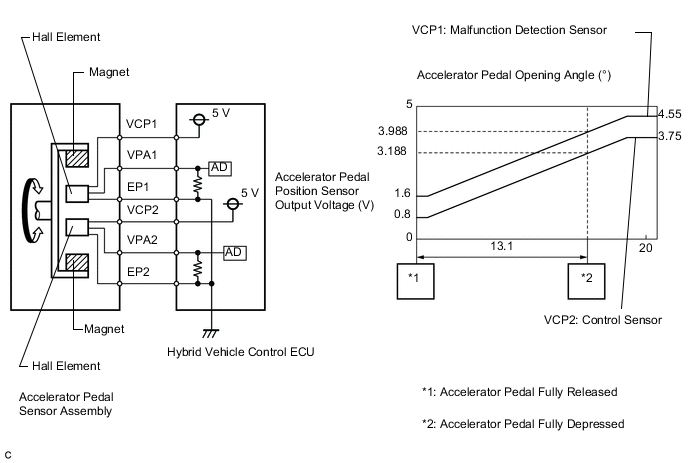
| DTC No. | INF Code | DTC Detection Condition | Trouble Area |
|---|---|---|---|
| P2120 | 152 | Main sensor circuit wiring malfunction or level is not stable Main sensor voltage is 0.4 V or less or 4.8 V or more for a certain period of time. (Both of the following conditions are met: The main sensor voltage is 0.4 V or less for a certain period of time and 4.8 V or more for a certain period of time.) (1 trip detection logic) |
|
| P2121 | 106 | Internal error of the main sensor Main sensor output changes rapidly (detected when there are no circuit malfunctions such as an open or short). (1 trip detection logic) |
|
| P2122 | 104 | Open or short to GND in the main sensor circuit The main sensor voltage is 0.4 V or less for 0.5 seconds. (1 trip detection logic) |
|
| P2123 | 105 | Short to +B in the main sensor circuit The main sensor voltage is 4.8 V or more for 2 seconds. (1 trip detection logic) |
|
| P2125 | 153 | Sub sensor circuit wiring malfunction or level is not stable When the main sensor circuit is normal, the sub sensor voltage is 1.2 V or less or 4.8 V or more for a certain period of time. (Both of the following conditions are met: Sub sensor voltage is 1.2 V or less for a certain period of time, and the main sensor is normal and sub sensor voltage is 4.8 V or more for a certain period of time.) (1 trip detection logic) |
|
| P2126 | 109 | Internal error of the sub sensor Sub sensor output changes rapidly (detected when there are no circuit malfunctions such as an open or short). (1 trip detection logic) |
|
| P2127 | 107 | Open or short to GND in the sub sensor circuit The sub sensor voltage is 1.2 V or less for 0.5 seconds. (1 trip detection logic) |
|
| P2128 | 108 | Short to +B in the sub sensor circuit Main sensor is normal and sub sensor voltage is 4.8 V or more for 2 seconds. (1 trip detection logic) |
|
| P2138 | 110 | Difference between the main sensor value and sub sensor value is large. (1 trip detection logic) |
|
| 154 | Main or sub sensor circuit wiring malfunction The difference in voltage between the main sensor and sub sensor is 0.02 V or less, or a low output malfunction continues in both the main and sub sensors for a certain period of time. (1 trip detection logic) |
| DTC No. | Data List |
|---|---|
| P2120-152 |
|
| P2121-106 | |
| P2122-104 | |
| P2123-105 | |
| P2125-153 | |
| P2126-109 | |
| P2127-107 | |
| P2128-108 | |
| P2138-110 | |
| P2138-154 |
WIRING DIAGRAM
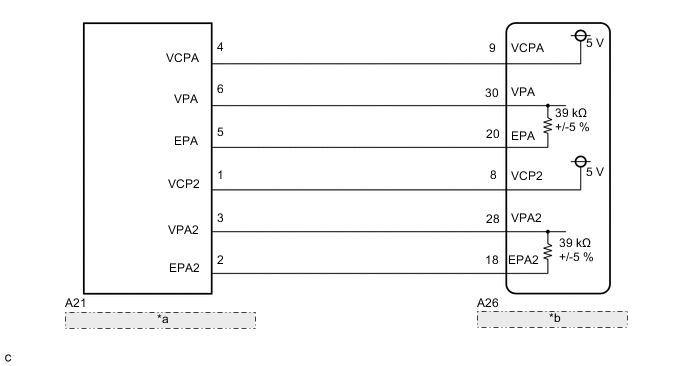
| *a | Accelerator Pedal Sensor Assembly |
| *b | Hybrid Vehicle Control ECU |
CAUTION / NOTICE / HINT
Tech Tips
After the repair, clear the DTCs and perform the following procedure to check that DTCs are not output.
-
Wait for approximately 10 seconds with the ignition switch to ON (READY) and the shift lever in P, then fully depress and release the accelerator pedal several times.
PROCEDURE
-
READ VALUE USING GTS (ACCEL PEDAL POS #1, ACCEL PEDAL POS #2)
-
Connect the GTS to the DLC3.
-
Turn the ignition switch to ON (IG).
-
Enter the following menus: Powertrain / Hybrid Control / Data List / Accel Pedal Pos #1, Accel Pedal Pos #2.
-
Read the Data List.
Result GTS Display Accelerator Pedal Condition Specified Condition Accel Pedal Pos #1 Not depressed 10 to 22 % Fully depressed 52 to 90 % Not depressed → Fully depressed → Not depressed (Accelerator pedal should be operated slowly) Value changes progressively Accel Pedal Pos #2 Not depressed 24 to 40 % Fully depressed 68 to 99 % Not depressed → Fully depressed → Not depressed (Accelerator pedal should be operated slowly) Value changes progressively -
Turn the ignition switch off.
OK 
CHECK FOR INTERMITTENT PROBLEMS Click here
NG 
-
-
CHECK CONNECTOR CONNECTION CONDITION (ACCELERATOR PEDAL SENSOR ASSEMBLY CONNECTOR)
-
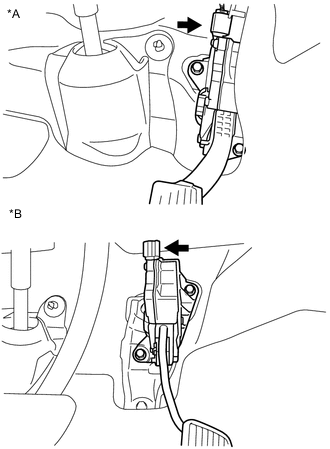
Text in Illustration *A for LHD *B for RHD Check the connection of the accelerator pedal sensor assembly connector.
OK The connector is connected securely and there are no contact problems.
NG
CONNECT SECURELY
OK
-
-
CHECK CONNECTOR CONNECTION CONDITION (HYBRID VEHICLE CONTROL ECU CONNECTOR)
-
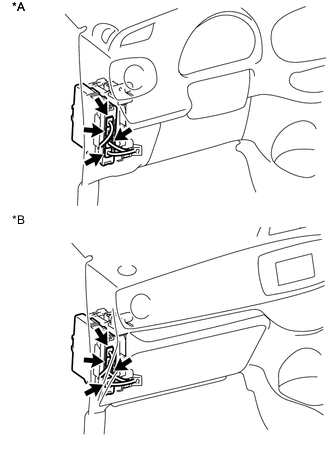
Text in Illustration *A for LHD *B for RHD Check the connector connections and contact pressure of the relevant terminals for the hybrid vehicle control ECU connectors Click here.
OK The connectors are connected securely and there are no contact pressure problems.
NG
CONNECT SECURELY
OK
-
-
CHECK HYBRID VEHICLE CONTROL ECU (CHECK VOLTAGE)
-
Disconnect the accelerator pedal sensor assembly connector.
-
Turn the ignition switch to ON (IG).
-
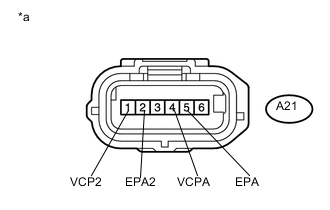
Text in Illustration *a Front view of wire harness connector
(to Accelerator Pedal Sensor Assembly)
Measure the voltage according to the value(s) in the table below.
Standard Voltage Tester Connection Switch Condition Specified Condition A21-4 (VCPA) - A21-5 (EPA) Ignition switch ON (IG) 4.5 to 5.5 V A21-1 (VCP2) - A21-2 (EPA2) Ignition switch ON (IG) 4.5 to 5.5 V -
Turn the ignition switch off.
-
Connect the accelerator pedal sensor assembly connector.
NG 
CHECK HARNESS AND CONNECTOR (HYBRID VEHICLE CONTROL ECU - ACCELERATOR PEDAL SENSOR) Click here
OK
-
-
CHECK HYBRID VEHICLE CONTROL ECU (CHECK RESISTANCE)
-
Disconnect the accelerator pedal sensor assembly connector.
-
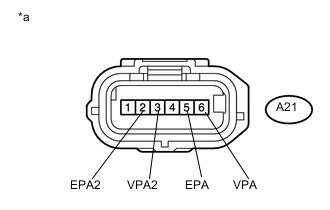
Text in Illustration *a Front view of wire harness connector
(to Accelerator Pedal Sensor Assembly)
Measure the resistance according to the value(s) in the table below.
Standard Resistance Tester Connection Switch Condition Specified Condition A21-6 (VPA) - A21-5 (EPA) Ignition switch off 36.60 to 41.61 kΩ A21-3 (VPA2) - A21-2 (EPA2) Ignition switch off 36.60 to 41.61 kΩ -
Connect the accelerator pedal sensor assembly connector.
OK
REPLACE ACCELERATOR PEDAL SENSOR ASSEMBLY Click here
NG
-
-
CHECK HARNESS AND CONNECTOR (HYBRID VEHICLE CONTROL ECU - ACCELERATOR PEDAL SENSOR)
-
Disconnect the accelerator pedal sensor assembly connector.
-
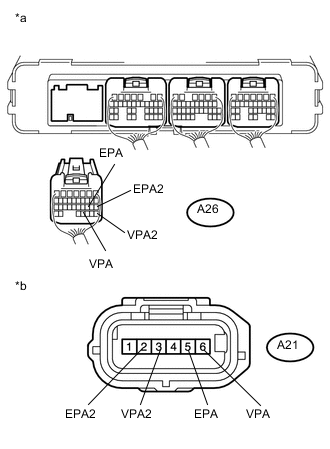
Text in Illustration *a Rear view of wire harness connector
(to Hybrid Vehicle Control ECU)
*b Front view of wire harness connector
(to Accelerator Pedal Sensor Assembly)
Disconnect the hybrid vehicle control ECU connector.
-
Turn the ignition switch to ON (IG).
-
Measure the voltage according to the value(s) in the table below.
Standard Voltage Tester Connection Switch Condition Specified Condition A26-30 (VPA) - Body ground Ignition switch ON (IG) Below 1 V A26-28 (VPA2) - Body ground Ignition switch ON (IG) Below 1 V A26-20 (EPA) - Body ground Ignition switch ON (IG) Below 1 V A26-18 (EPA2) - Body ground Ignition switch ON (IG) Below 1 V Note
Turning the ignition switch to ON (IG) with the hybrid vehicle control ECU connector disconnected causes other DTCs to be stored. Clear the DTCs after performing this inspection.
-
Turn the ignition switch off.
-
Measure the resistance according to the value(s) in the table below.
Standard Resistance (Check for Open) Tester Connection Switch Condition Specified Condition A26-30 (VPA) - A21-6 (VPA) Ignition switch off Below 1 Ω A26-20 (EPA) - A21-5 (EPA) Ignition switch off Below 1 Ω A26-28 (VPA2) - A21-3 (VPA2) Ignition switch off Below 1 Ω A26-18 (EPA2) - A21-2 (EPA2) Ignition switch off Below 1 Ω Standard Resistance (Check for Short) Tester Connection Switch Condition Specified Condition A26-30 (VPA) or A21-6 (VPA) - Body ground and other terminals Ignition switch off 10 kΩ or higher A26-20 (EPA) or A21-5 (EPA) - Body ground and other terminals Ignition switch off 10 kΩ or higher A26-28 (VPA2) or A21-3 (VPA2) - Body ground and other terminals Ignition switch off 10 kΩ or higher A26-18 (EPA2) or A21-2 (EPA2) - Body ground and other terminals Ignition switch off 10 kΩ or higher -
Connect the hybrid vehicle control ECU connector.
-
Connect the accelerator pedal sensor assembly connector.
OK
REPLACE HYBRID VEHICLE CONTROL ECU Click here
NG
REPAIR OR REPLACE HARNESS OR CONNECTOR
-
-
CHECK HARNESS AND CONNECTOR (HYBRID VEHICLE CONTROL ECU - ACCELERATOR PEDAL SENSOR)
-
Disconnect the accelerator pedal sensor assembly connector.
-
Disconnect the hybrid vehicle control ECU connector.
-
Turn the ignition switch to ON (IG).
-
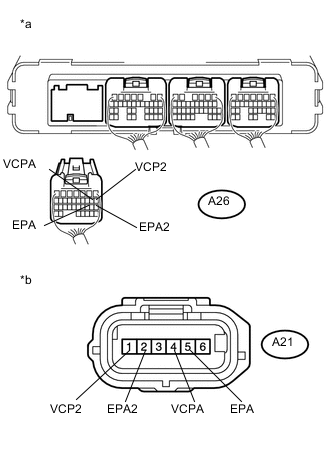
Text in Illustration *a Rear view of wire harness connector
(to Hybrid Vehicle Control ECU)
*b Front view of wire harness connector
(to Accelerator Pedal Sensor Assembly)
Measure the voltage according to the value(s) in the table below.
Standard Voltage Tester Connection Switch Condition Specified Condition A26-9 (VCPA) - Body ground Ignition switch ON (IG) Below 1 V A26-20 (EPA) - Body ground Ignition switch ON (IG) Below 1 V A26-8 (VCP2) - Body ground Ignition switch ON (IG) Below 1 V A26-18 (EPA2) - Body ground Ignition switch ON (IG) Below 1 V Note
Turning the ignition switch to ON (IG) with the hybrid vehicle control ECU connector disconnected causes other DTCs to be stored. Clear the DTCs after performing this inspection.
-
Turn the ignition switch off.
-
Measure the resistance according to the value(s) in the table below.
Standard Resistance (Check for Open) Tester Connection Switch Condition Specified Condition A26-9 (VCPA) - A21-4 (VCPA) Ignition switch off Below 1 Ω A26-20 (EPA) - A21-5 (EPA) Ignition switch off Below 1 Ω A26-8 (VCP2) - A21-1 (VCP2) Ignition switch off Below 1 Ω A26-18 (EPA2) - A21-2 (EPA2) Ignition switch off Below 1 Ω Standard Resistance (Check for Short) Tester Connection Switch Condition Specified Condition A26-9 (VCPA) or A21-4 (VCPA) - Body ground and other terminals Ignition switch off 10 kΩ or higher A26-20 (EPA) or A21-5 (EPA) - Body ground and other terminals Ignition switch off 10 kΩ or higher A26-8 (VCP2) or A21-1 (VCP2) - Body ground and other terminals Ignition switch off 10 kΩ or higher A26-18 (EPA2) or A21-2 (EPA2) - Body ground and other terminals Ignition switch off 10 kΩ or higher -
Connect the hybrid vehicle control ECU connector.
-
Connect the accelerator pedal sensor assembly connector.
OK
REPLACE HYBRID VEHICLE CONTROL ECU Click here
NG
REPAIR OR REPLACE HARNESS OR CONNECTOR
-