REPAIR INSTRUCTION PRECAUTION
-
BASIC REPAIR HINT
-
HINTS ON OPERATIONS
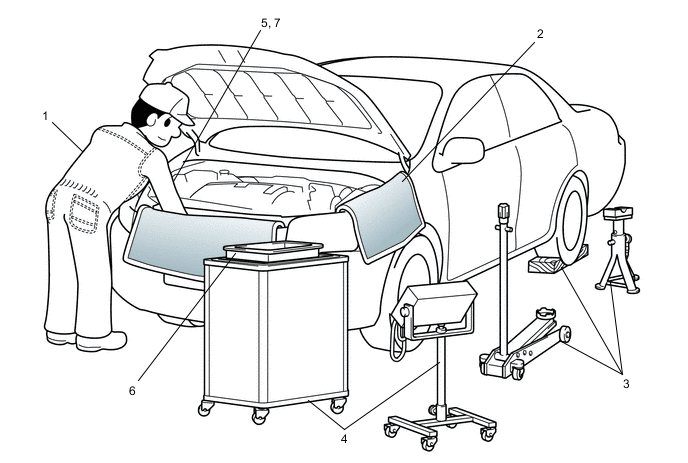
1 Attire
-
Always wear a clean uniform.
-
A hat and safety shoes must be worn.
2 Vehicle protection Prepare a grille cover, fender cover, seat cover and floor mat before starting work. 3 Safety procedures
-
When working with 2 or more persons, be sure to check the safety of one another.
-
When working with the engine running, make sure to provide ventilation for exhaust fumes in the workshop.
-
If working on high temperature, high pressure, rotating, moving or vibrating parts, wear appropriate safety equipment and take extra care not to injure yourself or others.
-
When jacking up the vehicle, be sure to support the specified locations with safety stands.
-
When lifting up the vehicle, use appropriate safety equipment.
4 Preparation of tools and measuring equipment Before starting work, prepare a tool stand, SST, measuring equipment, oil, and any replacement parts required. 5 Removal and installation, disassembly and assembly operations
-
Diagnose with a thorough understanding of proper procedures and of the reported problem.
-
Before removing any parts, check the general condition of the assembly and for deformation and damage.
-
If the procedure is complicated, take notes. For example, note the total number of electrical connections, bolts or hoses removed. Add matchmarks to ensure reassembly of components in the original positions. Temporarily mark hoses and their fittings if needed.
-
Clean and wash the removed parts if necessary and assemble them after a thorough check.
6 Removed parts
-
Place the removed parts in a separate box to avoid mixing them up with new parts or contaminating the new parts.
-
For non-reusable parts such as gaskets, O-rings and self-locking nuts, replace them with new ones as instructed in this manual.
-
Retain the removed parts for customer inspection, if requested.
7* Checks to perform after work is finished
-
Make sure that removed and installed parts (oil filler cap, level dipstick, floor mat, etc.) are properly installed/tightened.
-
Make sure that none of the cloths or tools that were used have been left in the engine compartment or within the vehicle.
-
Check that there are no oil leaks.
CAUTION:
*: Be sure to perform these checks properly, Not performing these checks properly after finishing work can lead to serious accident or injury.
-
-
JACKING UP AND SUPPORTING THE VEHICLE
-
Care must be taken when jacking up and supporting the vehicle. Be sure to lift and support the vehicle at the proper locations.
-
-
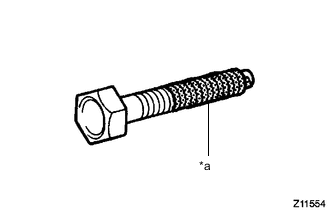
Text in Illustration *a Seal Lock Adhesive PRECOATED PARTS
-
Precoated parts are bolts and nuts that are coated with seal lock adhesive at the factory.
-
If a precoated part is retightened, loosened or moved in any way, it must be recoated with the specified adhesive.
-
When reusing a precoated part, clean off the old adhesive and dry the part with compressed air. Then apply new seal lock adhesive appropriately to that part.
-
Some seal lock agents harden slowly. You may have to wait for the seal lock adhesive to harden.
-
-
GASKETS
-
When necessary, use a sealer on gaskets to prevent leaks.
-
-
BOLTS, NUTS AND SCREWS
-
Carefully follow all the specifications for tightening torque. Always use a torque wrench.
-
Make sure that no foreign matter (burrs, paint, etc.) gets trapped under the heads of the bolts and nuts when tightening them.
-
-
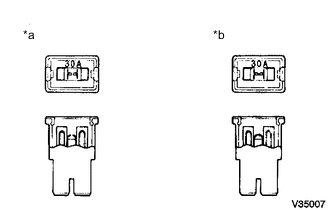
Text in Illustration *a INCORRECT *b CORRECT FUSES
-
When inspecting a fuse, check that the wire of the fuse is not broken.
-
If the wire of a fuse is broken, confirm that there are no shorts in its circuit.
-
When a fuse is replaced, a fuse with the same amperage rating must be used.
Illustration Symbol Part Name Abbreviation 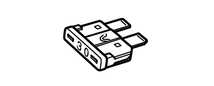
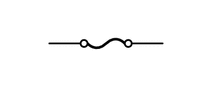
FUSE FUSE 
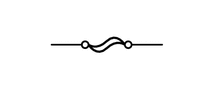
MEDIUM CURRENT FUSE M-FUSE 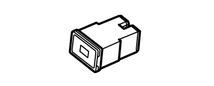
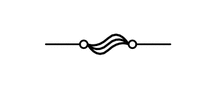
HIGH CURRENT FUSE H-FUSE 
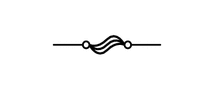
FUSIBLE LINK FL 
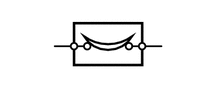
CIRCUIT BREAKER CB
-
-
CLIPS
-
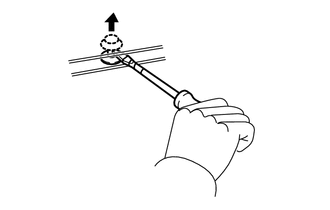
The removal and installation methods of typical clips used for vehicle body parts are shown in the table below.
Tech Tips
If clips are damaged during a procedure, always replace the damaged clips with new ones.
Shape (Example) Removal/Installation 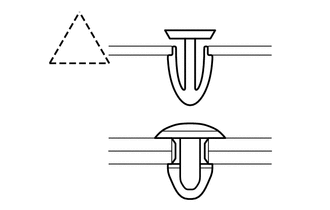
Remove the clips with a clip remover or pliers.
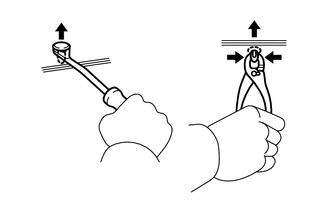
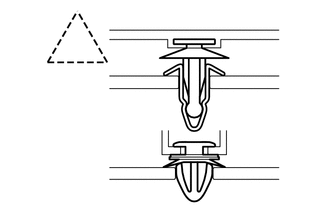
Remove the clips with a clip remover or screwdriver.
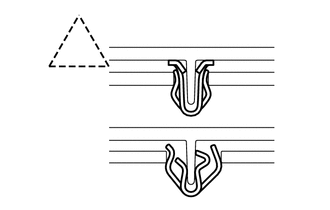
Remove the clips with a wide scraper to prevent panel damage.
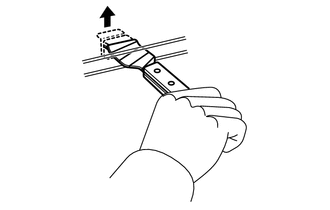
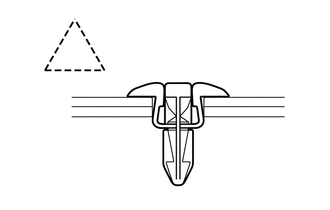
Remove the clips by pushing the center pin through and prying out the shell.
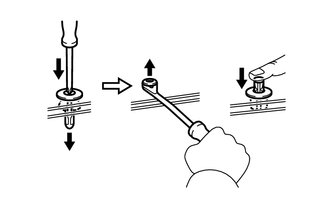
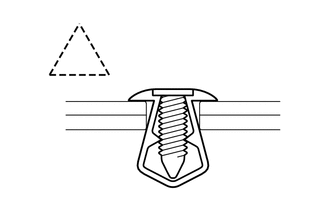
Remove the clips by unscrewing the center pin and prying out the shell.
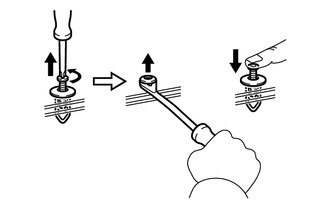
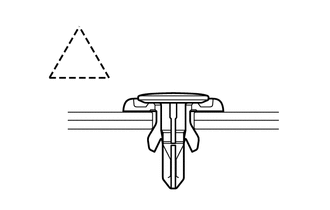
Remove the clips by prying out the pin and then prying out the shell.
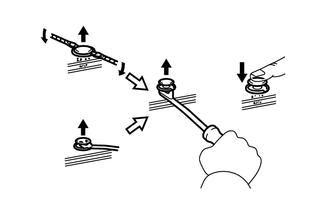
-
-
CLAWS
-
The removal and installation methods of typical claws used for vehicle body parts are shown in the table below.
Tech Tips
If claws are damaged during a procedure, always replace the cap or cover that has damaged claws with a new one.
Shape (Example) Procedures / Illustration 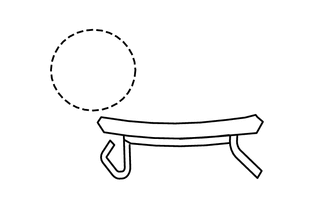
Using a screwdriver, disengage the claws and remove the cap or cover.
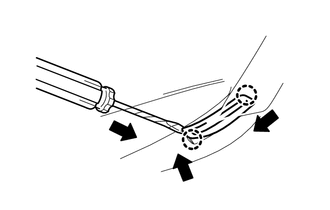
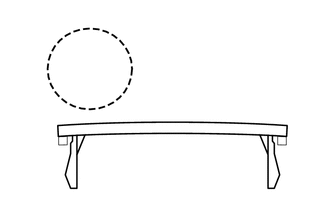
Using a screwdriver, disengage the claws and remove the cap or cover.
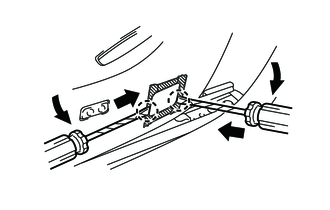
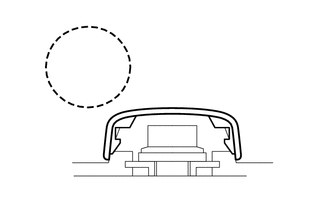
Using a screwdriver, disengage the claws and remove the cap or cover.
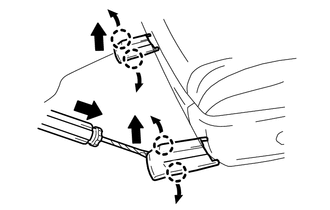
-
-
HINGES, GUIDES, CLAMPS, PINS, ETC.
-
The removal and installation methods of typical hinges, guides, clamps and pins used for vehicle body parts are shown in the table below.
Tech Tips
If clamps are damaged during a procedure, always replace the cap or cover that has damaged clamps with a new one.
Shape (Example) Removal/Installation 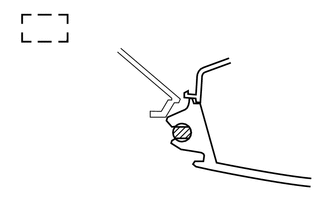
Pull away from the pins to disengage.
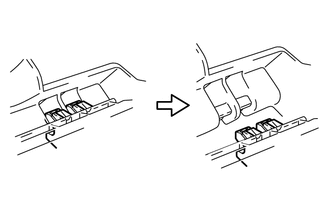
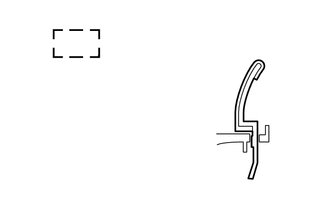
Disengage the pins by pulling.
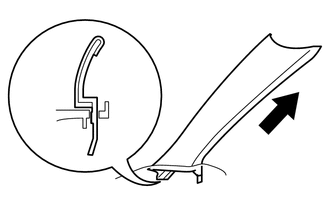
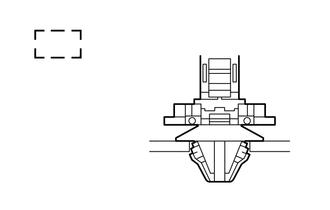
Remove the clamps with pliers.
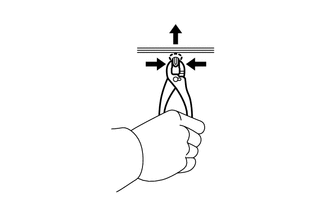
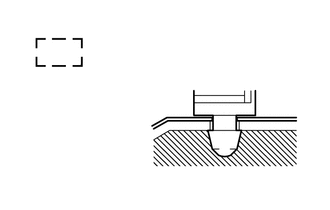
Disengage the pins by pulling.
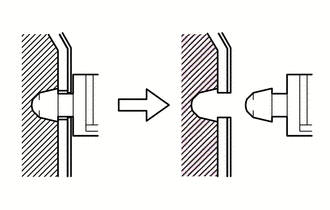
-
-
REMOVAL AND INSTALLATION OF VACUUM HOSES
-
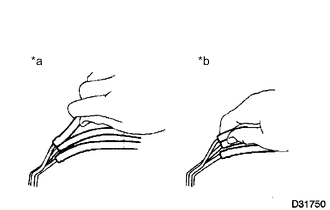
Text in Illustration *a INCORRECT *b CORRECT To disconnect a vacuum hose, pull and twist it from the end of the hose. Do not pull it from the middle of the hose as this may damage the hose.
-
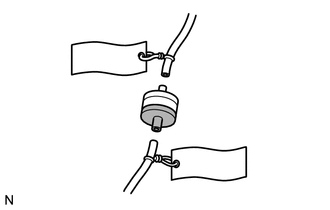
When disconnecting vacuum hoses, use tags to identify where they should be reconnected.
-
After completing any hose related repairs, double-check that the vacuum hoses are properly connected. The label under the hood shows the proper layout.
-
When using a vacuum gauge, never force the hose onto a connector that is too large. If a hose has been stretched, air may leak. Use a step-down adapter if necessary.
-
-
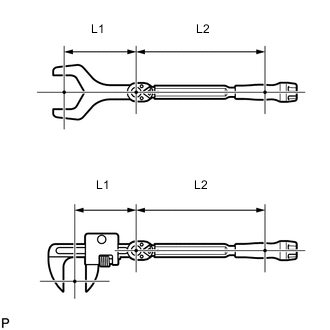
TORQUE WHEN USING TORQUE WRENCH WITH EXTENSION TOOL
-
Use the formula below to calculate special torque values for situations where SST or an extension tool is combined with a torque wrench.
-
Formula
T' = (L2/(L1 + L2))*T
T' Reading of torque wrench {N*m (kgf*cm, ft.*lbf)} T Torque {N*m (kgf*cm, ft.*lbf)} L1 Length of SST or extension tool {cm (in.)} L2 Length of torque wrench {cm (in.)}
Note
If an extension tool or SST is combined with a torque wrench and used to tighten to a torque specification in this manual, the actual torque will be excessive and parts will be damaged.
-
-
-
-
PRECAUTIONS FOR HIGH-VOLTAGE CIRCUIT INSPECTION AND SERVICE
CAUTION:
This vehicle has a hybrid control system that operates at voltages up to approximately 520 V. The hybrid control system uses an HV battery that contains an electrolyte which is a strong alkali solution that includes potassium hydroxide. Be sure to follow the instructions in this manual to handle the system correctly. Failure to do so may result in serious injury or electrocution.
-
Technicians must undergo special training to be able to service and inspect the high-voltage system.
-
All high-voltage wire harnesses and connectors are colored orange. The HV battery and other high-voltage components have "High Voltage" caution labels. Do not carelessly touch these wires or components.
-
When there is a problem with the wire harness or connector of a high-voltage circuit, repairs to the harness or connector should not be attempted. Replace damaged or malfunctioning high voltage cables or connectors.
-
Before inspecting or servicing the high-voltage system, be sure to follow all safety measures, such as wearing insulated gloves and removing the service plug to prevent electrocution. Carry the removed service plug in your pocket to prevent other technicians from accidentally reconnecting it while you are servicing the vehicle.
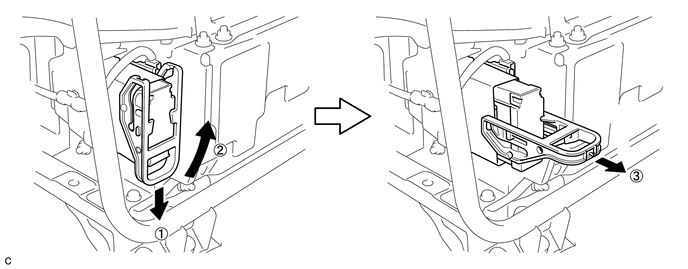
Note
After removing the service plug grip, do not turn the ignition switch to ON (READY), unless instructed by the repair manual because this may cause a malfunction.
-
After removing the service plug grip, wait 10 minutes before touching any of the high-voltage connectors and terminals.
Tech Tips
Waiting for at least 10 minutes is required to discharge the high-voltage capacitor inside the inverter with converter assembly.
-
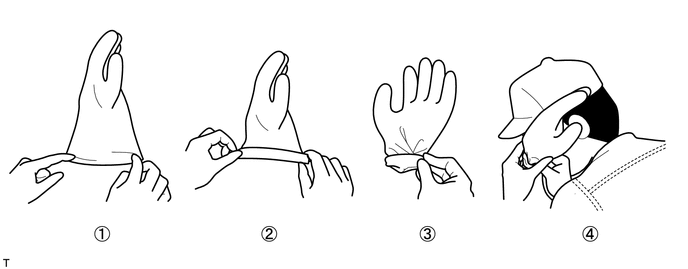
Before using insulated gloves, be sure to check them for cracks, tears and other types of damage by performing the following procedure.
-
Place the glove on its side.
-
Roll the opening up 2 or 3 times.
-
Fold the opening in half to close it.
-
Confirm that there are no air leaks.
-
-
When servicing the vehicle, do not carry metal objects like mechanical pencils or rulers that can be dropped accidentally and cause a short circuit.
-
Before touching a bare high-voltage terminal, wear insulated gloves and use a tester to make sure that the terminal voltage is 0 V.
-
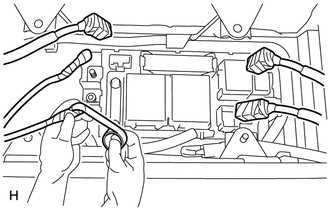
After disconnecting or exposing a high-voltage connector or terminal, insulate it immediately using insulating tape.
-
Bolts and nuts for high-voltage terminals should be tightened firmly to the specified torque. Both insufficient and excessive torque can cause failure.
-
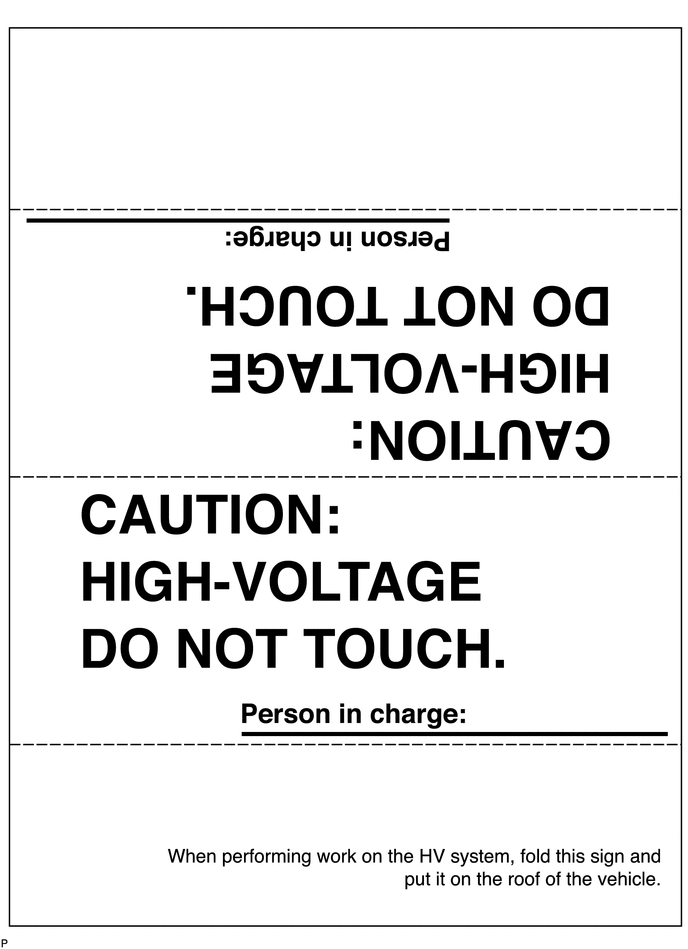
Use the "CAUTION: HIGH VOLTAGE DO NOT TOUCH" sign to notify other technicians that the high-voltage system is being inspected and/or repaired.
-
After servicing the high-voltage system and before reinstalling the service plug, check again that you have not left a part or tool inside, that the high-voltage terminals are firmly tightened, and that the connectors are correctly connected.
-
When performing work involving high-voltage wires, use either a tool wrapped with vinyl insulation tape or an insulated tool.
-
When installing hybrid control system components such as the HV battery, make sure that the polarity of all connections is correct.
-
-
PRECAUTIONS TO BE OBSERVED WHEN INSPECTING OR SERVICING ENGINE COMPARTMENT
-
The vehicle automatically turns the engine on and off when the READY light on the combination meter assembly is illuminated. To avoid injury, make sure that the READY light on the combination meter assembly are off.
-
-
ACTIONS TO BE TAKEN WHEN A WARNING LIGHT IS ILLUMINATED
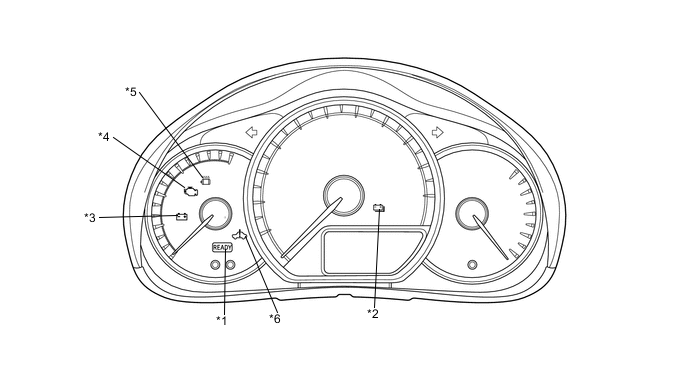
Text in Illustration *1 READY Indicator Light *2 Low Traction Battery Indicator Light *3 Auxiliary Battery Charging Warning Light *4 MIL *5 Hybrid System Overheat Warning Light *6 Hybrid System Warning Light
-
If one of the warning lights (3) to (6) illuminates, connect the GTS to the DLC3 to check the DTCs (Diagnostic Trouble Codes). Then, refer to the applicable troubleshooting steps in this manual to inspect and repair the affected area. The foregoing actions are also required if the READY light does not illuminate when attempting to turn the ignition switch to ON (READY).
Indicator Light Vehicle Condition (1) READY Indicator Light Illuminates when the ignition switch is turned to ON (READY), indicating that the vehicle is ready to be driven. (2) Low Traction Battery Indicator Light Illuminates when the State of Charge (SOC) of the HV battery is too low. (3) Auxiliary Battery Charging Warning Light Illuminates when there is a malfunction of a charging system component such as the DC/DC converter.
(If the hybrid system warning light also illuminates, check for DTCs.)
(4) MIL Illuminates when there is a malfunction in the SFI system.
(Also illuminates when the ignition switch is turned to ON (IG) and to ON (READY).)
(5) Hybrid System Overheat Warning Light Illuminates when the HV system or HV battery overheats with the READY indicator light illuminated. (6) Hybrid System Warning Light Illuminates and the warning buzzer sounds when there is a malfunction in the HV system or HV battery.
-
-
ACTIONS TO BE TAKEN WHEN BATTERIES ARE DISCHARGED
Tech Tips
The vehicle uses a 12 V auxiliary and a 144 V HV battery. Therefore, there are 2 recharging methods when the batteries are discharged.
-
Perform this procedure when the auxiliary battery is fully discharged.
Tech Tips
The following problems indicate that the auxiliary battery is discharged:
-
No display appears on the instrument panel when the ignition switch is turned to ON (IG).
-
The hybrid control system does not start.
-
The headlights are dim.
-
The sound from the horn is weak.
Note
Never use a quick charger.
-
Engage the parking brake.
-
Turn the ignition switch off and remove the key from the key cylinder*1 or interior detection area*2.
-
*1: w/o Power Switch
-
*2: w/ Power Switch
-
-
Remove the front floor cover RH Click here.
-
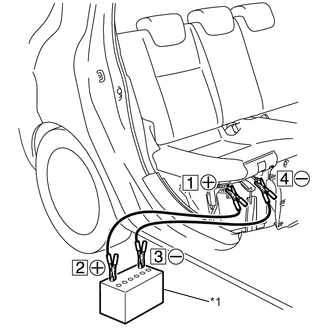
Text in Illustration *1 Auxiliary battery of rescue vehicle Using booster cables, connect the 12 V auxiliary battery of the rescue vehicle and the auxiliary battery of the stalled vehicle as shown in the illustration.
Connecting Sequence Connecting Location 1 Positive auxiliary battery terminal of stalled vehicle 2 Positive auxiliary battery terminal of rescue vehicle 3 Negative auxiliary battery terminal of rescue vehicle 4 Negative auxiliary battery terminal of stalled vehicle -
Start the engine of the rescue vehicle and run the engine at a speed slightly higher than usual.
-
Turn the ignition switch to ON (READY).
Note
-
Immediately disconnect the booster cables in the reverse order of connection after the hybrid control system has started. Do not leave the booster cables connected because they are not designed for recharging purposes.
-
When the hybrid control system does not start although the auxiliary battery has been charged, move the shift lever to P position, turn the ignition switch off and then turn the ignition switch to ON (READY) again.
If the hybrid control system fails to start and P position request indicator light or low traction battery indicator light in the combination meter assembly is blinking, the HV battery may be discharged.
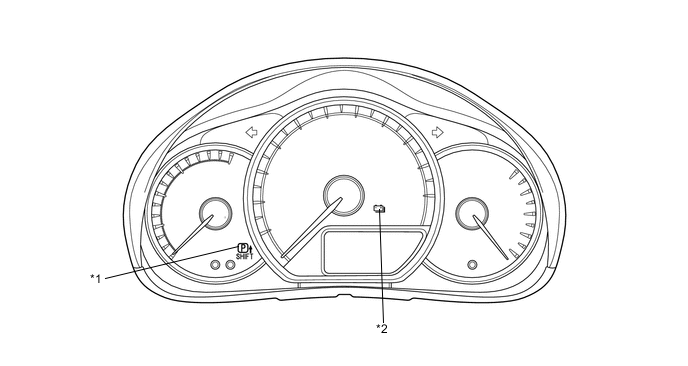
Text in Illustration *1 P Position Request Indicator Light (Blinking) *2 Low Traction Battery Indicator Light (Blinking) -
-
-
When the HV battery is discharged:
-
Using the THS charger, charge the HV battery Click here.
Tech Tips
Perform this operation when the HV battery is discharged or low, or if low traction battery indicator light is blinking and DTC P3000-388 or 389 is stored in the power management control ECU.
-
-
-
ACTIONS TO BE TAKEN FOR VEHICLES DAMAGED BY IMPACT
CAUTION:
This vehicle has a hybrid control system that operates at voltages of up to approximately 520 V. The hybrid control system uses an HV battery that contains an electrolyte which is a strong alkali solution that includes potassium hydroxide. Be sure to follow the instructions in this manual to handle the system correctly. Failure to do so may result in serious injury or electrocution.
-
Items to be prepared for the accident site
-
Protective clothing (insulated gloves, rubber gloves, goggles and safety shoes)
-
20 liters (21.1 US qts, 17.6 Imp. qts) saturated boric acid solution (obtain 800 g (1.76 lb) of boric acid powder, put it into a container, and dissolve it in water)
-
Red litmus paper
-
ABC fire extinguisher (effective against both oil flames and electrical flames)
-
A shop towel or piece of cloth (for wiping off the electrolyte)
-
Insulating tape (for insulating cables)
-
Electrical tester
-
-
Actions to be taken at the accident site
CAUTION:
-
Do not touch any bare cables that may have high-voltage. If a cable must be touched or if accidental contact is possible, wear insulated gloves and insulate the cable using insulating tape.
-
If the vehicle catches on fire, use an ABC fire extinguisher to extinguish the fire. Trying to extinguish a fire using only a small amount of water can be more dangerous than effective. Use a substantial amount of water or wait for firefighters.
-
Visually check the HV battery and the immediate area for any electrolyte leakage. Do not touch any leaked liquid because it could be highly alkaline electrolyte.
-
Work on the vehicle only after the vehicle has been pulled out of the water.
-
Check the vicinity of the HV battery for any leakage of the electrolyte.
CAUTION:
-
Do not touch any leaked liquid because it could be highly alkaline electrolyte. Wear rubber gloves and goggles, neutralize the liquid with saturated boric acid solution and then apply red litmus paper to the liquid. Check that the paper does not turn blue. Wipe the neutralized liquid with a shop towel or piece of cloth.
-
If the electrolyte comes in contact with your skin, use a saturated boric acid solution or a large amount of water to wash it off. If the electrolyte comes in contact with an article of clothing, take it off immediately.
-
If the electrolyte comes in contact with your eyes, call out loudly for help. Do not rub your eyes. Wash them immediately with a large amount of water and seek medical care.
-
-
If damage to any of the high-voltage components and cables is suspected, cut the high-voltage circuit using the following procedure.
CAUTION:
Be sure to wear insulated gloves, goggles and safety shoes.
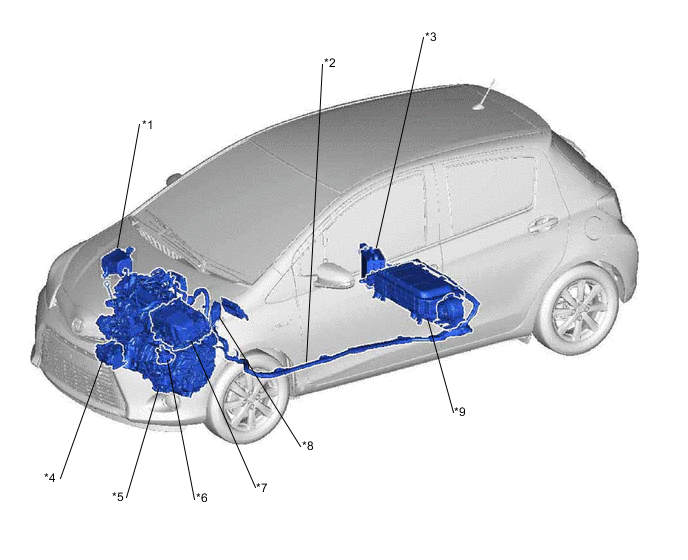
Text in Illustration *1 No. 2 Engine Room Relay Block and No. 2 Junction Block Assembly *2 Frame Wire *3 Auxiliary Battery *4 Compressor with Motor Assembly *5 Hybrid Vehicle Transaxle Assembly *6 Inverter Water Pump Assembly *7 Inverter with Converter Assembly *8 Engine Room Relay Block and Junction Block Assembly *9 HV Battery - - -
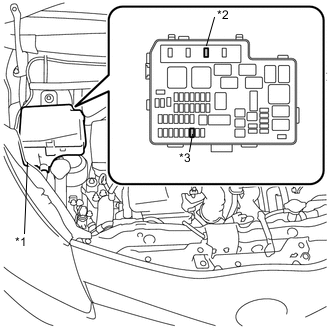
Text in Illustration *1 No. 2 Engine Room Relay Block and No. 2 Junction Block Assembly *2 IG2 Fuse *3 IGCT-MAIN Fuse Turn the ignition switch off.
Tech Tips
If the ignition switch cannot be turned off, remove the IG2 fuse and IGCT-MAIN fuse from the No. 2 engine room relay block and No. 2 junction block assembly. Confirm that the READY indicator light is off.
-
Disconnect the cable from the negative (-) auxiliary battery terminal.
-
Wear insulated gloves and then remove the service plug grip.
Note
After removing the service plug grip, do not turn the ignition switch to ON (READY), unless instructed by the repair manual because this may cause a malfunction.
-
-
Moving the damaged vehicle
If any of the following conditions is met, tow the vehicle away using a tow truck.
Note
When towing the vehicle, refer to the "PRECAUTIONS FOR TOWING VEHICLES".
-
One or more of the high-voltage components and cables are damaged.
-
Components related to driving, the transaxle, or the fuel system are damaged.
-
The hybrid system warning light is on.
-
The READY indicator light does not come on when attempting to turn the ignition switch to ON (READY).
CAUTION:
Before towing the vehicle away using a tow truck, disconnect the cable from the negative (-) auxiliary battery terminal and remove the service plug grip.
Note
Perform the procedure below if the hybrid system warning light turns on, or there are abnormal noises, unusual smells, or strong vibrations while driving:
-
Park the vehicle in a safe place.
-
Apply the parking brake, and then move the shift lever to P position.
-
Turn the ignition switch off, and disconnect the cable from the negative (-) auxiliary battery terminal.
-
Remove the service plug grip while wearing insulated gloves.
-
-
Actions required after moving the damaged vehicle
-
Procedure
If you see any liquid on the road surface, it could be highly alkaline electrolyte leakage.
Wear rubber gloves and goggles, neutralize the liquid with saturated boric acid solution, and then apply red litmus paper to the liquid. Check that the paper does not turn blue. Wipe up the neutralized liquid with a shop towel or piece of cloth.
-
-
Items to be prepared (when repairing a damaged vehicle)
-
Protective clothing (insulated gloves, rubber gloves, goggles and safety shoes)
-
20 liters (21.1 US qts, 17.6 Imp. qts) saturated boric acid solution (obtain 800 g (1.76 lb) of boric acid powder, put it into a container, and dissolve it in water)
-
Red litmus paper
-
A shop towel or piece of cloth (for wiping off the electrolyte)
-
Insulating tape (for insulating cables)
-
Electrical tester
-
-
Precautions to be observed when servicing a damaged vehicle
CAUTION:
Always follow instructions to ensure safety.
-
Wear insulated or rubber gloves, goggles, and safety shoes.
-
Check the HV battery and immediate area for any electrolyte leakage.
CAUTION:
-
Do not touch any leaked liquid because it could be highly alkaline electrolyte. Wear rubber gloves and goggles, neutralize the liquid with saturated boric acid solution and then apply red litmus paper to the liquid. Check that the paper does not turn blue. Wipe the neutralized liquid with a shop towel or piece of cloth.
-
If the electrolyte comes in contact with your skin, use a saturated boric acid solution or a large amount of water to wash it off. If the electrolyte comes in contact with an article of clothing, take it off immediately.
-
If the electrolyte comes in contact with your eyes, call out loudly for help. Do not rub your eyes. Wash them immediately with a large amount of water and seek medical care.
-
-
Do not touch any bare cables that could be high voltage cables. If a cable must be touched or if accidental contact is possible, follow the following instructions: 1) wear insulated gloves and goggles, 2) measure the voltage between the cable and body ground using an electrical tester, and 3) insulate the cable using insulating tape.
-
If damage to any of the high-voltage components and cables is suspected, cut the high-voltage circuit using the procedure below.
CAUTION:
Do not touch any bare cables that may have high-voltage. If a cable must be touched or if accidental contact is possible, wear insulated gloves and insulate the cable using insulating tape.
-
Text in Illustration *1 No. 2 Engine Room Relay Block and No. 2 Junction Block Assembly *2 IG2 Fuse *3 IGCT-MAIN Fuse Turn the ignition switch off.
Tech Tips
If the ignition switch cannot be turned off, remove the IG2 fuse and IGCT-MAIN fuse from the No. 2 engine room relay block and No. 2 junction block assembly. Confirm that the READY light is off.
-
Disconnect the cable from the negative (-) auxiliary battery terminal.
-
Wear insulated gloves, and then remove the service plug.
Note
After removing the service plug grip, do not turn the ignition switch to ON (READY), unless instructed by the repair manual because this may cause a malfunction.
-
-
Precautions to be taken when disposing of an HV battery
-
When disposing of an HV battery, make sure to return it through an authorized collection agent who is capable of handling it safely. If the HV battery is returned via the manufacturer specified route, it will be returned properly and in a safe manner by an authorized collection agent.
CAUTION:
-
Accidents such as electric shock may result if the HV battery is disposed of improperly or abandoned. Therefore, make sure to return all HV batteries through an authorized collection agent.
-
After removing the HV battery, keep it away from water. Exposure to water may cause the HV battery to produce heat, resulting in a fire.
-
-
-
Precautions to be observed when towing
-
Tow the damaged vehicle with its front and rear wheels lifted off the ground.
CAUTION:
Towing the damaged vehicle with its front wheels on the ground will cause the motor to generate electricity. This electricity could, depending on the nature of the damage, leak and cause a fire.
-
-
Towing with the 4 wheels on the ground
CAUTION:
-
If the vehicle needs to be towed using a rope with all 4 wheels on the ground, do not exceed 30 km/h (19 mph) and tow only for a short distance, such as distances required to load onto a lift-type truck or flatbed truck.
-
Turn the ignition switch to ON (IG), move the shift lever to N position.
-
Make sure not to turn the ignition switch off while the vehicle is being towed, or move the shift lever to P position, as it may result in damage or an accident.
-
If any abnormality is present in the damaged vehicle while towing, stop towing immediately.
-
-
-
FOR VEHICLES EQUIPPED WITH SRS AIRBAG AND SEAT BELT PRETENSIONER
This vehicle is equipped with a Supplemental Restraint System (SRS).
CAUTION:
-
Before performing pre-disposal deployment of any SRS component, review and closely follow all applicable environmental and hazardous material regulations. Pre-disposal deployment may be considered hazardous material treatment.
-
Failure to carry out the service operations in the correct sequence could cause the SRS to unexpectedly deploy during servicing and lead to serious injury. Furthermore, if a mistake is made when servicing the SRS, it is possible that the SRS may fail to operate properly. Before servicing (including removal or installation of parts, inspection or replacement), be sure to read the following section carefully.
-
GENERAL NOTICE
-
As malfunctions of the SRS are difficult to confirm, the Diagnostic Trouble Codes (DTCs) become the most important source of information when troubleshooting. When troubleshooting the SRS, always check for DTCs before disconnecting the auxiliary battery.
-
Work must not be started until at least 90 seconds after the ignition switch is turned off and after the cable is disconnected from the negative (-) auxiliary battery terminal.
The SRS is equipped with a back-up power source. If work is started within 90 seconds after turning the ignition switch off and disconnecting the cable from the negative (-) auxiliary battery terminal, the SRS may deploy.
When the cable is disconnected from the negative (-) auxiliary battery terminal, the clock and audio system memory will be cleared. Before starting work, make a note of the settings of each memory system. When work is finished, reset the clock and audio system as before.
CAUTION:
Never use a back-up power source (auxiliary battery or other) to avoid clearing the system memory. The back-up power source may inadvertently power the SRS and cause it to deploy.
-
If the vehicle has been involved in a minor collision where the SRS does not deploy, the steering pad, front passenger airbag assembly, knee airbag assembly, seat side airbag assembly, curtain shield airbag assembly and front seat outer belt assembly should be inspected before further use of the vehicle.
-
Never use SRS parts from another vehicle. When replacing parts, use new ones.
-
Before repairs, remove the airbag sensor assemblies if impacts are likely to be applied to the sensor during repairs.
-
Never disassemble and attempt to repair any airbag sensor assemblies or airbag assemblies.
-
Steering pad
-
Front passenger airbag assembly
-
Knee airbag assembly
-
Seat side airbag assembly
-
Curtain shield airbag assembly
-
Front seat outer belt assembly
-
-
Replace the airbag sensor assemblies and the airbag assemblies if: 1) damage has occurred from being dropped, or 2) cracks, dents or other defects in the case, bracket or connector are present.
-
Do not directly expose the airbag sensor assemblies or airbag assemblies to hot air or flames.
-
Use a voltmeter/ohmmeter with high impedance (minimum = 10 kΩ) for troubleshooting electrical circuits.
-
Information labels are attached to the SRS components. Follow the instructions on the labels.
-
After work on the SRS is completed, check the SRS warning light.
-
-
SPIRAL CABLE
-
The steering wheel must be fitted correctly to the steering column with the spiral cable at the neutral position. Otherwise, cable damage and other problems may occur. Refer to the information about correct installation of the steering wheel Click here.
-
-
STEERING PAD
-
Always place a removed or new steering pad with the surface facing upward. Placing the steering pad with the pad surface facing downward could cause a serious accident if the airbag deploys. Also, do not place anything on top of the steering pad.
-
Never measure the resistance of the airbag squib. This may cause the airbag to deploy, which could cause serious injury.
-
Grease or detergents of any kind should not be applied to the steering pad.
-
Store the steering pad in an area where the ambient temperature is below 93°C (199°F), the humidity is not high and there is no electrical noise.
-
Before using an electric welder anywhere on the vehicle, disconnect the center airbag sensor assembly connectors. These connectors contain shorting springs. This feature reduces the possibility of the airbag deploying due to current entering the squib wiring.
-
When disposing of the vehicle or the steering pad by itself, the airbag should be deployed using SST before disposal Click here. Deploy the airbag in a safe place away from electrical noise.
-
-
FRONT PASSENGER AIRBAG ASSEMBLY
-
Always place a removed or new front passenger airbag assembly with the pad surface facing upward as shown in the illustration. Placing the airbag assembly with the airbag deployment direction facing downward could cause a serious accident if the airbag deploys.
-
Never measure the resistance of the airbag squib. This may cause the airbag to deploy, which could cause serious injury.
-
Grease or detergents of any kind should not be applied to the front passenger airbag assembly.
-
Store the airbag assembly in an area where the ambient temperature is below 93°C (199°F), the humidity is not high and there is no electrical noise.
-
Before using an electric welder anywhere on the vehicle, disconnect the center airbag sensor assembly connectors. These connectors contain shorting springs. This feature reduces the possibility of the airbag deploying due to current entering the squib wiring.
-
When disposing of the vehicle or the airbag assembly unit by itself, the airbag should be deployed using SST before disposal Click here. Deploy the airbag in a safe place away from electrical noise.
-
-
KNEE AIRBAG ASSEMBLY
-
Always place a removed or new knee airbag assembly with the airbag deployment direction facing upward as shown in the illustration. Placing the airbag assembly with the airbag deployment direction facing downward could cause a serious accident if the airbag deploys.
-
Never measure the resistance of the airbag squib. This may cause the airbag to deploy, which could cause serious injury.
-
Grease or detergents of any kind should not be applied to the knee airbag assembly.
-
Store the knee airbag assembly in an area where the ambient temperature is below 93°C (199°F), the humidity is not high and there is no electrical noise.
-
Before using an electric welder anywhere on the vehicle, disconnect the center airbag sensor assembly connectors. These connectors contain shorting springs. This feature reduces the possibility of the airbag deploying due to current entering the squib wiring.
-
When disposing of a vehicle or knee airbag assembly unit by itself, the airbag should be deployed using SST before disposal Click here. Deploy the airbag in a safe place away from electrical noise.
-
-
SEAT SIDE AIRBAG ASSEMBLY
-
Always place a removed or new seat side airbag assembly with the airbag deployment direction facing upward.
-
Never measure the resistance of the airbag squib. This may cause the airbag to deploy, which could cause serious injury.
-
Grease or detergents of any kind should not be applied to the seat side airbag assembly.
-
Store the airbag assembly in an area where the ambient temperature is below 93°C (199°F), the humidity is not high and there is no electrical noise.
-
Before using an electric welder anywhere on the vehicle, disconnect the center airbag sensor assembly connectors. These connectors contain shorting springs. This feature reduces the possibility of the airbag deploying due to current entering the squib wiring.
-
When disposing of a vehicle or the airbag assembly unit by itself, the airbag should be deployed using SST before disposal Click here. Deploy the airbag in a safe place away from electrical noise.
-
-
CURTAIN SHIELD AIRBAG ASSEMBLY
-
Always place a removed or new curtain shield airbag assembly in a clear plastic bag, and keep it in a safe place.
CAUTION:
The plastic bag should be disposed of after use.
Note
Never disassemble the curtain shield airbag assembly.
-
Never measure the resistance of the airbag squib. This may cause the airbag to deploy, which could cause serious injury.
-
Grease or detergents of any kind should not be applied to the curtain shield airbag assembly.
-
Store the airbag assembly in an area where the ambient temperature is below 93°C (199°F), the humidity is not high and there is no electrical noise.
-
Before using an electric welder anywhere on the vehicle, disconnect the center airbag sensor assembly connectors. These connectors contain shorting springs. This feature reduces the possibility of the airbag deploying due to current entering the squib wiring.
-
When disposing of a vehicle or the airbag assembly unit by itself, the airbag should be deployed using SST before disposal Click here. Deploy the airbag in a safe place away from electrical noise.
-
-
FRONT SEAT OUTER BELT ASSEMBLY (SEAT BELT PRETENSIONER)
-
Never measure the resistance of the front seat outer belt assembly. This may cause the pretensioner of the front seat outer belt assembly to activate, which could cause serious injury.
-
Never disassemble the front seat outer belt assembly.
-
Never install the front seat outer belt assembly on another vehicle.
-
Store the seat outer belt assembly in an area where the ambient temperature is below 80°C (176°F), the humidity is not high and there is no electrical noise.
-
Before using an electric welder anywhere on the vehicle, disconnect the center airbag sensor assembly connectors. These connectors contain shorting springs. This feature reduces the possibility of the front seat outer belt assembly deploying due to current entering the squib wiring.
-
When disposing of a vehicle or the front seat outer belt assembly unit by itself, the front seat outer belt assembly should be activated before disposal Click here. Activate the front seat outer belt assembly in a safe place away from electrical noise.
-
As the front seat outer belt assembly is hot after being activated, allow some time for it to cool down sufficiently before disposal. Never apply water to cool down the front seat outer belt assembly.
-
Grease, detergents, oil or water should not be applied to the front seat outer belt assembly.
-
-
CENTER AIRBAG SENSOR ASSEMBLY
-
Never reuse a center airbag sensor assembly that has been involved in a collision where the SRS has deployed.
-
The connectors to the center airbag sensor assembly should be connected or disconnected with the sensor installed to the vehicle. If the connectors are connected or disconnected while the center airbag sensor assembly is not installed, the SRS may activate.
-
Work must be not started until at least 90 seconds after the ignition switch is turned off and the cable is disconnected from the negative (-) auxiliary battery terminal, even if only loosening the bolts of the center airbag sensor assembly.
-
-
WIRE HARNESS AND CONNECTOR
-
All the connectors in the system are a standard yellow color. If an SRS wire harness has an open circuit or a connector is broken, replace it.
-
-
-
ELECTRONIC CONTROL
-
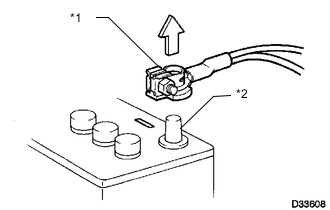
Text in Illustration *1 Cable *2 Negative (-) Auxiliary Battery Terminal REMOVAL AND INSTALLATION OF AUXILIARY BATTERY CABLE
Note
-
Certain systems need to be initialized after disconnecting and reconnecting the cable from the negative (-) auxiliary battery terminal.
-
After the ignition switch is turned off, the navigation receiver assembly (HDD navigation system) records various types of memory and settings. As a result, after turning the ignition switch off, make sure to wait at least 60 seconds before disconnecting the cable from the negative (-) auxiliary battery terminal.
-
Before performing electronic work, disconnect the cable from the negative (-) auxiliary battery terminal to prevent component and wire damage caused by accidental short circuits.
-
When disconnecting the cable, turn the ignition switch off and headlight dimmer switch off and loosen the cable nut completely. Perform these operations without twisting or prying the cable. Then disconnect the cable.
-
Clock settings, radio settings, audio system memory, DTCs and other data are cleared when the cable is disconnected from the negative (-) auxiliary battery terminal. Write down any necessary data before disconnecting the cable.
-
-
HANDLING OF ELECTRONIC PARTS
-
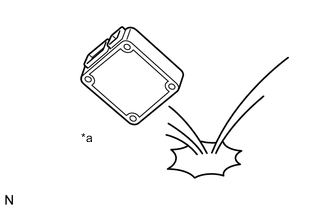
Text in Illustration *a Incorrect Do not open the cover or case of an ECU unless absolutely necessary. If the IC terminals are touched, the IC may be rendered inoperative by static electricity.
-
Do not pull the wires when disconnecting electronic connectors. Pull the connector.
-
Be careful not to drop electronic components, such as sensors or relays. If they are dropped on a hard surface, they should be replaced.
-
When cleaning the engine with steam, protect the electronic components, air filter and emissions-related components from water.
-
Never use an impact wrench to remove or install temperature switches or temperature sensors.
-
When measuring the resistance of a wire connector, insert the tester probe carefully to prevent the terminals from bending.
-
-
-
REMOVAL AND INSTALLATION OF FUEL CONTROL PARTS
-
PLACE FOR REMOVING AND INSTALLING FUEL SYSTEM PARTS
-
Work in a location with good air ventilation that does not have welders, grinders, drills, electric motors, stoves, or any other ignition sources.
-
Never work in a pit or near a pit as vaporized fuel will collect in those places.
-
-
REMOVING AND INSTALLING FUEL SYSTEM PARTS
-
Prepare a fire extinguisher before starting the operation.
-
To prevent static electricity, install a ground wire to the fuel changer, vehicle and fuel tank, and do not spray the surrounding area with water. Be careful when performing work in this area, as the work surface will become slippery. Do not clean up gasoline spills with water, as this may cause the gasoline to spread, and possibly create a fire hazard.
-
Avoid using electric motors, working lights and other electric equipment that can cause sparks or high temperatures.
-
Avoid using iron hammers as they may create sparks.
-
Dispose of fuel-contaminated cloths separately using a fire resistant container.
-
-
-
REMOVAL AND INSTALLATION OF ENGINE INTAKE PARTS
-
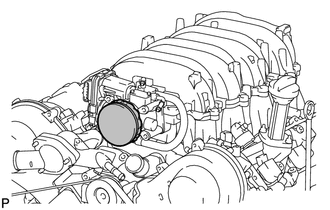
If any metal particles enter inlet system parts, they may damage the engine.
-
When removing and installing inlet system parts, cover the openings of the removed parts and engine openings. Use gummed tape or other suitable materials.
-
When installing inlet system parts, check that no metal particles have entered the engine or the installed parts.
-
-
HANDLING OF HOSE CLAMPS
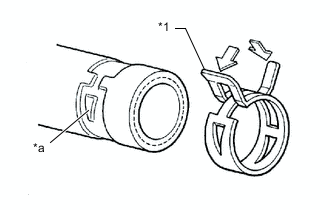
Text in Illustration *1 Spring Type Clamp *a Clamp Track
-
Before removing the hose, check the clamp position so that it can be reinstalled in the same position.
-
Replace any deformed or dented clamps with new ones.
-
When reusing a hose, attach the clamp on the clamp track portion of the hose.
-
For a spring type clamp, you may want to spread the tabs slightly after installation by pushing in the direction of the arrows as shown in the illustration.
-
-
FOR VEHICLES EQUIPPED WITH MOBILE COMMUNICATION SYSTEMS
-
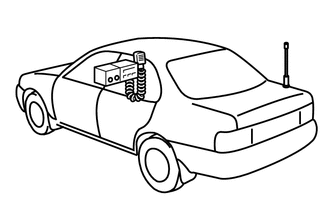
Install the antenna as far away from the ECU and sensors of the vehicle electronic systems as possible.
-
Install the antenna feeder at least 20 cm (7.87 in.) away from the ECU and sensors of the vehicle electronic systems. For details about ECU and sensor locations, refer to the section of the applicable components.
-
Keep the antenna and feeder separate from other wiring as much as possible. This will prevent signals from the communication equipment from affecting vehicle equipment and vice versa.
-
Check that the antenna and feeder are correctly adjusted.
-
Do not install a high-powered mobile communication system.
-
-
WHEN INSPECTING HEADLIGHT
-
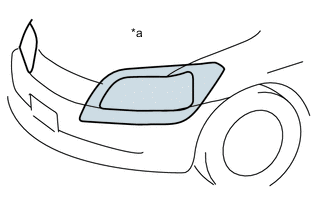
Text in Illustration *a Illumination for 3 minutes or more prohibited if covered When the headlights are illuminated, do not cover the headlights for 3 minutes or more.
Note
-
When the headlight dimmer switch assembly is set to HEAD, do not touch the high-voltage socket area of the discharge headlight.
-
As the outer lens of the headlight is made of resin, the resulting heat created when covering the headlight for an extended period of time may deform the headlight.
-
-
-
FOR VEHICLES EQUIPPED WITH TRACTION CONTROL (TRC) AND VEHICLE STABILITY CONTROL (VSC) SYSTEMS
-
NOTICES FOR WHEN TESTING WITH DRUM TESTER
-
When testing with a 2-wheel drum tester such as a speedometer tester, a combination speedometer and brake tester, or a chassis dynamometer, or when jacking up the front wheels and turning the wheels, perform the following procedure to enter inspection mode and disable the TRC and VSC systems.
Note
-
If the vehicle is tested in normal mode on the tester, TRC and VSC operation may cause the vehicle to jump off of the tester.
-
Secure the vehicle with chains for safety.
-
-
-
NOTICES FOR VSC RELATED PROCEDURES
-
For VSC related parts, adjustments are required after removal and installation. Therefore, perform removal and installation only when necessary.
-
When performing VSC related procedures, be sure to strictly follow the preparation and completion procedures.
-
When performing removal and installation or replacement of VSC related parts, first disconnect the cable from the negative (-) auxiliary battery terminal.
-
-
-
WHEN INSPECTING VEHICLES
Note
When the vehicle is run in inspection mode for an operation such as a speedometer test, a DTC may be set. Therefore, if the warning light comes on, after canceling inspection mode, check for DTCs using the GTS and clear the DTCs.
-
VEHICLE CONDITIONS
-
Before activating inspection mode, turn the air conditioning off, start the hybrid control system with shift lever in P position, and check that the engine stops within several seconds after starting (engine warm up check).
-
Activate the appropriate inspection mode and inspect the vehicle Click here.
Tech Tips
Different types of inspection mode are available. One is maintenance mode, and the other is certification mode. The following table indicates the mode appropriate for each test item.
Test Item Mode 1. Vehicle straight travelling test (side slip inspection) Maintenance mode or normal mode 2. Braking force test Normal mode 3. Speedometer test Maintenance mode 4. Exhaust gas test (idling) Maintenance mode 5. Headlight test Maintenance mode or normal mode -
Cancel inspection mode immediately after completion of inspection.
Note
Driving the vehicle without canceling inspection mode may damage the transaxle.
-
-
WHEN USING A BRAKE TESTER
CAUTION:
Be sure to perform the test in maintenance mode.
Note
-
A high-speed type brake tester cannot be used.
-
Vehicle speed should be less than 0.5 km/h (0.3 mph).
-
Follow all usage and safety procedures in the operator's manual for the brake tester.
-
Place the wheels to be tested (front or rear) onto the rollers.
-
Start the hybrid control system to allow normal brake booster operation.
-
Move the shift lever to N position.
-
Operate the brakes to perform the test.
-
-
WHEN USING A SPEEDOMETER TESTER
CAUTION:
Be sure to perform the test in maintenance mode.
Note
Do not perform rapid starting or quick acceleration on a speedometer tester. If rapid starting or quick acceleration is performed on a speedometer tester, damage may occur to the transaxle.
-
Depress the accelerator pedal slowly and gradually accelerate the vehicle. Make a measurement.
-
After the measurement, use the brakes to gradually decelerate the vehicle.
-
-
WHEN USING A CHASSIS DYNAMOMETER
-
Always set an appropriate load before starting the test.
Note
Sudden acceleration or deceleration of the vehicle on a chassis dynamometer under minimal load may damage the transaxle.
-
-
WHEN USING AN ON-VEHICLE BALANCER
-
Raise the vehicle until all 4 wheels are off the ground.
-
Support the vehicle with safety stands at an appropriate height. Make sure that the vehicle does not lean in any direction, and that the tires are completely clear of the floor.
-
Place the vibration pick-up unit into position for the wheel to be measured*1.
Tech Tips
*1: Different on-vehicle wheel balancers have different requirements for mounting the vibration pick-up unit(s). Refer to the operator's manual for the wheel balancer to confirm requirements for use.
-
Release the parking brake.
-
Check that no dragging force exists when turning each wheel by hand.
-
Put the wheel balancer in position.
-
Wheel balance measurement should be done by using both the engine and the wheel balancer drive roller to spin the wheels.
Note
-
Be sure to perform the test in maintenance mode.
-
Start the hybrid control system and then increase the vehicle speed gradually with the shift lever in D position.
-
Do not accelerate or decelerate suddenly.
-
Deceleration should be done by braking gradually.
-
Make sure that no one is standing in-line with the spinning wheels.
-
Measurement should be done quickly.
-
Confirm that the vehicle is securely immobilized.
-
Follow all usage and safety procedures in the operator's manual for the wheel balancer.
-
-
-
-
PRECAUTIONS FOR TOWING VEHICLES
-
Use one of the following methods to tow the vehicle.
-
If the vehicle has trouble with the chassis or drivetrain, use method 1 (flatbed truck).
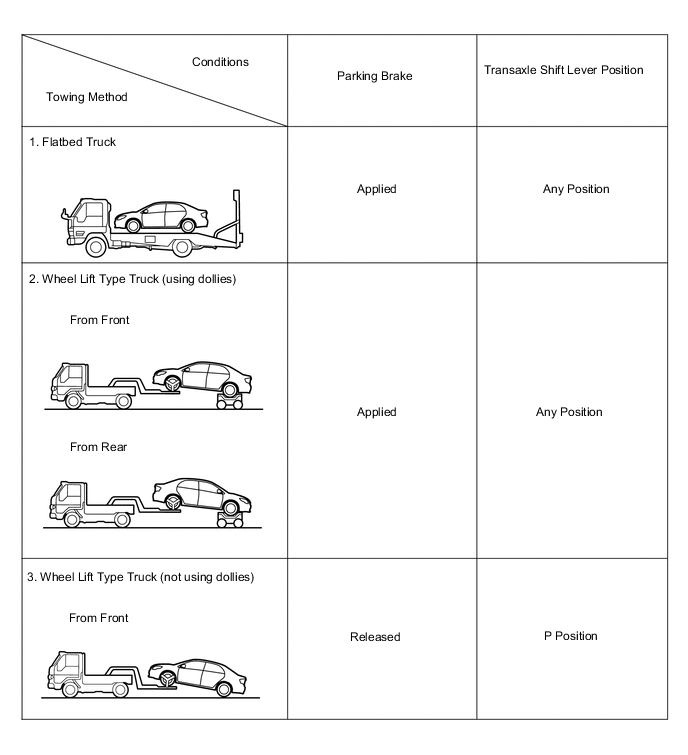
Note
Do not use any towing method other than those shown above.
-
If a tow truck is not available, in an emergency the vehicle may be temporarily towed using a cable or chain secured to the emergency towing eyelet(s). This should only be attempted on hard surfaced roads for short distances, such as distances required to load onto a lift-type truck or flatbed truck, at under 30 km/h (19 mph).
A driver must be in the vehicle to steer and operate the brakes. The vehicle's wheels, drivetrain, axles, steering and brakes must be in good condition.
Note
If the towing speed or distance exceeds the above limits, or the vehicle is towed with the front wheels on the ground, the transaxle may be damaged.
-
Emergency towing procedure
-
Turn the ignition switch to ON (IG).
-
Depress the brake pedal and move the transmission shift lever to N position.
-
Release the parking brake.
-
Release the brake pedal slowly.
Note
-
Use extreme caution when towing the vehicle. Avoid sudden starts or erratic driving maneuvers which place excessive stress on the emergency towing eyelet and the cables or chains.
-
If the hybrid control system is off, the power assist for the brakes and steering will not function, making steering and braking more difficult.
-
Do not turn off the ignition switch. Turning off the ignition switch may result in engagement of the steering lock, resulting in a hazardous situation or accident.
-
-
-
The following towing methods shown below are dangerous and can damage the vehicle, so do not use them.
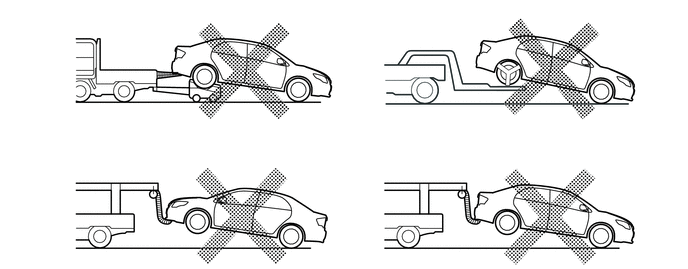
-
Do not tow the vehicle with the front wheels on the ground.
Note
If the vehicle is towed with the front wheels on the ground, the drivetrain may overheat and be damaged.
-
Do not use a sling-type towing method either from the front or rear.
Note
If a sling-type tow truck is used, damage may occur to the vehicle body.
-
-
-
FOR VEHICLES EQUIPPED WITH CATALYTIC CONVERTER
CAUTION:
If a large amount of unburned gasoline or gasoline vapors flow into the converter, it may cause converter overheating and create a fire hazard. To prevent this, observe the following precautions:
-
Use only unleaded gasoline.
-
Avoid idling the engine for more than 20 minutes.
-
Avoid performing unnecessary spark tests.
-
Perform a spark test only when absolutely necessary. Perform this test as rapidly as possible.
-
While testing, never race the engine unless instructed.
-
-
Avoid a prolonged engine compression measurement. Engine compression measurements must be performed as rapidly as possible.
-
Do not run the engine when the fuel tank is nearly empty. This may cause the engine to misfire and create an extra load on the converter.
-