СИСТЕМА ECD, Diagnostic DTC:P0400
| DTC Code | DTC Name |
|---|---|
| P0400 | Exhaust Gas Recirculation Flow |
DESCRIPTION
The EGR system recirculates exhaust gases back to the combustion chambers. The recirculated gas is intermixed with the intake air to slow combustion speed and keep the combustion temperature down. This helps reduce NOx emissions.
In order to increase EGR circulation efficiency, the ECM adjusts the EGR valve angle and the throttle valve angle.
| DTC Detection Drive Pattern | DTC Detection Condition | Trouble Area |
|---|---|---|
| All of following conditions are met:
|
Both of following conditions are met for 3 times in one driving cycle:
(1 trip detection logic) |
|
| DTC Detection Drive Pattern | DTC Detection Condition | Trouble Area |
|---|---|---|
| Ignition switch from ON to off | EGR valve position does not move smoothly within predetermined time of ignition switch being turned from ON to off. |
|
| DTC Detection Drive Pattern | DTC Detection Condition | Trouble Area |
|---|---|---|
| Idling after warming up engine | Target and actual mass air flow rates differ (2 trip detection logic) |
|
| DTC No. | Data List |
|---|---|
| P0400 (EGR valve malfunction) |
|
| P0400 (Flow malfunction) |
|
Tech Tips
-
If DTC P0400 is stored, the following symptoms may appear:
-
Black smoke
-
Lack of power
-
Combustion noise worsens
-
Lack of power due to a fail-safe operation
-
If a large amount of carbon deposits exists in the EGR valve assembly, the following parts possibly also have deposits inside: the intake manifold, diesel throttle body assembly, DPF catalyst, and other parts related to the exhaust gas.
-
For vehicles with DPF catalyst:
If the DPF catalyst has become clogged with PM (Particulate Matter) and the value of the "Catalyst Differential Press" is more than 0.4 at an engine speed of 4000 rpm, DTC P2463 (Diesel Particulate Filter Restriction - Soot Accumulation) may be present. If the value of the "Catalyst Differential Press" is about 0.4 or less at an engine speed of 4000 rpm, the catalyst is probably clogged with PM even if DTC P2463 is not present. Check the Catalyst Differential Press by entering the following menus on an intelligent tester: Powertrain / Engine and ECT / Data List / Catalyst Differential Press.
If the DPF catalyst has become clogged with PM (Particulate Matter) and the value of the "DPF Differential Pressure" is more than 80 kPa, DTC P244B (Diesel Particulate Filter Differential Pressure Too High) may be present. If the value of the "DPF Differential Pressure" is more than 80 kPa, the catalyst is probably clogged with PM even if DTC P244B is not present. Check the DPF Differential Pressure by entering the following menus on an intelligent tester: Powertrain / Engine and ECT / Data List / DPF Differential Pressure.
MONITOR DESCRIPTION
Either of the following conditions is met:
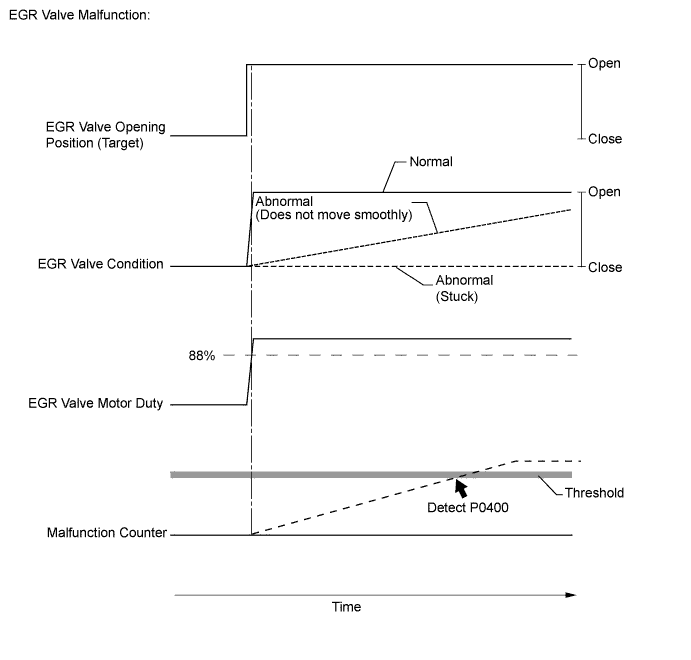
EGR valve malfunctionWhen the target and actual positions of the EGR valve are different, the ECM interprets this as a malfunction of the EGR valve and illuminates the MIL.
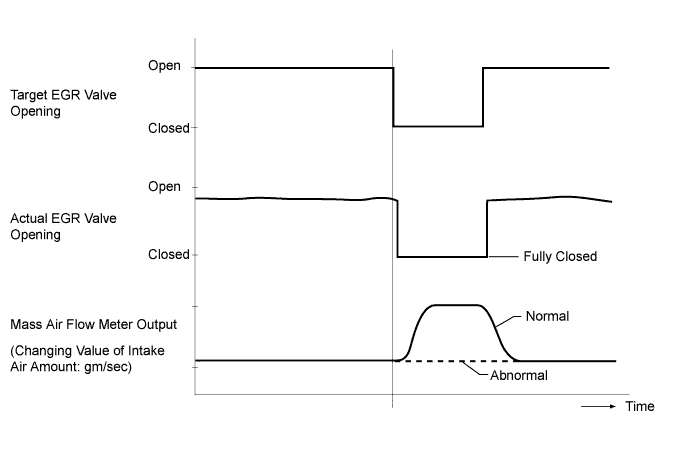
If the target and actual mass air flow rates are different, the ECM determines that the EGR valve is malfunctioning.
WIRING DIAGRAM
Refer to DTC P0405 Click here.
INSPECTION PROCEDURE
Note
-
When cleaning the EGR valve or the diesel throttle body, use a piece of cloth. Spraying the solvent directly onto these parts or soaking the parts in the solvent may damage the parts.
-
When replacing the ECM, the ECM needs Registration and Initialization Click here.
Tech Tips
-
When the ECM must be replaced, before replacing the ECM, perform the "Learning Values Save" function using the intelligent tester. Then after installing the new ECM, perform all of the initializations/registrations for the "Learning Values Write" function by following the instructions shown on the tester display.
-
Read freeze frame data using the intelligent tester. Freeze frame data records the engine condition when malfunctions are detected. When troubleshooting, freeze frame data can help determine if the vehicle was moving or stationary, if the engine was warmed up or not, and other data from the time the malfunction occurred.
-
Data List items related to P0400 are listed below:
-
Target EGR Position
-
Actual EGR Valve Pos.
-
MAF
-
MAP
-
Target Booster Pressure
-
Atmosphere Pressure
-
Coolant Temp
-
Injection Feedback Val #1 to #4
-
Injection Volume
PROCEDURE
-
CHECK ANY OTHER DTCS OUTPUT (IN ADDITION TO DTC P0400)
-
Connect the intelligent tester to the DLC3.
-
Turn the ignition switch to ON and turn the tester on.
-
Enter the following menus: Powertrain / Engine and ECT / DTC.
-
Read the DTCs.
Result Result Proceed to DTC P0400 A DTC P0400 and other DTCs B Tech Tips
If any DTCs other than P0400 are output, troubleshoot those DTCs first.
B 
GO TO DTC CHART Click here
A 
-
-
CHECK FREEZE FRAME DATA (TARGET EGR POSITION AND ACTUAL EGR VALVE POS.)
-
Connect the intelligent tester to the DLC3.
-
Turn the ignition switch to ON and turn the tester on.
-
Read the values of Target EGR Position and Actual EGR Valve Pos. in Freeze Frame Data.
Standard Actual EGR Valve Pos. is within +/-1% of Target EGR Position.
OK 
CHECK FOR EXHAUST GAS LEAKS Click here
NG
INSPECT ELECTRIC EGR CONTROL VALVE ASSEMBLY (FULL CLOSE) Click here
-
-
CHECK FOR EXHAUST GAS LEAKS
-
Check for exhaust gas leaks.
Result Result Proceed to Exhaust gas leaks out from exhaust system A No leaks B
B
CHECK AIR INDUCTION SYSTEM (AIR LEAKS AND BLOCKAGES) Click here
A
-
-
REPAIR EXHAUST GAS LEAKAGE POINT
-
Repair or replace the malfunctioning part in the exhaust system.
NEXT
-
-
CHECK AIR INDUCTION SYSTEM (AIR LEAKS AND BLOCKAGES)
-
Check for air leaks and blockages in the air intake system.
Result Result Proceed to Leaks or blockages exist in the air intake system A No leaks and blockages in the intake system B Tech Tips
-
Check for abnormal disconnection, pipe and hose squashing, and any damages in the intake system.
-
Using your hand, check whether the pipes and hoses in the intake system are securely connected.
-
Applying soapy water and revving the engine, air leaks from the intake system can be checked.
-
Check for any modifications in the intake system made by the user.
-
B
CHECK FOR DEPOSIT (EGR PASSAGE) Click here
A
-
-
REPAIR OR REPLACE AIR INDUCTION SYSTEM
-
Repair or replace the malfunctioning part in the air intake system.
NEXT
CHECK FOR DEPOSIT (EGR PASSAGE) Click here
-
-
INSPECT ELECTRIC EGR CONTROL VALVE ASSEMBLY (FULL CLOSE)
-
Remove the electric EGR valve assembly.
-
Visually check the electric EGR control valve for deposits. If there are deposits, clean the electric EGR control valve.
Note
-
When cleaning the electric EGR control valve, make sure the valve is completely closed.
-
When cleaning the electric EGR control valve, use a piece of cloth. Spraying the solvent directly onto these parts or soaking the parts in the solvent may damage the parts.
-
-
Hold the electric EGR control valve up to a light, and then from the side indicated by the arrow in the illustration, visually check that there is no gap between the valve and body.
OK No light passes through (there is no gap between the valve and body). 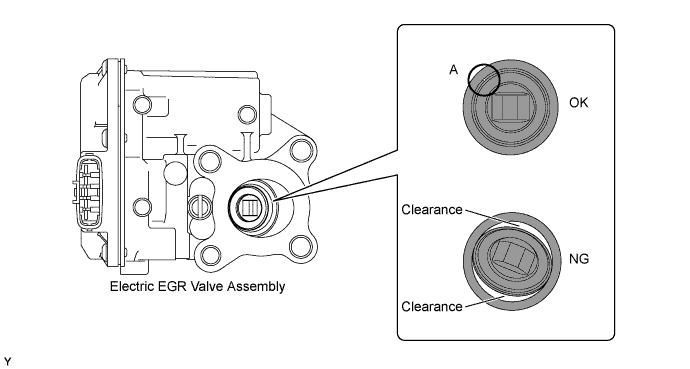
Tech Tips
-
Hold the EGR valve to a light and confirm that the valve contacts with the valve seat securely.
-
If light leaks out from the valve, the EGR valve is not fully closed.
-
If the EGR valve cannot close fully, hesitation or poor acceleration almost certainly has occurred while driving the vehicle.
-
Even if the EGR valve is closed completely, light leaks from the closed gap of valve seat (A part) as shown in the illustration, but this is normal.
-
OK
PERFORM ACTIVE TEST USING INTELLIGENT TESTER (CONTROL THE EGR STEP POSITION) Click here
NG
REPLACE ELECTRIC EGR CONTROL VALVE ASSEMBLY Click here
-
-
REPLACE ELECTRIC EGR CONTROL VALVE ASSEMBLY
-
Replace the electric EGR valve assembly Click here.
Tech Tips
Install the new electric EGR valve assembly after the inspection of EGR valve operation (next step).
-
Connect the electric EGR valve assembly connector.
-
Turn the ignition switch to ON.
-
Turn the ignition switch off and wait for 30 seconds or more.
NEXT
-
-
PERFORM ACTIVE TEST USING INTELLIGENT TESTER (CONTROL THE EGR STEP POSITION)
-
With the EGR valve assembly removed from the vehicle, connect the EGR valve connector.
-
Connect the intelligent tester to the DLC3.
-
Turn the ignition switch to ON and turn the tester on.
-
Enter the following menus: Powertrain / Engine and ECT / Active Test / Control the EGR Step Position / Data List / Actual EGR Valve Pos.
-
When changing the Active Test value for 0, 25, 50, 75 and 100%, check that Actual EGR Valve Pos. smoothly changes to the set opening angle.
OK Value smoothly changes to the set opening angle. Tech Tips
-
EGR valve closed: Actual EGR Valve Pos. is 0%
-
EGR valve open: Actual EGR Valve Pos. is 100%
-
OK
CHECK FOR DEPOSIT (EGR PASSAGE) Click here
NG
CHECK HARNESS AND CONNECTOR (ELECTRIC EGR VALVE ASSEMBLY - ECM) Click here
-
-
CHECK HARNESS AND CONNECTOR (ELECTRIC EGR VALVE ASSEMBLY - ECM)
-
Disconnect the electric EGR valve assembly connector.
-
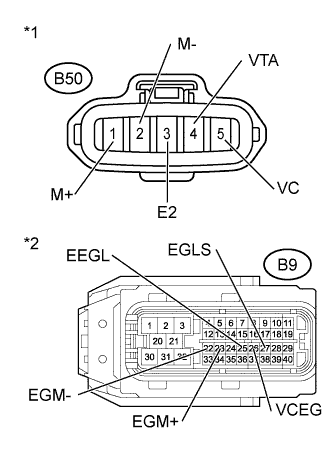
*1 Front view of wire harness connector
(to Electric EGR Valve Assembly)
*2 Front view of wire harness connector
(to ECM)
Disconnect the ECM connector.
-
Measure the resistance according to the value(s) in the table below.
Standard Resistance (Check for Open) Tester Connection Condition Specified Condition B50-5 (VC) - B9-26 (VCEG) Always Below 1 Ω B50-4 (VTA) - B9-27 (EGLS) Always Below 1 Ω B50-3 (E2) - B9-25 (EEGL) Always Below 1 Ω B50-2 (M-) - B9-22 (EGM-) Always Below 1 Ω B50-1 (M+) - B9-23 (EGM+) Always Below 1 Ω Standard Resistance (Check for Short) Tester Connection Condition Specified Condition B50-5 (VC) or B9-26 (VCEG) - Body ground Always 10 kΩ or higher B50-4 (VTA) or B9-27 (EGLS) - Body ground Always 10 kΩ or higher B50-2 (M-) or B9-22 (EGM-) - Body ground Always 10 kΩ or higher B50-1 (M+) or B9-23 (EGM+) - Body ground Always 10 kΩ or higher -
Reconnect the electric EGR valve assembly connector.
-
Reconnect the ECM connector.
NG
REPAIR OR REPLACE HARNESS OR CONNECTOR Click here
OK
-
-
REPLACE ELECTRIC EGR CONTROL VALVE ASSEMBLY
Tech Tips
If the EGR valve assembly has already been replaced, proceed to next step.
-
Replace the electric EGR valve assembly Click here.
-
Turn the ignition switch to ON.
-
Turn the ignition switch off and wait for 30 seconds or more.
NEXT
CHECK FOR DEPOSIT (EGR PASSAGE) Click here
-
-
REPAIR OR REPLACE HARNESS OR CONNECTOR
NEXT
-
CHECK FOR DEPOSIT (EGR PASSAGE)
-
Check the deposit conditions in the electric EGR valve assembly and the EGR passage of the intake manifold.
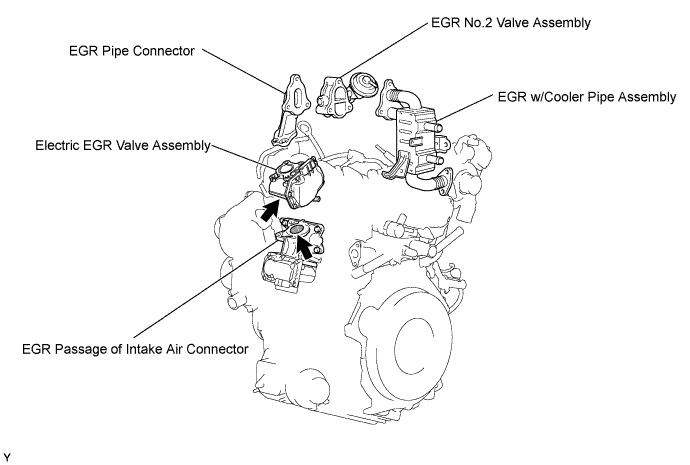
Result Result Proceed to Wet carbon exists A Dry carbon exists B Tech Tips
-
Wet carbon: Tar carbon that is sticky, or shiny carbon that is hard and smooth to the touch.
-
Dry carbon: Carbon that is dried, not shiny, and peels easily.
-
If wet carbon deposit exists in the EGR valve and EGR passage, an EGR valve slow response malfunction may occur in the EGR valve operation due to sticky carbon deposit. In this case, hesitation or poor acceleration will occur while driving the vehicle.
-
B
REMOVE DEPOSIT (CLEAN EGR PASSAGE) Click here
A
-
-
REPLACE ELECTRIC EGR CONTROL VALVE ASSEMBLY
Tech Tips
If the EGR valve assembly has already been replaced, proceed to next step.
-
Replace the electric EGR valve assembly Click here.
-
Turn the ignition switch to ON.
-
Turn the ignition switch off and wait for 30 seconds or more.
NEXT
CHECK FOR CAUSE OF FAILURE Click here
-
-
REMOVE DEPOSIT (CLEAN EGR PASSAGE)
-
Remove the electric EGR valve assembly, diesel throttle body assembly, intake air connector and EGR pipe connector.
-
Remove the deposits from those parts and clean them.
Note
-
When cleaning the EGR valve and the diesel throttle body, use a piece of cloth. Spraying the solvent directly onto these parts or soaking the parts in the solvent may damage the parts.
-
Extreme care must be taken to prevent the removed deposits from falling into the engine unit during cleaning.
Tech Tips
-
Remove the intake manifold from the cylinder head when it has to be cleaned.
-
Do not leave any deposits in the EGR valve assembly when cleaning the valve.
-
-
Reinstall the electric EGR valve assembly, diesel throttle body assembly, intake air connector and EGR pipe connector.
NEXT
-
-
CHECK FOR CAUSE OF FAILURE
Tech Tips
If causes of black smoke emissions are in the engine, the exhaust system easily clogs with carbon deposits. Check for black smoke emissions in the exhaust gas, and repair the cause of black smoke, if repair is necessary.
-
Start the engine and warm it up.
-
Turn the ignition switch off.
-
Connect the intelligent tester to the DLC3.
-
Read the values of the Data List items when the engine is under the following conditions.
-
Ignition switch ON (Engine not running).
-
Idling (after 1 minute or more elapsed)
-
Engine maintained at 4500 rpm with no load
-
-
Take snapshots with the intelligent tester for each engine condition above and analyze the cause of black smoke emission referring to the table below.
Engine Condition Data List Item Standard Diagnostic Note Ignition switch ON MAP Difference between MAP and Atmosphere Pressure is +/-7 kPa or less If the difference exceeds the standard range, the sensor that indicates the value most different from the actual atmospheric pressure is malfunctioning. Atmosphere Pressure Injector Compensation Code*1 The injector compensation codes stored in the ECM match the injector compensation codes of the installed fuel injectors. If the codes do not match, input the correct codes referring to "Registration". Idling Injection Feedback Val #1
Injection Feedback Val #2
Injection Feedback Val #3
Injection Feedback Val #4
-2.0 to 2.0 mm3/st
The injector for which the value is out of standard range is malfunctioning. Injection Volume Less than 8 mm3/st
- Coolant Temp
-
75°C (167°F) or more: After warming up the engine
-
When the engine is stopped and left overnight, the engine coolant temperature should be nearly equal to the intake air temperature.
If the value is out of standard range, check the engine coolant temperature sensor circuit. 4500 rpm with no load MAP
and
Target Booster Pressure
Difference between MAP and Target Booster Pressure is +/-15 kPa or less If the values are out of standard range, check the following items.
-
Intake system (leaks or blockages)
-
Turbocharger sub-assembly
-
Mass air flow meter circuit
-
Turbo pressure sensor circuit
Corrected MAF value*2 66.75 +/-13.4 gm/sec.
When the following conditions are met:
-
Engine speed is 4500 rpm
-
MAP is 170 kPa
-
Intake Air Temp (Turbo) is 42°C
-
*1: Check the Injector Compensation Codes by entering the following menus: Powertrain / Engine and ECT / Utility / Injector Compensation.
Tech Tips
-
*2: The MAF value should be corrected by applying the following formula.
MAF corrected [gm/sec] = MAF measured [gm/sec] x {4500 x 170 x (42 + 273)}/ {Engine Speed [rpm] x MAP [kPa] x (Intake Air Temp (Turbo) + 273)}
-
Example data
Engine speed: 4800 rpm, MAP: 166 kPa, MAF: 72.0, Intake Air Temp (Turbo): 63°C
72.0 x {4500 x 170 x (42 + 273)} / {4800 x 166 x (63 + 273)} = 64.81
-
If the value calculated by applying the above formula is higher than the standard, leaks may exist between the turbocharger and the intake manifold.
-
If the value calculated by applying the above formula is lower than the standard, leaks may exist between the air cleaner and the turbocharger.
-
-
Check the vacuum hose connection (turbo pressure sensor).
-
Check for air leaks in the intake pipes and hoses between the turbocharger and the intake manifold.
-
Check for air leaks in the intake manifold.
-
Check the turbocharger sub-assembly.
-
Check for deposit in the EGR cooler.
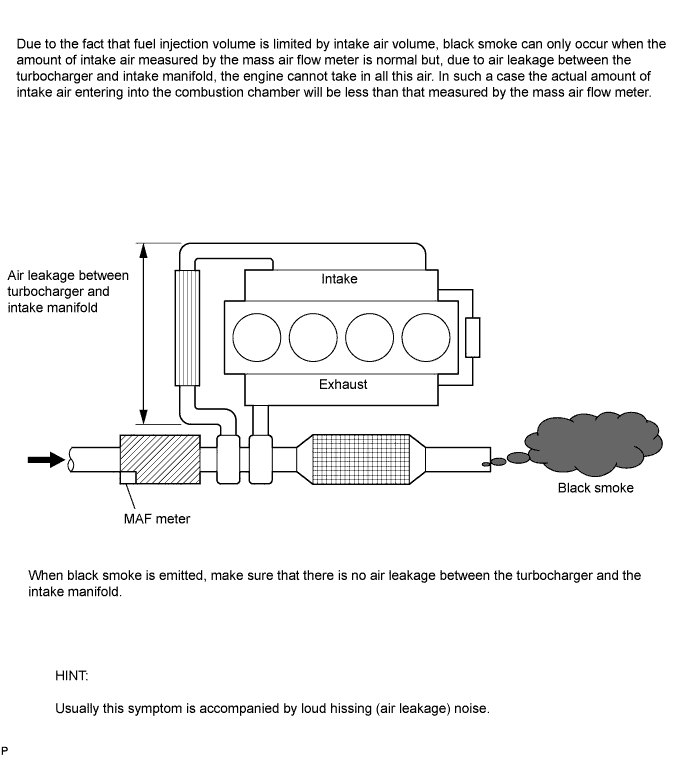
-
If any malfunctions are found, repair or replace them.
NEXT
-
-
CHECK WHETHER DTC OUTPUT RECURS (DTC P0400)
-
Connect the intelligent tester to the DLC3.
-
Turn the ignition switch to ON and turn the tester on.
-
Clear the DTCs Click here.
-
Turn the ignition switch off and wait for 30 seconds or more.
-
Start the engine and warm it up.
-
Taking 10 seconds, depress the accelerator pedal until the engine speed reaches 4000 rpm. (A)
-
Release the accelerator pedal and allow the engine to idle for 30 seconds. (B)
-
Repeat (A) and (B) procedures 5 times or more.
-
Enter the following menus: Powertrain / Engine and ECT / Utility / All Readiness.
-
Input DTC P0400.
-
Check the DTC judgment result.
Result Result Proceed to ABNORMAL A NORMAL B Tech Tips
If STATUS is INCOMPLETE or UNKNOWN, repeat the (A) and (B) driving pattern process 5 times or more.
B
END
A
-
-
REPLACE ELECTRIC EGR CONTROL VALVE ASSEMBLY
Tech Tips
If the EGR valve assembly has already been replaced, proceed to next step.
-
Replace the electric EGR valve assembly Click here.
-
Turn the ignition switch to ON.
-
Turn the ignition switch off and wait for 30 seconds or more.
NEXT
-
-
CHECK WHETHER DTC OUTPUT RECURS (DTC P0400)
-
Connect the intelligent tester to the DLC3.
-
Turn the ignition switch to ON and turn the tester on.
-
Clear the DTCs Click here.
-
Turn the ignition switch off and wait for 30 seconds or more.
-
Start the engine and warm it up.
-
Taking 10 seconds, depress the accelerator pedal until the engine speed reaches 4000 rpm. (A)
-
Release the accelerator pedal and allow the engine to idle for 30 seconds. (B)
-
Repeat (A) and (B) procedures 5 times or more.
-
Enter the following menus: Powertrain / Engine and ECT / Utility / All Readiness.
-
Input DTC P0400.
-
Check the DTC judgment result.
Result Result Proceed to ABNORMAL A NORMAL B Tech Tips
If STATUS is INCOMPLETE or UNKNOWN, repeat the (A) and (B) driving pattern process 5 times or more.
B
END
A
-
-
REPLACE ECM
-
Replace the ECM Click here.
NEXT
-
-
CONFIRM WHETHER MALFUNCTION HAS BEEN SUCCESSFULLY REPAIRED
-
Connect the intelligent tester to the DLC3.
-
Turn the ignition switch to ON and turn the tester on.
-
Clear the DTCs Click here.
-
Turn the ignition switch off and wait for 30 seconds or more.
-
Start the engine and warm it up.
-
Taking 10 seconds, depress the accelerator pedal until the engine speed reaches 4000 rpm. (A)
-
Release the accelerator pedal and allow the engine to idle for 30 seconds. (B)
-
Repeat (A) and (B) procedures 5 times or more.
-
Enter the following menus: Powertrain / Engine and ECT / DTC.
-
Confirm that the DTC is not output again.
Tech Tips
Perform the following procedure using the tester to determine whether or not the DTC judgment has been carried out.
-
Enter the following menus: Powertrain / Engine and ECT / Utility / All Readiness.
-
Input DTC P0400.
-
Check that STATUS is NORMAL. If STATUS is INCOMPLETE or UNKNOWN, repeat the (A) and (B) driving pattern process 5 times or more.
-
NEXT 
END
-