ENTRY AND START SYSTEM (for Entry Function) All Door Entry Lock/Unlock Functions do not Operate, but Wireless Functions Operate
DESCRIPTION
When the wireless functions can be used to lock and unlock the doors, the communication between the door control receiver and certification ECU is normal. When the entry functions do not operate, one of the following may be the cause: 1) entry cancel function is set through customization; 2) malfunction in the entry and start system communication (electrical key transmitter and vehicle); or 3) electrical interference.
INSPECTION PROCEDURE
Note
-
The entry and start system (for entry function) uses a multiplex communication system (LIN communication system) and CAN communication system. Inspect the communication function by following How to Proceed with Troubleshooting Click here. Troubleshoot the entry and start system (for entry function) after confirming that the communication system is functioning properly.
-
When using the intelligent tester with the engine switch off to troubleshoot: Connect the intelligent tester to the DLC3, and turn a courtesy light switch on and off at 1.5-second intervals until communication between the tester and vehicle begins
PROCEDURE
-
CHECK POWER DOOR LOCK OPERATION
-
When the door control switch on the master switch is operated, check that the doors unlock and lock according to switch operation Click here.
OK Door locks operate normally.
NG 
GO TO POWER DOOR LOCK CONTROL SYSTEM (PROCEED TO PROBLEM SYMPTOMS TABLE) Click here
OK 
-
-
READ VALUE USING INTELLIGENT TESTER (ENTRY CANCEL FUNCTION)
-
Connect the intelligent tester to the DLC3.
-
Turn the engine switch on (IG).
-
Turn the intelligent tester on.
-
Enter the following menus: Body / Entry & Start / Data List.
-
Read the Data List according to the display on the intelligent tester.
Entry and Start Tester Display Measurement Item/Range Normal Condition Diagnostic Note Auto Entry Cancel SW Entry function cancel / ON or OFF Mode status displayed - Result Result Proceed to Entry function cancel is OFF A Entry function cancel ON B
B
PERFORM CANCELLATION OF ENTRY KEY CANCEL FUNCTION Click here
A
-
-
CHECK WAVE ENVIRONMENT
-
Move the electrical key transmitter as described below and perform the operation inspection.
Tech Tips
-
When the electrical key transmitter is brought near the door outside handle assembly or electrical key antenna, the possibility of wave interference decreases, and it can be determined if wave interference is causing the problem symptom.
-
The transmitting waves of the wireless functions and entry functions are the same, but the wave logic is different. Therefore, it is possible that only the wireless functions or only the entry functions are affected by wave interference.
-
-
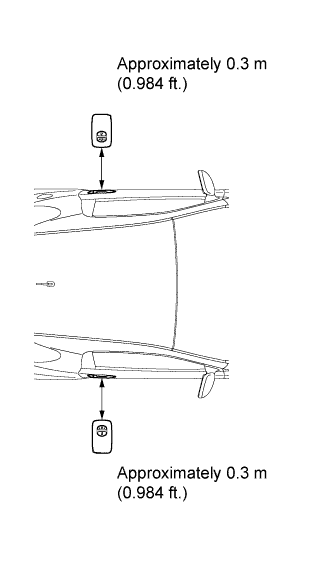
Bring the electrical key transmitter near the driver door outside handle assembly, and perform a front driver door entry lock and unlock operation check.
Note
If the key is brought within 0.2 m (0.656 ft.) of the door outside handle assembly, communication is not possible.
-
Bring the electrical key transmitter near the front passenger door outside handle assembly, and perform a front passenger door entry lock and unlock operation check.
Note
If the key is brought within 0.2 m (0.656 ft.) of the door outside handle assembly, communication is not possible.
-
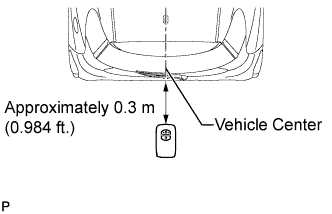
Bring the electrical key transmitter near the outside electrical key oscillator (outside luggage), and perform an entry back door open function check.
Note
If the key is brought within 0.2 m (0.656 ft.) of the rear bumper, communication is not possible.
Tech Tips
If the inspection result indicates that the problem only occurs in certain locations or times of day, the possibility of wave interference is high. Also, added vehicle components may cause wave interference. If installed, remove them and perform the operation check.
Result Result Proceed to All operation checks fail A All checks are normal B Some operation checks are normal C
B
AFFECTED BY WAVE INTERFERENCE
C
GO TO OTHER PROBLEM (PROCEED TO PROBLEM SYMPTOMS TABLE FOR EACH DOOR) Click here
A
-
-
PERFORM KEY DIAGNOSTIC MODE INSPECTION
-
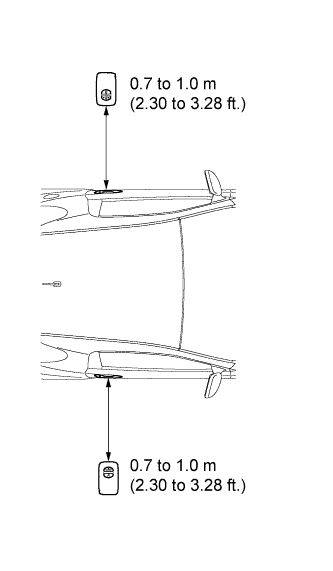
Diagnostic mode inspection (door electrical key oscillator (for driver side))
-
Connect the intelligent tester to the DLC3.
-
Turn the engine switch on (IG).
-
Turn the intelligent tester on.
-
Enter the following menus: Body / Entry & Start / Key Communication Check / Overhead + Driver Side.
-
When the electrical key transmitter is in the position shown in the illustration, check that the wireless door lock buzzer sounds.
-
-
Diagnostic mode inspection (door electrical key oscillator (for passenger side))
-
Connect the intelligent tester to the DLC3.
-
Turn the engine switch on (IG).
-
Turn the intelligent tester on.
-
Enter the following menus: Body / Entry & Start / Key Communication Check / Overhead + Passenger Side.
-
When the electrical key transmitter is in the position shown in the illustration, check that the wireless door lock buzzer sounds.
-
-
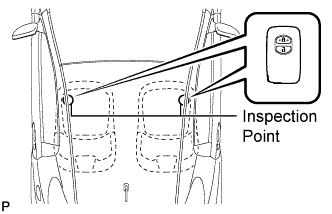
Diagnostic mode inspection (indoor electrical key oscillator (front side))
-
Connect the intelligent tester to the DLC3.
-
Turn the engine switch on (IG).
-
Turn the intelligent tester on.
-
Enter the following menus: Body / Entry & Start / Key Communication Check / Overhead + Front Room.
-
When the electrical key transmitter is in the position shown in the illustration, check that the wireless door lock buzzer sounds.
-
-
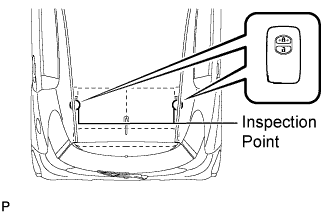
Diagnostic mode inspection (indoor electrical key oscillator (rear side))
-
Connect the intelligent tester to the DLC3.
-
Turn the engine switch on (IG).
-
Turn the intelligent tester on.
-
Enter the following menus: Body / Entry & Start / Key Communication Check / Overhead + Back Door (inside).
-
When the electrical key transmitter is in the position shown in the illustration, check that the wireless door lock buzzer sounds.
-
-
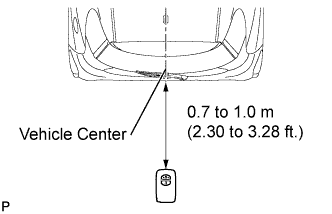
Diagnostic mode inspection (outside electrical key oscillator (outside luggage))
-
Connect the intelligent tester to the DLC3.
-
Turn the engine switch on (IG).
-
Turn the intelligent tester on.
-
Enter the following menus: Body / Entry & Start / Key Communication Check / Overhead + Back Door (outside).
-
When the electrical key transmitter is in the position shown in the illustration, check that the wireless door lock buzzer sounds.
Result Result Proceed to All diagnostic mode inspections fail A Some diagnostic mode inspections fail (door) B Some diagnostic mode inspections fail (cabin) C Some diagnostic mode inspections fail (outside) D All diagnostic mode inspections are normal E
-
B
GO TO OTHER PROBLEM (PROCEED TO PROBLEM SYMPTOMS TABLE FOR EACH DOOR) Click here
C
GO TO OTHER PROBLEM (PROCEED TO ROOM OSCILLATOR DOES NOT RECOGNIZE KEY) Click here
D
GO TO OTHER PROBLEM (PROCEED TO PROBLEM SYMPTOMS TABLE) Click here
E
REPLACE CERTIFICATION ECU
A
-
-
REPLACE ELECTRICAL KEY TRANSMITTER
-
Temporarily replace the electrical key transmitter with a new or normally functioning one.
NEXT
-
-
REGISTER ELECTRICAL KEY TRANSMITTER
-
Register the electrical key transmitter.
NEXT
-
-
CHECK ELECTRICAL KEY TRANSMITTER (OPERATION)
-
Check that the entry functions operate normally Click here.
OK Entry functions operate normally.
NG
REPLACE CERTIFICATION ECU
OK 
END (ELECTRICAL KEY TRANSMITTER IS DEFECTIVE)
-