VACUUM SENSOR ASSEMBLY ON-VEHICLE INSPECTION
-
INSPECT VACUUM SENSOR ASSEMBLY
-
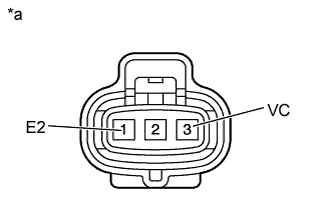
Text in Illustration *a Front view of wire harness connector
(to Vacuum Sensor Assembly)
Inspect the power source voltage.
-
Disconnect the vacuum sensor connector.
-
Turn the ignition switch to ON.
-
Measure the voltage according to the value(s) in the table below.
Standard Voltage Tester Connection Switch Condition Specified Condition 3 (VC) - 1 (E2) Ignition Switch ON 4.75 to 5.25 V If the result is not as specified, check the harness, connector, and engine stop and start ECU Click here.
-
Turn the ignition switch off.
-
Connect the vacuum sensor connector.
-
-
Inspect the atmospheric pressure voltage.
-
Disconnect the vacuum hose from the vacuum sensor.
-
Measure the PB terminal voltage at the engine stop and start ECU according to the value(s) in the table below.
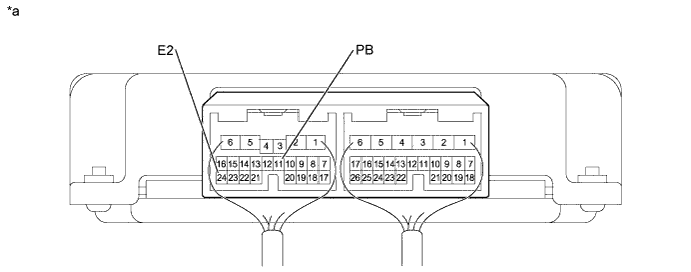
Text in Illustration *a Component with harness connected
(Engine Stop and Start ECU)
- - Standard Voltage Tester Connection Condition Specified Condition 11 (PB) - 24 (E2) Atmospheric pressure 3.4 to 3.8 V If the result is not as specified, check the harness and connector Click here.
-
-
Inspect the brake negative pressure.
-
Disconnect the vacuum hose from the vacuum sensor.
-
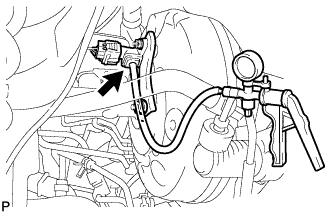
Connect a vacuum pump to the vacuum sensor.
-
Connect the intelligent tester to the DLC3.
-
Turn the ignition switch to ON and turn the tester on.
-
Enter the following menus: Powertrain / Stop and Start / Data List.
-
Read the value when applying vacuum using the vacuum pump.
Standard Tester Display Absolute pressure *1 Specified Condition Brake Negative Pressure 20 kPa (0.20 kgf/cm2)
20 kPa (0.20 kgf/cm2)
60 kPa (0.61 kgf/cm2)
60 kPa (0.61 kgf/cm2)
100 kPa (1.0 kgf/cm2)
100 kPa (1.0 kgf/cm2)
*1 Absolute pressure = Atmosphere pressure - Vacuum supplied by the vacuum pump.
Standard atmospheric pressure: 101 kPa
For every 100 m increase in altitude, pressure drops by 1 kPa.
Varies by weather (high atmospheric pressure, low atmospheric pressure).
If the result is not as specified, check the harness and connector Click here.
-
-