ENGINE ASSEMBLY INSTALLATION

Note
When the manual transaxle is removed, be sure to use a new clutch release with bearing cylinder and new installation bolts. Removal of the transaxle allows the compressed clutch release with bearing cylinder to return to its original position, and dust from the moving section could damage the seal of the clutch release with bearing cylinder, possibly causing clutch fluid leaks.
-
INSTALL TRANSVERSE ENGINE ENGINE MOUNTING INSULATOR
Tech Tips
Only perform this procedure when replacement of the transverse engine engine mounting insulator is necessary.
-
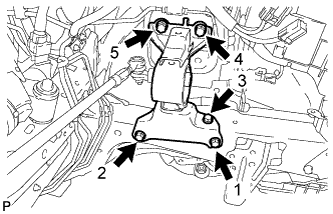
Temporarily install the transverse engine engine mounting insulator with the 5 bolts.
-
Fully tighten the 5 bolts in the order shown in the illustration.
- Torque:
- 52 N*m { 530 kgf*cm, 38 ft.*lbf }
-
-
INSTALL ENGINE MOUNTING INSULATOR SUB-ASSEMBLY RH
Tech Tips
Only perform this procedure when replacement of the engine mounting insulator RH is necessary.
-
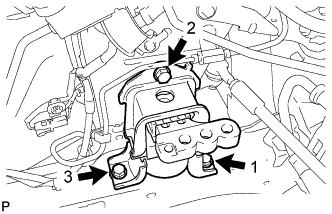
Temporarily install the engine mounting insulator RH with the 3 bolts.
-
Fully tighten the 3 bolts in the order shown in the illustration.
- Torque:
- 52 N*m { 530 kgf*cm, 38 ft.*lbf }
-
-
REMOVE ENGINE STAND
-
Using a chain block and sling device, secure the engine assembly.
Note
Make sure that the sling angle is correct to prevent the engine assembly and engine hangers from being damaged or deformed.
-
Remove the engine stand from the engine.
-
-
INSTALL INNER OIL SEAL (for Manual Transaxle)
-
Apply MP grease to the lip of a new inner oil seal.
Note
Keep the lip free from foreign matter.
-
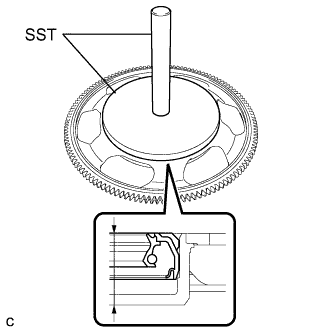
Using SST and a hammer, tap in the inner oil seal until its surface is flush with the ring gear sub-assembly.
- SST
- 09950-70010 ( 09951-07150 )
- 09951-01600
Oil seal tap in depth 14.7 to 15.7 mm (0.5787 to 0.6181 in.) Note
-
Uniformly tap in the oil seal.
-
Do not tap the oil seal at an angle.
-
-
INSTALL RING GEAR SUB-ASSEMBLY (for Manual Transaxle)
-

Install the ring gear sub-assembly.
Note
-
Do not apply excessive force to the ring gear sub-assembly.
-
Be sure not to allow any foreign matter, oil or grease to adhere to the sliding part of the engine rear oil seal.
-
Be sure not to allow any foreign matter to adhere to the lip of the engine rear oil seal.
-
-
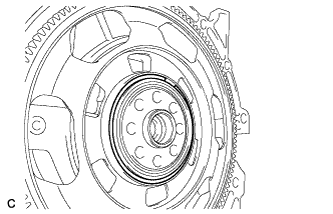
Using a screwdriver, install a new snap ring.
Note
Confirm that the snap ring is correctly located in the groove of the crankshaft bearing.
-
-
INSTALL ONE-WAY CLUTCH ASSEMBLY (for Manual Transaxle)
-
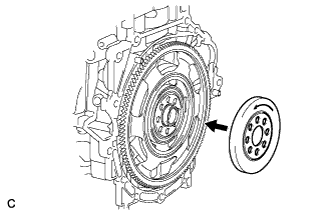
Turn the one-way clutch assembly counterclockwise while installing it.
Note
-
Be sure not to allow any foreign matter, oil or grease to adhere to the installation surfaces of the crankshaft and the one-way clutch.
-
Be sure not to allow any foreign matter, oil or grease to adhere to the sliding surface of the inner oil seal.
-
Be sure not to allow any foreign matter to adhere to the lip of the inner oil seal.
-
-
-
INSTALL FLYWHEEL SUB-ASSEMBLY (for Manual Transaxle)
-
Using SST, hold the crankshaft.
- SST
- 09960-10010 ( 09962-01000, 09963-01000 )
-
Clean the 8 bolts and their holes.
-
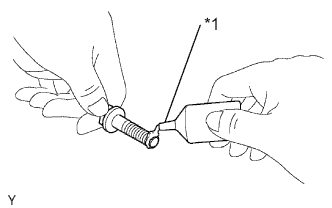
Text in Illustration *1 Adhesive Apply adhesive to 2 or 3 end threads of each bolt tip.
Adhesive Toyota Genuine Adhesive 1324, Three bond 1324 or equivalent -
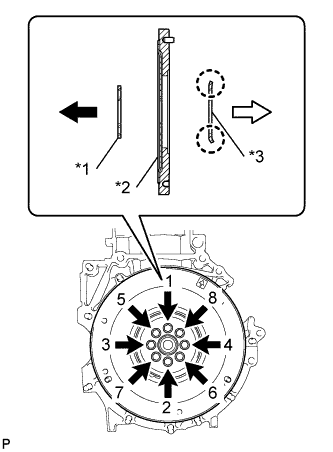
Text in Illustration *1 Front Flywheel Plate Spacer *2 Flywheel *3 Rear Flywheel Plate Spacer 
Engine 
Transaxle Temporarily install the front flywheel plate spacer, the flywheel and the rear flywheel plate spacer with the 8 bolts.
Tech Tips
-
The front spacer is reversible.
-
As the rear flywheel plate spacer and the flywheel are not reversible, be sure to install them in the direction shown in the illustration.
-
-
Fully tighten the 8 bolts in the order shown in the illustration.
- Torque:
- 78 N*m { 795 kgf*cm, 57 ft.*lbf }
Note
Do not start the engine for at least an hour after installing the flywheel.
-
-
INSTALL CLUTCH DISC ASSEMBLY (for Manual Transaxle)
-
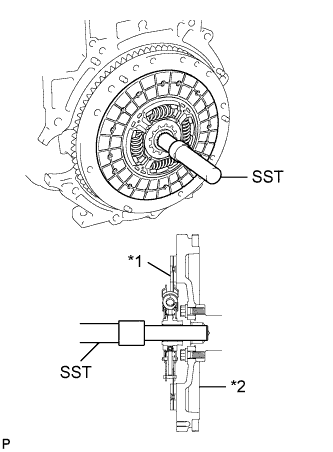
Text in Illustration *1 Clutch disc *2 Flywheel Insert SST into the clutch disc assembly, and then insert them both into the flywheel sub-assembly.
- SST
- 09301-00210
Note
Insert the clutch disc assembly in the correct direction.
-
-
INSTALL CLUTCH COVER ASSEMBLY (for Manual Transaxle)
-
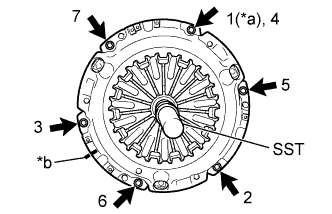
Text in Illustration *a Temporarily *b Matchmark Align the matchmark on the clutch cover assembly with that on the flywheel sub-assembly.
-
Following the procedures shown in the illustration, tighten the 6 bolts in order, starting with the bolt located near the knock pin at the top.
- SST
- 09301-00210
- Torque:
- 19 N*m { 195 kgf*cm, 14 ft.*lbf }
Tech Tips
-
Following the order in the illustration, tighten the bolts evenly one at a time.
-
Move SST up and down, right and left lightly after checking that the disc is in the center, and tighten the bolts.
-
-
INSPECT AND ADJUST CLUTCH COVER ASSEMBLY (for Manual Transaxle)
-
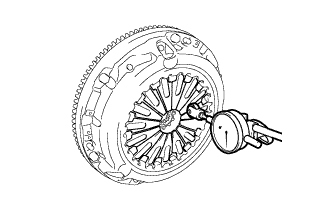
Using a dial indicator with a roller instrument, check the diaphragm spring tip alignment.
Maximum non-alignment 0.5 mm (0.020 in.) -
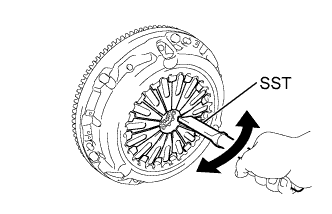
If the alignment is not as specified, using SST, adjust the diaphragm spring tip alignment.
- SST
- 09333-00013
-
-
INSTALL CLUTCH RELEASE WITH BEARING CYLINDER ASSEMBLY (for Manual Transaxle)
-
Clean and degrease all installation surfaces for the clutch release with bearing cylinder assembly.
-
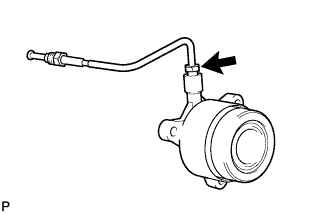
Temporarily tighten the bleeder clutch release tube onto the clutch release with bearing cylinder assembly.
-
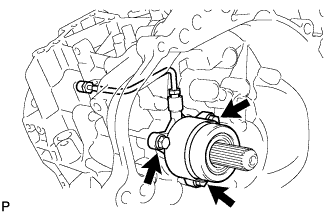
Install the new clutch release with the bearing cylinder with the 3 new bolts.
Note
-
The clutch release with bearing cylinder assembly and installation bolts cannot be reused and must be replaced with new ones.
-
Clean and degrease all installation surfaces and make sure the clutch release with bearing cylinder assembly fits securely with the transaxle during installation. The first bolt should be tightened by hand the clutch release with bearing cylinder assembly when installing.
-
Ensure that none of the clutch disc spline grease adheres to the clutch release with bearing cylinder assembly.
-
The clutch release with bearing cylinder assembly cannot be disassembled.
- Torque:
- 23 N*m { 229 kgf*cm, 17 ft.*lbf }
-
-
Install the clutch tube boot onto the transaxle.
-
Install the release cylinder bleeder plug onto the clutch release bleeder.
- Torque:
- 8.4 N*m { 86 kgf*cm, 74 in.*lbf }
-
Install the release cylinder bleeder plug cap.
-
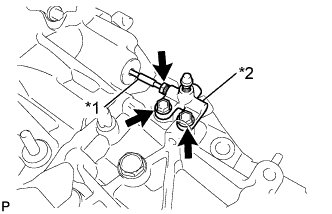
Text in Illustration *1 Bleeder clutch release tube *2 Clutch release bleeder Temporarily tighten the bleeder clutch release tube onto the clutch release bleeder.
-
Temporarily tighten the 2 bolts and install the clutch release bleeder.
-
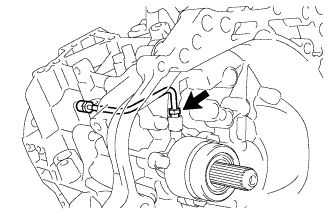
Using a union nut wrench 10 mm, install the bleeder clutch release tube.
- Torque:
- 15 N*m { 155 kgf*cm, 11 ft.*lbf }
Note
Use the formula to calculate special torque values for situations when union nut wrench is combined with a torque wrench Click here.
-
-
INSTALL CLUTCH RELEASE BLEEDER SUB-ASSEMBLY (for Manual Transaxle)
-
Separate the bleeder clutch release tube from the clutch release bleeder.
-
Remove the 2 bolts and the clutch release bleeder.
-
-
INSPECT CLUTCH PIPE LINE (for Manual Transaxle)
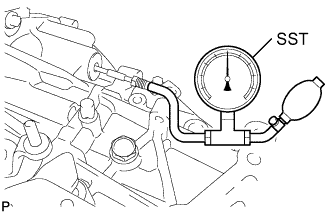
-
Using SST, apply pressure of 0.1 MPa to the clutch pipe location shown in the illustration and confirm that pressure is maintained for 15 seconds or more.
- SST
- 09992-00242
If the pressure drops, replace the bleeder clutch release tube.
-
-
INSTALL CLUTCH RELEASE BLEEDER SUB-ASSEMBLY (for Manual Transaxle)
-
Text in Illustration *1 Bleeder clutch release tube *2 Clutch release bleeder Temporarily tighten the bleeder clutch release tube onto the clutch release bleeder.
-
Install the 2 bolts and clutch release bleeder.
- Torque:
- 17 N*m { 170 kgf*cm, 12 ft.*lbf }
-
Using a union nut wrench 10 mm, install the bleeder clutch release tube.
- Torque:
- 15 N*m { 155 kgf*cm, 11 ft.*lbf }
Note
Use the formula to calculate special torque values for situations when union nut wrench is combined with a torque wrench Click here.
-
-
INSTALL BLEEDER TO ACCUMULATOR TUBE (for Manual Transaxle)
-
Install the bleeder clutch release tube with the bolt.
- Torque:
- 12 N*m { 122 kgf*cm, 9 ft.*lbf }
-
Using a union nut wrench 10 mm, install the bleeder clutch release tube.
- Torque:
- 15 N*m { 155 kgf*cm, 11 ft.*lbf }
Note
Use the formula to calculate special torque values for situations when union nut wrench is combined with a torque wrench Click here.
-
-
INSTALL MANUAL TRANSAXLE ASSEMBLY (for Manual Transaxle)
-
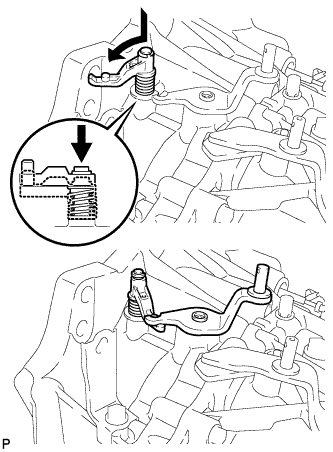
Hook the outer lever to the low fixture lever of the reverse restrict pin to secure it.
-
Make sure that the knock pins are not loose, bent, damaged or scratched and then install the transaxle onto the engine with the contact surfaces of the engine and transaxle flat against each other.
-
Align the input shaft with the clutch disc and install the manual transaxle onto the engine.
-
Install the 10 bolts.
- Torque:
- Bolt A
- 64 N*m { 653 kgf*cm, 47 ft.*lbf }
- Bolt B (for Flange Bolt)
- 37 N*m { 377 kgf*cm, 27 ft.*lbf, }
- Bolt B (for Bolt with Washer)
- 33 N*m { 337 kgf*cm, 24 ft.*lbf }
- Bolt C
- 39 N*m { 398 kgf*cm, 29 ft.*lbf }
Note
Insert knock pins into the knock pin holes securely so that the end face of the transaxle assembly fits close against the engine assembly before tightening the bolts.
-
-
INSTALL DRIVE PLATE AND RING GEAR SUB-ASSEMBLY (for CVT)
-
Using SST, hold the crankshaft.
- SST
- 09960-10010 ( 09962-01000, 09963-01000 )
-
Clean the 8 bolts and their holes.
-
Text in Illustration *1 Adhesive Apply adhesive to 2 or 3 end threads of each bolt tip.
Adhesive Toyota Genuine Adhesive 1324, Three bond 1324 or equivalent -
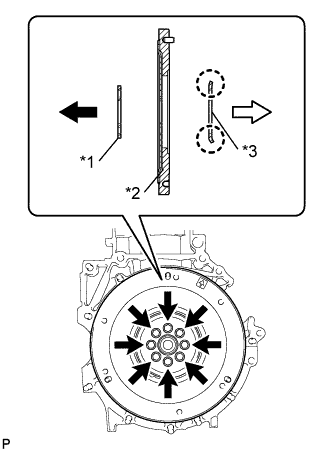
Text in Illustration *1 Front Drive Plate Spacer *2 Drive Plate *3 Rear Drive Plate Spacer Engine Transaxle Temporarily install the front drive plate spacer, the drive plate and the rear drive plate spacer with the 8 bolts.
Tech Tips
-
The front spacer is reversible.
-
As the rear drive plate spacer and the drive plate are not reversible, be sure to install them in the direction shown in the illustration.
-
-
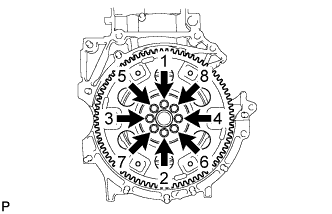
Fully tighten the 8 bolts in the order shown in the illustration.
- Torque:
- 88 N*m { 897 kgf*cm, 65 ft.*lbf }
Note
Do not start the engine for at least an hour after installing the drive plate.
-
-
INSTALL CONTINUOUSLY VARIABLE TRANSAXLE ASSEMBLY (for CVT)
-
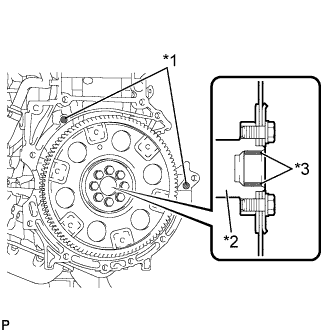
Text in Illustration *1 Knock Pin *2 Crankshaft Confirm that 2 knock pins are on the transaxle contact surface of the engine cylinder block before transaxle installation.
-
Apply clutch spline grease to the round of the crankshaft contact surface (*3) with the torque converter centerpiece.
Clutch spline grease Toyota Genuine Clutch Spline Grease or equivalent Maximum spread Approximately 1 g (0.353 oz) -
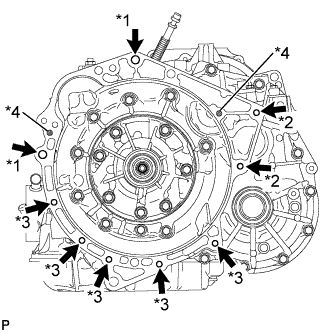
- Torque:
- *1
- 64 N*m { 653 kgf*cm, 47 ft.*lbf }
- *2
- 37 N*m { 377 kgf*cm, 27 ft.*lbf }
- *3
- 39 N*m { 398 kgf*cm, 29 ft.*lbf }
Maintain the engine and CVT in a horizontal position, align the knock pins and holes (*4), and tighten the 9 bolts shown the illustration.
- Torque:
- *1
- 64 N*m { 653 kgf*cm, 47 ft.*lbf }
- *2
- 37 N*m { 377 kgf*cm, 27 ft.*lbf }
- *3
- 39 N*m { 398 kgf*cm, 29 ft.*lbf }
Note
-
Confirm that there are 2 knock pins on the fitting surface of the engine block before installing the CVT.
-
Do not twist or apply excessive force to the CVT.
-
Check that the torque converter rotates smoothly after installation of the CVT.
Tech Tips
-
*1: 45 mm (1.77 in.)
-
*2: 45 mm (1.77 in.)
-
*3: 35 mm (1.38 in.)
Bolt length
-
-
INSTALL DRIVE PLATE AND TORQUE CONVERTER SETTING BOLT (for CVT)
-
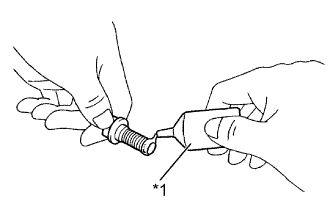
Clean and degrease the 6 drive plate and torque converter setting bolts.
-
Apply adhesive to 2 or 3 threads on the ends of the 6 torque converter set bolts.
Text in Illustration *1 Adhesive Adhesive Toyota Genuine Adhesive 1324, Three Bond 1324 or equivalent -
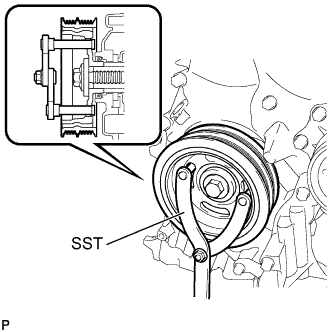
Use SST to hold the crankshaft pulley in place.
- SST
- 09960-10010 ( 09962-01000, 09963-01000 )
-
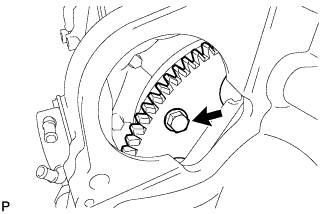
Install the 6 torque converter set bolts.
- Torque:
- 28 N*m { 286 kgf*cm, 21 ft.*lbf }
Tech Tips
Tighten the black-colored bolt first, and then tighten the 5 silver-colored bolts.
-
-
INSTALL STARTER ASSEMBLY
-
Install the starter assembly with the 2 bolts.
- Torque:
- 37 N*m { 377 kgf*cm, 27 ft.*lbf }
-
Connect the connector.
-
Connect terminal 30 with the nut.
- Torque:
- 9.8 N*m { 100 kgf*cm, 87 in.*lbf }
-
Close the terminal cap.
-
-
INSTALL FLYWHEEL HOUSING SIDE COVER
-
Insert the protruding portion into the end of the cylinder block and while pushing it along the cylinder block, fit the claw into the cylinder block.
Note
-
Make sure that the claw makes a click sound, indicating that it fits tightly.
-
Replace the claw with a new one if it does not fit tightly or is deformed.
-
-
-
INSTALL DRIVE SHAFT HEAT INSULATOR BRACKET
-
Install the drive shaft heat insulator bracket onto the engine with the 2 bolts.
- Torque:
- 16 N*m { 166 kgf*cm, 12 ft.*lbf }
-
-
INSTALL ENGINE WIRE
-
Install the engine wire onto the engine assembly with transaxle.
-
Install the ground wire onto the transaxle with the bolt.
- Torque:
- 13 N*m { 130 kgf*cm, 9 ft.*lbf }
-
Install the nut to the generator.
- Torque:
- 9.8 N*m { 100 kgf*cm, 87 in.*lbf }
-
Install the terminal cap to the generator.
-
Install the engine wire onto the wiring harness bracket with the bolt .
- Torque:
- 8.0 N*m { 82 kgf*cm, 71 in.*lbf }
-
Install the nut to the starter.
- Torque:
- 9.8 N*m { 100 kgf*cm, 87 in.*lbf }
-
Install the 2 ground wires onto the cylinder block with the 2 bolts.
- Torque:
- 8.4 N*m { 86 kgf*cm, 74 in.*lbf }
-
-
INSTALL NO. 2 RADIATOR HOSE
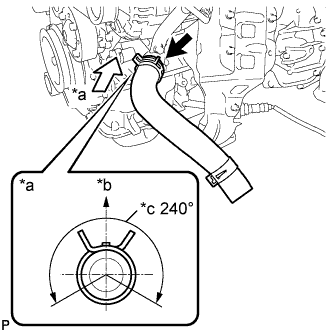
Text in Illustration *a View A *b Upper *c Clip installation range
-
Install the No. 2 radiator hose with the clip.
Note
Install the clip so that its claws are within the clip installation range.
-
-
INSTALL WATER FILLER ASSEMBLY
-
Install the water filler with the bolt.
- Torque:
- 13 N*m { 127 kgf*cm, 9 ft.*lbf }
-
-
INSTALL NO. 1 RADIATOR HOSE
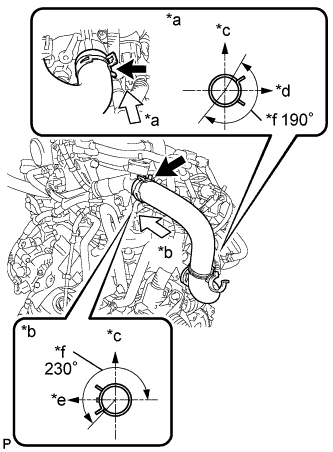
Text in Illustration *a View A *b View B *c Upper *d Rear of Vehicle *e Front of Vehicle *f Clip installation range
-
Install the No. 1 radiator hose with the 2 clips.
Note
Install the clip so that its claws are within the clip installation range.
-
-
INSTALL INLET HEATER WATER HOSE (for Manual Transaxle)
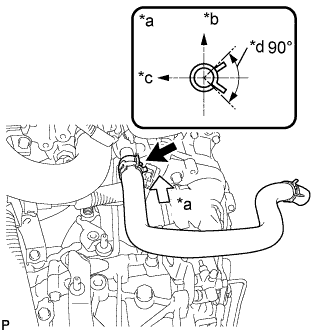
Text in Illustration *a View A *b Upper *c Front *d Clip installation range
-
Install the inlet heater water hose with the clip.
Note
Install the clip so that its claws are within the clip installation range.
-
-
INSTALL WATER BY-PASS HOSE ASSEMBLY (for Manual Transaxle)
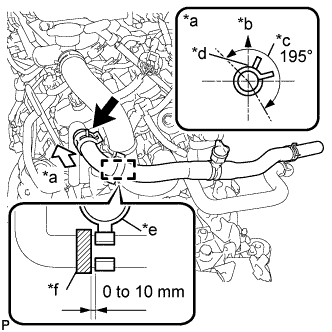
Text in Illustration *a View A *b Upper *c Clip installation range *d Paint mark of the hose *e Hose clamp *f Stopper
-
Install the water by-pass hose with the clip.
Note
Install the clip so that its claws are within the clip installation range.
-
Engage the hose clamp.
-
-
INSTALL WATER BY-PASS HOSE ASSEMBLY (for CVT)
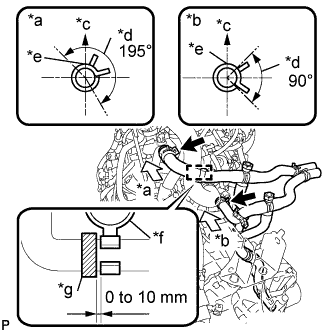
Text in Illustration *a View A *b View B *c Upper *d Clip installation range *e Paint mark of the hose *f Hose clamp *g Stopper
-
Install the water by-pass hose with the 2 clips.
Note
Install the clip so that its claws are within the clip installation range.
-
Engage the hose clamp.
-
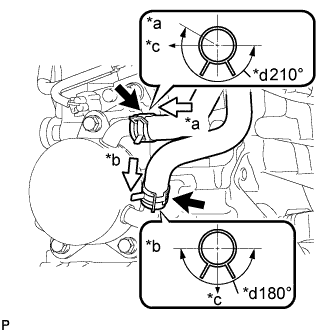
Text in Illustration *a View A *b View B *c Rear of Vehicle *d Clip installation range Connect the 2 water by-pass hoses to the oil cooler with the 2 clips.
Note
Install the clip so that its claws are within the clip installation range.
-
Install the water by-pass hose onto the CVT with the bolt.
- Torque:
- 29 N*m { 296 kgf*cm, 21 ft.*lbf }
-
Engage the clamp and install the breather hose to the water by-pass hose.
-
-
INSTALL ENGINE ASSEMBLY WITH TRANSAXLE
-
Set the engine assembly with transaxle on the engine lifter.
-
Operate the engine lifter and lift the engine assembly with transaxle to the position where the engine mounting insulator RH and transverse engine engine mounting insulator can be installed.
CAUTION:
Do not raise the engine more than necessary. If the engine is raised excessively, the vehicle may also be lifted up.
Note
-
Make sure that the engine is clear of all wiring and hoses.
-
While raising the engine into the vehicle, do not allow it to contact the vehicle.
-
-
Install the transverse engine engine mounting insulator with the through bolt and nut.
- Torque:
- 52 N*m { 530 kgf*cm, 38 ft.*lbf }
-
Install the engine mounting insulator RH with the bolt and 2 nuts.
- Torque:
- 52 N*m { 530 kgf*cm, 38 ft.*lbf }
-
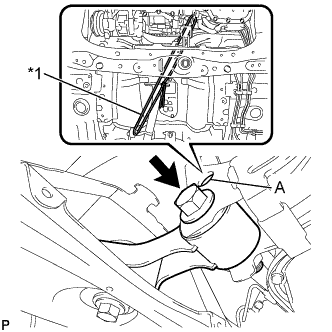
Text in Illustration *1 Rope Secure the hole (A) shown in the illustration and the body with a piece of rope.
Note
When installing the engine assembly with the transaxle, make sure that the engine assembly does not move to the vehicle front, to prevent it from contacting other parts.
-
Remove the 2 bolts and the 2 engine hangers.
-
-
INSTALL ENGINE MOVING CONTROL ROD
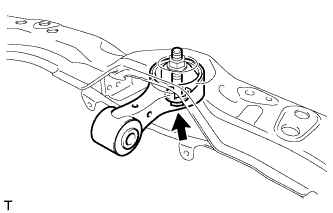
-
Install the engine moving control rod with the bolt.
- Torque:
- 100 N*m { 1020 kgf*cm, 74 ft.*lbf }
-
-
INSTALL ENGINE MOVING CONTROL ROD COVER (for Cold Area)
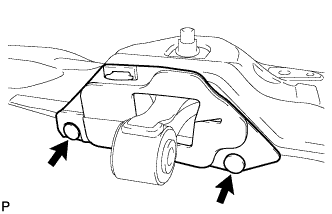
-
Install the engine moving control rod cover with the 2 clips.
-
-
INSTALL COOLER COMPRESSOR ASSEMBLY (w/ Air Conditioning System)
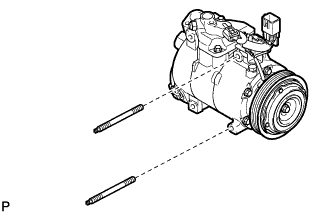
-
Using a "TORX" socket wrench (E8), install the compressor with the 2 stud bolts.
- Torque:
- 15 N*m { 153 kgf*cm, 11 ft.*lbf }
-
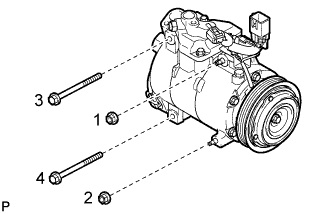
Install the compressor with the 2 bolts and the 2 nuts.
- Torque:
- 25 N*m { 250 kgf*cm, 18 ft.*lbf }
Tech Tips
Tighten the bolts and the nuts in the order shown in the illustration.
-
Connect the connector.
-
-
INSTALL SUCTION HOSE SUB-ASSEMBLY (w/ Air Conditioning System)
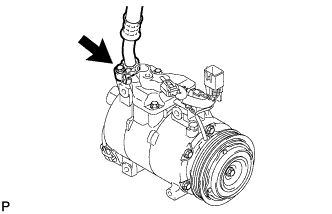
-
Remove the attached vinyl tape from the suction hose.
-
Sufficiently apply compressor oil to a new O-ring and the fitting surface of the cooler compressor.
Compressor oil ND-OIL 8 or equivalent -
Install the O-ring onto the suction hose.
-
Connect the suction hose to the cooler compressor with the bolt.
- Torque:
- 9.8 N*m { 100 kgf*cm, 87 in.*lbf }
-
-
INSTALL DISCHARGE HOSE SUB-ASSEMBLY (w/ Air Conditioning System)
-
Connect the discharge hose to the vehicle with the bolt.
- Torque:
- 9.8 N*m { 100 kgf*cm, 87 in.*lbf }
-
Remove the attached vinyl tape from the discharge hose.
-
Sufficiently apply compressor oil to a new O-ring and the fitting surface of the cooler compressor.
Compressor oil ND-OIL 8 or equivalent -
Install the O-ring onto the discharge hose.
-
Connect the discharge hose to the cooler compressor with the bolt.
- Torque:
- 9.8 N*m { 100 kgf*cm, 87 in.*lbf }
-
-
INSTALL FRONT FRAME ASSEMBLY
-
Support the front frame assembly with 4 wooden blocks and the jack.
-
Provisionally install the front frame assembly onto the body with the 6 bolts.
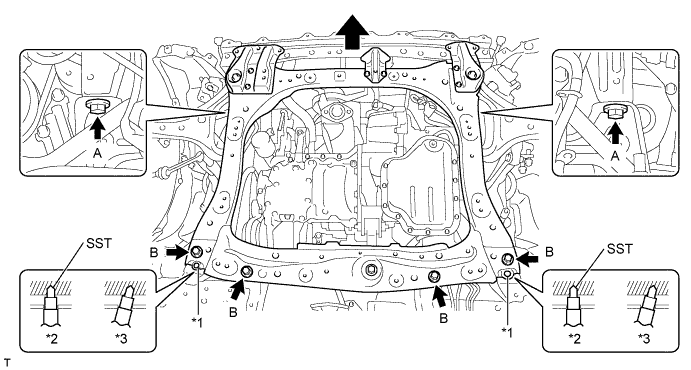
Text in Illustration *1 Datum Hole *2 OK *3 NG Bolt Underhead Length (mm) A 38 B 69 -
By inserting SST into the datum holes in the front frame assembly RH and LH alternately, tighten bolts A and B on both sides to the specified torque, in several steps.
- SST
- 09670-00011
- Torque:
- 108 N*m { 1101 kgf*cm, 80 ft.*lbf, for bolt A }
- 120 N*m { 1224 kgf*cm, 89 ft.*lbf, for bolt B }
Note
-
Insert SST into the datum hole in a vertical orientation.
-
If SST can not be inserted into the datum hole vertically, loosen all the bolts and then insert SST again.
-
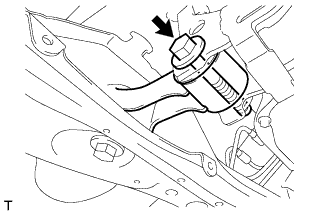
Install the engine moving control rod to engine mounting control bracket with the bolt.
- Torque:
- 120 N*m { 1224 kgf*cm, 89 ft.*lbf }
-
Remove the strong rope from engine mounting control bracket and body.
-
-
INSTALL FRONT DRIVE SHAFT ASSEMBLY LH
-
Coat the spline of the inboard joint with gear oil.
-
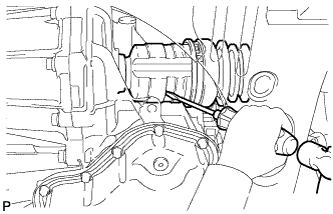
Align the inboard joint splines and install the drive shaft with a screwdriver and hammer.
Note
-
Face the cut area of the front drive shaft hole snap ring downward.
-
Do not damage the oil seal.
-
Do not damage the inboard joint boot.
Tech Tips
Confirm whether the drive shaft is securely driven in by checking the reaction force and sound.
-
-
-
INSTALL FRONT DRIVE SHAFT ASSEMBLY RH
Tech Tips
Use the same procedure as for the LH side.
-
INSTALL DRIVE SHAFT HEAT INSULATOR
-
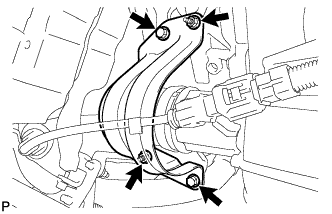
Install the drive shaft heat insulator with the 2 bolts and the 2 nuts.
- Torque:
- 16 N*m { 166 kgf*cm, 12 ft.*lbf }
-
-
INSTALL FRONT AXLE ASSEMBLY LH
-
Push the front axle out of the vehicle to align the splines of the drive shaft with the front axle and insert the front axle.
Note
-
Do not push the front axle further out of the vehicle than is necessary.
-
Do not damage the outboard joint boot.
-
Check for any foreign matter on the speed sensor rotor and insertion area.
-
Do not damage the speed sensor rotor.
-
-
-
INSTALL FRONT AXLE ASSEMBLY RH
Tech Tips
The installation procedure for the RH side is the same as that for the LH side.
-
INSTALL FRONT LOWER SUSPENSION ARM SUB-ASSEMBLY LH
-
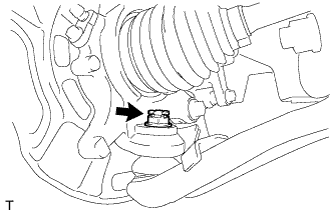
Install the lower arm onto the steering knuckle with a new castle nut.
- Torque:
- 98 N*m { 999 kgf*cm, 72 ft.*lbf }
Note
If the holes for the clip are not aligned, tighten the nut by a further turn of up to 60°.
-
Install a new clip.
-
-
INSTALL FRONT LOWER SUSPENSION ARM SUB-ASSEMBLY RH
Tech Tips
The installation procedure for the RH side is the same as that for the LH side.
-
INSTALL FRONT STABILIZER LINK ASSEMBLY LH
-
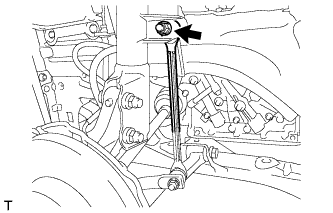
Install the stabilizer link with the nut.
- Torque:
- 74 N*m { 755 kgf*cm, 55 ft.*lbf }
Tech Tips
If the ball joint turns together with the nut, use a socket hexagon wrench 6 to hold the stud.
-
-
INSTALL FRONT STABILIZER LINK ASSEMBLY RH
Tech Tips
The installation procedure for the RH side is the same as that for the LH side.
-
INSTALL FRONT SPEED SENSOR LH
-
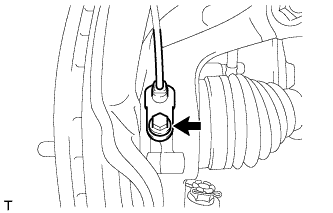
Install the speed sensor onto the steering knuckle with the bolt.
- Torque:
- 8.5 N*m { 87 kgf*cm, 75 in.*lbf }
Note
-
Check that the speed sensor tip and installation area are free of foreign matter.
-
Install the speed sensor without turning it from its original installation angle.
-
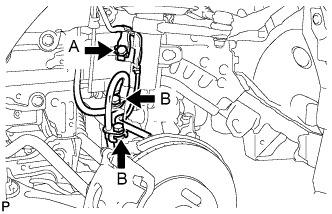
Install the flexible hose and speed sensor with the bolt.
- Torque:
- Bolt A
- 29 N*m { 296 kgf*cm, 21 ft.*lbf }
- Bolt B
- 29 N*m { 300 kgf*cm, 22 ft.*lbf }
Note
Install the flexible hose and speed sensor without twisting them.
-
-
INSTALL FRONT SPEED SENSOR RH
Tech Tips
The installation procedure for the RH side is the same as that for the LH side.
-
INSTALL FRONT AXLE SHAFT LH NUT
-
Clean the threaded parts on the drive shaft and axle hub nut using a non-residue solvent.
Note
-
Be sure to perform this work for a new drive shaft.
-
Keep the threaded part free of oil and foreign objects.
-
-
Using a 30 mm deep socket wrench, install a new axle hub nut.
- Torque:
- 216 N*m { 2203 kgf*cm, 159 ft.*lbf }
-
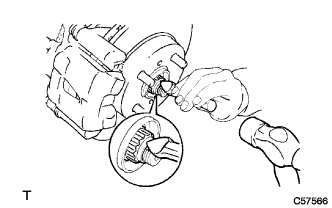
Using a chisel and hammer, stake the axle hub nut.
-
-
INSTALL FRONT AXLE SHAFT RH NUT
Tech Tips
The installation procedure for the RH side is the same as that for the LH side.
-
INSTALL UNION TO CHECK VALVE HOSE
-
Install the union to check valve hose with the clip.
-
-
INSTALL NO. 1 CLUTCH HOSE (for Manual Transaxle)
-
Install the a new clip.
-
Using a union nut wrench 10 mm, connect the No. 1 clutch hose to the clutch release cylinder to flexible hose tube.
- Torque:
- 15 N*m { 155 kgf*cm, 11 ft.*lbf }
Note
Use the formula to calculate special torque values for situations where union nut wrench is combined with a torque wrench Click here.
-
-
INSTALL TRANSMISSION CONTROL CABLE ASSEMBLY (for CVT)
-
Install the transmission control cable to the No. 1 transmission control cable bracket, using a new clip.
-
Using the nut, connect the transmission control cable to the transmission control shaft lever.
- Torque:
- 12 N*m { 122 kgf*cm, 9 ft.*lbf }
-
-
INSTALL TRANSMISSION CONTROL CABLE ASSEMBLY (for Manual Transaxle)
-
Install the 2 new clips <B> onto the transmission control cable.
-
Connect the transmission control cable with the 2 clips <A> onto the transaxle.
-
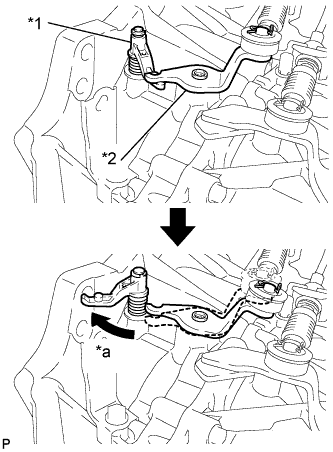
Text in Illustration *1 Reverse Restrict Pin Assembly *2 Outer Lever *a Release Put the shift lever in the reverse position and release the fixture lever.
-
-
CONNECT OUTLET HEATER WATER HOSE
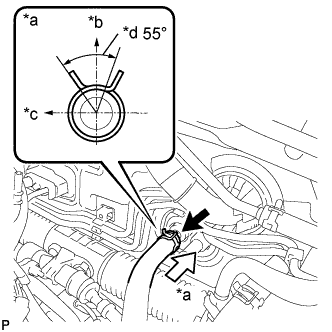
Text in Illustration *a View A *b Upper *c RH *d Clip center installation range
-
Connect the outlet heater water hose with the clip.
Note
Install the clip so that its claws are within the clip center installation range.
-
-
CONNECT INLET HEATER WATER HOSE
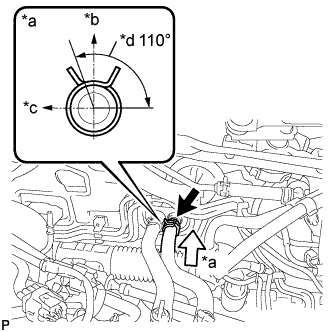
Text in Illustration *a View A *b Upper *c RH *d Clip center installation range
-
Connect the inlet heater water hose with the clip.
Note
Install the clip so that its claws are within the clip center installation range.
-
-
INSTALL FUEL TUBE SUB-ASSEMBLY
-
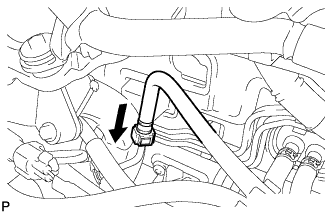
Line up the pipe and connector and push them together until a "click" sound is heard.
Note
-
Check that there are no scratches or foreign objects on the connecting part.
-
If the pipe is difficult to push into the connector, apply a small amount of clean engine oil to the tip of the pipe and reinsert it
-
After connecting, check that the pipe and connector are securely connected by pulling on them.
-
-
-
INSTALL EFI FUEL PIPE CLAMP
-
Install the EFI fuel pipe clamp.
-
-
CONNECT NO. 1 FUEL VAPOR FEED HOSE
-
Connect the No. 1 fuel vapor feed hose with the clip.
-
-
CONNECT NO. 2 RADIATOR HOSE
-
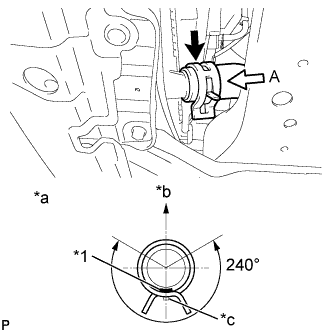
Text in Illustration *1 White Paint Mark *a View A *b Upper Side *c Projection On Radiator Connect the radiator hose to the radiator assembly with the hose clamp.
Note
Perform the installation with the hose clip and mark at the correct angle.
-
-
INSTALL NO. 3 RADIATOR HOSE
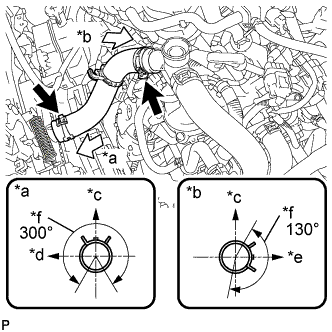
Text in Illustration *a View A *b View B *c Upper *d LH *e Front of Vehicle *f Clip installation range
-
Install the No. 3 radiator hose with the 2 clamps.
Note
Install the clip so that its claws are within the clip installation range.
-
-
CONNECT RADIATOR RESERVOIR TANK HOSE
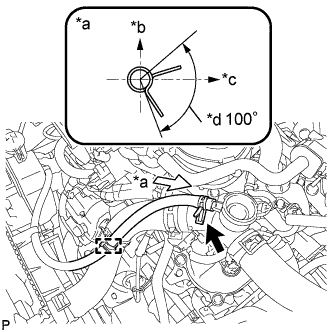
Text in Illustration *a View A *b Upper *c Front of Vehicle *d Clip installation range
-
Connect the radiator reservoir tank hose with the clip.
Note
Install the clip so that its claws are within the clip installation range.
-
Engage the hose clamp.
-
-
INSTALL ENGINE WIRE
-
Connect the earth wire with the bolt.
- Torque:
- 8.0 N*m { 82 kgf*cm, 71 in.*lbf }
-
Connect the 4 engine wire connectors and 2 clamps to the engine room junction block.
-
Install the junction block cover.
-
Connect the 2 connectors to the battery terminal.
-
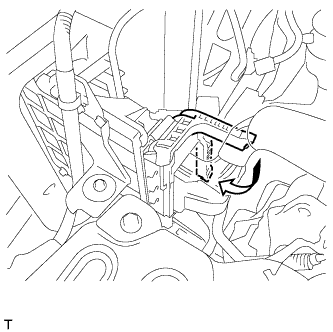
Connect the engine wire connector to the ECM.
-
Turn the lever and connect the ECM connector.
-
-
INSTALL AIR CLEANER FILTER ELEMENT SUB-ASSEMBLY
-
INSTALL AIR CLEANER AND HOSE
-
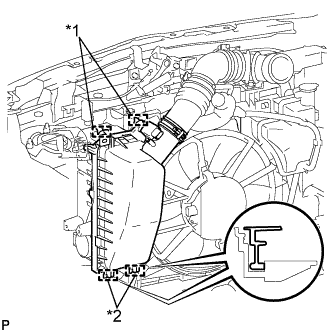
Text in Illustration *1 Clamp *2 Guide Align the 2 hinges with the guides on the case and engage them in the grooves.
-
Install the air cleaner and hose with the 2 clamps.
-
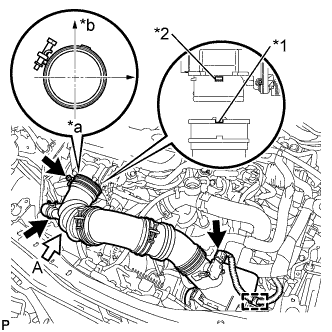
Text in Illustration *1 Recession *2 Protrusion *a View A *b Upper Side Connect the air cleaner hose with the hose clamp as shown in the illustration.
- Torque:
- 3.0 N*m { 31 kgf*cm, 27 in.*lbf }
Note
-
The clamp should contact the air cleaner hose stopper.
-
Perform the installation with the hose clip at the correct angle.
-
Connect the ventilation hose.
-
Install the mass air flow meter connector and the wire harness clamp.
-
-
INSTALL NO. 2 BATTERY CARRIER
-
Install the No. 2 battery carrier with the 3 bolts.
- Torque:
- 17 N*m { 75 kgf*cm, 13 ft.*lbf }
-
Engage the harness clamp.
-
-
INSTALL BATTERY TRAY
-
Install the battery tray.
-
-
INSTALL BATTERY
-
Install the battery onto the vehicle.
-
Install the battery clamp with the 2 nuts.
- Torque:
- 3.5 N*m { 36 kgf*cm, 35 in.*lbf }
-
Connect the cable to the battery terminal.
- Torque:
- 5.0 N*m { 55 kgf*cm, 43 in.*lbf }
-
-
INSTALL FAN AND GENERATOR V-RIBBED BELT
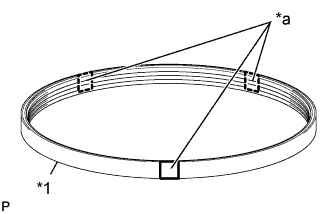
Text in Illustration *1 V-ribbed belt *a Paint Mark
-
Install the V-ribbed belt.
Note
-
There are 2 types of V-ribbed belt. The type to use depends on the type of generator, so be sure to confirm the belt type before installing.
Generator Paint Mark 80 A Blue 100 A Red -
Before installing the V-ribbed belt, check each pulley for any liquid or chips.
-
Check that the ribs of the V-ribbed belt are correctly fitted into the grooves of the pulleys.
-
-
Turn the V-ribbed belt tensioner clockwise and remove the 4 mm bi-hexagon wrench.
-
-
INSTALL NO. 1 V-RIBBED (COOLER COMPRESSOR TO CRANKSHAFT PULLEY) BELT (w/ Air Conditioning System)
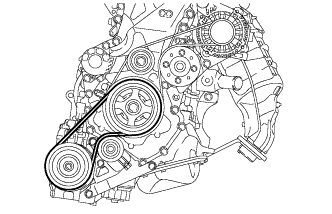
-
Temporarily install the No. 1 V-ribbed belt onto each pulley.
Note
-
Before installing the No. 1 V-ribbed belt, check each pulley for any liquid or chips.
-
Check that the ribs of the No. 1 V-ribbed belt are correctly fitted into the grooves of the pulleys.
-
-
-
ADJUST NO. 1 V-RIBBED (COOLER COMPRESSOR TO CRANKSHAFT PULLEY) BELT (w/ Air Conditioning System)
-
Turn the adjust bolt B to adjust the tension of No. 1 V-ribbed belt.
Deflection Pressing Force N ( kg, lb) New Belt mm (in.) Used Belt mm (in.) 10
(10, 22)
8.0 to 10.0
(0.315 to 0.394)
10.0 to 12.0
(0.394 to 0.472)
-
Tighten bolt A.
- Torque:
- 44 N*m { 449 kgf*cm, 32 ft.*lbf }
-
-
INSPECT FAN AND GENERATOR V-RIBBED BELT
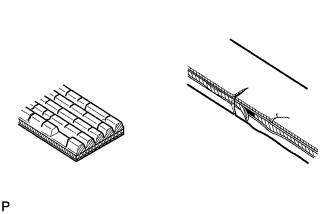
-
Check the belt for wear, cracks or other signs of damage.
If any of the following defects is found, replace the V-ribbed belt.
Tech Tips
-
The belt is cracked.
-
The belt is worn out to the extent that the cords are exposed.
-
The belt has chunks missing from the ribs.
-
-
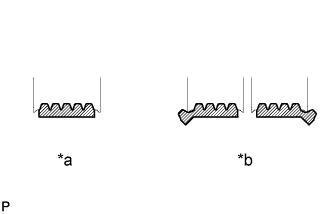
Text in Illustration *a Correct *b Incorrect Check that the belt fits properly in the ribbed grooves.
Tech Tips
Check with your hand to confirm that the belt has not slipped out of the grooves on the bottom of the pulley. If it has slipped out, replace the V-ribbed belt. Install a new V-ribbed belt correctly.
-
-
INSPECT NO. 1 V-RIBBED (COOLER COMPRESSOR TO CRANKSHAFT PULLEY) BELT (w/ Air Conditioning System)
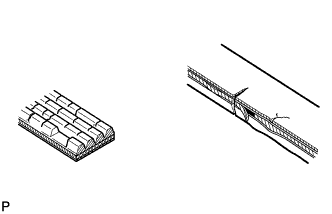
-
Check the belt for wear, cracks or other signs of damage.
If any of the following defects is found, replace the No. 1 V-ribbed belt.
Tech Tips
-
The belt is cracked.
-
The belt is worn out to the extent that the cords are exposed.
-
The belt has chunks missing from the ribs.
-
-
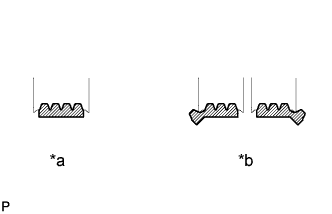
Text in Illustration *a Correct *b Incorrect Check that the belt fits properly in the ribbed grooves.
Tech Tips
Check with your hand to confirm that the belt has not slipped out of the grooves on the bottom to the pulley. If it has slipped out, replace the No. 1 V-ribbed belt. Install a new No. 1 V-ribbed belt correctly.
-
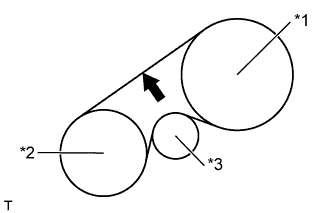
Text in Illustration *1 Crankshaft *2 A/C Compressor *3 Tensioner Inspect the No. 1 V-ribbed belt deflection.
Deflection Pressing Force
N ( kg, lb)
New Belt
mm (in.)
Used Belt
mm (in.)
10
(10, 22)
8.0 to 10.0
(0.315 to 0.394)
10.0 to 12.0
(0.394 to 0.472)
Tech Tips
No. 1 V-ribbed belt tension
New Belt
N (kg, lb)
Used Belt
N (kg, lb)
397 to 593
(40 to 60, 89 to 133)
300 to 398
(31 to 41, 67 to 89)
Note
-
Check the No. 1 V-ribbed belt deflection at the specified point.
-
When installing a new belt, set its deflection value as specified.
-
When checking a belt used for over 5 minutes, confirm that the deflection value is within the specified range for a used belt.
-
When reinstalling a belt used for over 5 minutes, check whether its deflection value is within the specified range for a used belt.
-
-
-
INSTALL NO. 1 ENGINE COVER (w/ No. 1 Engine Cover)
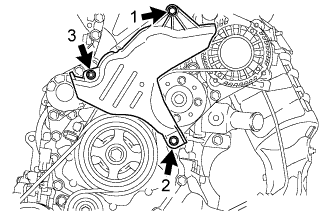
-
Temporarily install the No. 1 engine cover with the 2 bolts and nut.
-
Fully tighten the 2 bolts and nut in the order shown in the illustration.
- Torque:
- 10 N*m { 102 kgf*cm, 7 ft.*lbf }
-
-
INSTALL NO. 1 COOLER COVER (w/ No. 1 Cooler Cover)
-
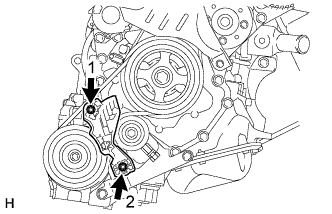
Temporarily install the No. 1 cooler cover with the 2 nuts.
-
Fully tighten the 2 nuts in the order shown in the illustration.
- Torque:
- 9.8 N*m { 100 kgf*cm, 87 in.*lbf }
-
-
INSTALL FRONT EXHAUST PIPE ASSEMBLY
-
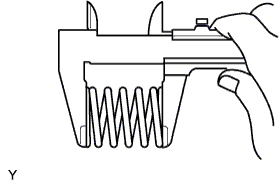
Using a vernier caliper, measure the free length of the compression springs.
Minimum Length Item Length Front 41.5 mm (1.634 in.) Tech Tips
If the length is not as specified, replace the compression spring.
-
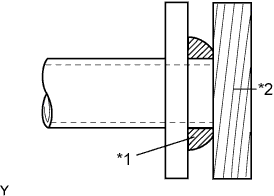
Text in Illustration *1 Gasket *2 Wooden Block Using a plastic hammer and a wooden block, tap in a new exhaust pipe gasket until its surface is flush with the exhaust manifold.
Note
-
Install the gasket in the correct direction.
-
Do not reuse the gasket.
-
Do not damage the gasket by dropping it, etc.
-
Do not damage the outer surface of the gasket.
-
Do not push in the gasket with the exhaust pipe when connecting it.
-
After the installation, check that the gaps between the flanges of the exhaust manifold and front exhaust pipe assembly are consistent front-to-rear and left-to-right.
-
-
Install the front exhaust pipe assembly to the exhaust manifold with the 2 bolts and the 2 compression springs.
- Torque:
- 43 N*m { 438 kgf*cm, 32 ft.*lbf }
-
Using a vernier caliper, measure the free length of the compression springs.
Minimum Length Item Length Rear 38.5 mm (1.594 in.) Tech Tips
If the length is not as specified, replace the compression spring.
-
Fully push a new exhaust pipe gasket onto the front exhaust pipe assembly.
Note
-
Install the gasket in the correct direction.
-
Do not reuse the gasket.
-
Do not damage the gasket by dropping it, etc.
-
Do not damage the outer surface of the gasket.
-
Do not push in the gasket with the exhaust pipe when connecting it.
-
After the installation, check that the gaps between the flanges of the exhaust manifold and front exhaust pipe assembly are consistent front-to-rear and left-to-right.
-
-
Install the front exhaust pipe assembly to the tail exhaust pipe assembly with the 2 bolts and the 2 compression springs.
- Torque:
- 43 N*m { 438 kgf*cm, 32 ft.*lbf }
-
Connect the heated oxygen sensor connector.
-
-
INSTALL FRONT BUMPER ENERGY ABSORBER SUB-ASSEMBLY
-
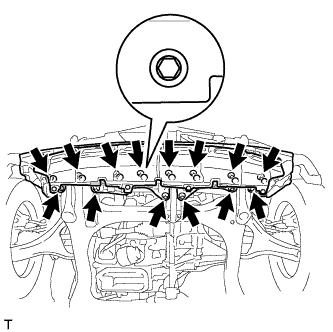
Install the front bumper energy absorber with the 14 screws.
-
-
INSTALL FRONT BUMPER COVER
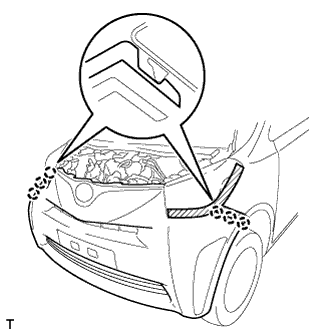
-
Engage the 6 claws and install the front bumper cover.
-
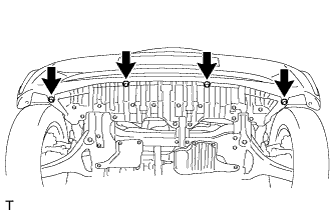
Tighten the 4 screws.
-
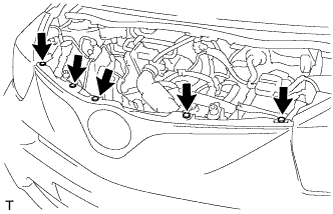
Install the 5 clips.
-
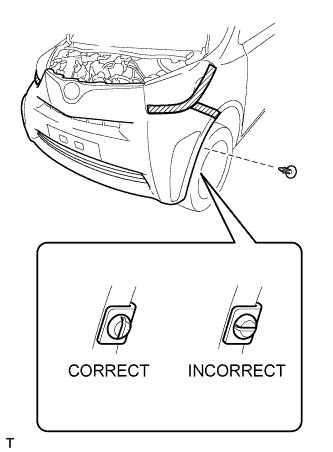
Install the pin hold clip.
Note
Insert the pin hold clip with the slot aligned vertically. Do not rotate the clip after inserting it. After installation, confirm that the slot is vertically.
Tech Tips
Use the same procedure for the RH and LH sides.
-
-
INSTALL FRONT WHEELS
-
ADD ENGINE COOLANT
-
Tighten the radiator drain cock plug.
-
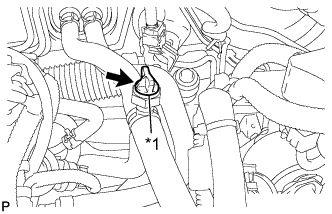
Text in Illustration *1 Air Bleed Valve Loosen the air bleed valve.
-
Remove the water filler cap sub-assembly.
-
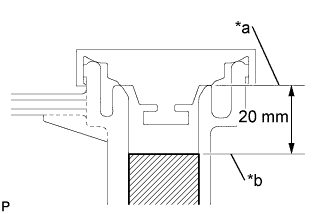
Text in Illustration *a Filler Tube End *b Coolant Level Slowly fill the radiator with TOYOTA Super Long Life Coolant (SLLC) from the water filler (Coolant level should be within 20 mm (0.787 in.) from the filler tube end).
Standard Capacity Item Capacity M/T 4.7 liters (5.0 US qts, 4.1 Imp. qts) CVT 4.9 liters (5.2 US qts, 4.3 Imp. qts) Note
Never use water as a substitute for engine coolant.
Tech Tips
TOYOTA vehicles are filled with TOYOTA SLLC at the factory. In order to avoid damage to the engine cooling system and other technical problems, only use TOYOTA SLLC or similar high quality ethylene glycol based non-silicate, non-amine, non-nitrite, non-borate coolant with long-life hybrid organic acid technology (coolant with long-life hybrid organic acid technology is a combination of low phosphates and organic acids).
-
Remove the reserve tank cap.
If the coolant level is low, add coolant.
-
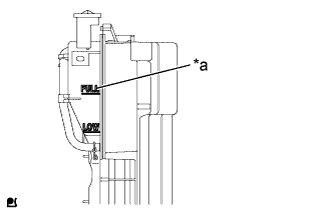
Text in Illustration *a FULL Line Fill the radiator reserve tank with coolant to the FULL line.
-
Text in Illustration *1 Air Bleed Valve Tighten the air bleed valve.
-
Install the water filler cap sub-assembly and reserve tank cap.
-
Start the engine and warm it up.
-
Bleed air from the cooling system.
Tech Tips
-
Before starting the engine, turn the A/C switch off.
-
Adjust the air conditioning temperature setting to MAX (HOT).
-
Adjust the air conditioning blower setting to LO.
-
Run the engine intermittently for 7 minutes or more (5 seconds running at 3000 rpm and 45 seconds idling, repeat several times).
-
-
Stop the engine, and wait until the engine coolant cools down.
-
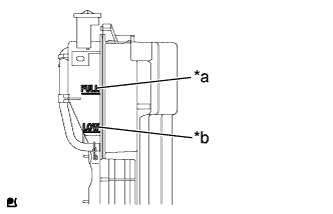
Text in Illustration *a FULL Line *b LOW Line After the engine is cooled down, check that the coolant level is between the FULL and LOW lines.
If the coolant level is low, add coolant to the reservoir tank FULL line.
-
-
ADD ENGINE OIL
-
Add new engine oil.
Standard Oil Grade Oil Grade Oil Viscosity (SAE)
-
API grade SL "Energy-Conserving".
-
SM "Energy-Conserving" or ILSAC multigrade engine oil
-
0W-20
-
5W-20
-
5W-30
-
10W-30
API grade SL or SM multigrade engine oil
-
15W-40
-
20W-50
Standard Capacity Item Specified Condition Drain and refill with oil filter change 3.5 liters (3.7 US qts, 3.1 Imp. qts) Drain and refill without oil filter change 3.3 liters (3.5 US qts, 2.9 Imp. qts) Dry fill 3.9 liters (4.1 US qts, 3.4 Imp. qts) -
-
Install the oil filler cap.
-
-
CHARGE REFRIGERANT (w/ Air Conditioning System)
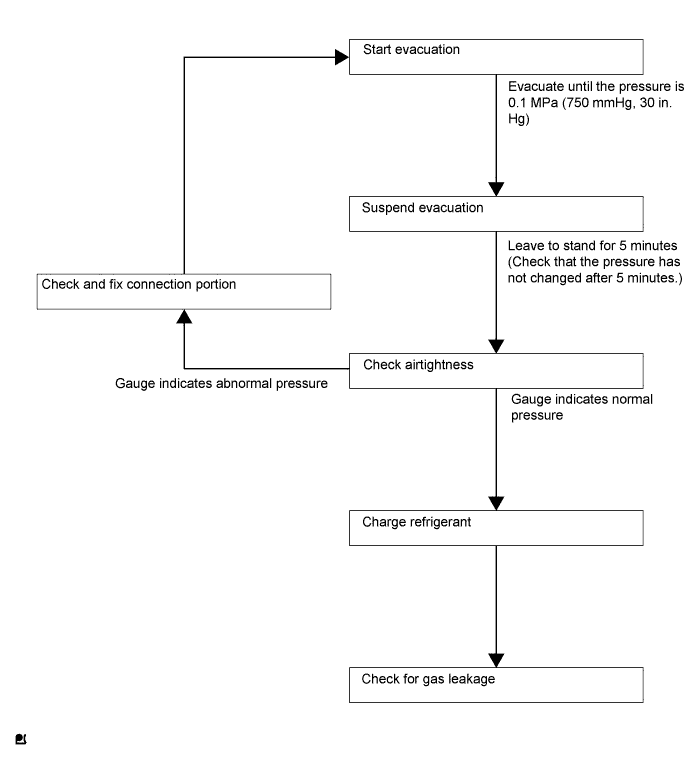
Tech Tips
Charge refrigerant in accordance with the equipment manual.
-
Perform vacuum purging using a vacuum pump.
-
Charge refrigerant HFC-134a (R134a).
- SST
- 09985-20010 ( 09985-02010, 09985-02050, 09985-02060, 09985-02070, 09985-02080, 09985-02090, 09985-02110, 09985-02130, 09985-02140, 09985-02150 )
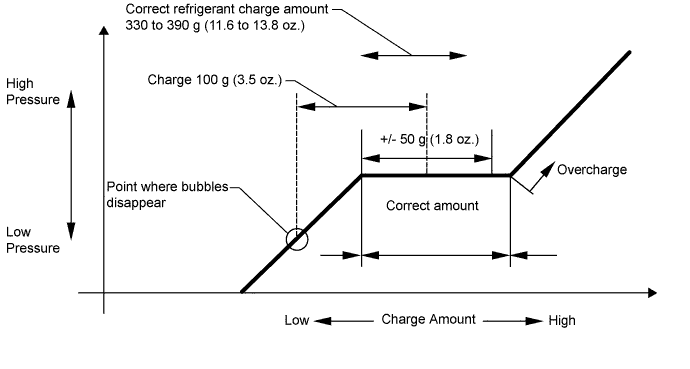
Standard 330 to 390 g (11.6 to 13.8 oz.) Note
-
Do not start the engine before charging it with refrigerant as the cooler compressor does not work properly without sufficient refrigerant. This could cause the compressor to overheat.
-
Approximately 100 g (3.5 oz.) of refrigerant may need to be charged after bubbles disappear.
The volume of refrigerant should be measured, not checked with the sight glass.
Tech Tips
-
The relationship between the refrigerant charge amount and the pressure is as follows.
-
High Charge Range:
If the refrigerant is overcharged, the pressure rises on the high-pressure side. High-pressure cut off frequently occurs. This causes insufficient cooling performance and also insufficient compressor lubrication.
-
Low Charge Range:
A shortage of refrigerant causes insufficient cooling performance and low circulation of refrigerant oil, which shortens the compressor life. Operation with insufficient coolant raises the refrigerant temperature and causes heat deterioration of the rubber seals and hoses. Cracking and subsequent refrigerant leakage may occur.
-
Install the caps onto the service valves on the refrigerant line.
-
-
ADD MANUAL TRANSAXLE OIL (for Manual Transaxle)
-
Install a new gasket and the manual transmission drain plug.
- Torque:
- 45 N*m { 459 kgf*cm, 33 ft.*lbf }
-
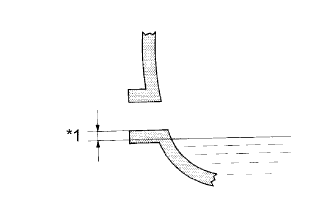
Text in Illustration *1 0 to 5 mm (0 to 0.20 in.) Add manual transaxle oil.
-
-
ADD CONTINUOUSLY VARIABLE TRANSAXLE FLUID (for CVT)
Tech Tips
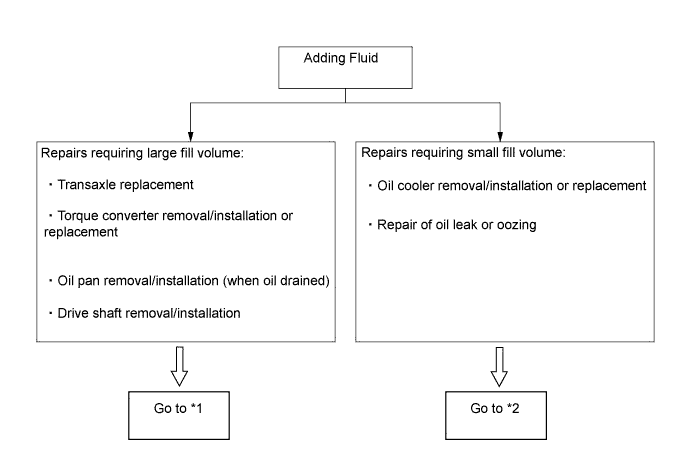
Refer to the following diagram when adding fluid.
-
When adding fluid (large fill volume) *1
-
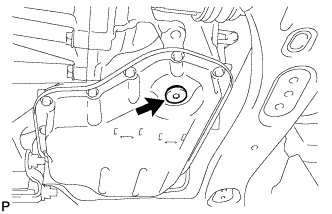
Be sure that the vehicle remains level and lift the vehicle.
-
Use a socket hexagon wrench (6 mm) to remove the drain plug and gasket.
-
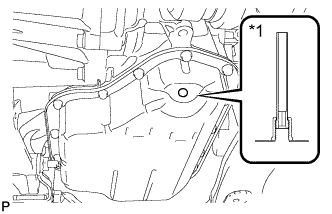
Text in Illustration *1 No. 1 Transmission Oil Filler Tube Use a socket hexagon wrench (6 mm) to check that the No. 1 transmission oil filler tube is tightened to the specified torque.
- Torque:
- 0.8 N*m { 8.2 kgf*cm, 7 in.*lbf }
Note
If the No. 1 transmission oil filler tube is not tightened to the specified torque, then the fluid level cannot be adjusted correctly.
-
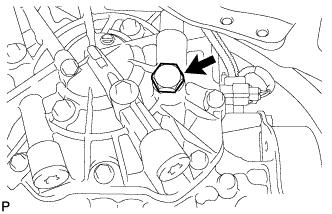
Remove the refill plug and gasket.
-
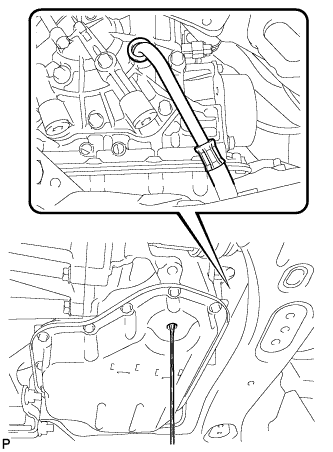
Add fluid into the refill hole until it flows out from the overflow hole.
Note
This transmission requires Toyota Genuine CVT Fluid TC.
-
Wait until the steady flow slows to a trickle, install a gasket, and temporarily tighten the drain plug with a socket hexagon wrench (6 mm).
Tech Tips
Because the drain plug will be removed again, the gasket can be reused at this time.
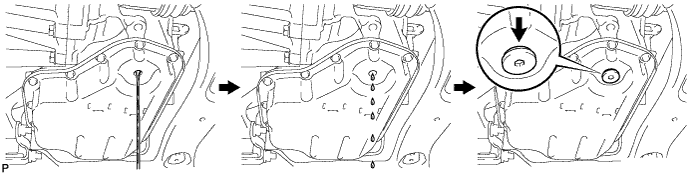
-
Fill the specified volume of transmission fluid into the refill hole.
Note
The fill amount varies depending on the procedures being completed.
Reference Capacity Related Procedure Fill Volume Transaxle replacement (with a new torque converter) 1.4 liters (1.48 US qts, 1.23 Imp. qts) Transaxle replacement (when reusing the torque converter) 0.4 liters (0.42 US qts, 0.35 Imp. qts) Torque converter replacement 1.6 liters (1.69 US qts, 1.41 Imp. qts) Torque converter removal/installation 0.4 liters (0.42 US qts, 0.35 Imp. qts) Oil pan removal/installation (when oil drained) 0.4 liters (0.42 US qts, 0.35 Imp. qts) Drive shaft removal/installation 0.4 liters (0.42 US qts, 0.35 Imp. qts) -
Install the gasket and temporarily tighten the refill plug.
Tech Tips
Because the refill plug will be removed again, the gasket can be reused at this time.
-
Lower the vehicle.
-
-
When refilling (small fill volume) *2
-
Be sure that the vehicle remains level and lift the vehicle.
-
Remove the refill plug and gasket.
-
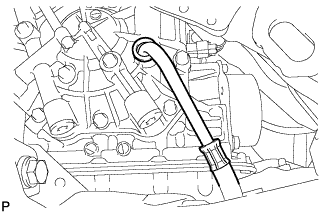
Fill the specified volume of transmission fluid into the refill hole.
Reference Capacity Related Procedure Fill Volume Oil cooler removal/installation or replacement 0.4 liters (0.42 US qts, 0.35 Imp. qts) Repair of oil seeping or oozing 0.4 liters (0.42 US qts, 0.35 Imp. qts) -
Install the gasket and temporarily tighten the refill plug.
Tech Tips
Because the refill plug will be removed again, the gasket can be reused at this time.
-
Lower the vehicle.
-
-
-
FILL BRAKE FLUID RESERVOIR (for Manual Transaxle)
-
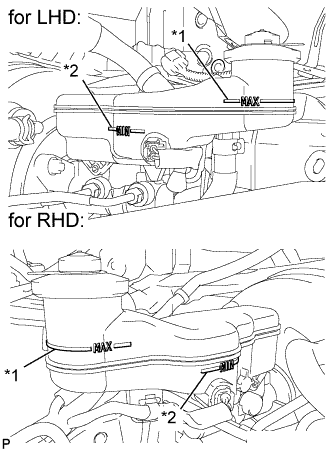
Text in Illustration *1 MAX Line *2 MIN Line Fill the reservoir with brake fluid.
Brake Fluid SAE J1703 or FMVSS No. 116 DOT 3 Note
Add brake fluid to keep the level between the MIN and MAX lines of the reservoir while bleeding the brakes.
-
-
BLEED CLUTCH LINE (for Manual Transaxle)
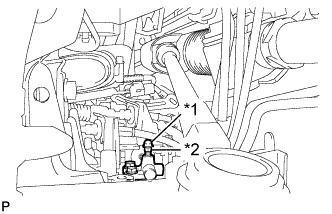
Text in Illustration *1 Bleeder plug cap *2 Bleeder plug Tech Tips
In case of clutch fluid replacement, make sure that the old fluid is replaced in the clutch line between the reservoir and the bleeder before bleeding.
-
Remove the bleeder plug cap.
-
Connect a vinyl tube to the bleeder plug.
-
Depress the clutch pedal 5 times, and then loosen the bleeder plug while the pedal is depressed.
-
When fluid no longer comes out, tighten the bleeder plug, and then release the clutch pedal.
-
Repeat both of the previous 2 steps 6 times.
-
Tighten the bleeder plug.
- Torque:
- 8.4 N*m { 86 kgf*cm, 74 in.*lbf }
-
Depress the clutch pedal 10 times or more and confirm its operation.
Note
This must be performed before the engine is started.
-
Install the bleeder plug cap.
-
Check that all the air has been bled from the clutch line.
-
-
CHECK BRAKE FLUID LEVEL IN RESERVOIR (for Manual Transaxle)
-
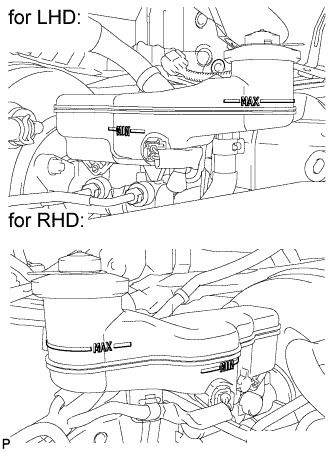
Check the brake fluid level.
If brake fluid level is lower than the MIN line, check for leaks and inspect the disc brake pads. If necessary, refill the reservoir with brake fluid to the MAX line after repair or replacement.
Brake Fluid SAE J1703 or FMVSS No. 116 DOT 3
-
-
FLUID TEMPERATURE CHECK (for CVT)
Note
The fluid temperature can be confirmed by checking the indicator light in the meter or by using the intelligent tester. When using the intelligent tester, it is necessary to change to temperature detection mode in order to idle the vehicle appropriately.
-
When using the intelligent tester
-
Turn the ignition switch off.
-
Connect the intelligent tester to the DLC3.
-
Turn the ignition switch to ON.
-
Turn the tester on.
-
Enter the following menus: Powertrain / Engine and ECT / Data Test / A/T Oil Temperature 1.
-
Enter the following menus: Powertrain / Engine and ECT / Active Test / Connect the TC and TE1.
-
-
When not using the intelligent tester
-
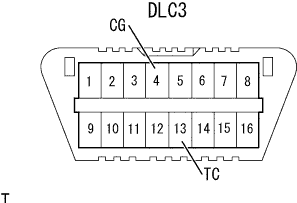
Using SST, connect terminals 13 (TC) and 4 (CG) of the DLC3.
- SST
- 09843-18040
-
-
Start the engine.
Note
Check that electrical systems such as the air conditioning system, audio system and lighting system are off.
Tech Tips
Indicator lights of the meter blink to output DTCs when terminals TC and CG are connected.
-
Slowly move the shift lever from P to B (from P to D for multi-mode automatic transmission) and back to P again.
Tech Tips
Hold the shift lever in each position for about 3 seconds.
-
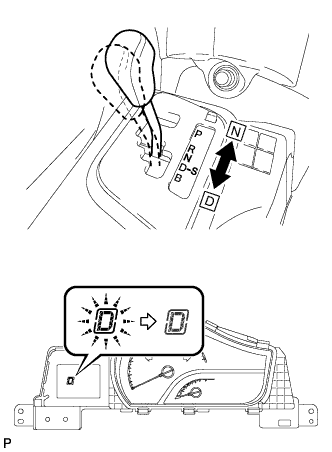
Move the shift lever to D, and then continuously move the shift lever back and forth between N and D at a rate of 1 shift/1.5 seconds or faster for 6 seconds or more. This will activate the fluid temperature detection mode.
Standard condition The indicator light (D) remains illuminated for 2 seconds and then turns off. -
Return the shift lever to P.
-
The indicator light (D) remains off, illuminates, or blinks depending on the fluid temperature.
Indicator Light (D) Remains OFF Illuminates Blinks Below 35 °C (95°F) 35 °C (95 °F) to
45 °C (113 °F)
45 °C (113 °F) or higher Below proper temperature Proper temperature range Above proper temperature -
If the indicator remains off or illuminates, disconnect the TC terminal and perform the "Fluid Level Check".
Note
-
If the TC terminal is not OFF (open), accurate fluid level adjustment is not possible, so be sure to disconnect this terminal.
-
If the TC terminal is not OFF (open), in some cases, the fluid temperature reading will immediately exceed the proper temperature for adjustment.
-
If the light is blinking, stop the engine, wait for the fluid temperature to decrease, and repeat the procedure from "Fluid Temperature Check".
-
-
-
FLUID LEVEL CHECK (for CVT)
-
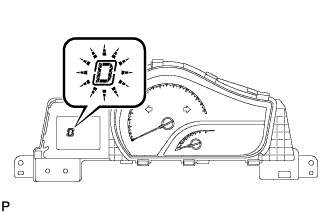
Idle the engine to warm it up, and ensure that the fluid temperature is correct.
-
Lift the vehicle immediately after the indicator light (D) illuminates.
Note
Adjust the fluid level while the indicator light (D) is illuminated.
-
Use a socket hexagon wrench (6 mm) to remove the drain plug and gasket, and then check the fluid condition.
Tech Tips
-
Check that the fluid flows out from the overflow tube.
-
If the volume of fluid that flows out is small, it is possible that fluid was remaining in the tube (about 5 cc (0.30512 cu in.)), so assume that there was no overflow.
-
-
If the fluid overflows
-
Wait until the steady flow slows to a trickle, and then use a socket hexagon wrench (6 mm) to install a new gasket and tighten the drain plug.
- Torque:
- 40 N*m { 408 kgf*cm, 30 ft.*lbf }
-
Replace the refill plug with a new gasket and tighten the refill plug.
- Torque:
- 49 N*m { 500 kgf*cm, 36 ft.*lbf }
-
-
If the fluid does not overflow
-
Remove the refill plug and gasket.
-
Add fluid into the refill hole until it flows out from the overflow hole.
Note
This transmission requires Toyota Genuine CVT Fluid TC.
-
Wait until the steady flow slows to a trickle, and then install a new gasket and tighten the drain plug.
- Torque:
- 40 N*m { 408 kgf*cm, 30 ft.*lbf }
-
Install a new gasket and fully tighten the refill plug.
- Torque:
- 49 N*m { 500 kgf*cm, 36 ft.*lbf }
-
-
Lower the vehicle.
-
Turn the ignition switch off and disconnect the intelligent tester.
-
-
INSPECT FOR ENGINE COOLANT LEAK
CAUTION:
To avoid the danger of being burned, do not remove the water filler cap sub-assembly while the engine and radiator assembly are still hot. Thermal expansion will cause hot engine coolant and steam to blow out from the radiator assembly.
-
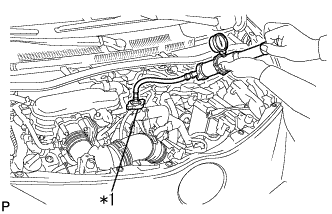
Text in Illustration *1 Radiator Cap Tester Fill the radiator assembly with engine coolant, and attach a radiator cap tester.
-
Pump the tester to 118 kPa (1.2 kgf/cm2, 17.1 psi), and then check that the pressure does not drop.
If the pressure drops, check the hoses, radiator assembly and water pump assembly for leaks. If there are no signs or traces of external engine coolant leaks, check the heater core, cylinder block and head.
-
-
INSPECT RESERVOIR ENGINE COOLANT LEVEL
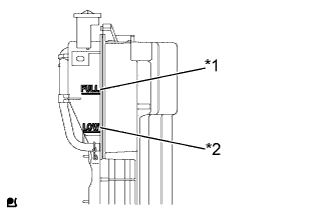
Text in Illustration *1 Full Line *2 Low Line
-
The engine coolant should be between the LOW and FULL lines when the engine is cold.
Tech Tips
If it is below the LOW line, check for leaks and add Toyota Super Long Life Coolant (SLLC) or similar high quality ethylene glycol based non-silicate, non-amine, non-nitrite, and non-borate coolant with long-life hybrid organic acid technology up to the FULL line.
-
-
INSPECT FOR ENGINE OIL LEAK
-
INSPECT FOR MANUAL TRANSAXLE OIL LEAK (for Manual Transaxle)
-
Text in Illustration *1 0 to 5 mm (0 to 0.20 in.) Check that the oil surface is within 5 mm (0.20 in.) of the bottom of the manual transmission filler plug opening.
Note
Excessively large or small amounts of oil may cause problems.
-
Check for oil leakage when the oil level is low.
-
Install the manual transmission filler plug and a new gasket.
- Torque:
- 39 N*m { 400 kgf*cm, 29 ft.*lbf }
-
-
INSPECT CONTINUOUSLY VARIABLE TRANSAXLE FLUID LEAK (for CVT)
-
Clean the area and check for fluid leaks.
-
-
INSPECT FOR EXHAUST GAS LEAK
-
INSPECT FOR FUEL LEAK
-
INSPECT FOR REFRIGERANT LEAK (w/ Air Conditioning System)
-
After recharging the refrigerant gas, check for refrigerant gas leakage using a halogen leak detector.
-
Perform the operation as follows:
-
Stop the engine.
-
Secure good ventilation (the halogen leak detector may react to volatile gases other than refrigerant, such as evaporated gasoline or exhaust gas).
-
Repeat the test 2 or 3 times.
-
Make sure that some refrigerant remains in the refrigeration system.
When the compressor is off: approximately 392 to 588 kPa (4 to 6 kgf/cm2, 57 to 85 psi)
Tech Tips
It is impossible for the above pressure to be maintained if there is leakage.
-
-
Using the halogen leak detector, check the refrigerant line, especially at the connection points, for leakage.
-
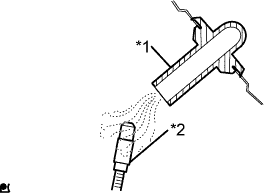
Text in illustration *1 Drain hose *2 Halogen leak detector Bring the halogen leak detector close to the drain hose before performing the test.
Tech Tips
-
After the blower motor has stopped, leave the cooling unit for at least 15 minutes.
-
Place the halogen leak detector sensor under the drain hose.
-
When bringing the halogen leak detector close to the drain hose, make sure that the halogen leak detector does not react to other volatile gases.
If such a reaction is unavoidable, the vehicle must be lifted up.
-
-
If no gas leakage is detected from the drain hose, remove the blower motor from the cooling unit. Insert the halogen leak detector sensor into the unit and perform the test.
-
Disconnect the pressure switch connector and leave it for approximately 20 minutes. Bring the halogen leak detector close to the pressure switch and perform the test.
-
-
INSPECT IGNITION TIMING
Note
-
Check the ignition timing with the cooling fans off.
-
Turn off all electrical systems and the A/C.
-
When checking the ignition timing, the transaxle should be in neutral or park.
-
Warm up and stop the engine.
-
When using the intelligent tester: Check the ignition timing.
-
Connect the intelligent tester to the DLC3.
-
Start the engine and run it at idle.
-
Turn the tester on.
-
Enter the following menus: Powertrain / Engine and ECT / Data List / IGN Advance.
Standard ignition timing Transaxle Ignition Timing Manual Transaxle 0 to 10 degrees BTDC CVT -5 to 5 degrees BTDC Tech Tips
Refer to the intelligent tester operator's manual for further details.
-
Check that the ignition timing advances immediately when the engine speed is increased.
-
Enter the following menus: Powertrain / Engine and ECT / Active Test / Connect the TC and TE1 / ON.
-
Monitor IGN Advance of the Data List.
Standard ignition timing Transaxle Ignition Timing Manual Transaxle 8 to 12 degrees BTDC CVT Note
When checking the ignition timing, the transaxle should be in neutral or park.
Tech Tips
Refer to the intelligent tester operator's manual for further details.
-
Enter the following menus: Connect the TC and TE1 / OFF.
-
Turn the ignition switch off.
-
Disconnect the intelligent tester from the DLC3.
-
-
When not using the intelligent tester:
-
Remove the No. 3 engine under cover (w/ No. 1 Engine Cover).
-
Remove the No. 1 engine cover. (w/ No. 1 Engine Cover)
-
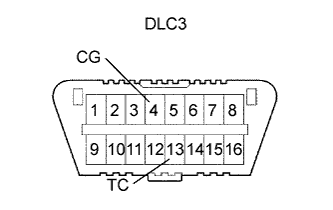
Using SST, connect terminals 13 (TC) and 4 (CG) of the DLC3.
- SST
- 09843-18040
Note
-
Be sure to connect the terminals correctly. Failure to do this can damage the engine.
-
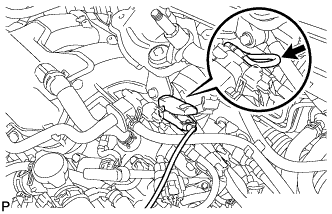
Connect the clip of the timing light to the wire harness.
Note
Use a timing light that detects the primary signal.
-
Inspect the ignition timing at idle.
Standard ignition timing Transaxle Ignition Timing Manual Transaxle 8 to 12 degrees BTDC CVT Note
When checking the ignition timing, the transaxle should be in neutral or park.
Tech Tips
After running the engine at 1000 to 1300 rpm for 5 seconds, check that it returns to idle speed.
-
Disconnect SST from terminals 13 (TC) and 4 (CG) of the DLC3.
-
Inspect the ignition timing at idle.
Standard ignition timing Transaxle Ignition Timing Manual Transaxle 0 to 10 degrees BTDC CVT -5 to 5 degrees BTDC -
Confirm that the ignition timing advances when the engine rpm is increased.
-
Remove the timing light.
-
Install the No. 1 engine cover (w/ No. 1 Engine Cover).
-
Install the No. 3 engine under cover (w/ No. 1 Engine Cover).
-
-
-
INSPECT ENGINE IDLING SPEED
Note
-
Turn all electrical systems and the A/C off.
-
Inspect the idle speed with the cooling fans off.
-
When checking the idle speed, the transaxle should be in neutral or park.
-
Warm up and stop the engine.
-
Connect the intelligent tester to the DLC3.
-
Start the engine and run it at idle.
-
Turn the tester on.
-
Enter the following menus: Powertrain / Engine and ECT / Data List / Engine Speed.
Tech Tips
Refer to the intelligent tester operator's manual for further details.
-
Inspect the engine idle speed.
Standard Idle Speed Transaxle Idling Speed Manual Transaxle 550 to 650 rpm CVT 600 to 700 rpm -
Turn the ignition switch off.
-
Disconnect the intelligent tester from the DLC3.
-
-
INSPECT CO/HC
Tech Tips
This check determines whether or not the idle CO/HC complies with local regulations.
-
Start the engine.
-
Run the engine at 2500 rpm for approximately 180 seconds.
-
Insert the CO/HC meter testing probe at least 40 cm (1.3 ft.) into the tailpipe while idling.
-
Check the CO/HC concentration during idle and when the engine is running at 2500 rpm.
Tech Tips
When doing the 2 mode (with the engine idling/ running at 2500 rpm) test, the measurement procedures are determined by applicable local regulations.
If the CO/HC concentration does not comply with local regulations, troubleshoot in the order given below.
-
Check the A/F sensor and heated oxygen sensor operation.
-
See the table below for possible causes, and then inspect the applicable parts and repair them if necessary.
CO HC Problem Possible Cause Normal High Rough idle
-
Faulty ignition:
-
Incorrect timing
-
Fouled, shorted or improperly gapped plugs
-
Incorrect valve clearance
-
Leakage from intake and exhaust valves
-
Leakage from cylinders
Low High Rough idle (Fluctuating HC reading)
-
Vacuum leaks:
-
PCV hoses
-
Intake manifold
-
Throttle body
-
Brake booster line
-
Lean mixture causing misfire
High High Rough idle (Black smoke from exhaust)
-
Restricted air cleaner filter element
-
Plugged PCV valve
-
Faulty EFI system:
-
Faulty pressure regulator
-
Faulty engine coolant temperature sensor
-
Faulty mass air flow meter
-
Faulty ECM
-
Faulty injectors
-
Throttle body
-
-
-
-
INSPECT AND ADJUST FRONT WHEEL ALIGNMENT
-
Inspect and adjust front wheel alignment Click here.
-
-
INSTALL NO. 3 ENGINE UNDER COVER
-
Install the No. 3 engine under cover with the 3 clips.
-
-
INSTALL NO. 2 ENGINE UNDER COVER
- Torque:
- 5.0 N*m { 51 kgf*cm, 44 in.*lbf }
-
INSTALL FRONT FLOOR COVER RH
-
INSTALL FRONT FLOOR COVER LH
-
INSTALL WINDSHIELD WIPER MOTOR AND LINK
-
Install the windshield wiper motor and link Click here.
-