ECD SYSTEM SYSTEM DESCRIPTION

-
ENGINE CONTROL SYSTEM
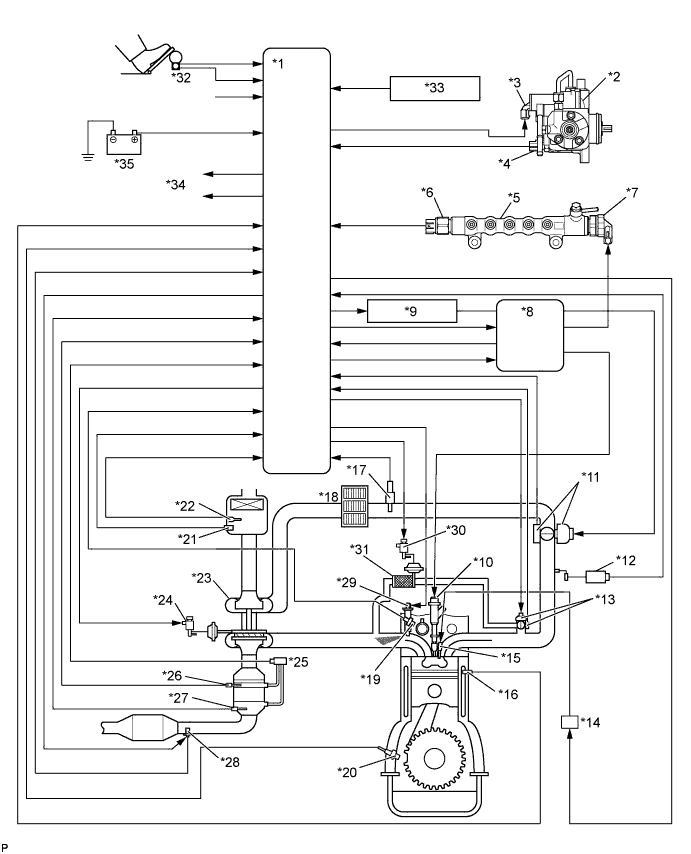
Text in Illustration *1 ECM *19 Camshaft Position Sensor *2 Fuel Supply Pump *20 Crankshaft Position Sensor *3 Suction Control Valve *21 Mass Air Flow Meter *4 Fuel Temperature Sensor *22 IAT Sensor (Built Into Mass Air Flow Meter) *5 Common Rail *23 Turbocharger *6 Fuel Pressure Sensor *24 E-VRV for Turbocharger Control *7 Pressure Discharge Valve *25 Differential Pressure Sensor *8 Injector Driver (EDU) *26 Exhaust Gas Temperature Sensor (B1S1) *9 EDU Relay *27 Exhaust Gas Temperature Sensor (B1S2) *10 Injector *28 Air Fuel Ratio Sensor *11 Diesel Throttle Body Assembly *29 Exhaust Fuel Addition Injector *12 Manifold Absolute Pressure Sensor *30 VSV for EGR Cooler *13 EGR Valve Assembly *31 EGR Cooler *14 GLOW Relay *32 Accelerator Pedal Position Sensor *15 Glow Plug *33 Generator *16 ECT Sensor *34 Cooling Fan Relay *17 Intake Air Temperature Sensor (Turbo) *35 Battery *18 Intercooler - - -
DIESEL PARTICULATE FILTER SYSTEM DESCRIPTION
-
Diesel Particulate Filter System comprehensively regulates engine control (consists of a catalytic system and a fuel injection system) that purifies particulate matter (PM) by diesel engines. The catalytic system purifies hydrocarbons (HC) and carbon monoxides (CO), and reduces PM with a catalytic converter with the Diesel Particulate Filter (DPF). The fuel injection system adds fuel into the exhaust port using the exhaust fuel addition injector to produce maintain a proper catalyst temperature for DPF catalyst regeneration.
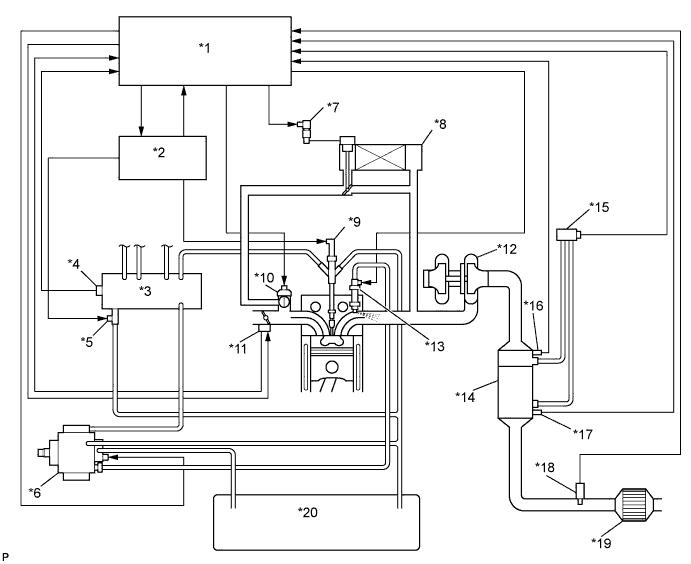
Text in Illustration *1 ECM *11 Diesel Throttle Body Assembly *2 Injector Driver (EDU) *12 Turbocharger *3 Common Rail *13 Exhaust Fuel Addition Injector *4 Fuel Pressure Sensor *14 DPF Catalytic Converter *5 Pressure Discharge Valve *15 Differential Pressure Sensor *6 Fuel Supply Pump *16 Exhaust Gas Temperature Sensor (B1S1) *7 VSV for EGR Cooler *17 Exhaust Gas Temperature Sensor (B1S2) *8 EGR Cooler *18 Air Fuel Ratio Sensor *9 Injector *19 Oxidation Catalyst Converter *10 EGR Valve Assembly *20 Fuel Tank -
DPF components:
Component Description DPF catalytic converter Reduces HC, CO and PM. Exhaust fuel addition injector Adds fuel into the exhaust port in order to raise catalyst temperature for DPF catalyst regeneration. Exhaust gas temperature sensor Used for estimating the DPF catalytic converter temperature and adjusting fuel addition by ECM while DPF catalyst regeneration is performed. Also detects the DPF catalytic converter temperature to prevent the catalytic converter temperature from rising too high. Differential pressure sensor Detects the volume of PM deposits and any incorrect vacuum hose arrangement on the DPF catalytic converter. A/F sensor Used for controlling the air-fuel ratio. By controlling the air-fuel ratio, combustion control for low temperature combustion and DPF catalyst regeneration are properly regulated. -
Diagnostics Trouble Codes (DTCs) table for DPF:
Tech Tips
This table indicates typical DTC combinations for each malfunction occurrence.
Trouble Area Malfunction DTC No. DPF catalytic converter Deteriorated or clogged P2002, P1601, P1386* Exhaust fuel addition injector Stuck open P1386 Stuck closed P1386, P2002* Low fuel addition volume P1386, P2002* Open in exhaust fuel addition injector circuit P1386, P2047, P2002* Short in exhaust fuel addition injector circuit P1386, P2047 Open or short in exhaust fuel addition injector circuit P1386, P2047, P2002* Exhaust gas temperature sensor Open in exhaust gas temperature sensor circuit P0545, P0546, P1386, P2032, P2033 Short in exhaust gas temperature sensor circuit P0545, P0546, P1386*, P2002*, P2032, P2033 Exhaust gas temperature sensor P0545, P0546, P1386*, P2032, P2033 Differential pressure sensor Open in differential pressure sensor circuit P2002*, P2454, P2455 Short in differential pressure sensor circuit P2002*, P2454, P2455 Differential pressure sensor P2002*, P2454, P2455 Differential pressure sensor clogged P2002*, P2453 Incorrect vacuum hose arrangement of the differential pressure sensor P2002*, P2453 A/F sensor Open or short in A/F sensor or heater circuit P0031, P0032, P1386*, P2238, P2239, P2252, P2253 A/F sensor P0031, P0032, P1386*, P2238, P2239, P2252, P2253 Exhaust gas leaks Exhaust gas leaks P1386*, P2002* Fuel leaks Fuel leaks in fuel addition injector P1386* Fuel supply pump Correct fuel pressure cannot be fed to the exhaust fuel addition injector P1386* *: There may be no DTC output depending on the condition of the malfunction.
-
Diagnostics trouble code description for DPF:
DTC No. Description P0031 Open or short in A/F sensor heater control circuit (Low output) P0032 Open or short in A/F sensor or heater circuit (High output) P0545 Open or short in exhaust gas temperature sensor circuit (B1S1) (Low output) P0546 Open or short in exhaust gas temperature sensor circuit (B1S1) (High output) P1386 DPF fuel addition system malfunction P2002 DPF catalytic converter malfunction P2032 Open or short in exhaust gas temperature sensor circuit (B1S2) (Low output) P2033 Open or short in exhaust gas temperature sensor circuit (B1S2) (High output) P2047 Open in exhaust fuel addition injector circuit P2238 Open or short in A/F sensor or heater circuit (Low output) P2239 Open or short in A/F sensor or heater circuit (High output) P2252 Open or short in A/F sensor or heater circuit (Low output) P2253 Open or short in A/F sensor or heater circuit (High output) P2453 Differential pressure sensor is clogged or has incorrect vacuum hose arrangement P2454 Open or short in differential pressure sensor circuit (Low output) P2455 Open or short in differential pressure sensor circuit (High output)
-
-
COMMON RAIL SYSTEM DESCRIPTION
-
Common rail system:
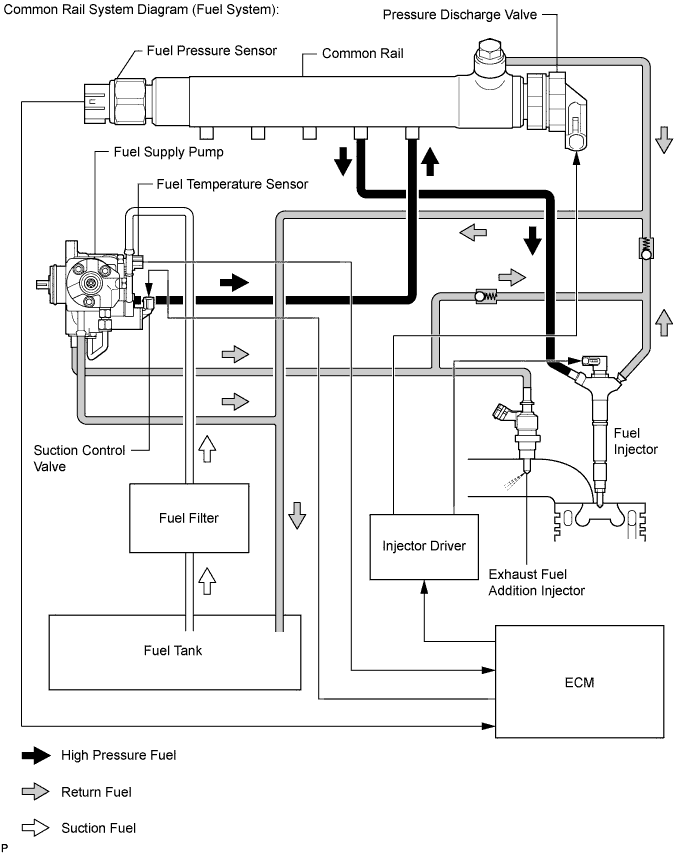
The common rail system uses high-pressure fuel for improved fuel economy. This system also provides robust engine power while suppressing engine vibration and noise.
This system stores fuel in the common rail, which has been pressurized and supplied by the supply pump. By storing fuel at high-pressure, the common rail system can provide fuel at stable fuel injection pressures, regardless of engine speed or engine load.
The ECM, using the EDU, provides an electric current to the piezo actuator in each injector to regulate the fuel injection timing and volume. The ECM also monitors the internal fuel pressure of the common rail using the fuel pressure sensor. The ECM causes the supply pump to supply the fuel necessary to obtain the target fuel pressure.
In addition, this system uses a piezo actuator inside each injector to open and close the fuel passages. Therefore, both fuel injection time and fuel injection volume can be precisely regulated by the ECM.
The common rail system allows a two stage fuel injection process. In order to soften combustion shock, this system performs "pilot-injection" prior to the main fuel injection. This helps to reduce engine vibration and noise.
Tech Tips
If there is a problem with a fuel return pipe, as bleeding air from the fuel system may not be able to be performed properly in certain instances, such as after replacing a fuel injector, etc., the engine startability may deteriorate.
-
Common rail system components:
Component Description Common rail Stores high-pressure fuel produced by supply pump Fuel supply pump Operated by crankshaft
Supplies high-pressure fuel to common rail
Injector Injects fuel to combustion chamber based on signals from ECM Fuel pressure sensor Monitors internal fuel pressure of common rail and sends signals to ECM Pressure discharge valve Based on signals from ECM, opens valve when sudden deceleration occurs, or when ignition switch is off to prevent fuel pressure from becoming too high. Suction control valve Based on signals from ECM, adjusts fuel volume supplied to common rail and regulates internal fuel pressure Check valve Keeps pressure that discharges from injector -
Diagnostic trouble code (DTC) table for the common rail system:
Tech Tips
This table indicates typical DTC combinations for each malfunction occurrence.
Trouble Area Malfunction DTC No. Injector Open or short in injector circuit P062D, P1238, P0093* Stuck open P0093, P1238 Stuck closed P1238 Fuel pressure sensor Open or short in fuel pressure sensor circuit or pressure sensor output fixed P0087, P0190, P0191, P0192, P0193 Pressure discharge valve Open or short in pressure discharge valve circuit P1271, P1272, P0088*, P0093*, P1229* Stuck open P0093 Stuck closed P1272, P0088* Suction control valve Open or short in suction control valve circuit P0627, P1229, P0088* Stuck open P1229, P0088* EDU Faulty EDU P0093*, P062D*, P1238*, P1271*, P1272* Common rail system (Fuel system) Fuel leaks in high-pressure area P0093 *: There may be no DTC output depending on the condition of the malfunction.
-
Diagnostic trouble code description for the common rail system:
DTC No. Description P0087 Fuel pressure sensor output does not change P0088 Internal fuel pressure too high (200000 kPa [2039.4 kgf/cm2, 29000 psi] or more)
P0093 Fuel leaks in high-pressure areas P0190 Open or short in fuel pressure sensor circuit (output voltage is too low or too high) P0192 Open or short in fuel pressure sensor circuit (output voltage is too low) P0193 Open or short in fuel pressure sensor circuit (output voltage is too high) P062D Open or short in EDU or injector circuit P0627 Open or short in suction control valve circuit P1229 Fuel over-feed
-
-
INJECTION CONTROL SYSTEM DESCRIPTION
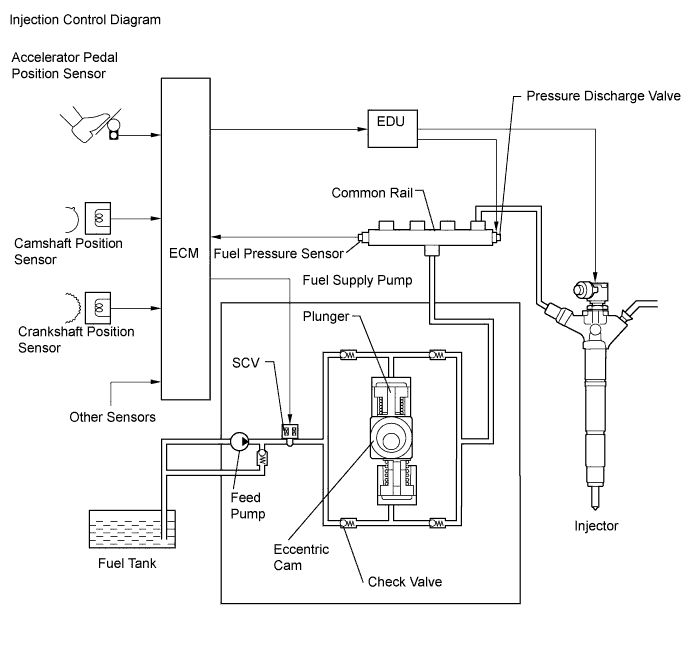
The ECM controls the fuel injection system through the EDU, injectors and supply pump.
The ECM determines the injection volume and injection timing based on signals from the accelerator pedal position sensor, crankshaft position sensor and camshaft position sensor. Based on the signals from the ECM, the EDU controls the injectors. The EDU also controls the suction control valve installed on the supply pump to help regulate fuel pressure.
The piezo type injector used in the 2AD-FTV engine makes noise when the engine is idling because this injector operates at high speed. Therefore, the EDU controls the injector to operate at low speed when the engine is idling based on signals from the ECM to achieve noise reduction.
The feed pump is used to pump fuel from the fuel tank to the supply pump.
-
SUPPLY PUMP OPERATION SYSTEM DESCRIPTION
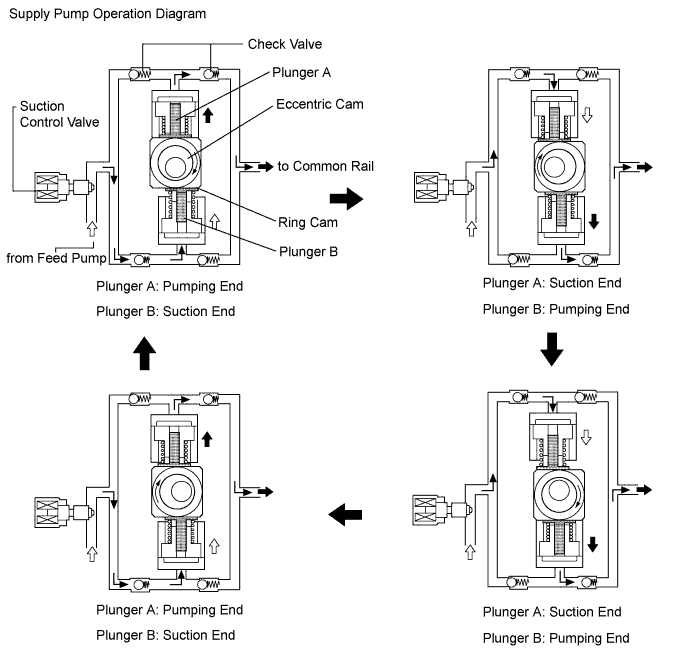
The rotation of the eccentric cam in the supply pump causes the ring cam in the supply pump to push plunger A upward as illustrated below. The spring force pulls plunger B (located opposite to plunger A) upward. As a result, plunger B draws fuel in, and plunger A pumps fuel out at the same time.
-
SUCTION CONTROL VALVE OPERATION SYSTEM DESCRIPTION
Tech Tips
The ECM controls the suction control valve operation to regulate the fuel volume that is produced by the supply pump for the common rail. This control is performed to regulate the internal fuel pressure of the common rail to the target injection pressure.
-
Small opening of the suction control valve:
-
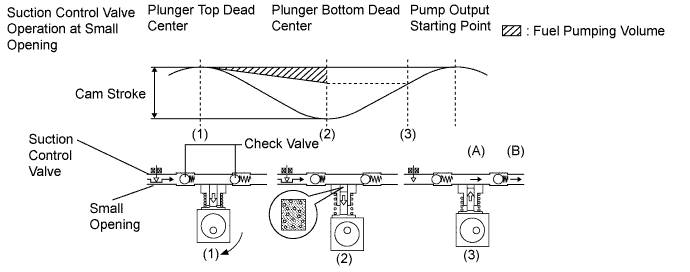
When the opening of the suction control valve is small, the volume of supplied fuel is small.
-
The suction volume becomes small due to the narrow path despite the plunger stroke being full. The difference between the geometrical volume and suction volume creates a vacuum.
-
Pump output will start when the fuel pressure at (A) becomes higher than the common rail pressure (B).
-
-
Large opening of the suction control valve:
-
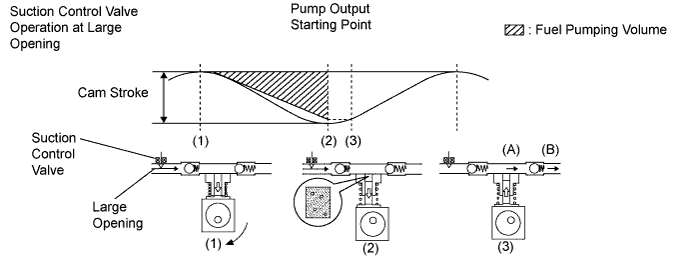
When the opening of the suction control valve is large, the volume of supplied fuel is large.
-
If the plunger stroke is full, the suction volume becomes large because of the wide path.
-
Pump output will start when the fuel pressure at (A) becomes higher than the common rail pressure (B).
-
-