ECD SYSTEM (for CCo) TERMINALS OF ECM

-
CHECK ECM
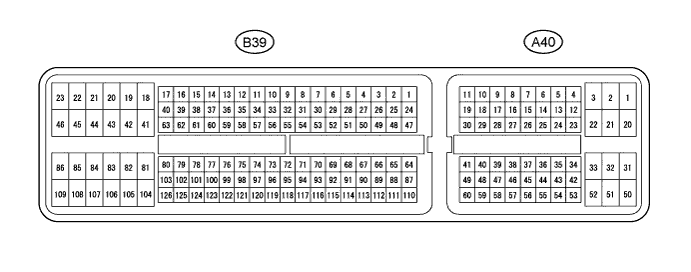
-
Measure the voltage of the ECM connector.
Tech Tips
The standard voltage of each ECM terminal is shown in the table below.
In the table, first follow the information in "Condition". Look at "Terminal No. (Symbol)" for the terminals to be inspected. The standard voltage between the terminals is shown in "Specified Condition".
Use the illustration above as a reference for the ECM terminals.
Terminal No. (Symbol) Wiring Color Terminal Description Condition Specified Condition A40-2 (BATT) - B39-109 (E1) P - BR Battery (for measuring the battery voltage and for the ECM memory) Always 11 to 14 V A40-25 (IGSW) - B39-109 (E1) B - BR Ignition switch Ignition switch ON 11 to 14 V A40-1 (+B) - B39-109 (E1) B - BR Power source of ECM Ignition switch ON 11 to 14 V A40-45 (MREL) - B39-109 (E1) W - BR EFI MAIN relay Ignition switch ON 11 to 14 V A40-45 (MREL) - B39-109 (E1) W - BR EFI MAIN relay 2 seconds elapsed after ignition switch off 0 to 1.5 V A40-44 (IREL) - B39-109 (E1) R - BR EDU relay ignition switch off 11 to 14 V A40-44 (IREL) - B39-109 (E1) R - BR EDU relay Idling 0 to 1.5 V B39-58 (GREL) - B39-109 (E1) R - BR Glow plug relay Cranking 11 to 14 V B39-58 (GREL) - B39-109 (E1) R - BR Glow plug relay Idling (10 minutes or more after engine start) 0 to 1.5 V A40-53 (VPA) - A40-56 (EPA) W - R Accelerator pedal position sensor (for engine control) Ignition switch ON, accelerator pedal fully released 0.5 to 1.1 V A40-53 (VPA) - A40-56 (EPA) W - R Accelerator pedal position sensor (for engine control) Ignition switch ON, accelerator pedal fully depressed 3.0 to 4.6 V A40-54 (VPA2) - A40-58 (EPA2) Y - G Accelerator pedal position sensor (for sensor malfunction detection) Ignition switch ON, accelerator pedal fully released 0.9 to 2.3 V A40-54 (VPA2) - A40-58 (EPA2) Y - G Accelerator pedal position sensor (for sensor malfunction detection) Ignition switch ON, accelerator pedal fully depressed 3.4 to 5.0 V A40-55 (VCPA) - A40-56 (EPA) P-L - R Power source of accelerator pedal position sensor (for VPA1) Ignition switch ON 4.5 to 5.5 V A40-57 (VCP2) - A40-58 (EPA2) B - G Power source of accelerator pedal position sensor (for VPA2) Ignition switch ON 4.5 to 5.5 V A40-43 (STA) - B39-109 (E1) LG - BR Starter signal Cranking 6.0 V or higher B39-51 (INJF) - B39-109 (E1) R-B - BR EDU Idling Pulse generation
(See waveform 3)
B39-50 (#1) - B39-109 (E1) V - BR Injector Idling Pulse generation
(See waveform 2)
B39-49 (#2) - B39-109 (E1) W-R - BR B39-48 (#3) - B39-109 (E1) LG - BR B39-47 (#4) - B39-109 (E1) B - BR B39-52 (PRD) - B39-109 (E1) R-L - BR Pressure relief valve drive signal Ignition switch off 4 to 5.5 V B39-62 (IDLO) - B39-109 (E1) W-G - BR EDU Idling 4 to 5.5 V B39-103 (NE+) - B39-102 (NE-) G - R Crankshaft position sensor Idling Pulse generation
(See waveform 4)
B39-80 (G+) - B39-79 (G-) P - L Camshaft position sensor Idling Pulse generation
(See waveform 4)
A40-35 (STP) - B39-109 (E1) V - BR Stop light switch Ignition switch ON, brake pedal depressed 7.5 to 14 V A40-35 (STP) - B39-109 (E1) V - BR Stop light switch Ignition switch ON, brake pedal released 0 to 1.5 V A40-34 (ST1-) - B39-109 (E1) R-W - BR Stop light switch Ignition switch ON, brake pedal depressed 0 to 1.5 V A40-34 (ST1-) - B39-109 (E1) R-W - BR Stop light switch Ignition switch ON, brake pedal released 7.5 to 14 V A40-26 (TC) - B39-109 (E1) P - BR Terminal TC of DLC3 Ignition switch ON 11 to 14 V A40-12 (W) - B39-109 (E1) P - BR MIL MIL illuminated 0 to 3 V A40-12 (W) - B39-109 (E1) P - BR MIL MIL not illuminated 11 to 14 V A40-14 (SPD) - B39-109 (E1) Y- BR Speed signal from combination meter Ignition switch ON, drive wheels rotating slowly Pulse generation
(See waveform 6)
B39-117 (PIM) - B39-72 (EPIM) G - BR Manifold absolute pressure sensor Negative pressure of 40 kPa (300 mmHg, 11.8 in.Hg) applied 0.3 to 0.9 V B39-117 (PIM) - B39-72 (EPIM) G - BR Manifold absolute pressure sensor Atmospheric pressure 0.8 to 1.4 V B39-117 (PIM) - B39-72 (EPIM) G - BR Manifold absolute pressure sensor Positive pressure of 69 kPa (518 mmHg, 20.3 in.Hg) applied 1.6 to 2.2 V A40-13 (TACH) - B39-109 (E1) GR - BR Engine speed Idling Pulse generation
(See waveform 7)
B39-68 (VCM) - B39-67 (E2M) W-R - W-G Common rail pressure sensor Ignition switch ON 4.5 to 5.5 V B39-69 (VCS) - B39-91 (E2S) G-B - B-R Common rail pressure sensor Ignition switch ON 4.5 to 5.5 V B39-66 (PCR1) - B39-67 (E2M) P - W-G Common rail pressure sensor (main) Idling 1.8 to 2.1 V B39-114 (PCR2) - B39-91 (E2S) R-B - B-R Common rail pressure sensor (sub) Idling 1.2 to 1.5 V B39-54 (ALT) - B39-109 (E1) L - BR Generator duty ratio Idling Pulse generation
(See waveform 8)
B39-41 (PCV+) - B39-81 (PCV-) R - R-W Suction control valve Idling Pulse generation
(See waveform 1)
B39-83 (VN) - B39-109 (E1) W - BR VRV (for VN turbocharger) Idling Pulse generation
(See waveform 5)
B39-97 (VCVL) - B39-96 (EVLU) L-R - B Throttle position sensor Ignition switch ON 4.5 to 5.5 V B39-119 (VLU) - B39-96 (EVLU) Y - B Throttle position sensor Ignition switch ON, throttle valve fully opened 2.8 to 3.8 V B39-42 (M+) - B39-84 (ME01) L - W-B Throttle valve duty signal Engine warmed up, engine racing Pulse generation B39-43 (M-) - B39-84 (ME01) R - W-B Throttle valve duty signal Engine warmed up, engine racing Pulse generation B39-94 (VCEG) - B39-95 (EEGL) W - V EGR valve position sensor Ignition switch ON 4.5 to 5.5 V B39-118 (EGLS) - B39-95 (EEGL) L - V EGR valve position sensor Ignition switch ON 1.03 to 1.37 V B39-86 (EGM+) - B39-84 (ME01) W - W-B EGR valve duty signal Engine warmed up, idling Pulse generation B39-85 (EGM-) - B39-84 (ME01) B - W-B EGR valve duty signal Engine warmed up, idling Pulse generation B39-113 (THIA) - B39-90 (ETHI) GR- L-B Intake air temperature sensor (Intake manifold) Idling, intake air temperature at 0 to 80°C (32 to 176°F) 0.5 to 3.4 V B39-112 (THF) - B39-89 (ETHF) L - G Fuel temperature sensor Ignition switch ON 0.5 to 3.4 V B39-111 (THW) - B39-88 (ETHW) B - BR ECT sensor Idling, engine coolant temperature at 60 to 120°C (140 to 248°F) 0.2 to 1.0 V B39-65 (VG) - B39-64 (EVG) V - R MAF meter power source Ignition switch ON Pulse generation B39-110 (THA) - B39-87 (ETHA) P - BR-W IAT sensor Idling, intake air temperature at 0 to 80°C (32 to 176°F) 0.5 to 3.4 V A40-22 (FANL) - B39-109 (E1) R - BR FAN NO. 3 relay Ignition switch ON 11 to 14 V A40-22 (FANL) - B39-109 (E1) R - BR FAN NO. 3 relay Idling with A/C on
or
High engine coolant temperature
Below 1.5 V A40-21 (FANH) - B39-109 (E1) W - BR FAN NO. 1, 2 relay Idling with high engine coolant temperature Below 1.5 V A40-7 (CANH) - B39-109 (E1) Y - BR CAN communication line Ignition switch ON Pulse generation
(See waveform 9)
A40-6 (CANL) - B39-109 (E1) W - BR CAN communication line Ignition switch ON Pulse generation
(See waveform 10)
-
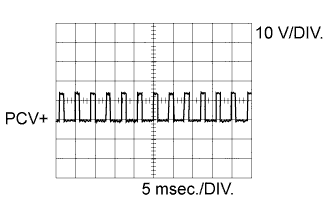
Using an oscilloscope, check waveform 1.
Tech Tips
The waveform varies depending on the suction control valve operation.
-
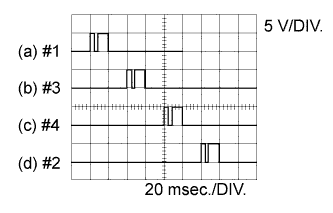
Using an oscilloscope, check waveform 2.
Tech Tips
The waveform varies depending on the injector injection.
-
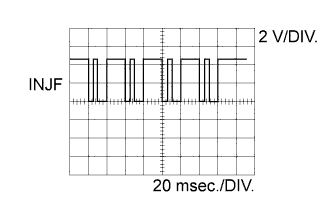
Using an oscilloscope, check waveform 3.
Tech Tips
The waveform varies depending on the injector injection.
-
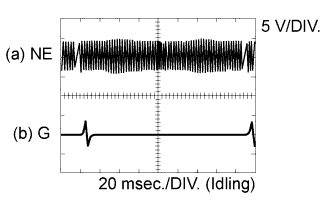
Using an oscilloscope, check waveform 4.
Tech Tips
The waveform varies depending on the engine speed.
-
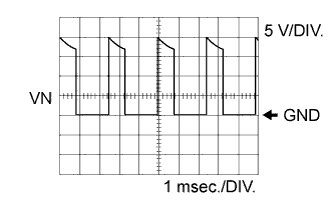
Using an oscilloscope, check waveform 5.
Tech Tips
The waveform changes depending on the electric vacuum regulating valve for turbocharger operation.
-
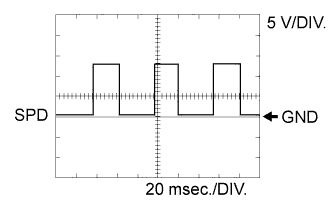
Using an oscilloscope, check waveform 6.
Tech Tips
The wavelength becomes shorter as the vehicle speed increases.
-
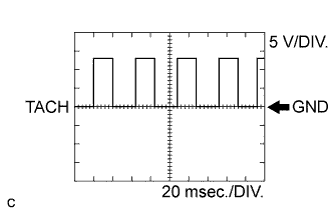
Using an oscilloscope, check waveform 7.
Tech Tips
The wavelength becomes shorter as the engine speed increases.
-
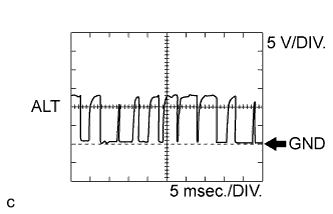
Using an oscilloscope, check waveform 8.
-
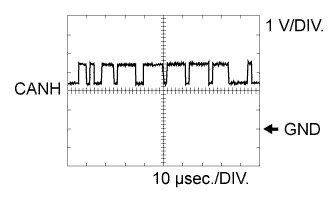
Using an oscilloscope, check waveform 9.
Tech Tips
The waveform varies depending on the CAN communication signal.
-
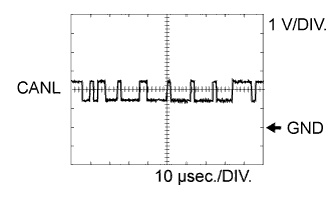
Using an oscilloscope, check waveform 10.
Tech Tips
The waveform varies depending on the CAN communication signal.
-