AUTOMATIC TRANSMISSION SYSTEM(for 2GR-FKS) MECHANICAL SYSTEM TESTS
-
STALL SPEED TEST
CAUTION:
-
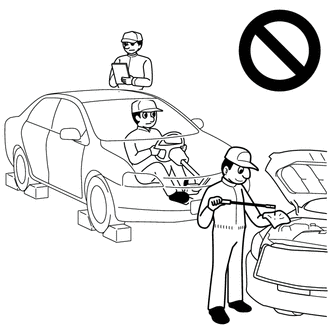
Do not perform a stall test if there are any people or objects near the vehicle.
-
The vehicle could begin moving suddenly, resulting in a serious accident.
-
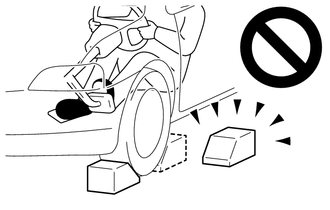
Do not perform a stall test if any wheel chocks are out of position.
-
The vehicle could begin moving suddenly, resulting in a serious accident.
-
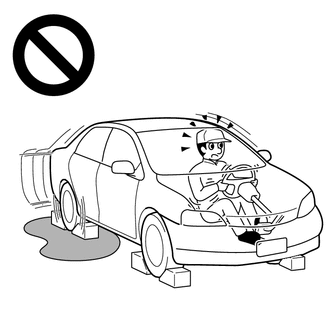
Do not perform the stall test on a slippery or low-friction surface that could allow the tires to spin.
-
The vehicle could begin moving suddenly, resulting in a serious accident.
-
A stall speed test should always be performed with at least 2 people. One person should observe the condition of the wheels and wheel chocks while the other is performing the test.
Note
-
Do not perform the stall speed test for longer than 5 seconds.
-
When performing the stall speed test repeatedly, wait for 15 seconds or more between tests.
-
Perform this test with the ATF (Automatic Transmission Fluid) at the normal operating temperature: 50 to 80°C (122 to 176°F)
Tech Tips
This test is to check the overall performance of the engine and transmission.
-
Connect the GTS to the DLC3.
-
Drive the vehicle until the transmission fluid temperature has reached 50 to 80°C (122 to 176°F).
-
Allow the engine to idle with the air conditioning and headlights off.
-
Chock all 4 wheels.
-
Set the parking brake and keep the brake pedal depressed firmly with your left foot.
-
Move the shift lever to D.
-
Depress the accelerator pedal as much as possible with your right foot.
-
Read the engine speed (stall speed) and release the accelerator pedal immediately.
Evaluation Test Result Possible Cause Stall speed is lower than standard value
-
Engine power output may be insufficient
-
Stator one-way clutch not operating properly
Tech Tips
If the value is less than the specified value by 600 rpm or more, the torque converter assembly may be faulty.
Stall speed is higher than standard value
-
Line pressure is too low
-
Forward multiple clutch (C1) slipping
-
No. 1 one-way clutch (F1) is not operating properly
-
Improper fluid level
-
-
-
SHIFT TIME LAG TEST
Tech Tips
When the shift lever is moved while the engine is idling, there will be a certain time lapse or lag before shock can be felt. This is used for checking the condition of the clutch and brake.
-
Connect the GTS to the DLC3.
-
Drive the vehicle until the transmission fluid temperature has reached 50 to 80°C (122 to 176°F).
-
Allow the engine to idle with the air conditioning off.
-
Set the parking brake and keep the brake pedal depressed firmly.
-
Check the D position time lag.
-
Move the shift lever to N and wait for 1 minute.
-
Move the shift lever to D and measure the time until shock is felt.
-
Repeat the 2 steps above 3 times, and calculate the average time of the 3 tests.
-
-
Check the R position time lag.
-
Move the shift lever to N and wait for 1 minute.
-
Move the shift lever to R and measure the time until shock is felt.
-
Repeat the 2 steps above 3 times, and calculate the average time of the 3 tests.
-
-