SFI SYSTEM(w/ Canister Pump Module), Diagnostic DTC:P0201, P0202, P0203, P0204, P0205, P0206, P062D
| DTC Code | DTC Name |
|---|---|
| P0201 | Injector Circuit / Open - (Cylinder 1) |
| P0202 | Injector Circuit / Open - (Cylinder 2) |
| P0203 | Injector Circuit / Open - (Cylinder 3) |
| P0204 | Injector Circuit / Open - (Cylinder 4) |
| P0205 | Injector Circuit / Open - (Cylinder 5) |
| P0206 | Injector Circuit / Open - (Cylinder 6) |
| P062D | No. 1 Fuel Injector Driver Circuit Performance |
DESCRIPTION
The D-4S system has two fuel injection methods. One is the in-cylinder direct injection method, which directly injects pressurized fuel into the combustion chamber. The other is the intake port injection method. The ECM determines which fuel injection method to use in accordance with the engine conditions. For the in-cylinder direct injection method, the injector driver (EDU) in the engine room operates the fuel injector assemblies (for direction injection) at high speeds. The EDU receives fuel injection request signals from the ECM and converts the signals to high voltage/high current injector operation signals to operate the fuel injector assemblies (for direction injection).
| DTC No. | Detection Item | DTC Detection Condition | Trouble Area | MIL | Memory |
|---|---|---|---|---|---|
| P0201 | Injector Circuit / Open - (Cylinder 1) | Either of following condition is detected (1 trip detection logic):
|
|
Comes on | DTC stored |
| P0202 | Injector Circuit / Open - (Cylinder 2) | Either of following condition is detected (1 trip detection logic):
|
|
Comes on | DTC stored |
| P0203 | Injector Circuit / Open - (Cylinder 3) | Either of following condition is detected (1 trip detection logic):
|
|
Comes on | DTC stored |
| P0204 | Injector Circuit / Open - (Cylinder 4) | Either of following condition is detected (1 trip detection logic):
|
|
Comes on | DTC stored |
| P0205 | Injector Circuit / Open - (Cylinder 5) | Either of following condition is detected (1 trip detection logic):
|
|
Comes on | DTC stored |
| P0206 | Injector Circuit / Open - (Cylinder 6) | Either of following condition is detected (1 trip detection logic):
|
|
Comes on | DTC stored |
| P062D | No. 1 Fuel Injector Driver Circuit Performance | INJ1, INJ2 and INJ3 signal is not input 60 times or more (1 trip detection logic) |
|
Comes on | DTC stored |
MONITOR DESCRIPTION
The fuel injection sequence occurs in numerical order from No. 1 to No. 6.
The ECM monitors the EDU at all times. If drivers or fuel injector assemblies are malfunctioning, the EDU sends fuel injector assembly operation condition signals (fail signals INJ1 to INJ3) to the ECM. When the ECM receives the signals, the ECM stops the fuel injection control of the appropriate cylinders, cuts voltage to the appropriate injector relay, and illuminates the MIL.
| Definition of the Injector Driver Signal | - |
| Injector Driver Signal (INJ1) | #1 (No. 1 Fuel injector assembly) #4 (No. 4 Fuel injector assembly) |
| Injector Driver Signal (INJ2) | #2 (No. 2 Fuel injector assembly) #5 (No. 5 Fuel injector assembly) |
| Injector Driver Signal (INJ3) | #3 (No. 3 Fuel injector assembly) #6 (No. 6 Fuel injector assembly) |
MONITOR STRATEGY
| Required Sensors/Components | Injector for direct injection, injector driver (EDU) |
| Frequency of Operation | Continuous |
CONFIRMATION DRIVING PATTERN
-
Connect the GTS to the DLC3.
-
Turn the engine switch on (IG) and turn the GTS on.
-
Clear the DTCs (even if no DTCs are stored, perform the clear DTC procedure).
-
Turn the engine switch off and wait for at least 30 seconds.
-
Turn the engine switch on (IG) and turn the GTS on.
-
Start the engine.
-
Idle the engine for 15 seconds or more [A].
-
Enter the following menus: Powertrain / Engine / Trouble Codes / Pending.
-
Read pending DTCs [B].
Tech Tips
-
If a pending DTC is output, the system is malfunctioning.
-
If a pending DTC is not output, perform the following procedure.
-
-
Enter the following menus: Powertrain / Engine / Utility / All Readiness.
-
Input the DTC: P0201, P0202, P0203, P0204, P0205, P0206 or P062D.
-
Check the DTC judgment result.
GTS Display Description NORMAL
-
DTC judgment completed
-
System normal
ABNORMAL
-
DTC judgment completed
-
System abnormal
INCOMPLETE
-
DTC judgment not completed
-
Perform driving pattern after confirming DTC enabling conditions
N/A
-
Unable to perform DTC judgment
-
Number of DTCs which do not fulfill DTC preconditions has reached ECU memory limit
Tech Tips
-
If the judgment result shows NORMAL, the system is normal.
-
If the judgment result shows ABNORMAL, the system has a malfunction.
-
If the judgment result shows INCOMPLETE or N/A, perform steps [A] and [B] again.
-
WIRING DIAGRAM
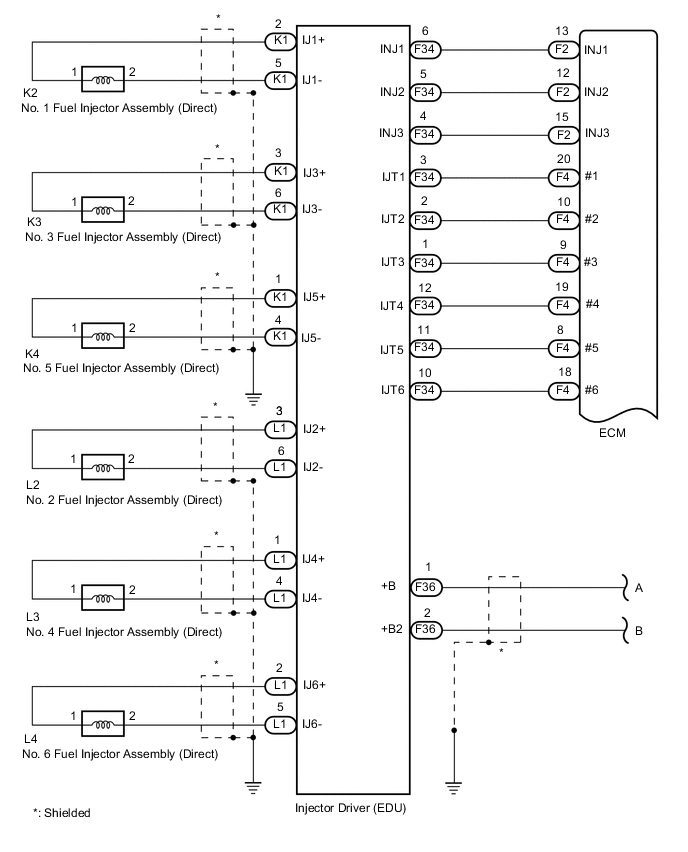
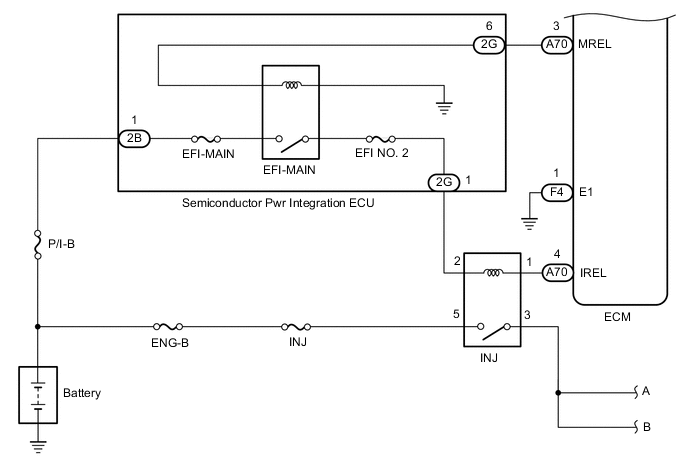
CAUTION / NOTICE / HINT
Note
Inspect the fuses for circuits related to this system before performing the following procedure.
Tech Tips
-
If the current from the INJ relay is cut because DTC P062D is stored, DTC P1235 will be stored even if the fuel pump (for high pressure side) is normal.
-
Read freeze frame data using the GTS. The ECM records vehicle and driving condition information as freeze frame data the moment a DTC is stored. When troubleshooting, freeze frame data can help determine if the vehicle was moving or stationary, if the engine was warmed up or not, if the air fuel ratio was lean or rich, and other data from the time the malfunction occurred.
PROCEDURE
-
CHECK DTC OUTPUT
-
Connect the GTS to the DLC3.
-
Turn the engine switch on (IG).
-
Turn the GTS on.
-
Enter the following menus: Powertrain / Engine / Trouble Codes.
-
Read the DTCs.
Powertrain > Engine > Trouble CodesResult Result Proceed to DTC P0201, P0202, P0203, P0204, P0205 or P0206 is output A One of the following pairs of DTCs is output: P0201 and P0204, P0202 and P0205, or P0203 and P0206 B DTC P062D is output C
B 
GO TO STEP 11 Click here
C
INSPECT INJ RELAY Click here
A 
-
-
CHECK HARNESS AND CONNECTOR
-
Disconnect the injector driver (EDU) connector.
-
Measure the resistance according to the value(s) in the table below.
Standard Resistance Tester Connection Condition Specified Condition K1-2 (IJ1+) - K1-5 (IJ1-) 20°C (68°F) 2.01 to 2.31 Ω L1-3 (IJ2+) - L1-6 (IJ2-) 20°C (68°F) 2.01 to 2.31 Ω K1-3 (IJ3+) - K1-6 (IJ3-) 20°C (68°F) 2.01 to 2.31 Ω L1-1 (IJ4+) - L1-4 (IJ4-) 20°C (68°F) 2.01 to 2.31 Ω K1-1 (IJ5+) - K1-4 (IJ5-) 20°C (68°F) 2.01 to 2.31 Ω L1-2 (IJ6+) - L1-5 (IJ6-) 20°C (68°F) 2.01 to 2.31 Ω K1-2 (IJ1+) - Body ground Always 1 MΩ or higher L1-3 (IJ2+) - Body ground Always 1 MΩ or higher K1-3 (IJ3+) - Body ground Always 1 MΩ or higher L1-1 (IJ4+) - Body ground Always 1 MΩ or higher K1-1 (IJ5+) - Body ground Always 1 MΩ or higher L1-2 (IJ6+) - Body ground Always 1 MΩ or higher Tech Tips
The standard values shown are fuel injector assembly (for direct injection) resistance values.
Result Proceed to OK NG
NG
INSPECT FUEL INJECTOR ASSEMBLY (FOR DIRECT INJECTION (RESISTANCE)) Click here
OK
-
-
CHECK HARNESS AND CONNECTOR (ECM - INJECTOR DRIVER (EDU))
-
Disconnect the ECM connector.
-
Disconnect the injector driver (EDU) connector.
-
Measure the resistance according to the value(s) in the table below.
Standard Resistance Tester Connection Condition Specified Condition F4-20 (#1) - F34-3 (IJT1) Always Below 1 Ω F4-10 (#2) - F34-2 (IJT2) Always Below 1 Ω F4-9 (#3) - F34-1 (IJT3) Always Below 1 Ω F4-19 (#4) - F34-12 (IJT4) Always Below 1 Ω F4-8 (#5) - F34-11 (IJT5) Always Below 1 Ω F4-18 (#6) - F34-10 (IJT6) Always Below 1 Ω F4-20 (#1) or F34-3 (IJT1) - Body ground Always 10 kΩ or higher F4-10 (#2) or F34-2 (IJT2) - Body ground Always 10 kΩ or higher F4-9 (#3) or F34-1 (IJT3) - Body ground Always 10 kΩ or higher F4-19 (#4) or F34-12 (IJT4) - Body ground Always 10 kΩ or higher F4-8 (#5) or F34-11 (IJT5) - Body ground Always 10 kΩ or higher F4-18 (#6) or F34-10 (IJT6) - Body ground Always 10 kΩ or higher Result Proceed to OK NG
NG 
REPAIR OR REPLACE HARNESS OR CONNECTOR
OK
-
-
CHECK ECM (#1, #2, #3, #4, #5 AND #6 VOLTAGE)
-
Connect the GTS to the DLC3.
-
Turn the engine switch on (IG).
-
Turn the GTS on.
-
Clear the DTCs.
Powertrain > Engine > Clear DTCsTech Tips
If DTC P062D is stored, the current from the INJ relay is cut.
-
Turn the engine switch off and wait for at least 30 seconds.
-
Disconnect the F34 injector driver (EDU) connector.
-
Inspect the ECM using an oscilloscope.
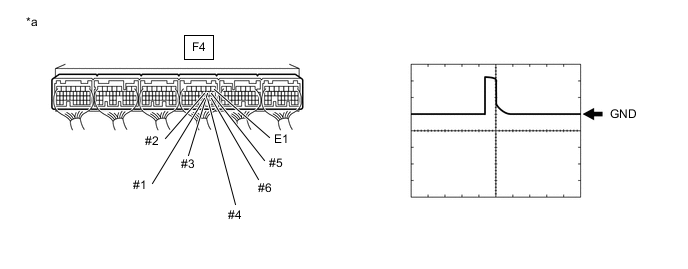
*a Component with harness connected
(ECM)
- -
-
While cranking the engine, check waveform the terminals of the ECM connector.
Standard Signal waveform appears as shown in the illustration. ECM Terminal Name F4-20 (#1) - F4-1 (E1)
F4-10 (#2) - F4-1 (E1)
F4-9 (#3) - F4-1 (E1)
F4-19 (#4) - F4-1 (E1)
F4-8 (#5) - F4-1 (E1)
F4-18 (#6) - F4-1 (E1)
Tester Range 2 V/DIV., 20 ms./DIV. Condition Cranking
Result Proceed to OK NG -
OK
REPLACE INJECTOR DRIVER (EDU) Click here
NG
REPLACE ECM Click here
-
-
INSPECT FUEL INJECTOR ASSEMBLY (FOR DIRECT INJECTION (RESISTANCE))
-
Check the resistance of the fuel injector assembly (for direct injection).
Tech Tips
Perform "Inspection After Repair" after replacing the fuel injector assembly (for direct injection).
Result Proceed to OK NG
OK
REPAIR OR REPLACE HARNESS OR CONNECTOR (INJECTOR DRIVER (EDU) - FUEL INJECTOR ASSEMBLY (FOR DIRECT INJECTION))
NG
REPLACE FUEL INJECTOR ASSEMBLY (FOR DIRECT INJECTION) Click here
-
-
INSPECT INJ RELAY
-
Inspect the INJ relay.
Result Proceed to OK NG
NG
REPLACE INJ RELAY
OK
-
-
CHECK HARNESS AND CONNECTOR (POWER SOURCE OF INJ RELAY)
-
Remove the INJ relay from the No. 2 engine room relay block and No. 2 junction block assembly.
-
Measure the voltage according to the value(s) in the table below.
Standard Voltage Tester Connection Condition Specified Condition 5 (INJ relay) - Body ground Always 11 to 14 V Result Proceed to OK NG
NG
REPAIR OR REPLACE HARNESS OR CONNECTOR (BATTERY - INJ RELAY)
OK
-
-
CHECK HARNESS AND CONNECTOR (INJ RELAY - INJECTOR DRIVER)
-
Remove the INJ relay from the No. 2 engine room relay block and No. 2 junction block assembly.
-
Disconnect the injector driver (EDU) connector.
-
Measure the resistance according to the value(s) in the table below.
Standard Resistance Tester Connection Condition Specified Condition 3 (INJ relay) - F36-1 (+B) Always Below 1 Ω 3 (INJ relay) - F36-2 (+B2) Always Below 1 Ω 3 (INJ relay) or F36-1 (+B) - Body ground Always 10 kΩ or higher 3 (INJ relay) or F36-2 (+B2) - Body ground Always 10 kΩ or higher Result Proceed to OK NG
NG
REPAIR OR REPLACE HARNESS OR CONNECTOR
OK
-
-
CHECK HARNESS AND CONNECTOR (POWER SOURCE OF INJ RELAY)
-
Remove the INJ relay from the No. 2 engine room relay block and No. 2 junction block assembly.
-
Turn the engine switch on (G).
-
Measure the voltage according to the value(s) in the table below.
Standard Voltage Tester Connection Condition Specified Condition 2 (INJ relay) - Body ground Engine switch on (IG) 11 to 14 V Result Proceed to OK NG
NG
CHECK HARNESS AND CONNECTOR (SEMICONDUCTOR PWR INTEGRATION ECU - INJ RELAY) Click here
OK
-
-
CHECK HARNESS AND CONNECTOR (INJ RELAY - ECM)
-
Disconnect the ECM connector.
-
Remove the INJ relay from the No. 2 engine room relay block and No. 2 junction block assembly.
-
Measure the resistance according to the value(s) in the table below.
Standard Resistance Tester Connection Condition Specified Condition 1 (INJ relay) - A70-4 (IREL) Always Below 1 Ω 1 (INJ relay) or A70-4 (IREL) - Body ground Always 10 kΩ or higher Result Proceed to OK NG
NG
REPAIR OR REPLACE HARNESS OR CONNECTOR
OK
-
-
CHECK HARNESS AND CONNECTOR (ECM - INJECTOR DRIVER (EDU))
-
Disconnect the ECM connector.
-
Disconnect the injector driver (EDU) connector.
-
Measure the resistance according to the value(s) in the table below.
Standard Resistance Tester Connection Condition Specified Condition F2-13 (INJ1) - F34-6 (INJ1) Always Below 1 Ω F2-12 (INJ2) - F34-5 (INJ2) Always Below 1 Ω F2-15 (INJ3) - F34-4 (INJ3) Always Below 1 Ω F2-13 (INJ1) or F34-6 (INJ1) - Body ground Always 10 kΩ or higher F2-12 (INJ2) or F34-5 (INJ2) - Body ground Always 10 kΩ or higher F2-15 (INJ3) or F34-4 (INJ3) - Body ground Always 10 kΩ or higher Result Proceed to OK NG
NG
REPAIR OR REPLACE HARNESS OR CONNECTOR
OK
-
-
CHECK TERMINAL VOLTAGE (ECM OUTPUT VOLTAGE)
-
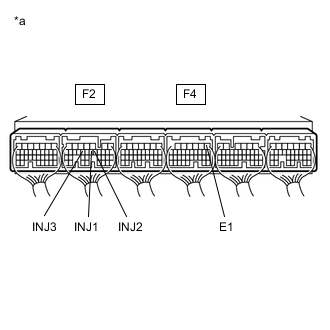
*a Component with harness connected
(ECM)
Disconnect the F34 injector driver (EDU) connector.
-
Turn the engine switch on (IG).
-
Measure the voltage according to the value(s) in the table below.
Standard Voltage Tester Connection Condition Specified Condition F2-13 (INJ1) - F4-1 (E1) Engine switch on (IG) 4.5 to 5.5 V F2-12 (INJ2) - F4-1 (E1) Engine switch on (IG) 4.5 to 5.5 V F2-15 (INJ3) - F4-1 (E1) Engine switch on (IG) 4.5 to 5.5 V Result Proceed to OK NG
OK
REPLACE INJECTOR DRIVER (EDU) Click here
NG
REPLACE ECM Click here
-
-
CHECK HARNESS AND CONNECTOR (SEMICONDUCTOR PWR INTEGRATION ECU - INJ RELAY)
-
Remove the INJ relay from the No. 2 engine room relay block and No. 2 junction block assembly.
-
Disconnect the semiconductor pwr integration ECU connector.
-
Measure the resistance according to the value(s) in the table below.
Standard Resistance Tester Connection Condition Specified Condition 2G-1 - 2 (INJ relay) Always Below 1 Ω 2G-1 or 2 (INJ relay) - Body ground Always 10 kΩ or higher Result Proceed to OK NG
OK
REPLACE SEMICONDUCTOR PWR INTEGRATION ECU Click here
NG
REPAIR OR REPLACE HARNESS OR CONNECTOR
-