TRANSFER SYSTEM INSPECTION

-
INSPECT INDICATOR LIGHT
-
Check the 4LO indicator light.
-
Start the engine.
-
Stop the vehicle.
-
Move the shift lever to N.
-
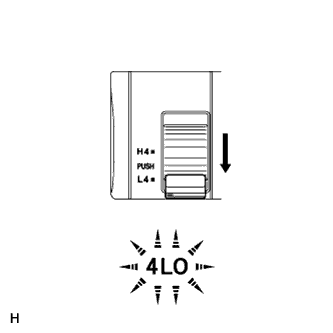
Turn the transfer position switch from H4 to L4.
-
Check the 4LO indicator light.
OK Switch Condition Specified Condition Turned from H4 to L4 4LO indicator light comes on immediately or comes on after blinking If there is a malfunction, inspect the switch, four wheel drive control ECU and transfer shift actuator. If the system is normal, there may be a malfunction in the CAN communication system or combination meter. In that case, first check the CAN communication system for LHD Click here, for RHD Click here. Then check the combination meter Click here.
-
-
Check the center differential lock indicator light.
-
Start the engine.
-
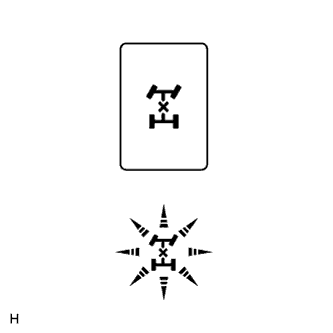
Push the center differential lock switch.
Note
-
Do not push the switch while the vehicle is turning.
-
Push the switch at a vehicle speed less than 100 km/h (62 mph).
-
-
Check the center differential lock indicator light.
OK Switch Condition Specified Condition Pushed Center differential lock indicator light comes on immediately or comes on after blinking If there is a malfunction, inspect the switch, four wheel drive control ECU and transfer shift actuator. If the system is normal, there may be a malfunction in the CAN communication system or combination meter. In that case, first check the CAN communication system for LHD Click here, for RHD Click here. Then check the combination meter Click here.
-
-
-
INSPECT FUSE
-
Remove the 4WD fuse from the main body ECU (cowl side junction block LH).
-
Measure the resistance according to the value(s) in the table below.
Standard Resistance Tester Connection Condition Specified Condition 4WD fuse Always Below 1 Ω If the fuse is blown, inspect the harness connected to the fuse for a short circuit, and repair or replace the harness or replace the fuse.
-
-
INSPECT TRANSFER POSITION SWITCH (BUILT INTO INTEGRATION CONTROL AND PANEL)
-
Remove the integration control and panel Click here.
-
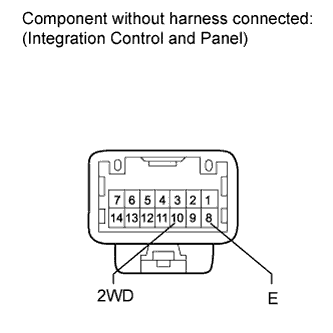
Measure the resistance according to the value(s) in the table below.
Standard Resistance Tester Connection Switch Condition Specified Condition 10 (2WD) - 8 (E) H4 position 100 kΩ or higher L4 position Below 1 Ω If there is a malfunction, replace the suspension control switch.
-
Check the harness and connector (ECU - transfer position switch and body ground).
-
Disconnect the A27 ECU connector.
-
Disconnect the V4 suspension control switch connector.
-
Measure the resistance according to the value(s) in the table below.
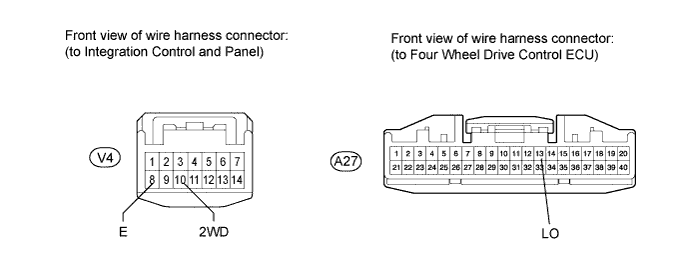
Standard Resistance Tester Connection Condition Specified Condition V4-10 (2WD) - A27-13 (LO) Always Below 1 Ω V4-10 (2WD) - Body ground Always 100 kΩ or higher V4-8 (E) - Body ground Always Below 1 Ω If there is a malfunction, repair or replace the harness or connector.
-
-
-
INSPECT CENTER DIFFERENTIAL LOCK SWITCH
-
Remove the center differential lock switch Click here.
-
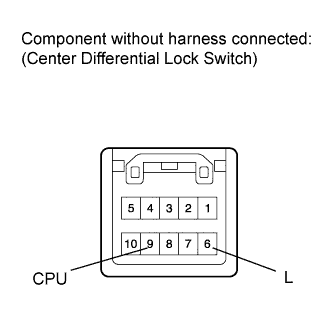
Measure the resistance according to the value(s) in the table below.
Standard Resistance Tester Connection Switch Condition Specified Condition 6 (L) - 9 (CPU) Switch is pressed and held Below 1 Ω Switch is not pressed 100 kΩ or higher If there is a malfunction, replace the center differential lock switch.
-
Check the harness and connector (ECU - center differential lock switch and body ground).
-
Disconnect the A27 ECU connector.
-
Disconnect the E49 center differential lock switch connector.
-
Measure the resistance according to the value(s) in the table below.
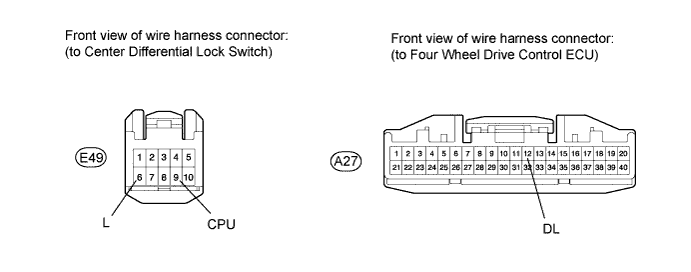
Standard Resistance Tester Connection Condition Specified Condition A27-12 (DL) - E49-9 (CPU) Always Below 1 Ω A27-12 (DL) - Body ground Always 100 kΩ or higher E49-6 (L) - Body ground Always Below 1 Ω If there is a malfunction, repair or replace the harness or connector.
-
-
-
INSPECT TRANSFER SHIFT ACTUATOR ASSEMBLY (HIGH-LOW TRANSFER SHIFT ACTUATOR)
Tech Tips
After inspecting the ECU power supply or transfer position switch, check the high-low transfer shift actuator.
-
Check the harness and connector (ECU - high-low transfer shift actuator).
-
Disconnect the C44 actuator connector.
-
Disconnect the A27 and A28 ECU connectors.
-
Measure the resistance according to the value(s) in the table below.
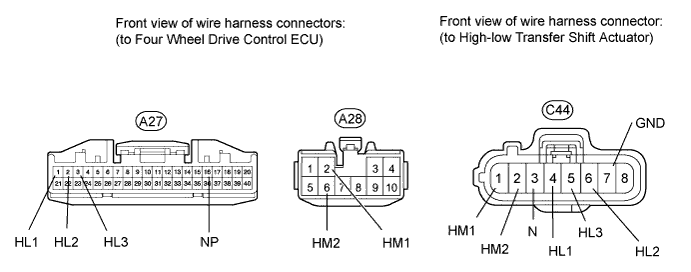
Standard Resistance Tester Connection Condition Specified Condition A27-1 (HL1) - C44-4 (HL1) Always Below 1 Ω A27-1 (HL1) - Body ground Always 100 kΩ or higher A27-2 (HL2) - C44-6 (HL2) Always Below 1 Ω A27-2 (HL2) - Body ground Always 100 kΩ or higher A27-3 (HL3) - C44-5 (HL3) Always Below 1 Ω A27-3 (HL3) - Body ground Always 100 kΩ or higher A27-16 (NP) - C44-3 (N) Always Below 1 Ω A27-16 (NP) - Body ground Always 100 kΩ or higher A28-2 (HM1) - C44-1 (HM1) Always Below 1 Ω A28-2 (HM1) - Body ground Always 100 kΩ or higher A28-6 (HM2) - C44-2 (HM2) Always Below 1 Ω A28-6 (HM2) - Body ground Always 100 kΩ or higher C44-7 (GND) - Body ground Always Below 1 Ω If there is a malfunction, repair or replace the harness or connector.
-
-
Check the high-low transfer shift actuator.
-
Turn the engine switch on (IG).
-
Stop the vehicle.
-
Move the shift lever to N.
-
Check that there is an operating noise from the transfer shift actuator when the transfer position switch is turned from H4 to L4, or L4 to H4.
OK There is an operating noise. Tech Tips
-
If the actuator fork cannot move from high to low, or low to high even though there is an operating noise, there may be a mechanical malfunction in the transfer.
-
If there is no operating noise, there may be a malfunction in the high-low transfer shift actuator. However, it may also be a result of a mechanical malfunction in the transfer, so inspect each part.
-
-
Remove the transfer shift actuator assembly Click here.
-
Check the high to low switch.
-
Connect lines via a relay as shown in the illustration, and check that the actuator fork moves from the high to low position.
Note
-
Make sure to perform this inspection with the actuator removed from the vehicle. If this inspection is performed with the actuator installed to the vehicle, the actuator will be damaged.
-
When inspecting the actuator, make sure to operate it with the lines connected via a relay. If the lines are not connected via a relay and battery voltage is directly applied to the actuator, the actuator will be damaged.
Tech Tips
When performing the operation described above, use the DEFOG relay.
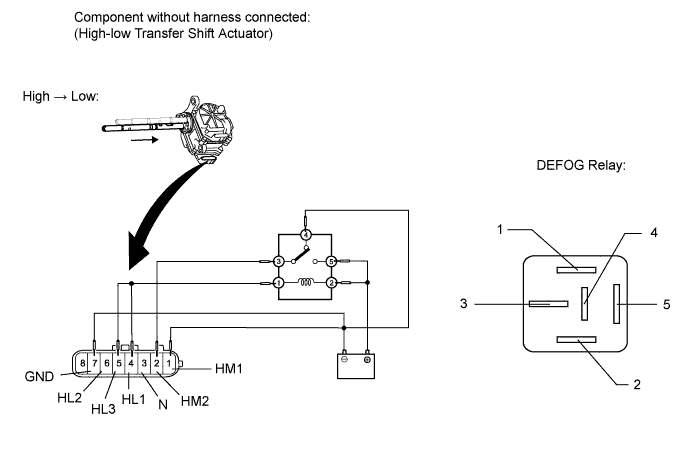
-
-
After the high to low switch is complete, check the neutral position detection switch and limit switch.
-
Measure the resistance according to the value(s) in the table below.
Standard Resistance Tester Connection Condition Specified Condition 3 (N) - 7 (GND) After high to low switch is complete 100 kΩ or higher 4 (HL1) - 7 (GND) After high to low switch is complete 100 kΩ or higher 5 (HL3) - 7 (GND) After high to low switch is complete 100 kΩ or higher 6 (HL2) - 7 (GND) After high to low switch is complete Below 1 Ω If there is a malfunction, replace the transfer shift actuator assembly.
-
-
Check the low to high switch.
-
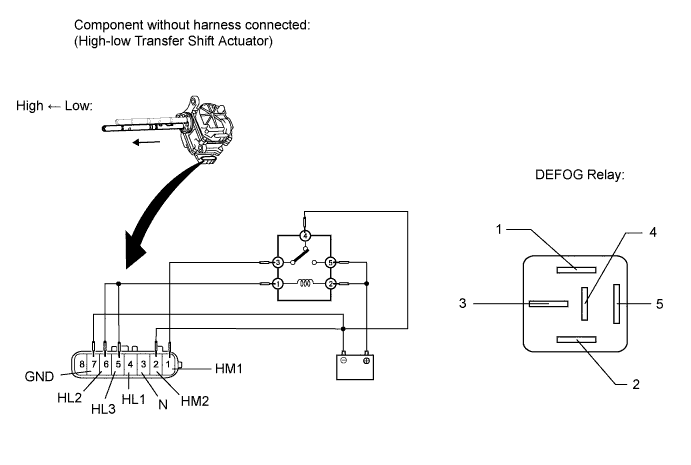
Connect lines via a relay as shown in the illustration, and check that the actuator fork moves from the low to high position.
Note
-
Make sure to perform this inspection with the actuator removed from the vehicle. If this inspection is performed with the actuator installed to the vehicle, the actuator will be damaged.
-
When inspecting the actuator, make sure to operate it with the lines connected via a relay. If the lines are not connected via a relay and battery voltage is directly applied to the actuator, the actuator will be damaged.
Tech Tips
When performing the operation described above, use the DEFOG relay.
-
-
After the low to high switch is complete, check the neutral position detection switch and limit switch.
-
Measure the resistance according to the value(s) in the table below.
Standard Resistance Tester Connection Condition Specified Condition 3 (N) - 7 (GND) After low to high switch is complete 100 kΩ or higher 4 (HL1) - 7 (GND) After low to high switch is complete Below 1 Ω 5 (HL3) - 7 (GND) After low to high switch is complete 100 kΩ or higher 6 (HL2) - 7 (GND) After low to high switch is complete 100 kΩ or higher If there is a malfunction, replace the transfer shift actuator assembly.
-
-
-
-
INSPECT TRANSFER SHIFT ACTUATOR ASSEMBLY (CENTER DIFFERENTIAL LOCK ACTUATOR)
Tech Tips
After inspecting the ECU power supply or center differential lock switch, check the center differential lock actuator.
-
Check the harness and connector (ECU - center differential lock actuator).
-
Disconnect the C43 actuator connector.
-
Disconnect the A27 and A28 ECU connectors.
-
Measure the resistance according to the value(s) in the table below.
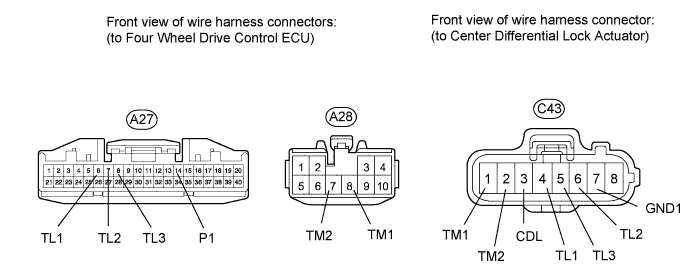
Standard Resistance Tester Connection Condition Specified Condition A27-6 (TL1) - C43-4 (TL1) Always Below 1 Ω A27-6 (TL1) - Body ground Always 100 kΩ or higher A27-7 (TL2) - C43-6 (TL2) Always Below 1 Ω A27-7 (TL2) - Body ground Always 100 kΩ or higher A27-8 (TL3) - C43-5 (TL3) Always Below 1 Ω A27-8 (TL3) - Body ground Always 100 kΩ or higher A27-14 (P1) - C43-3 (CDL) Always Below 1 Ω A27-14 (P1) - Body ground Always 100 kΩ or higher A28-7 (TM2) - C43-2 (TM2) Always Below 1 Ω A28-7 (TM2) - Body ground Always 100 kΩ or higher A28-8 (TM1) - C43-1 (TM1) Always Below 1 Ω A28-8 (TM1) - Body ground Always 100 kΩ or higher C43-7 (GND1) - Body ground Always Below 1 Ω If there is a malfunction, repair or replace the harness or connector.
-
-
Check the center differential lock actuator.
-
Turn the engine switch on (IG).
-
Check that there is an operating noise from the transfer shift actuator when the center differential lock switch is pressed to switch from Free to Lock, or lock to free.
OK There is an operating noise. Tech Tips
-
If the actuator fork cannot move from free to lock, or lock to free even though there is an operating noise, there may be a mechanical malfunction in the transfer.
-
If there is no operating noise, there may be a malfunction in the center differential lock actuator. However, it may also be a result of a mechanical malfunction in the transfer, so inspect each part.
-
-
Remove the transfer shift actuator assembly Click here.
-
Check the free to lock switch.
-
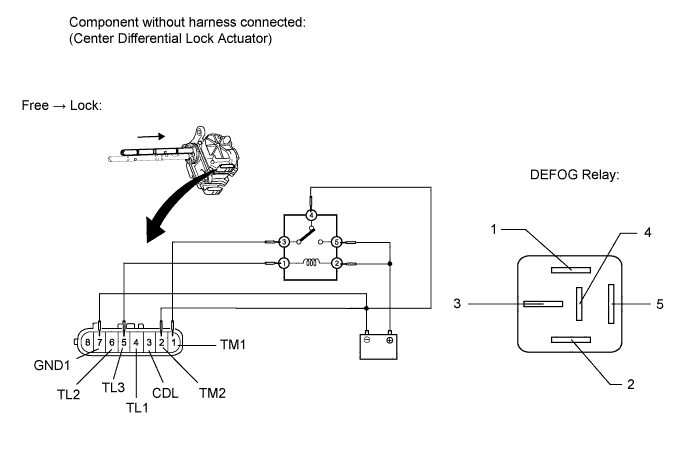
Connect lines via a relay as shown in the illustration, and check that the actuator fork moves from the free to lock position.
Note
-
Make sure to perform this inspection with the actuator removed from the vehicle. If this inspection is performed with the actuator installed to the vehicle, the actuator will be damaged.
-
When inspecting the actuator, make sure to operate it with the lines connected via a relay. If the lines are not connected via a relay and battery voltage is directly applied to the actuator, the actuator will be damaged.
Tech Tips
When performing the operation described above, use the DEFOG relay.
-
-
After the free to lock switch is complete, check the center differential lock detection switch and limit switch.
-
Measure the resistance according to the value(s) in the table below.
Standard Resistance Tester Connection Condition Specified Condition 3 (CDL) - 7 (GND1) After free to lock switch is complete Below 1 Ω 4 (TL1) - 7 (GND1) After free to lock switch is complete 100 kΩ or higher 5 (TL3) - 7 (GND1) After free to lock switch is complete 100 kΩ or higher 6 (TL2) - 7 (GND1) After free to lock switch is complete Below 1 Ω If there is a malfunction, replace the transfer shift actuator assembly.
-
-
Check the lock to free switch.
-
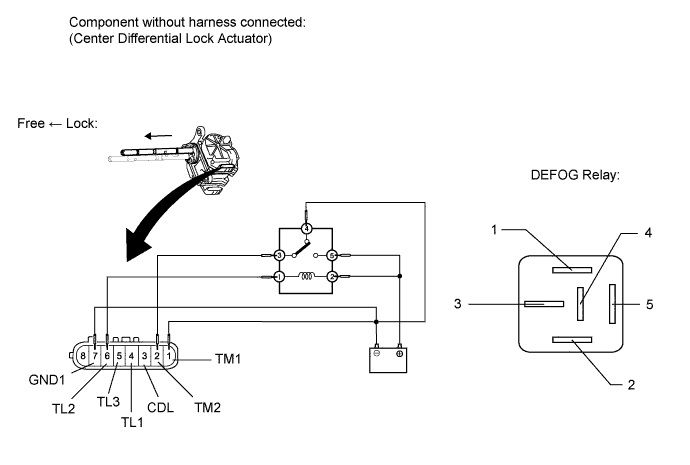
Connect lines via a relay as shown in the illustration, and check that the actuator fork moves from the lock to free position.
Note
-
Make sure to perform this inspection with the actuator removed from the vehicle. If this inspection is performed with the actuator installed to the vehicle, the actuator will be damaged.
-
When inspecting the actuator, make sure to operate it with the lines connected via a relay. If the lines are not connected via a relay and battery voltage is directly applied to the actuator, the actuator will be damaged.
Tech Tips
When performing the operation described above, use the DEFOG relay.
-
-
After the lock to free switch is complete, check the center differential lock detection switch and limit switch.
-
Measure the resistance according to the value(s) in the table below.
Standard Resistance Tester Connection Condition Specified Condition 3 (CDL) - 7 (GND1) After lock to free switch is complete 100 kΩ or higher 4 (TL1) - 7 (GND1) After lock to free switch is complete 100 kΩ or higher 5 (TL3) - 7 (GND1) After lock to free switch is complete Below 1 Ω 6 (TL2) - 7 (GND1) After lock to free switch is complete 100 kΩ or higher If there is a malfunction, replace the transfer shift actuator assembly.
-
-
-
-
INSPECT 4 WHEEL DRIVE CONTROL ECU
Tech Tips
Inspect the connectors from the back side while the connectors are connected.
-
Check the four wheel drive control ECU.
-
Measure the resistance and voltage according to the value(s) in the table below.
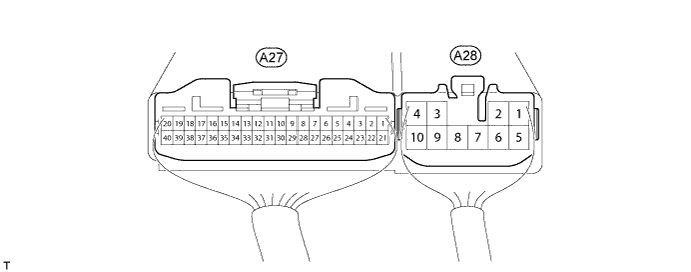
Tester Connection Terminal Description Condition Specified Condition A27-1 (HL1) - A28-4 (GND) High-low transfer shift actuator limit switch Engine switch on (IG)
Transfer in high position
Below 1.5 V Engine switch on (IG)
Transfer in low position
11 to 14 V Engine switch on (IG)
Transfer in neutral position
11 to 14 V A27-2 (HL2) - A28-4 (GND) High-low transfer shift actuator limit switch Engine switch on (IG)
Transfer in high position
11 to 14 V Engine switch on (IG)
Transfer in low position
Below 1.5 V Engine switch on (IG)
Transfer in neutral position
11 to 14 V A27-3 (HL3) - A28-4 (GND) High-low transfer shift actuator limit switch Engine switch on (IG)
Transfer in high position
11 to 14 V Engine switch on (IG)
Transfer in low position
11 to 14 V Engine switch on (IG)
Transfer in neutral position
Below 1.5 V A27-5 (TT) - A27-25 (TGND)* Temperature sensor Engine switch on (IG) 0 to 5 V A27-6 (TL1) - A28-4 (GND) Center differential lock actuator limit switch Engine switch on (IG)
Center differential in free position
11 to 14 V Engine switch on (IG)
Center differential in lock position
11 to 14 V Engine switch on (IG)
Transfer in neutral position
Below 1.5 V A27-7 (TL2) - A28-4 (GND) Center differential lock actuator limit switch Engine switch on (IG)
Center differential in free position
11 to 14 V Engine switch on (IG)
Center differential in lock position
Below 1.5 V Engine switch on (IG)
Transfer in neutral position
11 to 14 V A27-8 (TL3) - A28-4 (GND) Center differential lock actuator limit switch Engine switch on (IG)
Center differential in free position
Below 1.5 V Engine switch on (IG)
Center differential in lock position
11 to 14 V Engine switch on (IG)
Transfer in neutral position
11 to 14 V A27-12 (DL) - A28-4 (GND) Center differential lock switch Engine switch on (IG)
Center differential lock switch is pressed and held
Below 1.5 V Engine switch on (IG)
Center differential lock switch is not pressed
11 to 14 V A27-13 (LO) - A28-4 (GND) Transfer position switch Engine switch on (IG)
Transfer in high position
11 to 14 V Engine switch on (IG)
Transfer in low position
Below 1.5 V A27-14 (P1) - A28-4 (GND) Center differential lock detection switch Engine switch on (IG)
Center differential in free position
11 to 14 V Engine switch on (IG)
Center differential in lock position
Below 1.5 V A27-16 (NP) - A28-4 (GND) Transfer shift actuator neutral position detection switch Engine switch on (IG)
Transfer in neutral position
Below 1.5 V Engine switch on (IG)
Transfer in high or low position
11 to 14 V A27-19 (CAN+) - A27-20 (CAN-) CAN communication line Engine switch off 54 to 69 Ω A27-21 (L4) - A28-4 (GND) Transfer shift actuator Low detection switch Engine switch on (IG)
Transfer position switch in H4 position
11 to 14 V Engine switch on (IG)
Transfer position switch in L4 position
Below 1.5 V A28-2 (HM1) - A28-4 (GND) High-low transfer shift actuator motor Engine switch on (IG)
Transfer position switch H4 → L4
(During operation of high-low transfer shift actuator motor from high to low)
Below 1.5 V or alternating between below 1.5 V and 11 to 14 V Engine switch on (IG)
Transfer position switch L4 → H4
(During operation of high-low transfer shift actuator motor from low to high)
11 to 14 V A28-3 (IG) - A28-4 (GND) IG power Engine switch on (IG) 11 to 14 V A28-4 (GND) - Body ground Ground Always Below 1 Ω A28-6 (HM2) - A28-4 (GND) High-low transfer shift actuator motor Engine switch on (IG)
Transfer position switch H4 → L4
(During operation of high-low transfer shift actuator motor from high to low)
11 to 14 V Engine switch on (IG)
Transfer position switch L4 → H4
(During operation of high-low transfer shift actuator motor from low to high)
Below 1.5 V or alternating between below 1.5 V and 11 to 14 V A28-7 (TM2) - A28-4 (GND) Center differential lock actuator motor Engine switch on (IG)
Center differential position free → lock
Below 1.5 V or alternating between below 1.5 V and 11 to 14 V Engine switch on (IG)
Center differential position lock → free
11 to 14 V A28-8 (TM1) - A28-4 (GND) Center differential lock actuator motor Engine switch on (IG)
Center differential position free → lock
11 to 14 V Engine switch on (IG)
Center differential position lock → free
Below 1.5 V or alternating between below 1.5 V and 11 to 14 V *: w/ Temperature Sensor
If there is a malfunction, inspect the harnesses, connectors, transfer position switch, center differential lock switch, and transfer shift actuator assembly. If these are normal, replace the four wheel drive control ECU Click here.
-
-