AUTOMATIC TRANSMISSION ASSEMBLY (for 1UR-FE) INSTALLATION

-
INSTALL TORQUE CONVERTER CLUTCH ASSEMBLY
-
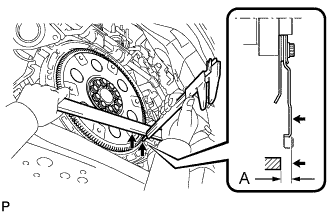
Using a vernier caliper and straightedge, measure dimension A between the transmission and the end surface of the drive plate.
-
Install the torque converter to the transmission housing.
-
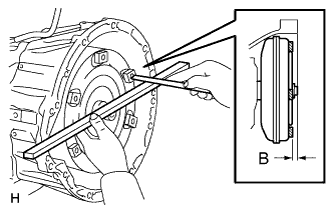
Using a vernier caliper and straightedge, measure dimension B shown in the illustration and check that B is more than A measured in the first step.
Standard distance B = A + 1.00 mm (0.0394 in.) or more
-
-
INSTALL WIRE HARNESS CLAMP BRACKET
-
Install the front bracket LH with the bolt.
- Torque:
- 8.0 N*m { 82 kgf*cm, 71 in.*lbf }
-
Install the rear bracket LH with the bolt.
- Torque:
- 29 N*m { 296 kgf*cm, 21 ft.*lbf }
-
Install the rear bracket RH with the bolt.
- Torque:
- 29 N*m { 296 kgf*cm, 21 ft.*lbf }
-
Install the front bracket RH with the bolt.
- Torque:
- 8.0 N*m { 82 kgf*cm, 71 in.*lbf }
-
Install the rear engine bracket with the bolt.
- Torque:
- 8.0 N*m { 82 kgf*cm, 71 in.*lbf }
-
-
INSTALL TRANSFER ASSEMBLY
-
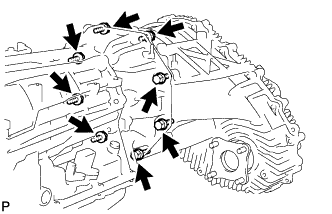
Install the transfer with the 8 bolts.
- Torque:
- 40 N*m { 408 kgf*cm, 30 ft.*lbf }
Note
Take care not to damage the adaptor oil seal with the transfer input shaft spline.
-
-
INSTALL TRANSFER CASE LOWER PROTECTOR
-
Install the transfer case lower protector with the 7 bolts.
- Torque:
- 14 N*m { 143 kgf*cm, 10 ft.*lbf }
-
Connect the clamp of grand cable to the transfer case lower protector.
-
-
CONNECT BREATHER PLUG HOSE
-
Attach the 3 breather hose clamps to connect the transfer breather hose to the automatic transmission breather tube.
-
Connect the 2 breather plug hoses to the harness clamp bracket.
-
-
INSTALL AUTOMATIC TRANSMISSION ASSEMBLY
Note
Confirm that the 2 knock pins are attached to the transmission contact surface of the engine block before the installing the transmission.
-
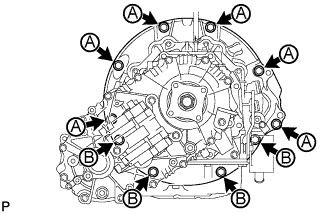
Install the transmission with the 10 bolts.
- Torque:
- for 17 mm head bolt A
- 71 N*m { 724 kgf*cm, 52 ft.*lbf }
- for 14 mm head bolt B
- 37 N*m { 377 kgf*cm, 27 ft.*lbf }
-
-
CONNECT TRANSMISSION OIL COOLER HOSE
-
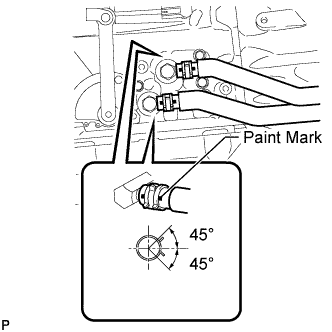
Connect the 2 transmission oil cooler hoses to the oil cooler tube union.
Note
-
Make sure the pinching portion of each clip is facing the direction shown in the illustration.
-
Make sure the paint mark of each hose is facing outward.
-
-
-
CONNECT WIRE HARNESS AND CONNECTOR
-
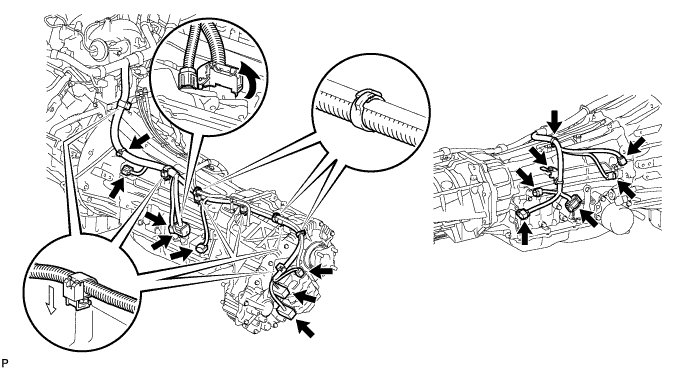
Connect the park/neutral position switch connector, 2 transmission wire connectors, 2 speed sensor connectors and 3 transfer control side connectors.
Tech Tips
Push up the lever until the claw of the transmission wire connector makes a connection sound.
-
Connect the 4 connector clamps and 6 harness clamps.
-
Connect the wire harness with the bolt.
- Torque:
- 8.0 N*m { 82 kgf*cm, 71 in.*lbf }
-
Tilt up the automatic transmission.
-
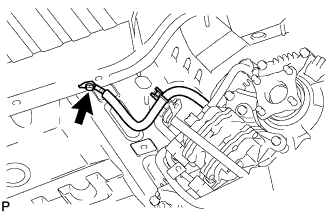
Connect the ground cable with the bolt.
- Torque:
- 8.4 N*m { 86 kgf*cm, 74 in.*lbf }
-
-
INSTALL REAR NO. 1 ENGINE MOUNTING INSULATOR
-
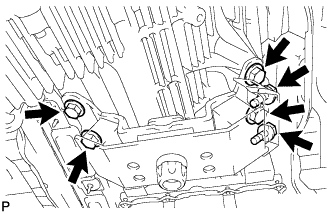
Install the rear engine mounting insulator to the transmission with the 4 bolts.
- Torque:
- 59 N*m { 602 kgf*cm, 44 ft.*lbf }
-
Install the engine mounting heat insulator with the 2 bolts.
- Torque:
- 12 N*m { 122 kgf*cm, 9 ft.*lbf }
-
-
INSTALL NO. 2 FRAME CROSSMEMBER SUB-ASSEMBLY
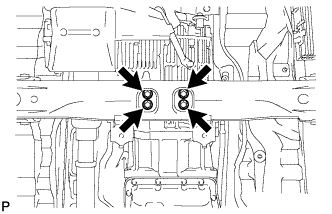
-
Install the frame crossmember to the rear engine mounting insulator with the 4 bolts.
- Torque:
- 37 N*m { 377 kgf*cm, 27 ft.*lbf }
-
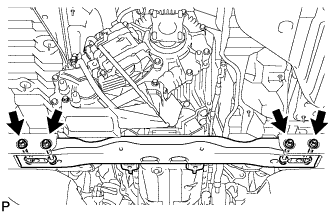
Install the frame crossmember to the frame with the 4 bolts and 4 nuts.
- Torque:
- 110 N*m { 1122 kgf*cm, 81 ft.*lbf }
-
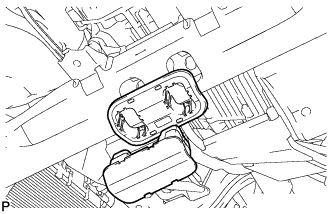
Install the engine mounting hole cover.
-
-
INSTALL DRIVE PLATE AND TORQUE CONVERTER CLUTCH SETTING BOLT
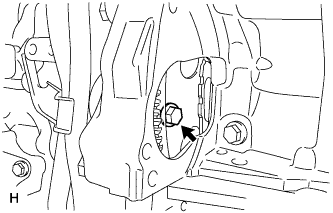
-
Turn the crankshaft to gain access to the installation locations of the 6 bolts and install the bolts while holding the crankshaft pulley set bolt with a wrench.
- Torque:
- 53 N*m { 535 kgf*cm, 39 ft.*lbf }
Note
First install the black colored bolt and then the remaining 5 bolts.
-
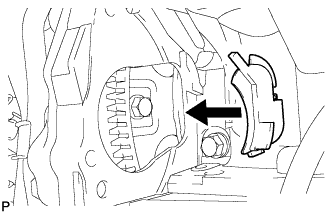
Install the flywheel housing side cover.
-
-
INSTALL STARTER ASSEMBLY
-
INSTALL NO. 2 MANIFOLD STAY
-
Temporarily install the manifold stay with the 3 bolts.
-
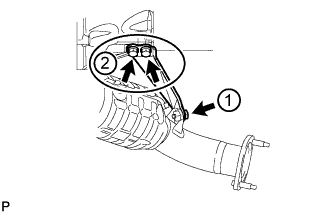
Tighten the 3 bolts in the sequence shown in the illustration.
- Torque:
- 40 N*m { 408 kgf*cm, 30 ft.*lbf }
-
-
INSTALL MANIFOLD STAY
-
Temporarily install the manifold stay with the 3 bolts.
-
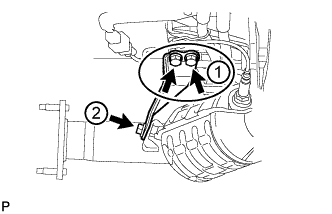
Tighten the 3 bolts in the sequence shown in the illustration.
- Torque:
- 40 N*m { 408 kgf*cm, 30 ft.*lbf }
-
-
INSTALL EXHAUST PIPE
-
INSTALL PROPELLER SHAFT ASSEMBLY
-
INSTALL FRONT PROPELLER SHAFT ASSEMBLY
-
CONNECT FLOOR SHIFT GEAR SHIFTING ROD SUB-ASSEMBLY
-
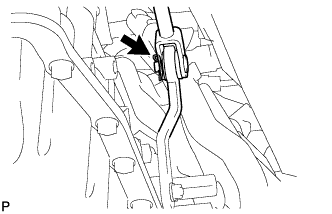
Connect the gear shifting rod to the transmission control shaft lever RH with the pin and a new clip.
-
-
CONNECT CABLE TO NEGATIVE BATTERY TERMINAL
Note
When disconnecting the cable, some systems need to be initialized after the cable is reconnected Click here.
-
ADD AUTOMATIC TRANSMISSION FLUID
-
ADD TRANSFER OIL
-
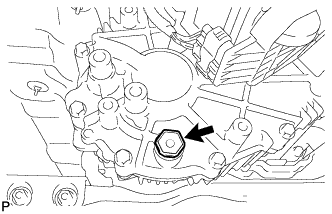
Install a new gasket to the drain plug and then install the plug.
- Torque:
- 37 N*m { 377 kgf*cm, 27 ft.*lbf }
-
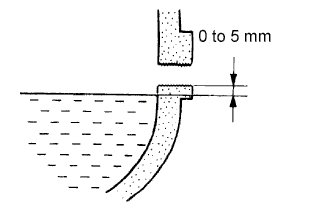
Add oil so that the oil level is between 0 to 5.0 mm (0 to 0.197 in.) from the bottom lip of the filler plug hole.
Note
-
Add oil slowly.
-
Add oil a little at a time, waiting several minutes between each addition of oil.
-
-
Wait approximately 5 minutes and check that the oil level has not changed.
-
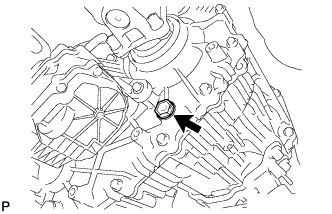
Install a new gasket to the filler plug and then install the plug.
- Torque:
- 37 N*m { 377 kgf*cm, 27 ft.*lbf }
-
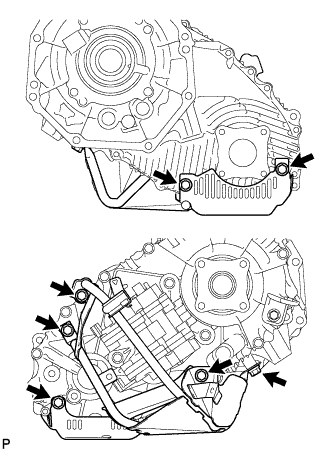
Install the lower transfer case protector with the 7 bolts.
- Torque:
- 14 N*m { 139 kgf*cm, 10 ft.*lbf }
-
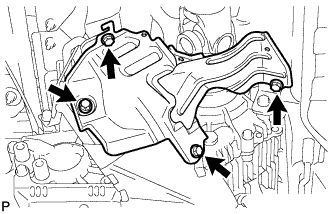
Install the transfer heat insulator with the 4 bolts.
- Torque:
- 30 N*m { 306 kgf*cm, 22 ft.*lbf }
-
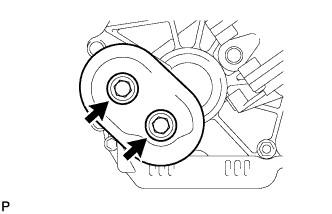
Install the transfer dynamic damper with the 2 bolts.
- Torque:
- 12 N*m { 122 kgf*cm, 9 ft.*lbf }
-
-
ADD ENGINE COOLANT
-
Add engine coolant.
Standard capacity 16.5 liters (17.4 US qts, 14.5 Imp. qts) Note
Do not substitute plain water for engine coolant.
Tech Tips
-
TOYOTA vehicles are filled with TOYOTA SLLC at the factory. In order to avoid damage to the engine cooling system and other technical problems, only use TOYOTA SLLC or similar high quality ethylene glycol based non-silicate, non-amine, non-nitrite, non-borate coolant with long-life hybrid organic acid technology (coolant with long-life hybrid organic acid technology consists of a combination of low phosphates and organic acids).
-
Press the No. 1 and No. 2 radiator hoses several times by hand, and then check the coolant level. If the coolant level is low, add coolant.
-
-
Slowly pour coolant into the radiator reservoir until it reaches the F line.
-
Install the reservoir cap.
-
Install the radiator cap.*1
-
Start the engine and stop it immediately.*2
-
Allow approximately 10 seconds to pass. Then remove the radiator cap and check the coolant level. If the coolant level has decreased, add coolant.*3
-
Repeat steps *1, *2 and *3 until the coolant level does not decrease.
Tech Tips
Be sure to perform this step while the engine is cold, as air in the No. 1 radiator hose will flow into the radiator if the engine is warmed up and the thermostat opens.
-
Install the radiator cap.*4
-
Set the air conditioning as follows.*5
Item Condition Fan speed Any setting except off Temperature Toward WARM Air conditioning switch Off -
Start the engine, warm it up until the thermostat opens, and then continue to run the engine for several minutes to circulate the coolant.*6
CAUTION:
-
Wear protective gloves. Hot areas on the parts may injure your hands.
-
Be careful of the fan.
-
Be careful as the engine, radiator and radiator hoses are hot and can cause burns.
Note
-
Immediately after starting the engine, if the radiator reservoir does not have any coolant, perform the following: 1) stop the engine, 2) wait until the coolant has cooled down, and 3) add coolant until the coolant is filled to the F line.
-
Do not start the engine when there is no coolant in the radiator reservoir.
-
Pay attention to the needle of the engine coolant temperature receiver gauge. Make sure that the needle does not show an abnormally high temperature.
-
If there is not enough coolant, the engine may burn out or overheat.
Tech Tips
-
Press the No. 1 and No. 2 radiator hoses several times by hand to bleed air while warming up the engine.
-
The thermostat opening timing can be confirmed by pressing the No. 2 radiator hose by hand and checking when the engine coolant starts to flow inside the hose.
-
-
Stop the engine, wait until the engine coolant cools down to ambient temperature. Then remove the radiator cap and check the coolant level.*7
CAUTION:
Do not remove the radiator cap while the engine and radiator are still hot. Pressurized, hot engine coolant and steam may be released and cause serious burns.
-
If the coolant level has decreased, add coolant and warm up the engine until the thermostat opens.*8
-
If the coolant level has not decreased, check that the coolant level in the radiator reservoir is at the F line.
If the coolant level is below the F line, repeat steps *4 through *8.
If the coolant level is above the F line, drain coolant until the coolant level reaches the F line.
-
-
INSPECT SHIFT LEVER POSITION
-
When moving the shift lever from P to R with the engine switch on (IG) and the brake pedal depressed, make sure that it moves smoothly and correctly into position.
-
Check that the shift lever does not stop when moving the shift lever from R to P, and check that the shift lever does not stick when moving the shift lever from D to S.
-
Start the engine and make sure that the vehicle moves forward after moving the shift lever from N to D and moves rearward after moving the shift lever to R.
If there are problems during the above inspections, perform the adjustment using the following procedures.
-
Move the shift lever to N
-
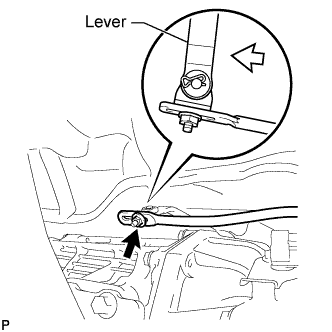
Loosen the nut of the floor shift gear shifting rod. Then, with the lever of the floor shift assembly lightly pushed towards the rear of the vehicle, tighten the nut.
- Torque:
- 13 N*m { 133 kgf*cm, 10 ft.*lbf }
-
-
-
INSPECT OIL LEAK
-
INSPECT FOR ENGINE COOLANT LEAK
CAUTION:
To avoid being burned, do not remove the radiator reservoir cap while the engine and radiator are still hot. Thermal expansion may cause hot engine coolant and steam to blow out from the radiator.
-
Fill the radiator with engine coolant, and then attach a radiator cap tester.
-
Warm up the engine.
-
Using the radiator cap tester, increase the pressure inside the radiator to 123 kPa (1.3 kgf/cm2, 18 psi), and then check that the pressure does not drop.
If the pressure drops, check the hoses, radiator and engine water pump for leakage. If there are no signs or traces of external engine coolant leakage, check the heater core, cylinder block and head.
-
-
INSPECT FOR EXHAUST GAS LEAK
-
INSTALL OIL PAN PROTECTOR ASSEMBLY
-
Install the oil pan protector assembly with the 4 bolts.
- Torque:
- 63 N*m { 642 kgf*cm, 46 ft.*lbf }
-
-
INSTALL NO. 2 ENGINE UNDER COVER
-
Install the No. 2 engine under cover with the 2 bolts.
- Torque:
- 29 N*m { 296 kgf*cm, 21 ft.*lbf }
-
-
INSTALL NO. 1 ENGINE UNDER COVER
-
Install the No. 1 engine under cover sub-assembly with the 10 bolts.
- Torque:
- 29 N*m { 296 kgf*cm, 21 ft.*lbf }
-
-
INSTALL FRONT FENDER SPLASH SHIELD SUB-ASSEMBLY LH
-
Push in the clip to install the front fender splash shield sub-assembly LH.
-
Install the 3 bolts and 2 screws.
-
-
INSTALL FRONT FENDER SPLASH SHIELD SUB-ASSEMBLY RH
Tech Tips
Use the same procedure described for the LH side.
-
RESET MEMORY
for 1UR-FE: Click here