Click here
-
AUTOMATIC LIGHT CONTROL SYSTEM OPERATION CHECK
-
Turn the engine switch on (IG).
-
Turn the light control switch to the AUTO position.
-
Cover the automatic light control sensor.
-
Check that the taillights and low beam headlights come on.
-
Uncover the automatic light control sensor.
-
Check that the low beam headlights and taillights go off.
-
-
LIGHT TURN-OFF SYSTEM OPERATION CHECK
-
Close all doors.
-
Turn the engine switch on (IG).
-
Turn the taillights, low beam headlights, high beam headlights or front fog lights on.
-
Turn the engine switch off.
-
Open the driver side door, front passenger side door, slide door LH or slide door RH.
-
Check that all of lights go off.
-
-
AFS OPERATION CHECK
-
Check that the initialization (determination of the initial position) of the leveling motor and swivel motor is performed after the engine is started.
-

Check that the AFS OFF indicator light in the combination meter assembly comes on for approximately 3 seconds and then goes off when the engine switch is turned on (IG).
-
-
HID HEADLIGHT SYSTEM OPERATION CHECK
-
Perform the following illumination diagnosis when both of the following conditions are met: 1) the light control ECU is not visibly damaged, and 2) the light control ECU has been struck but is operating normally. If all of the following diagnosis results are normal, the light control ECU can be reused.
-
Perform low beam headlight cold starts (10 minutes or more off, then turned on) and hot starts (15 minutes or more on, 1 minute off, then turned on again) several times. Check that the low beam headlights illuminate normally.
-
For 5 minutes immediately after a light cold start (before the lights stabilize), visually check the illumination condition and check that the lights do not flicker or show signs of instability.
-
Install bulbs that have approximately the same usage time, and illuminate the low beam headlights for approximately 30 seconds. Check that the brightness of the left and right bulbs are approximately the same, and that the illumination is stable.
-
-
-
AUTOMATIC HIGH BEAM SYSTEM OPERATION CHECK
-
Check the operation of the inner rear view mirror assembly indicator light.
-
Turn the engine switch on (IG).
-
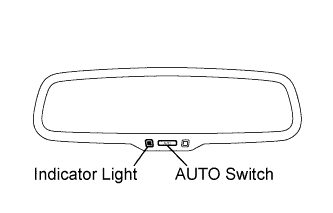
Check that the inner rear view mirror assembly indicator light comes on.
-
Press the inner rear view mirror assembly AUTO switch once.
-
Check that the inner rear view mirror assembly indicator light goes off.
-
Press the inner rear view mirror assembly AUTO switch once again.
-
Check that the inner rear view mirror assembly indicator light comes on.
Tip:If the inner rear view mirror assembly indicator light flashes, turn the engine switch off, then turn the engine switch on (IG). If the inner rear view mirror assembly indicator light flashes continuously, replace the inner rear view mirror assembly.
-
-

Check the operation of the automatic high beam indicator light.
-
Turn the engine switch on (IG).
-
Turn the light control switch to the AUTO position.
-
Cover the automatic light control sensor to turn the low beam headlights on.
-
Turn the dimmer switch to the high position.
-
Check that the automatic high beam indicator comes on.
-
-
Check the operation of the automatic high beam function.
-
At night, when driving the vehicle with the automatic high beam system in standby mode, check that the high beams automatically turn on after a short delay when all of the following conditions are met:
-
Vehicle speed is more than 30 km/h (18.6 mph).
-
The area in front of the vehicle is dark.
-
There are no oncoming vehicles with headlights on.
-
There are no preceding vehicles with taillights on.
-
There are few streetlights along the street ahead.
-
-
At night, when driving the vehicle with the high beams turned on by the automatic high beam system, check that the automatic high beam system turns off the high beams and returns to standby mode when any of the following conditions are met:
-
Vehicle speed is less than 20 km/h (12.4 mph).
-
The level of ambient light is higher than a specified threshold.
-
There are oncoming vehicles with headlights on.
-
There are preceding vehicles with taillights on.
-
Light from streetlights ahead is higher than a specified threshold.
-
-
-