POWER SLIDE DOOR SYSTEM Power Slide Door Sensor LH Circuit
DESCRIPTION
When the power slide door sensor assembly LH (touch sensor LH) sends a jam detection signal to the slide door motor unit LH (power slide door ECU LH), the ECU stops the close operation of the power slide door.
WIRING DIAGRAM
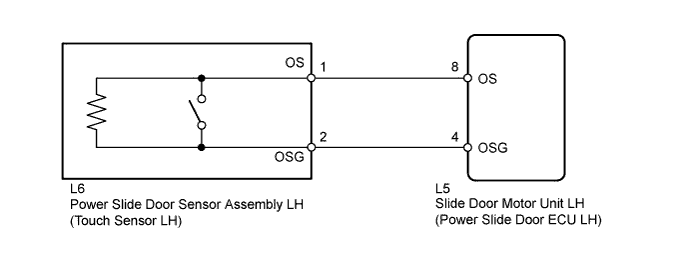
INSPECTION PROCEDURE
PROCEDURE
-
READ VALUE USING INTELLIGENT TESTER (PSD TOUCH SENSOR)
-
Connect the intelligent tester to the DLC3.
-
Turn the engine switch on (IG).
-
Enter the following menus: Body / Rear Left Door / Data List.
-
Check if the touch sensor is functioning properly.
Rear Left Door (Power Slide Door ECU LH) Tester Display Measurement Item / Range Normal Condition Diagnosis Note PSD Touch Sensor Power slide door touch sensor signal / OFF, ON or Open OFF: Power slide door touch sensor not pressed
ON: Power slide door touch sensor pressed
Open: Power slide door touch sensor open
- OK The intelligent tester should display as shown in the table according to touch sensor operation.
NG 
INSPECT POWER SLIDE DOOR SENSOR ASSEMBLY LH (TOUCH SENSOR LH) Click here
OK 
PROCEED TO NEXT SUSPECTED AREA SHOWN IN PROBLEM SYMPTOMS TABLE Click here
-
-
INSPECT POWER SLIDE DOOR SENSOR ASSEMBLY LH (TOUCH SENSOR LH)
-
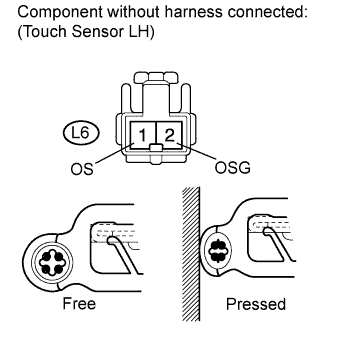
Remove the power slide door sensor assembly LH (touch sensor LH) Click here.
-
Measure the resistance according to the value(s) in the table below.
Standard Resistance Tester Connection Condition Specified Condition L6-1 (OS) - L6-2 (OSG) Pressed Below 100 Ω L6-1 (OS) - L6-2 (OSG) Free 0.95 to 1.05 kΩ
NG 
REPLACE POWER SLIDE DOOR SENSOR ASSEMBLY LH (TOUCH SENSOR LH) Click here
OK 
-
-
CHECK NO. 2 REAR DOOR WIRE (TOUCH SENSOR LH - ECU LH AND BODY GROUND)
-
Disconnect the L5 power slide door ECU LH connector.
-
Measure the resistance according to the value(s) in the table below.
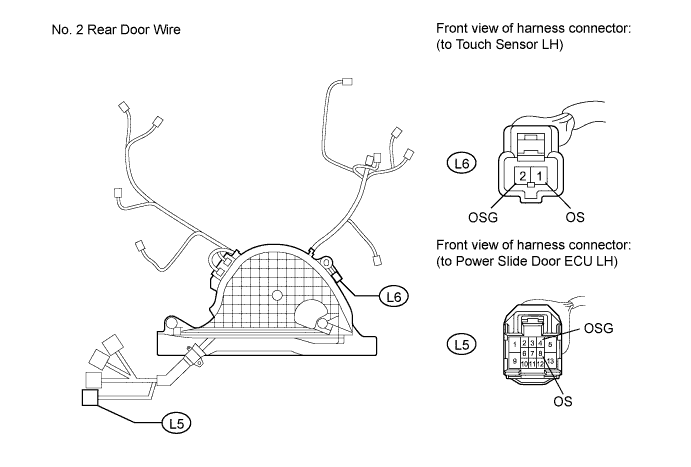
Standard Resistance Tester Connection Condition Specified Condition L6-1 (OS) - L5-8 (OS) Always Below 1 Ω L6-2 (OSG) - L5-4 (OSG) Always Below 1 Ω L6-1 (OS) - Body ground Always 10 kΩ or higher L6-2 (OSG) - Body ground Always 10 kΩ or higher
NG
REPAIR OR REPLACE NO. 2 REAR DOOR WIRE Click here
OK
REPLACE SLIDE DOOR MOTOR UNIT LH Click here
-