TOYOTA PARKING ASSIST-SENSOR SYSTEM SYSTEM DESCRIPTION

-
GENERAL
-
This system uses ultrasonic sensors to detect any obstacles at the corners and the rear of the vehicle. The system then informs the driver of the distance between the sensors and the obstacles as well as their positions by indicating them on the multi-information display, multi-display and by sounding a buzzer.
-
-
FUNCTION OF COMPONENTS
Component Function No. 1 Ultrasonic Sensor (6) Detects the distance between the vehicle and an obstacle No. 1 Clearance Warning Buzzer
-
Sounds to inform the driver when the Toyota parking assist-sensor system power is on (the engine switch is on (IG) and the clearance sonar main switch is on) for 0.8 seconds*1
-
Sounds to inform the driver according to the distance to an obstacle
Multi-information Display on Combination Meter Assembly
-
Displays the location of an obstacle and the approximate distance between the vehicle and the obstacle
-
Displays a malfunction of the ultrasonic sensor to inform the driver
Clearance Sonar Indicator on Combination Meter Assembly Illuminates to inform the driver while the Toyota parking assist-sensor system power is on (the engine switch is on (IG) and the clearance sonar main switch is on) Combination Meter Assembly Transmits the vehicle speed signal to the clearance warning ECU assembly Clearance Sonar Main Switch Operating this switch enables, disables or cuts off the operation of Toyota parking assist-sensor system Clearance Warning ECU Assembly
-
Judges the approximate distance between the vehicle and an obstacle based on the signals from the ultrasonic sensors and sends it to the multi-information display
-
Sounds the buzzer
Main Body ECU Transmits the destination information to the clearance warning ECU assembly ECM Transmits the shift position signal to the clearance warning ECU assembly Navigation ECU Sub-assembly*2 Receives the ultrasonic sensor information from the clearance warning ECU assembly through the CAN communication line, and displays them on the multi-display
-
*1: The buzzer does not sound when the engine switch is on (IG) while the clearance main switch is on.
-
*2: w/ Navigation System
-
-
OPERATION EXPLANATION
-
The operating conditions of each ultrasonic sensor differ according to the installation position as shown in the table below.
Installation Position Operating Condition Front Corner Sensor
-
Engine switch is on (IG).
-
Clearance sonar main switch is on.
-
Shift lever is in any position other than P.
-
Vehicle speed is less than approximately 10 km/h (6.2 mph). The sensors stop operating when the vehicle speed exceeds approximately 15 km/h (9.3 mph), and start operating when the vehicle speed drops below approximately 10 km/h (6.2 mph).
Rear Corner Sensor
-
Engine switch is on (IG).
-
Clearance sonar main switch is on.
-
Shift lever is in R.
Rear Center Sensor
-
Engine switch is on (IG).
-
Clearance sonar main switch is on.
-
Shift lever is in R.
When the system operates, the clearance warning ECU assembly transmits ultrasonic waves from the ultrasonic sensors. If these waves encounter an obstacle within one or more of the sensors ranges, the waves are reflected back to the sensors, which transmit them to the clearance warning ECU assembly.
Based on this information, the clearance warning ECU assembly sends signals to the indicator and the clearance warning buzzer. The appropriate distance between the vehicle and the obstacle is then indicated, and the buzzer sounds.
Tech Tips
Refer to Detection Range Measurement and Display Inspection Click here.
-
-
-
COMMUNICATION SIGNALS OF COMPONENTS
Tech Tips
-
Allocation refers to the process of the clearance warning ECU assembly setting aside IDs for the sensors.
-
The vehicle has the sensors arranged in 2 groups. There is a front series and a rear series. The sensors are connected in a "daisy chain".
-
Initialization mode:
An ID is allocated to each sensor and sensor diagnosis is performed.
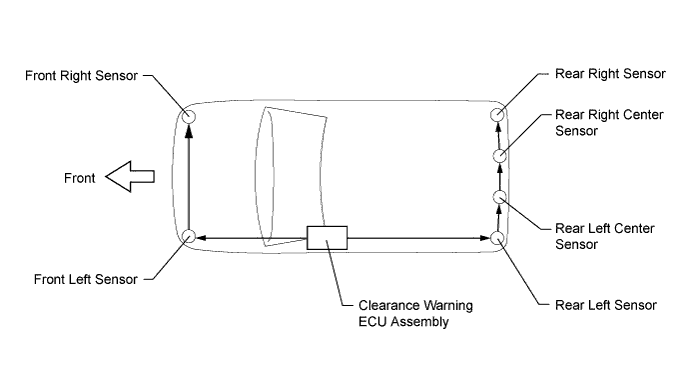
-
When the initial check is operating (the engine switch is on (IG) and the clearance sonar main switch is on), the clearance warning ECU assembly provides power to the first sensors in each series (front left sensor and rear left sensor)
Tech Tips
Refer to Self-check Function Inspection (Initial Check) Click here.
-
After the power is supplied, the front left sensor and rear left sensor enter standby mode to receive an ID from the ECU. When a certain amount of time has elapsed, the ECU sends an ID allocation signal to these sensors.
-
The front left sensor and rear left sensor receive the ID allocation signal from the ECU and perform self-diagnosis. When the sensor self-diagnosis is completed, the ECU sends an ID allocation confirmation signal to these sensors.
-
After the ID allocation confirmation is performed, the ECU provides power to the second sensors in each series (front right sensor and rear left center sensor) via the first sensors. In the same manner as the first sensors, the second sensors enter standby mode. When a certain amount of time has elapsed, the ECU sends an ID allocation signal to the second sensors.
-
The above operation will be repeated until an ID is allocated to the last sensor, which is in the rear series (rear right sensor). Initialization ends when ID allocation to all ultrasonic sensors is completed.
-
-
Detection mode:
After initialization mode is completed, the system switches into detection mode. In detection mode, the clearance warning ECU assembly sends information request signals and sensor activation signals to the ultrasonic sensors and receives detection result signals from the sensors.
-
The ECU regularly sends ID signals, information request signals, and sensor activation signals to each ultrasonic sensor according to the communication schedule.
-
When a certain amount of time has elapsed (sensor detection operation is completed), the ECU sends an ID signal to the sensor to receive a detection result signal.
-
The ultrasonic sensor sends a detection result signal or detection information signal to the ECU.
-
The above operation is performed repeatedly for each ultrasonic sensor.
-
-