Click here
-
TROUBLESHOOTING PRECAUTION
Note:
-
Since the brake lines are critical safety related parts, be sure to disassemble and inspect the components if a brake fluid leak is found. If any abnormality is found, replace the component with a new one.
-
When removing brake components, cover the brake line connections to prevent foreign matter such as dust or dirt from entering the lines.
-
Do not damage or deform the brake lines during the removal and installation procedures.
-
When installing a grommet to the body, ensure that the brake line passes through the center of the grommet.
-
When installing a brake line or flexible hose, ensure that they are free from twists or bends.
-
If the metal end of a flexible hose does not match the groove on the bracket, twist the hose slightly to insert it.
-
Flexible hoses must be free from shock absorber oil, grease, etc.
-
When installing a brake line to a plastic clamp, ensure that the brake line is not loose or pinched.
-
Do not reuse any clips or plastic clamps removed from a flexible hose.
-
After installing a brake line or flexible hose, ensure that they do not interfere with any other components.
-
Do not allow brake fluid on any painted vehicle body surface. If brake fluid leaks onto a painted surface, immediately wash it off.
-
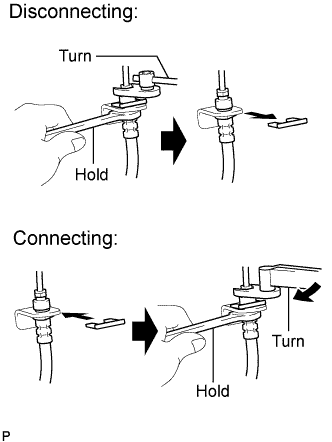
When disconnecting and connecting a flexible hose and brake line:
-
-
While holding the flexible hose with a wrench, disconnect the brake tube using a union nut wrench (10 mm) without deforming it.
-
Remove the clip and disconnect the flexible hose.
-
Secure the flexible hose with a new clip. At this time, be sure to securely install the clip.
-
Using a union nut wrench (10 mm), connect the brake tube without deforming it.
-
-
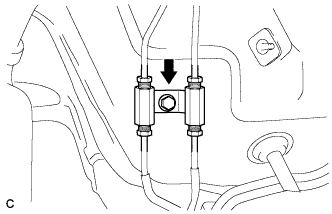
When connecting a brake line and way:
-
-
While supporting the way to prevent the brake tubes from being deformed, connect each brake tube with a union nut wrench (10 mm).
-
While supporting the way to prevent the brake lines from being deformed, install the way to the vehicle body with the bolt.
-
-