| DTC Code | DTC Name |
|---|---|
| P0766 | Shift Solenoid "D" Performance (Shift Solenoid Valve S4) |
SYSTEM DESCRIPTION
The ECM uses signals from the vehicle speed sensor to detect the actual gear position (1st, 2nd, 3rd or 4th (O/D) gear).
Then the ECM compares the actual gear with the shift schedule in the ECM memory to detect mechanical problems of the shift solenoid valves, valve body or automatic transaxle (clutch, brake or gear etc.).
| DTC No. | DTC Detection Condition | Trouble Area |
|---|---|---|
| P0766 | The gear required by the ECM does not match the actual gear when driving (2-trip detection logic) |
|
MONITOR DESCRIPTION
The ECM commands gear shifts by turning the shift solenoid valves "ON/OFF". According to the input shaft revolution, intermediate (counter) shaft revolution and output shaft revolution, the ECM detects the actual gear position (1st, 2nd, 3rd or 4th (O/D) gear position). When the gear position commanded by the ECM and the actual gear position are not the same, the ECM illuminates the MIL and stores the DTC.
INSPECTION PROCEDURE
Using the Intelligent tester to perform Active Test allows relays, VSVs, actuators and other items to be operated without removing any parts. This non-intrusive functional inspection can be very useful because intermittent operation may be discovered before parts or wiring is disturbed. Performing Active Test early in troubleshooting is one way to save diagnostic time. Data List information can be displayed while performing Active Test.
Click here
-
PERFORM ACTIVE TEST
-
Warm up the engine.
-
Turn the engine switch off.
-
Connect the Intelligent tester to the DLC3.
-
Turn the engine switch on (IG).
-
Turn on the Intelligent tester.
-
Select the item "Enter / Powertrain / Engine and ECT / Active Test / Shift Status".
-
According to the display on the tester, perform the "Active Test".
Tip:While driving, the shift position can be forcibly changed with the Intelligent tester.
Comparing the shift position commanded by the Active Test with the actual shift position enables you to confirm the problem (Click here).
Tester Display Test Part Control Range Diagnostic Note Control the Shift Position [Test Details]
Operate the shift solenoid valve and set each shift position by yourself.
[Vehicle Condition]
-
IDL: ON
-
Less than 50 km/h (31 mph)
[Others]
-
Press "→" button: Shift up
-
Press "←" button: Shift down
1st / 2nd / 3rd / 4th Possible to check the operation of the shift solenoid valves. Tip:
-
This test can be conducted when the vehicle speed is 50 km/h (31 mph) or less.
-
The shift position commanded by the ECM is shown in the Data List / Shift Status display on the Intelligent tester.
-
-
PROCEDURE
- Click here
CHECK OTHER DTCS OUTPUT (IN ADDITION TO DTC P0766)
-
Connect the Intelligent tester to the DLC3.
-
Turn the engine switch on (IG) and turn the Intelligent tester main switch on.
-
Select the item "Enter / Powertrain / Engine and ECT / Trouble Codes".
-
Read the DTCs using the Intelligent tester.
Result Display (DTC output) Proceed to Only "P0766" is output A "P0766" and other DTCs B Tip:If any other codes besides "P0766" are output, perform the troubleshooting for those DTCs first.
-
- Click here
INSPECT SHIFT SOLENOID VALVE S4
-
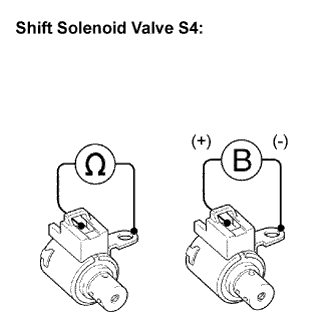
Remove the shift solenoid valve S4.
-
Measure the resistance according to the value(s) in the table below.
Standard resistance Tester Connection Condition Specified Condition Solenoid Connector (S4) - Solenoid Body (S4) 20°C (68°F) 11 to 15 Ω -
Connect the positive (+) lead to the terminal of the solenoid connector, and the negative (-) lead to the solenoid body.
OK The solenoid makes an operating sound.
- OKClick here
- NGClick here
-
- Click here
INSPECT TRANSMISSION VALVE BODY ASSEMBLY
OK There are no foreign objects on each valve.
- OKClick here
- NGClick here
- Click here
INSPECT TORQUE CONVERTER CLUTCH ASSEMBLY
OK The torque converter clutch operates normally.
- OKClick here
- NGClick here
- Click here
REPAIR OR REPLACE AUTOMATIC TRANSAXLE ASSEMBLYClick here
- Click here
GO TO DTC CHARTClick here
- Click here
REPLACE SHIFT SOLENOID VALVE S4Click here
- Click here
REPAIR OR REPLACE TRANSMISSION VALVE BODY ASSEMBLYClick here
- Click here
REPLACE TORQUE CONVERTER CLUTCH ASSEMBLY