AIR CONDITIONING SYSTEM (for Automatic Air Conditioning System), Diagnostic DTC:B1449/49

| DTC Code | DTC Name |
|---|---|
| B1449/49 | Rear Air Outlet Damper Control Servo Motor Circuit |
DESCRIPTION
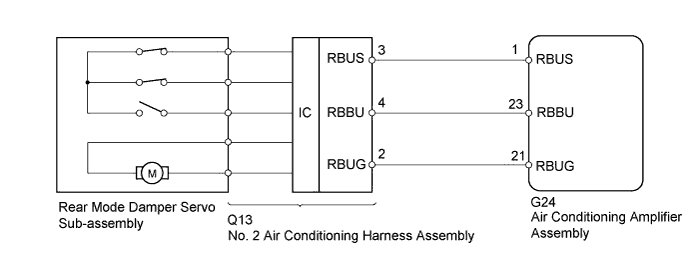
The rear mode damper servo sub-assembly sends pulse signals to indicate the damper position to the air conditioning amplifier assembly. The air conditioning amplifier assembly activates the motor (normal or reverse) based on these signals to move the rear air outlet damper to any position, which controls the air outlet modes.
The air conditioning amplifier assembly communicates with the servo through the No. 2 air conditioning harness.
Tech Tips
Confirm that there are no mechanical problems because this DTC may be stored when either a damper link or damper is mechanically locked.
| DTC Code | DTC Detection Condition | Trouble Area |
|---|---|---|
| B1449/49 | Rear air outlet damper position does not change when the air conditioning amplifier assembly operates the rear mode damper servo sub-assembly. |
|
WIRING DIAGRAM
INSPECTION PROCEDURE
PROCEDURE
-
READ VALUE USING INTELLIGENT TESTER (REAR MODE DAMPER SERVO)
-
Use the Data List to check if the rear mode damper servo sub-assembly is functioning properly Click here.
Air Conditioner Tester Display Measurement Item/Range Normal Condition Diagnostic Note Air Outlet Servo Pulse (R) Rear mode damper servo sub-assembly target pulse / Min.: 0, Max.: 255 83 (pulse): FACE
41 (pulse): B/L
7 (pulse): FOOT
- Air Mix Servo Actual Pulse (R) Rear mode damper servo sub-assembly actual pulse / Min.: 0, Max.: 255 83 (pulse): FACE
41 (pulse): B/L
7 (pulse): FOOT
- OK The display is as specified in the normal condition column. Result Result Proceed to OK (When troubleshooting according to problem symptoms table) A OK (When troubleshooting according to the DTC) B NG C
B 
REPLACE AIR CONDITIONING AMPLIFIER ASSEMBLY Click here
C 
PERFORM ACTIVE TEST USING INTELLIGENT TESTER (REAR MODE DAMPER SERVO) Click here
A 
PROCEED TO NEXT SUSPECTED AREA SHOWN IN PROBLEM SYMPTOMS TABLE Click here
-
-
PERFORM ACTIVE TEST USING INTELLIGENT TESTER (REAR MODE DAMPER SERVO)
-
Select the Active Test, use the intelligent tester to generate a control command, and then check that the rear mode damper servo sub-assembly operates Click here.
Air Conditioner Tester Display Test Part Control Range Diagnostic Note A/O Servo Pulse (Rr D) Rear mode damper servo sub-assembly pulse Min.: 0, Max.: 255 - OK Rear mode damper servo sub-assembly operates normally.
NG
CHECK HARNESS AND CONNECTOR (NO. 2 AIR CONDITIONING HARNESS - AIR CONDITIONING AMPLIFIER) Click here
OK
REPLACE AIR CONDITIONING AMPLIFIER ASSEMBLY Click here
-
-
CHECK HARNESS AND CONNECTOR (NO. 2 AIR CONDITIONING HARNESS - AIR CONDITIONING AMPLIFIER)
-
Disconnect the Q13 harness connector.
-
Disconnect the G24 amplifier connector.
-
Measure the resistance according to the value(s) in the table below.
Standard Resistance Tester Connection Condition Specified Condition Q13-3 (RBUS) - G24-1 (RBUS) Always Below 1 Ω Q13-4 (RBBU) - G24-23 (RBBU) Always Below 1 Ω Q13-2 (RBUG) - G24-21 (RBUG) Always Below 1 Ω G24-1 (RBUS) - Body ground Always 10 kΩ or higher G24-23 (RBBU) - Body ground Always 10 kΩ or higher G24-21 (RBUG) - Body ground Always 10 kΩ or higher
NG
REPAIR OR REPLACE HARNESS OR CONNECTOR
OK 
-
-
REPLACE REAR MODE DAMPER SERVO SUB-ASSEMBLY
-
Replace the rear mode damper servo sub-assembly Click here.
Tech Tips
Since the rear mode damper servo sub-assembly cannot be inspected while it is removed from the vehicle, replace the rear mode damper servo sub-assembly with a new or normally functioning one.
NEXT
-
-
CHECK FOR DTC
-
Clear the DTCs Click here.
-
Check for DTCs Click here.
OK DTC B1449 is not output.
NG
REPLACE AIR CONDITIONING AMPLIFIER ASSEMBLY Click here
OK
END (REAR MODE DAMPER SERVO SUB-ASSEMBLY IS FAULTY)
-
-
REPLACE AIR CONDITIONING AMPLIFIER ASSEMBLY
-
Temporarily replace the air conditioning amplifier assembly with a new or normally functioning one Click here.
NEXT
-
-
CHECK FOR DTC
-
Clear the DTCs Click here.
-
Check for DTCs Click here.
OK DTC B1449 is not output.
NG
REPLACE NO. 2 AIR CONDITIONING HARNESS ASSEMBLY Click here
OK
END (AIR CONDITIONING AMPLIFIER ASSEMBLY IS FAULTY)
-