SFI SYSTEM, Diagnostic DTC:P1613

| DTC Code | DTC Name |
|---|---|
| P1613 | Secondary Air Injection Driver Malfunction |
DESCRIPTION
Refer to DTC P0412 Click here.
| DTC No. | DTC Detection Conditions | Trouble Areas |
|---|---|---|
| P1613 | Either condition (1) or (2) met: (1) All conditions are met (1 trip detection logic):
(2) Both conditions are met (1 trip detection logic):
|
|
| P1613 |
|
|
| P1613 |
|
|
MONITOR DESCRIPTION
For a short time a after cold engine start, the ECM transmits command signals to the air injection control driver to drive the air pump and air switching valve. The air injection control driver detects open and short circuits according to the voltages at the air injection control driver terminals connected to the air pump and air switching valve, and the circuit voltage of the air injection control driver power source, and transmits diagnostic information as a signal to the ECM.
If the Secondary Air Injection (AIR) system circuit or the air injection control driver itself malfunctions, the air injection control driver sends a malfunction signal (duty signal) as diagnostic information to the ECM (when the system is normal, a system normal signal is sent). The ECM stores the DTC based on the diagnostic information from the air injection control driver.
Example:
-
The duty ratio of the diagnostic signal from the air injection control driver is 0 or 100% (remains at 0 V or is the same as battery voltage).
-
The duty ratio of the diagnostic signal from the air injection control driver shows an impossible ratio (other than 0, 20, 40, 80 or 100%).
-
The air injection control driver outputs the normal signal (normal duty signal: 80%) while the system is not operating.
WIRING DIAGRAM
Refer to DTC P0412 Click here.
INSPECTION PROCEDURE
Tech Tips
Diagnostic information output by the air injection control driver can be confirmed by connecting an oscilloscope to the diagnostic information terminal of the air injection control driver. Reading the waveform while performing the AIR system forced operation provided in the system check allows the possible trouble areas to be narrowed down.
-
(a) Start the engine and warm it up.
-
(b) Turn the ignition switch off.
-
(c) Connect the intelligent tester to the DLC3.
-
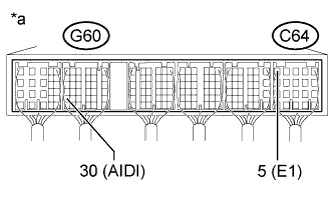
Text in Illustration *a Component with harness connected
(ECM)
(d) Connect oscilloscope probes to the AIDI and E1 terminals of the ECM.
-
(e) Turn the ignition switch to ON and turn the intelligent tester on.
-
(f) Enter the following menus: Powertrain / Engine and ECT / Utility / Secondary Air Injection Check / Manual Mode / AIR PUMP: ON, ASV: CLOSE.
Tech Tips
When Manual Mode is selected, the intelligent tester initialization (atmospheric pressure measurement) is performed automatically. The initialization takes 10 seconds. After the initialization, AIR PUMP and ASV operation can be selected.
-
(g) Start the engine.
-
(h) Perform the AIR system forced operation while the engine is idling.
-
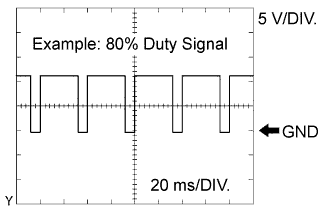
(i) Monitor the air injection control driver voltage output (duty ratio signal).
Measurement Condition Item Content ECM Terminal Name AIDI - E1 Tester Range 5 V/DIV., 20 ms/DIV. Condition Idling -
(j) Turn the ignition switch off.
Note
-
Secondary Air Injection Check only allows technicians to operate the AIR system for a maximum of 5 seconds. Furthermore, the check can only be performed up to 4 times per trip. If the test is repeated, intervals of at least 30 seconds are required between checks. While AIR system operation using the intelligent tester is prohibited, the intelligent tester display indicates the prohibition (Wait or Error).
If Error is displayed on the intelligent tester during the test, stop the engine for 10 minutes, and then try again.
-
Performing Secondary Air Injection Check repeatedly may cause damage to the AIR system. If it is necessary to repeat the check, leave an interval of several minutes between System Check operations to prevent the system from overheating.
-
When performing Secondary Air Injection Check operation after the battery cable has been reconnected, wait for 7 minutes with the ignition switch ON or the engine running.
-
Turn the ignition switch off when the Secondary Air Injection Check operation finishes.
-
| AID Diagnostic Signal Waveform | ECM Command |
DTC (ECM Output) |
Suspected Trouble Area |
|---|---|---|---|
| 100% Duty Ratio 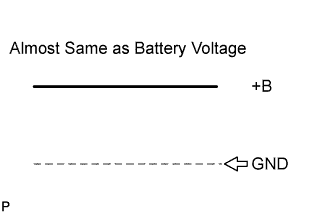 |
Any Secondary Air Injection (AIR) System Operation | P1613 |
|
| 0% Duty Ratio 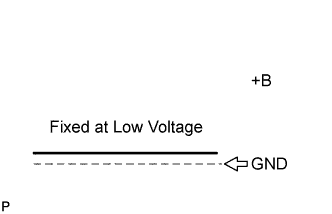 |
AIR System: ON (Air pump ON, Air switching valve ON) | P1613 |
|
| AIR System: OFF (Air pump OFF, Air switching valve OFF) | - | Normal | |
| 20% Duty Ratio 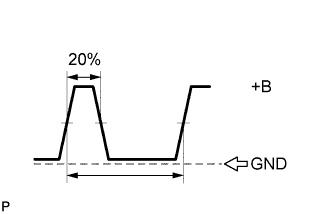 |
Air Pump: ON | P0418 |
|
| Air Pump: OFF | P0418 |
|
|
| 40% Duty Ratio 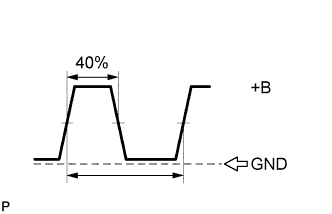 |
Air switching valve: ON | P0412 |
|
| Air switching valve: OFF | P0412 |
|
|
| 80% Duty Ratio 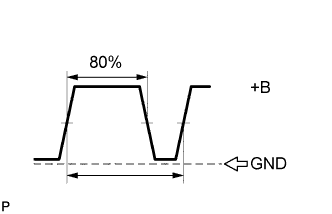 |
AIR System: OFF (Air pump OFF, Air switching valve OFF) | P1613 |
|
| AIR System: ON (Air pump ON, Air switching valve ON) | - | Normal | |
| Other than above (other than 0, 20, 40, 80 or 100% duty) |
- | P1613 |
|
Tech Tips
-
By using the intelligent tester to perform the Secondary Air Injection Check operation in the system check, the air-fuel ratio and the pressure in the secondary air injection system passage can be checked while the secondary air injection system is operating. This helps technicians to troubleshoot the system when it malfunctions.
-
Read freeze frame data using the intelligent tester. Freeze frame data records the engine condition when malfunctions are detected. When troubleshooting, freeze frame data can help determine if the vehicle was moving or stationary, if the engine was warmed up or not, if the air-fuel ratio was lean or rich, and other data from the time the malfunction occurred.
PROCEDURE
-
CHECK FOR ANY OTHER DTCS OUTPUT (IN ADDITION TO DTC P1613)
-
Connect the intelligent tester to the DLC3.
-
Turn the ignition switch to ON and turn the intelligent tester on.
-
Enter the following menus: Powertrain / Engine and ECT / Trouble Codes.
-
Read DTCs.
Result Result Proceed to P1613 A P1613 and other DTCs B If any DTCs other than P1613 are output, troubleshoot those DTCs first.
NG 
GO TO DTC CHART Click here
OK 
-
-
PERFORM ACTIVE TEST USING INTELLIGENT TESTER (AIDI VOLTAGE)
Text in Illustration *a Component with harness connected
(ECM)
-
Start the engine and warm it up.
-
Turn the ignition switch off.
-
Connect the intelligent tester to the DLC3.
-
Turn the ignition switch to ON and turn the intelligent tester on.
-
Enter the following menus: Powertrain / Engine and ECT / Utility / Secondary Air Injection Check / Manual Mode / AIR PUMP: ON, ASV: CLOSE.
Tech Tips
When Manual Mode is selected, the intelligent tester initialization (atmospheric pressure measurement) is performed automatically. The initialization takes 10 seconds. After the initialization, AIR PUMP and ASV operation can be selected.
-
Start the engine.
-
Perform the AIR system forced operation while the engine is idling.
-
Measure the voltage between the AIDI and E1 terminals of the ECM connector when the AIR system is on and off.
-
Turn the ignition switch off.
Note
-
Do not perform the system check operation repetitively. It may cause the damage in the system. If it is necessary to repeat the check, leave an interval of several minutes between system check operations.
-
When performing the Secondary Air Injection Check operation after the battery cable has been reconnected, wait for 7 minutes with the ignition switch ON or the engine running.
-
Turn the ignition switch off when the Secondary Air Injection Check operation finishes.
Result Results Suspected Trouble Areas Proceed To Fixed at low voltage (1.6 V or less) even when AIR system ON (Air pump ON, ASV OPEN)
-
Short between air pump or air switching valve command signal circuit and body ground
-
Open in air pump command signal circuit (between ECM and air injection control driver)
-
Open in air switching valve assembly command signal circuit (between ECM and air injection control driver)
-
Open in air injection control driver ground circuit (between air injection control driver and body ground)
-
Diagnostic signal circuit ground short
-
Air injection control driver
-
ECM
A Fixed at high voltage (12 V or higher) even when AIR system OFF (Air pump OFF, ASV CLOSE)
-
Open in diagnostic signal circuit (ECM - air injection control driver)
-
Short between +B and diagnostic signal circuits (ECM - air injection control driver)
-
Open in air injection control driver power source circuit
-
Air injection control driver
-
ECM
B Other than above:
Fluctuating (duty signal other than 20, 40 or 80%)
-
Air injection control driver
-
Open in air injection control driver ground circuit (between air injection control driver and body ground)
C -
B 
CHECK AIR INJECTION CONTROL DRIVER POWER SOURCE CIRCUIT Click here
C
CHECK HARNESS AND CONNECTOR (AIR INJECTION CONTROL DRIVER - BODY GROUND) Click here
A
-
-
INSPECT ECM (AIRP AND AIRV VOLTAGE)
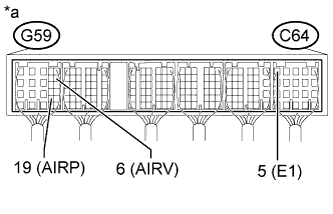
Text in Illustration *a Component with harness connected
(ECM)
-
Turn the ignition switch to ON.
-
Measure the voltage according to the value(s) in the table below.
Standard Voltage Tester Connection Switch Condition Specified Condition G59-19 (AIRP) - C64-5 (E1) Ignition switch ON 11 to 14 V G59-6 (AIRV) - C64-5 (E1) Ignition switch ON 11 to 14 V
NG
CHECK HARNESS AND CONNECTOR (ECM - AIR INJECTION CONTROL DRIVER) Click here
OK 
REPLACE ECM Click here
-
-
CHECK HARNESS AND CONNECTOR (ECM - AIR INJECTION CONTROL DRIVER)
-
Disconnect the ECM connector.
-
Disconnect the air injection control driver connector.
-
Measure the resistance according to the value(s) in the table below.
Standard Resistance (Check for Open) Tester Connection Condition Specified Condition A16-1 (E) - Body ground Always Below 1 Ω A16-4 (SIP) - G59-19 (AIRP) Always Below 1 Ω A16-3 (SIV) - G59-6 (AIRV) Always Below 1 Ω -
Measure the voltage according to the value(s) in the table below.
Standard Voltage (Check for Short) Tester Connection Switch Condition Specified Condition A16-2 (DI) - A16-1 (E) Ignition switch ON 11 to 14 V Result Result Proceed to NG A OK B -
Reconnect the ECM connector.
-
Reconnect the air injection control driver connector.
B
PERFORM ACTIVE TEST USING INTELLIGENT TESTER Click here
A
REPAIR OR REPLACE HARNESS OR CONNECTOR
-
-
CHECK AIR INJECTION CONTROL DRIVER POWER SOURCE CIRCUIT
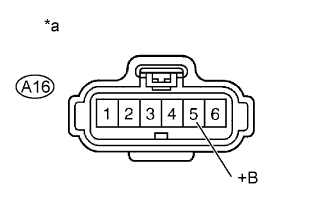
Text in Illustration *a Front view of wire harness connector
(to Air Injection Control Driver)
-
Disconnect the air injection control driver connector.
-
Turn the ignition switch to ON.
-
Measure the voltage according to the value(s) in the table below.
Standard Voltage Tester Connection Switch Condition Specified Condition A16-5 (+B) - Body ground Ignition switch ON 11 to 14 V -
Measure the resistance according to the value(s) in the table below.
Standard Resistance (Check for Short) Tester Connection Condition Specified Condition G59-19 (AIRP) or A16-4 (SIP) - Body ground Always 10 kΩ or higher G59-6 (AIRV) or A16-3 (SIV) - Body ground Always 10 kΩ or higher -
Reconnect the air injection control driver connector.
NG
REPAIR OR REPLACE HARNESS OR CONNECTOR
OK
-
-
INSPECT AIR INJECTION CONTROL DRIVER (DI TERMINAL VOLTAGE)
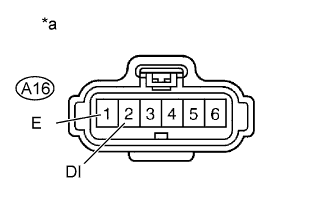
Text in Illustration *a Front view of wire harness connector
(to Air Injection Control Driver)
-
Disconnect the air injection control driver connector.
-
Turn the ignition switch to ON.
-
Measure the voltage according to the value(s) in the table below.
Standard Voltage Tester Connection Switch Condition Specified Condition A16-2 (DI) - A16-1 (E) Ignition switch ON 11 to 14 V -
Reconnect the air injection control driver connector.
NG
CHECK HARNESS AND CONNECTOR (ECM - AIR INJECTION CONTROL DRIVER) Click here
OK
PERFORM ACTIVE TEST USING INTELLIGENT TESTER Click here
-
-
CHECK HARNESS AND CONNECTOR (ECM - AIR INJECTION CONTROL DRIVER)
-
Disconnect the ECM connector.
-
Disconnect the air injection control driver connector.
-
Measure the resistance according to the value(s) in the table below.
Standard Resistance (Check for Open) Tester Connection Condition Specified Condition A16-2 (DI) - G60-30 (AIDI) Always Below 1 Ω Standard Resistance (Check for Short) Tester Connection Condition Specified Condition A16-2 (DI) or G60-30 (AIDI) - Body ground Always 10 kΩ or higher -
Reconnect the ECM and air injection control driver connectors.
NG
REPAIR OR REPLACE HARNESS OR CONNECTOR
OK
REPLACE ECM Click here
-
-
CHECK HARNESS AND CONNECTOR (AIR INJECTION CONTROL DRIVER - BODY GROUND)
-
Disconnect the air injection control driver connector.
-
Measure the resistance according to the value(s) in the table below.
Standard Resistance (Check for Open) Tester Connection Condition Specified Condition A16-1 (E) - Body ground Always Below 1 Ω -
Reconnect the air injection control driver connector.
NG
REPAIR OR REPLACE HARNESS OR CONNECTOR
OK
-
-
PERFORM ACTIVE TEST USING INTELLIGENT TESTER
-
Disconnect the air injection control driver connector.
-
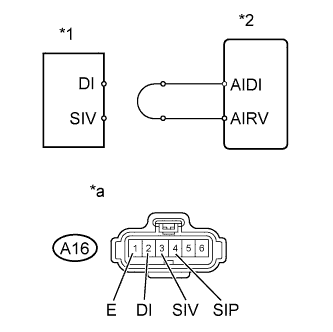
Text in Illustration *1 Air Injection Control Driver *2 ECM *a Front view of wire harness connector
(to Air Injection Control Driver)
Connect terminals DI and SIV of the wire harness connector for the air injection control driver.
-
Connect the intelligent tester to the DLC3.
-
Turn the ignition switch to ON and turn the intelligent tester on.
-
Enter the following menus: Powertrain / Engine and ECT / Utility / Secondary Air Injection Check / Manual Mode / AIR PUMP: ON, ASV: OPEN.
Tech Tips
When Manual Mode is selected, the intelligent tester initialization (atmospheric pressure measurement) is performed automatically. The initialization takes 10 seconds. After the initialization, AIR PUMP and ASV operation can be selected.
-
Start the engine.
-
Perform the AIR system intrusive operation while the engine is idling.
-
Measure the voltage between the SIV and E terminals of the ECM connector when the AIR system is on and off.
-
Turn the ignition switch off.
Note
-
Do not perform the System Check operation repetitively. It may cause the damage in the system. If necessary, leave an interval of several minutes between System Check operations.
-
When performing the Secondary Air Injection Check operation after the battery cable has been reconnected, wait for 7 minutes with the ignition switch ON or the engine running.
-
Turn the ignition switch off when the Secondary Air Injection Check operation finishes.
Standard Voltage Tester Connection Condition Specified Condition A16-3 (SIV) - A16-1 (E) AIR PUMP: ON, ASV: OPEN 0.5 to 2 V A16-3 (SIV) - A16-1 (E) AIR PUMP: OFF, ASV: CLOSE 11 to 14 V -
-
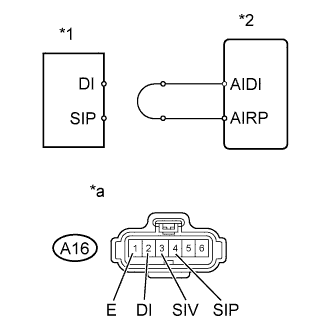
Text in Illustration *1 Air Injection Control Driver *2 ECM *a Front view of wire harness connector
(to Air Injection Control Driver)
Connect terminals DI and SIP of the wire harness connector for the air injection control driver.
-
Connect the intelligent tester to the DLC3.
-
Turn the ignition switch to ON and turn the intelligent tester on.
-
Enter the following menus: Powertrain / Engine and ECT / Utility / Secondary Air Injection Check / Manual Mode / AIR PUMP: ON, ASV: OPEN.
Tech Tips
When Manual Mode is selected, the intelligent tester initialization (atmospheric pressure measurement) is performed automatically. The initialization takes 10 seconds. After the initialization, AIR PUMP and ASV operation can be selected.
-
Start the engine.
-
Perform the AIR system intrusive operation while the engine is idling.
-
Measure the voltage between the SIP and E terminals of the ECM connector when the AIR system is on and off.
-
Turn the ignition switch off.
Note
-
Do not perform the System Check operation repetitively. It may cause the damage in the system. If necessary, leave an interval of several minutes between System Check operations.
-
When performing the Secondary Air Injection Check operation after the battery cable has been reconnected, wait for 7 minutes with the ignition switch ON or the engine running.
-
Turn the ignition switch off when the Secondary Air Injection Check operation finishes.
Standard Voltage Tester Connection Condition Specified Condition A16-4 (SIP) - A16-1 (E) AIR PUMP: ON, ASV: OPEN 0.5 to 2 V A16-4 (SIP) - A16-1 (E) AIR PUMP: OFF, ASV: CLOSE 11 to 14 V -
-
Reconnect the air injection control driver connector.
NG
REPLACE ECM Click here
OK
-
-
REPLACE AIR INJECTION CONTROL DRIVER
-
Replace the air injection control driver Click here.
NEXT
-
-
CHECK WHETHER DTC OUTPUT RECURS (SYSTEM CHECK AUTOMATIC MODE)
-
Start the engine and warm it up.
-
Turn the ignition switch off.
-
Connect the intelligent tester to the DLC3.
-
Turn the ignition switch to ON and turn the intelligent tester on.
-
Clear DTCs (if stored) Click here.
-
Enter the following menus: Powertrain / Engine and ECT / Utility / Secondary Air Injection Check / Automatic Mode.
-
Start the engine after the intelligent tester initialization is finished.
-
Perform the system check operation by pressing Next.
-
After operating the AIR system, press the Exit button to confirm the AIR system pending codes.
-
Check Pending DTCs.
OK No pending DTC output. -
Turn the ignition switch off.
Note
-
When performing the Secondary Air Injection Check operation after the battery cable has been reconnected, wait for 7 minutes with the ignition switch ON or the engine running.
-
Turn the ignition switch off when the Secondary Air Injection Check operation finishes.
-
NG
REPLACE ECM Click here
OK
END
-