SFI SYSTEM ECM Power Source Circuit
DESCRIPTION
When the ignition switch is turned to ON, battery voltage is applied to the IGSW terminal of the ECM. The output signal from the MREL terminal of the ECM causes a current to flow to the coil, closing the contacts of the No. 1 integration relay (EFI) and supplying power to either terminal +B or +B2 of the ECM.
WIRING DIAGRAM
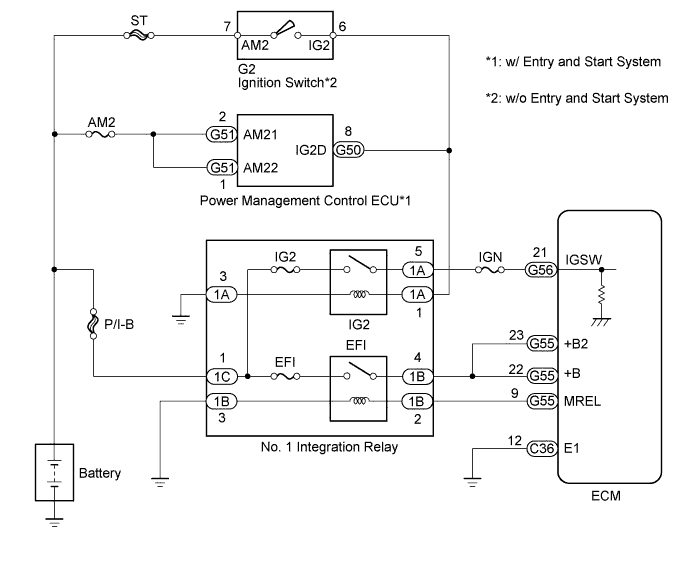
INSPECTION PROCEDURE
Note
Inspect the fuses for circuits related to this system before performing the following inspection procedure.
PROCEDURE
-
CHECK HARNESS AND CONNECTOR (NO. 1 INTEGRATION RELAY - BATTERY)
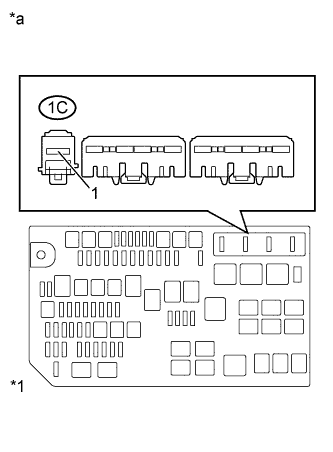
Text in Illustration *1 Engine Room Relay Block *a Front view of wire harness connector
(to No. 1 Integration Relay)
-
Remove the No. 1 integration relay from the engine room relay block.
-
Measure the voltage according to the value(s) in the table below.
Standard Voltage Tester Connection Condition Specified Condition 1C-1 - Body ground Always 11 to 14 V -
Reinstall the No. 1 integration relay.
NG 
REPAIR OR REPLACE HARNESS OR CONNECTOR
OK 
-
-
INSPECT NO. 1 INTEGRATION RELAY (EFI AND IG2)
-
Inspect the EFI relay Click here.
-
Inspect the IG2 relay Click here.
NG
REPLACE NO. 1 INTEGRATION RELAY
OK
-
-
CHECK HARNESS AND CONNECTOR (+B, +B2 AND MREL CIRCUIT)
-
Check the harness and connectors between the No. 1 integration relay and ECM.
-
Remove the No. 1 integration relay from the engine room relay block.
-
Disconnect the ECM connector.
-
Measure the resistance according to the value(s) in the table below.
Standard Resistance (Check for Open) Tester Connection Condition Specified Condition G55-9 (MREL) - 1B-2 Always Below 1 Ω G55-22 (+B) - 1B-4 Always Below 1 Ω G55-23 (+B2) - 1B-4 Always Below 1 Ω Standard Resistance (Check for Short) Tester Connection Condition Specified Condition G55-9 (MREL) or 1B-2 - Body ground Always 10 kΩ or higher G55-22 (+B) or 1B-4 - Body ground Always 10 kΩ or higher G55-23 (+B2) or 1B-4 - Body ground Always 10 kΩ or higher -
Reinstall the No. 1 integration relay.
-
Reconnect the ECM connector.
-
-
Check the harness and connectors between the No. 1 integration relay and body ground.
-
Remove the No. 1 integration relay from the engine room relay block.
-
Measure the resistance according to the value(s) in the table below.
Standard Resistance (Check for Open) Tester Connection Condition Specified Condition 1B-3 - Body ground Always Below 1 Ω -
Reinstall the No. 1 integration relay.
-
NG
REPAIR OR REPLACE HARNESS OR CONNECTOR
OK
-
-
CHECK HARNESS AND CONNECTOR (ECM - BODY GROUND)
-
Disconnect the ECM connector.
-
Measure the resistance according to the value(s) in the table below.
Standard Resistance (Check for Open) Tester Connection Condition Specified Condition C36-12 (E1) - Body ground Always Below 1 Ω -
Reconnect the ECM connector.
NG
REPAIR OR REPLACE HARNESS OR CONNECTOR
OK
-
-
INSPECT ECM (IGSW VOLTAGE)
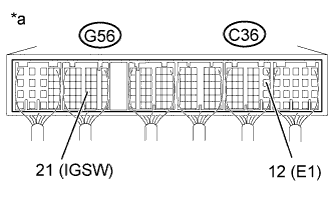
Text in Illustration *a Component with harness connected
(ECM)
-
Measure the voltage according to the value(s) in the table below.
Standard Voltage Tester Connection Switch Condition Specified Condition G56-21 (IGSW) - C36-12 (E1) Ignition switch ON 11 to 14 V
NG 
CHECK HARNESS AND CONNECTOR (NO. 1 INTEGRATION RELAY - ECM, NO. 1 INTEGRATION RELAY - BODY GROUND) Click here
OK 
REPLACE ECM Click here
-
-
CHECK HARNESS AND CONNECTOR (NO. 1 INTEGRATION RELAY - ECM, NO. 1 INTEGRATION RELAY - BODY GROUND)
-
Remove the No. 1 integration relay from the engine room relay block.
-
Disconnect the ECM connector.
-
Measure the resistance according to the value(s) in the table below.
Standard Resistance (Check for Open) Tester Connection Condition Specified Condition 1A-5 - G56-21 (IGSW) Always Below 1 Ω Standard Resistance (Check for Short) Tester Connection Condition Specified Condition 1A-5 or G56-21 (IGSW) - Body ground Always 10 kΩ or higher -
Reinstall the No. 1 integration relay.
-
Reconnect the ECM connector.
NG
REPAIR OR REPLACE HARNESS OR CONNECTOR
OK
-
-
CHECK IF VEHICLE IS EQUIPPED WITH ENTRY AND START SYSTEM
Result Result Proceed to w/ Entry and Start System A w/o Entry and Start System B
B
CHECK HARNESS AND CONNECTOR (IGNITION SWITCH - NO. 1 INTEGRATION RELAY) Click here
A
-
CHECK HARNESS AND CONNECTOR (POWER MANAGEMENT CONTROL ECU - NO. 1 INTEGRATION RELAY)
-
Remove the No. 1 integration relay from the engine room relay block.
-
Disconnect the power management control ECU connector.
-
Measure the resistance according to the value(s) in the table below.
Standard Resistance (Check for Open) Tester Connection Condition Specified Condition G50-8 (IG2D) - 1A-1 Always Below 1 Ω Standard Resistance (Check for Short) Tester Connection Condition Specified Condition G50-8 (IG2D) or 1A-1 - Body ground Always 10 kΩ or higher -
Reinstall the No. 1 integration relay.
-
Reconnect the power management control ECU connector.
NG
REPAIR OR REPLACE HARNESS OR CONNECTOR
OK
-
-
CHECK ENTRY AND START SYSTEM (POWER SOURCE MODE DOES NOT CHANGE)
-
Check the entry and start system Click here.
NG
REPAIR ENTRY AND START SYSTEM Click here
OK
REPLACE ECM Click here
-
-
CHECK HARNESS AND CONNECTOR (IGNITION SWITCH - NO. 1 INTEGRATION RELAY)
-
Remove the No. 1 integration relay from the engine room relay block.
-
Disconnect the ignition switch connector.
-
Measure the resistance according to the value(s) in the table below.
Standard Resistance (Check for Open) Tester Connection Condition Specified Condition G2-6 (IG2) - 1A-1 Always Below 1 Ω Standard Resistance (Check for Short) Tester Connection Condition Specified Condition G2-6 (IG2) or 1A-1 - Body ground Always 10 kΩ or higher -
Reinstall the No. 1 integration relay.
-
Reconnect the ignition switch connector.
NG
REPAIR OR REPLACE HARNESS OR CONNECTOR
OK
-
-
INSPECT IGNITION SWITCH ASSEMBLY
-
Inspect the ignition switch assembly Click here.
NG
REPLACE IGNITION SWITCH ASSEMBLY Click here
OK
REPAIR OR REPLACE HARNESS OR CONNECTOR (IGNITION SWITCH - BATTERY)
-