SFI SYSTEM, Diagnostic DTC:P0016, P0017

| DTC Code | DTC Name |
|---|---|
| P0016 | Crankshaft Position - Camshaft Position Correlation (Bank 1 Sensor A) |
| P0017 | Crankshaft Position - Camshaft Position Correlation (Bank 1 Sensor B) |
DESCRIPTION
In the VVT (Variable Valve Timing) system, the appropriate intake and exhaust valve open and close timing is controlled by the ECM. The ECM performs intake and exhaust valve control by performing the following: 1) controlling the camshaft and camshaft timing oil control valve assembly, and operating the camshaft timing gear; and 2) changing the relative positions of the camshaft and crankshaft.
| DTC No. | DTC Detection Condition | Trouble Area |
|---|---|---|
| P0016 | Deviation in crankshaft position sensor signal and camshaft position sensor (for intake camshaft) signal (2 trip detection logic). |
|
| P0017 | Deviation in crankshaft position sensor signal and camshaft position sensor (for exhaust camshaft) signal (2 trip detection logic). |
|
MONITOR DESCRIPTION
To monitor the correlation of the intake camshaft position and crankshaft position, the ECM checks the VVT learned value while the engine is idling. The VVT learned value is calibrated based on the camshaft position and crankshaft position. The intake valve timing is set to the most retarded angle while the engine is idling. If the VVT learned value is out of the specified range in consecutive driving cycles, the ECM illuminates the MIL and stores DTC P0016.
To monitor the correlation of the exhaust camshaft position and crankshaft position, the ECM checks the VVT learned value while the engine is idling. The VVT learned value is calibrated based on the camshaft position and crankshaft position. The exhaust valve timing is set to the most advanced angle while the engine is idling. If the VVT learned value is out of the specified range in consecutive driving cycles, the ECM illuminates the MIL and stores DTC P0017.
MONITOR STRATEGY
| Related DTCs | P0016: Camshaft timing misalignment at idling (for intake camshaft) P0017: Camshaft timing misalignment at idling (for exhaust camshaft) |
| Required Sensors/Components (Main) | Camshaft timing gear assembly Camshaft timing exhaust gear assembly |
| Required Sensors/Components (Related) | Camshaft position sensor Crankshaft position sensor |
| Frequency of Operation | Continuous |
| Duration | Within 1 minute |
| MIL Operation | 2 driving cycles |
| Sequence of Operation | None |
TYPICAL ENABLING CONDITIONS
| Monitor runs whenever the following DTCs are not stored | P0010 (VVT oil control valve) P0102, P0103 (Mass air flow meter) P0115, P0117, P0118 (Engine coolant temperature sensor) P0125 (Insufficient coolant temperature for closed loop fuel control) P0335 (Crankshaft position sensor) P0340, P0342, P0343 (Camshaft position sensor) |
| Engine speed | 500 to 1000 rpm |
| Monitor runs whenever the following DTCs are not stored | P0013 (Exhaust VVT oil control valve) P0102, P0103 (Mass air flow meter) P0115, P0117, P0118 (Engine coolant temperature sensor) P0125 (Insufficient coolant temperature for closed loop fuel control) P0335 (Crankshaft position sensor) P0340, P0342, P0343 (Camshaft position sensor) |
| Engine speed | 500 to 1000 rpm |
TYPICAL MALFUNCTION THRESHOLDS
| Either of the of following conditions is met | - |
| VVT learned value at maximum retarded valve timing | Less than 22°CA (crankshaft angle) |
| VVT learned value at maximum retarded valve timing | More than 47°CA (crankshaft angle) |
| Either of the of following conditions is met | - |
| VVT learned value at maximum advanced valve timing | Less than 82.5°CA (crankshaft angle) |
| VVT learned value at maximum advanced valve timing | More than 107.5°CA (crankshaft angle) |
CONFIRMATION DRIVING PATTERN
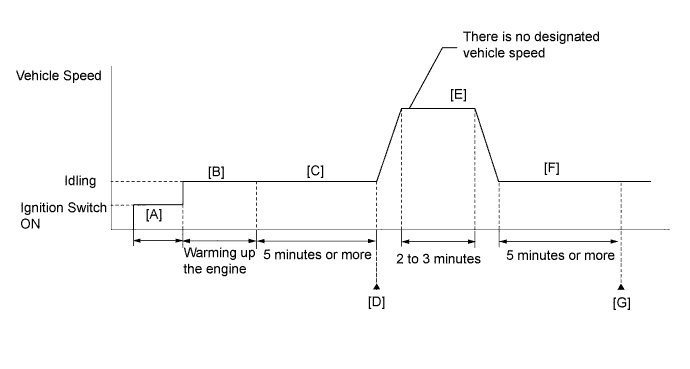
-
Connect the Techstream to the DLC3.
-
Turn the ignition switch to ON and turn the Techstream on.
-
Clear the DTCs (even if no DTCs are stored, perform the clear DTC procedure).
-
Turn the ignition switch off and wait for at least 30 seconds.
-
Turn the ignition switch to ON and turn the Techstream on [A].
-
Start the engine and warm it up until the engine coolant temperature reaches 75°C (167°F) or higher [B].
-
Idle the engine for 5 minutes or more [C].
-
Enter the following menus: Powertrain / Engine and ECT / Trouble Codes [D].
-
Read the pending DTCs.
Tech Tips
-
If a pending DTC is output, the system is malfunctioning.
-
If a pending DTC is not output, perform the following procedure.
-
-
Enter the following menus: Powertrain / Engine and ECT / Utility / All Readiness.
-
Input the DTC: P0016 or P0017.
-
Check the DTC judgment result.
Techstream Display Description NORMAL -
DTC judgment completed
-
System normal
ABNORMAL -
DTC judgment completed
-
System abnormal
INCOMPLETE -
DTC judgment not completed
-
Perform driving pattern after confirming DTC enabling conditions
N/A -
Unable to perform DTC judgment
-
Number of DTCs which do not fulfill DTC preconditions has reached ECU memory limit
Tech Tips
-
If the judgment result shows NORMAL, the system is normal.
-
If the judgment result shows ABNORMAL, the system has a malfunction.
-
If the judgment result shows INCOMPLETE or N/A, perform steps [E] through [G].
-
-
Drive the vehicle for 2 to 3 minutes [E].
CAUTION:
When performing the confirmation driving pattern, obey all speed limits and traffic laws.
-
Idle the engine for 5 minutes or more [F].
-
Enter the following menus: Powertrain / Engine and ECT / Trouble Codes [G].
-
Read the pending DTCs.
Tech Tips
-
If a pending DTC is output, the system is malfunctioning.
-
If a pending DTC is not output, perform the following procedure.
-
-
Check the DTC judgment result.
-
If the judgment result is INCOMPLETE or N/A and no pending DTC is output, perform a universal trip and check for permanent DTCs Click here.
Tech Tips
-
If a permanent DTC is output, the system is malfunctioning.
-
If no permanent DTC is output, the system is normal.
-
INSPECTION PROCEDURE
Tech Tips
-
The monitor for this DTC detects when the timing chain is shifted by one tooth or more.
-
Read freeze frame data using the Techstream. The ECM records vehicle and driving condition information as freeze frame data the moment a DTC is stored. When troubleshooting, freeze frame data can help determine if the vehicle was moving or stationary, if the engine was warmed up or not, if the air fuel ratio was lean or rich, and other data from the time the malfunction occurred.
PROCEDURE
-
CHECK ANY OTHER DTCS OUTPUT (IN ADDITION TO DTC P0016 AND P0017)
-
Connect the Techstream to the DLC3.
-
Turn the ignition switch to ON.
-
Turn the Techstream on.
-
Enter the following menus: Powertrain / Engine and ECT / Trouble Codes.
-
Read the DTCs.
Result Result Proceed to DTC P0016 or P0017 is output A DTC P0016 or P0017 and other DTCs are output B Tech Tips
If any DTCs other than P0016 or P0017 are output, troubleshoot those DTCs first.
B 
GO TO DTC CHART Click here
A 
-
-
PERFORM ACTIVE TEST USING TECHSTREAM (OPERATE CAMSHAFT TIMING OIL CONTROL VALVE ASSEMBLY)
Tech Tips
If the VVT system can be operated through the Active Test, it can be assumed that the VVT system is operating normally.
-
Connect the Techstream to the DLC3.
-
Start the engine.
-
Turn the A/C on.
-
Turn the Techstream on.
-
Enter the following menus: Powertrain / Engine and ECT / Active Test / Control the VVT Linear (Bank 1) or Control the VVT Exhaust Linear (Bank 1) / Gas Valve Control / VVT Change Angle #1, VVT Ex Chg Angle #1.
-
Perform the Active Test. Check that the displacement angle varies.
OK Displacement angle varies.
NG 
INSPECT CAMSHAFT TIMING OIL CONTROL VALVE ASSEMBLY (FOR INTAKE OR EXHAUST CAMSHAFT) Click here
OK
-
-
ADJUST VALVE TIMING
-
Adjust the valve timing Click here.
NEXT
CHECK WHETHER DTC OUTPUT RECURS (DTC P0016 OR P0017) Click here
-
-
INSPECT CAMSHAFT TIMING OIL CONTROL VALVE ASSEMBLY (FOR INTAKE OR EXHAUST CAMSHAFT)
-
Inspect the camshaft timing oil control valve assembly (for intake or exhaust camshaft) Click here.
NG
REPLACE CAMSHAFT TIMING OIL CONTROL VALVE ASSEMBLY (FOR INTAKE OR EXHAUST CAMSHAFT) Click here
OK
-
-
INSPECT OIL CONTROL VALVE FILTER
-
Remove the oil control valve filter Click here.
-
Check that the filter is not clogged.
OK Filter is not clogged.
NG
REPLACE OIL CONTROL VALVE FILTER
OK
-
-
REPLACE CAMSHAFT TIMING GEAR ASSEMBLY OR CAMSHAFT TIMING EXHAUST GEAR ASSEMBLY
-
Replace the camshaft timing gear assembly or camshaft timing exhaust gear assembly Click here.
Tech Tips
Perform "Inspection After Repair" after replacing the camshaft timing gear assembly or camshaft timing exhaust gear assembly Click here.
NEXT
-
-
CHECK WHETHER DTC OUTPUT RECURS (DTC P0016 OR P0017)
-
Connect the Techstream to the DLC3.
-
Turn the ignition switch to ON.
-
Turn the Techstream on.
-
Clear the DTCs Click here.
-
Turn the ignition switch off and wait for at least 30 seconds.
-
Turn the ignition switch to ON.
-
Turn the Techstream on.
-
Start the engine and warm it up.
-
Drive the vehicle in accordance with the driving pattern described in the Confirmation Driving Pattern.
-
Enter the following menus: Powertrain / Engine and ECT / Trouble Codes / Pending.
-
Read the pending DTCs.
Result Result Proceed to DTC is not output A DTC P0016 or P0017 is output B
B
REPLACE ECM Click here
A 
END
-