AUTOMATIC TRANSAXLE UNIT INSPECTION

-
INSPECT TRANSMISSION OIL CLEANER MAGNET
-
Examine particles in the automatic transaxle oil pan sub-assembly.
-
Collect any steel chips with the removed magnets. Look carefully at the chips and particles in the automatic transaxle oil pan sub-assembly and on the transmission oil cleaner magnets to see the type of wear which might be found in the automatic transaxle assembly.
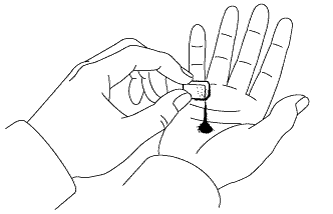
Result Steel (magnetic) Brass (non-magnetic) Bearing, gear and plate wear Bushing wear
-
-
-
INSPECT INPUT SHAFT END PLAY
-
Using a dial indicator, measure the input shaft end play.
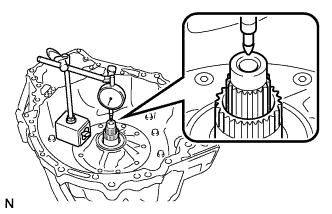
Standard end play 0.020 to 1.242 mm (0.000788 to 0.0488 in.)
-
-
INSPECT INTERMEDIATE SHAFT END PLAY
-
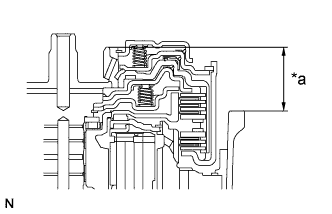
Clean the contact surfaces of the transaxle case sub-assembly and rear transaxle cover sub-assembly.
-
As shown in the illustration, place a straightedge on the multiple direct clutch drum and measure the distance between the transaxle case sub-assembly and the straightedge using a vernier caliper (Dimension A).
Text in Illustration *a Dimension A -
Using a vernier caliper and a straightedge, measure the distance shown in the illustration (Dimension B).
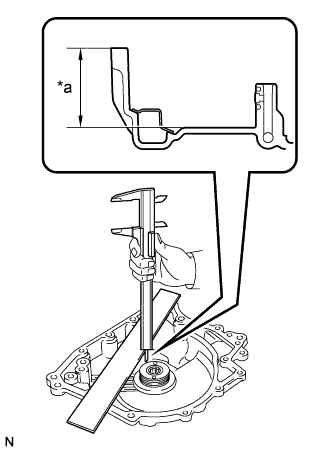
Text in Illustration *a Dimension B -
Calculate the end play value using the following formula:
End play = Dimension B - Dimension A - Thrust needle roller bearing thickness
Standard end play 0.022 to 1.099 mm (0.000867 to 0.0432 in.)
-
-
INSPECT PLANETARY SUN GEAR SUB-ASSEMBLY
-
Using a caliper gauge, measure the inside diameter of the bushings of the planetary sun gear.
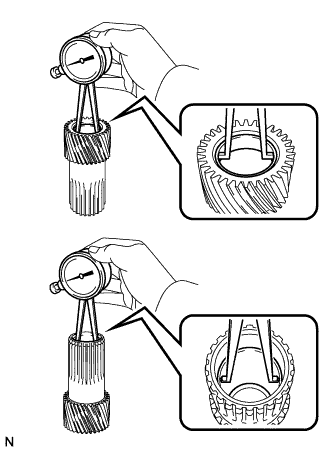
Standard inside diameter 25.525 to 25.546 mm (1.00492 to 1.00575 in.) Maximum inside diameter 25.546 mm (1.00575 in.) If the inside diameter is greater than the maximum, replace the planetary sun gear.
-
-
INSPECT REAR PLANETARY SUN GEAR ASSEMBLY
-
Using a caliper gauge, measure the inside diameter of the bushing of the rear planetary sun gear sub-assembly.
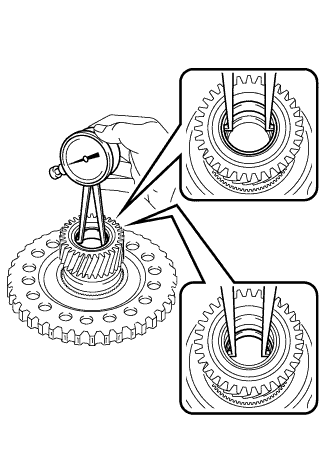
Standard inside diameter 25.580 to 25.601 mm (1.00708 to 1.00791 in.) Maximum inside diameter 25.601 mm (1.00791 in.) If the inside diameter is greater than the maximum, replace the automatic transaxle assembly.
-
-
INSPECT UNDERDRIVE PLANETARY GEAR ASSEMBLY
-
Using a feeler gauge, measure the clearance between the underdrive planetary gear and the pinion gear at 4 points.
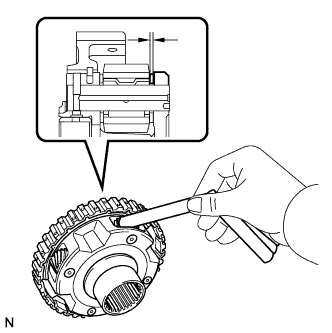
Standard clearance 0.18 to 0.54 mm (0.00709 to 0.0213 in.) If the clearance is greater than the standard clearance, replace the automatic transaxle assembly.
-
-
INSPECT ONE-WAY CLUTCH ASSEMBLY
-
Temporarily install the one-way clutch assembly to the planetary ring gear.
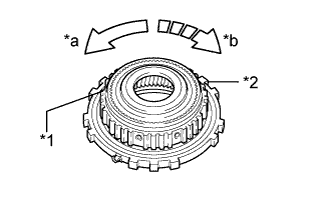
Text in Illustration *1 Planetary Ring Gear *2 One-way Clutch Assembly *a Free *b Lock -
Make sure that the one-way clutch assembly turns freely counterclockwise and locks when turned clockwise.
If the one-way clutch assembly does not operate normally, replace it.
-
-
INSPECT NO. 1 BRAKE DISC
-
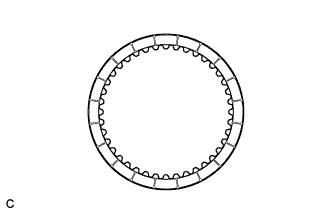
Check if the contact surfaces of the discs, plates and flange are worn or burnt.
Note
-
If the lining of any disc is peeled off or discolored, or even if part of the groove is damaged, replace all discs.
-
Before assembling new discs, soak them in ATF for at least 15 minutes.
If necessary, replace them.
-
-
-
INSPECT NO. 2 BRAKE DISC
-
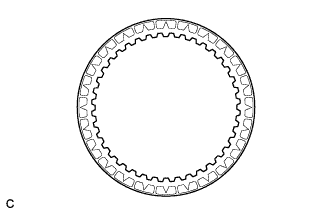
Check if the contact surfaces of the discs, plates and flange are worn or burnt.
Note
-
If the lining of any disc is peeled off or discolored, or even if part of the groove is damaged, replace all discs.
-
Before assembling new discs, soak them in ATF for at least 15 minutes.
If necessary, replace them.
-
-
-
INSPECT NO. 3 BRAKE DISC
-
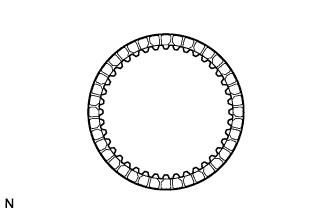
Check if the contact surfaces of the discs, plates and flanges are worn or burnt.
Note
-
If the lining of any disc is peeled off or discolored, or even if part of the groove is damaged, replace all discs.
-
Before assembling new discs, soak them in ATF for at least 15 minutes.
If necessary, replace them.
-
-
-
INSPECT 2ND BRAKE PISTON RETURN SPRING SUB-ASSEMBLY
-
Using a vernier caliper, measure the free length of the 3 2nd brake piston return springs including the spring seats.
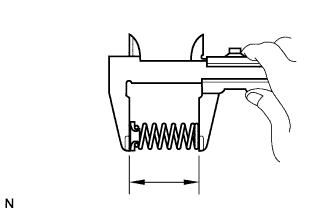
Standard free length 23.26 mm (0.916 in.) If the free length is shorter than the standard free length, replace the 2nd brake piston return spring.
-
-
INSPECT 1ST AND REVERSE BRAKE RETURN SPRING SUB-ASSEMBLY
-
Using a vernier caliper, measure the free length of the 1st and reverse brake return spring together with the spring seat.
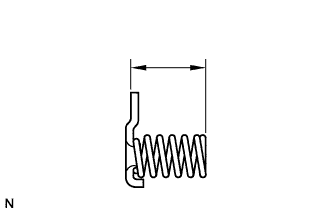
Standard free length 15.79 mm (0.622 in.) If the free length is shorter than the standard free length, replace the 1st and reverse brake return spring.
-
-
INSPECT NO. 3 BRAKE PISTON RETURN SPRING SUB-ASSEMBLY
-
Using a vernier caliper, measure the free length of the No. 3 brake piston return spring together with the spring seat.
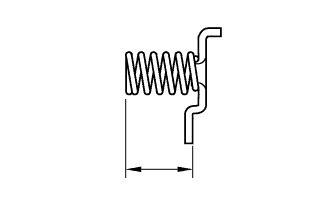
Standard free length 9.15 mm (0.360 in.) If the free length is shorter than the standard free length, replace the No. 3 brake piston return spring.
-
-
INSPECT CLEARANCE OF NO. 1 BRAKE
-
Using a dial indicator, measure the clearance of the No. 1 brake while applying compressed air (200 kPa, 2.0 kgf/cm2, 29 psi).
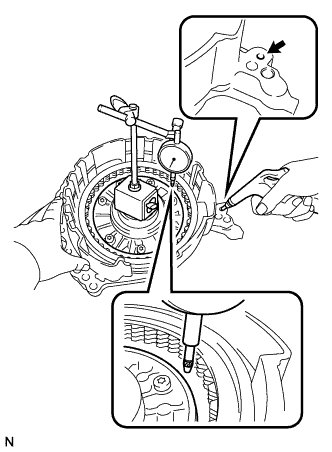
Standard clearance 0.601 to 0.819 mm (0.0237 to 0.0322 in.) Tech Tips
Measure the clearance at 3 points where the brake piston diameter is approximately 140 mm (5.51 in.) and calculate the average.
If the clearance is not as specified, select an appropriate No. 1 brake flange so that the clearance will be within the specified range.
No. 1 Brake Flange Thickness Mark Thickness [mm (in.)] 30 3.0 (0.118) 31 3.1 (0.122) 32 3.2 (0.126) 33 3.3 (0.130) 34 3.4 (0.134) 35 3.5 (0.138)
-
-
INSPECT CLEARANCE OF NO. 2 BRAKE
-
Using a dial indicator, measure the clearance of the No. 2 brake while applying compressed air (200 kPa, 2.0 kgf/cm2, 29 psi).
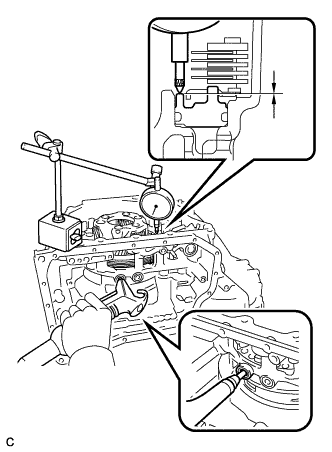
Standard clearance 0.707 to 0.974 mm (0.0278 to 0.0383 in.) Tech Tips
Measure the clearance at 3 points where the brake piston diameter is approximately 140 mm (5.51 in.) and calculate the average.
If the clearance is not as specified, select an appropriate No. 2 brake flange so that the clearance will be within the specified range.
No. 2 Brake Flange Thickness Mark Thickness [mm (in.)] 40 4.0 (0.157) 41 4.1 (0.161) 42 4.2 (0.165) 43 4.3 (0.169) 44 4.4 (0.173)
-
-
INSPECT CLEARANCE OF NO. 3 BRAKE
-
Using a vernier caliper and a straightedge, measure the distance shown in the illustration (Dimension A) while a load of 500 N (51 kgf, 112.4 lbf) is being applied to the flange.
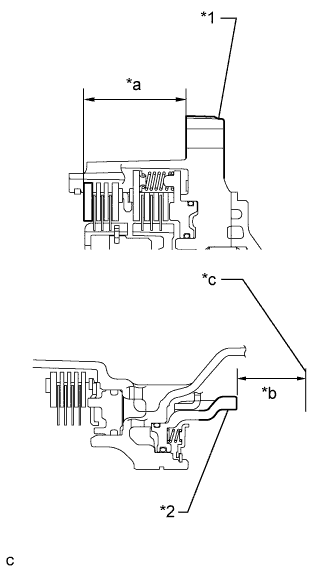
Text in Illustration *1 Front Oil Pump Assembly *2 No. 3 Brake *a Dimension A *b Dimension B *c Contact Surface of Front Oil Pump Assembly Tech Tips
Measure dimension A at 3 points where the flange diameter is approximately 166 mm (6.54 in.) and calculate the average.
-
Using a vernier caliper and a straightedge, measure the distance shown in the illustration (Dimension B).
Tech Tips
Measure dimension B at 3 points where the No. 3 brake diameter is approximately 166 mm (6.54 in.) and calculate the average.
-
Calculate the clearance value using the following formula:
Clearance = Dimension B - Dimension A - Flange Thickness
Standard clearance 0.599 to 0.799 mm (0.0236 to 0.0315 in.) If the clearance is not as specified, select an appropriate brake flange so that the clearance will be within the specified range.
No. 3 Brake Flange Thickness Mark Thickness [mm (in.)] 38 3.80 (0.150) 39 3.90 (0.154) 40 4.00 (0.157) 41 4.10 (0.161) 42 4.20 (0.165) 43 4.30 (0.169)
-
-
INSPECT CLEARANCE OF NO. 1 CLUTCH
-
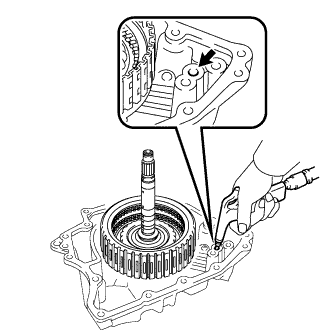
Install the direct multiple disc clutch assembly onto the rear transaxle cover sub-assembly.
-
Check that the piston moves when compressed air (200 kPa, 2.0 kgf/cm2, 29 psi) is applied to the oil hole.
-
Using a feeler gauge, measure the No. 1 clutch pack clearance.
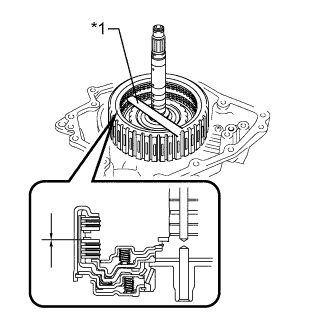
Text in Illustration *1 Feeler Gauge Tech Tips
Measure the clearance at 3 points where the flange diameter is approximately 152 mm (5.98 in.) and calculate the average.
Standard pack clearance 0.601 to 0.819 mm (0.0237 to 0.0322 in.) If the pack clearance is not as specified, replace the rear multiple disc clutch assembly.
-
-
INSPECT CLEARANCE OF NO. 2 CLUTCH
-
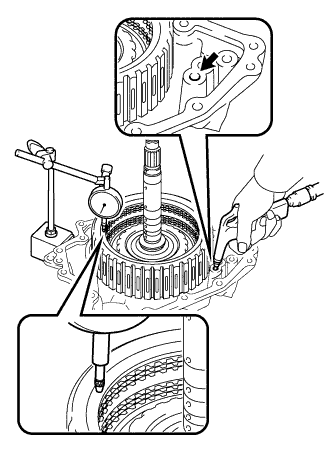
Install the direct multiple disc clutch assembly onto the rear transaxle cover sub-assembly.
-
Using a dial indicator, measure the No. 2 clutch pack clearance while applying and releasing compressed air (200 kPa, 2.0 kgf/cm2, 29 psi).
Tech Tips
Measure the clearance at 3 points where the diameter of the No. 2 direct multiple clutch piston is approximately 152 mm (5.98 in.) and calculate the average.
Standard pack clearance 0.394 to 0.605 mm (0.0155 to 0.0238 in.) If the pack clearance is not as specified, replace the rear multiple disc clutch assembly.
-