FRONT POWER SEAT CONTROL SYSTEM (w/ Seat Position Memory System) One or more Power Seat Motors do not Operate
DESCRIPTION
When the front power seat switch is operated, a command signal is sent to the position control ECU. The position control ECU then controls the appropriate seat motor as needed. The position control ECU is designed so that a malfunction of the seat memory system will not interfere with manual seat control.
WIRING DIAGRAM
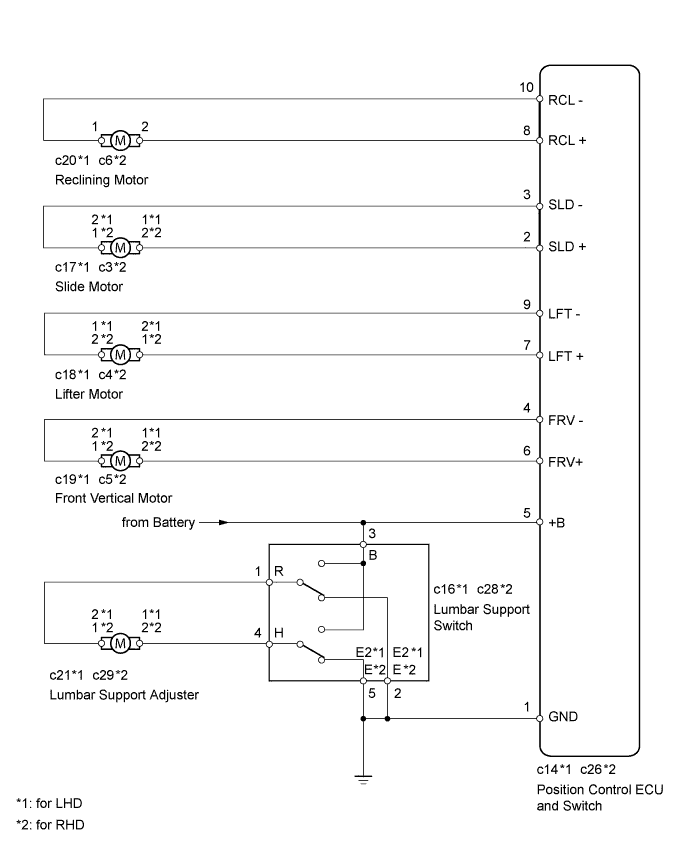
INSPECTION PROCEDURE
PROCEDURE
-
CHECK FRONT POWER SEAT OPERATION
-
Check that each function of the power seat operates normally by using the front power seat switches.
Result Result Proceed to All front power seat switch operations are malfunctioning except lumbar support switch operation A Only lumbar support switch operation is malfunctioning B
B 
INSPECT LUMBAR SUPPORT SWITCH Click here
A 
-
-
READ VALUE USING INTELLIGENT TESTER (FRONT POWER SEAT SWITCH)
-
Using the intelligent tester, read the Data List.
Driver Seat Item Measurement Item/Display (Range) Normal Condition Diagnostic Note Reclining Rear Reclining switch signal (Rearward) / ON or OFF ON: Reclining switch (Rearward) on
OFF: Reclining switch (Rearward) off
- Reclining Front Reclining switch signal (Forward) / ON or OFF ON: Reclining switch (Forward) on
OFF: Reclining switch (Forward) off
- Front Vertical Down Front vertical switch signal (Downward) / ON or OFF ON: Front vertical switch (Downward) on
OFF: Front vertical switch (Downward) off
- Front Vertical Up Front vertical switch signal (Upward) / ON or OFF ON: Front vertical switch (Upward) on
OFF: Front vertical switch (Upward) off
- Lifter Switch Down Lifter switch signal (Downward) / ON or OFF ON: Lifter switch (Downward) on
OFF: Lifter switch (Downward) off
- Lifter Switch Up Lifter switch signal (Upward) / ON or OFF ON: Lifter switch (Upward) on
OFF: Lifter switch (Upward) off
- Slide Rear Sliding switch signal (Rearward) / ON or OFF ON: Sliding switch (Rearward) on
OFF: Sliding switch (Rearward) off
- Slide Front Sliding switch signal (Forward) / ON or OFF ON: Sliding switch (Forward) on
OFF: Sliding switch (Forward) off
- OK On intelligent tester screen, each item changes between ON and OFF according to above chart.
NG 
REPLACE POSITION CONTROL ECU AND SWITCH Click here
OK
-
-
PERFORM ACTIVE TEST USING INTELLIGENT TESTER (FRONT POWER SEAT MOTOR)
-
Using the intelligent tester, perform the Active Test.
Driver Seat Tester Display Test Part Control Range Diagnostic Note Seat Reclining Seat reclining operation Front / OFF / Rear - Front Vertical Operation Seat front vertical operation Up / OFF / Down - Lifter Operation Seat lifter operation Up / OFF / Down - Seat Slide Operation Seat sliding operation Front / OFF / Rear - OK The power seat motors operate normally.
NG
INSPECT FRONT SEAT ASSEMBLY (FRONT POWER SEAT MOTOR) Click here
OK 
REPLACE POSITION CONTROL ECU AND SWITCH Click here
-
-
INSPECT FRONT SEAT ASSEMBLY (FRONT POWER SEAT MOTOR)
-
Remove the front seat assembly LH (for LHD) Click here.
-
Remove the front seat assembly RH (for RHD) Click here.
-
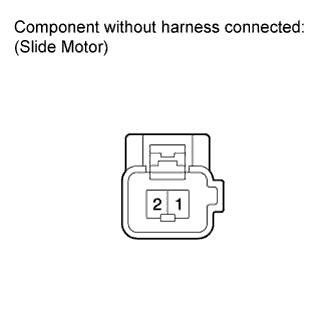
Check operation of the slide motor.
-
Check if the seat moves smoothly when the battery is connected to the slide motor connector terminals.
OK for LHD Measurement Condition Specified Condition Battery positive (+) → 1
Battery negative (-) → 2
Forward Battery positive (+) → 2
Battery negative (-) → 1
Rearward for RHD Measurement Condition Specified Condition Battery positive (+) → 2
Battery negative (-) → 1
Forward Battery positive (+) → 1
Battery negative (-) → 2
Rearward
-
-
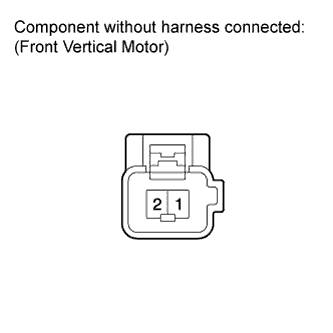
Check operation of the front vertical motor.
-
Check if the seat moves smoothly when the battery is connected to the front vertical motor connector terminals.
OK for LHD Measurement Condition Specified Condition Battery positive (+) → 1
Battery negative (-) → 2
Upward Battery positive (+) → 2
Battery negative (-) → 1
Downward for RHD Measurement Condition Specified Condition Battery positive (+) → 2
Battery negative (-) → 1
Upward Battery positive (+) → 1
Battery negative (-) → 2
Downward
-
-
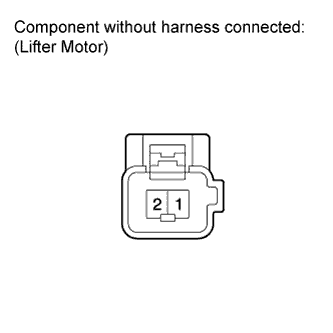
Check operation of the lifter motor.
-
Check if the seat moves smoothly when the battery is connected to the lifter motor connector terminals.
OK for LHD Measurement Condition Specified Condition Battery positive (+) → 2
Battery negative (-) → 1
Upward Battery positive (+) → 1
Battery negative (-) → 2
Downward for RHD Measurement Condition Specified Condition Battery positive (+) → 1
Battery negative (-) → 2
Upward Battery positive (+) → 2
Battery negative (-) → 1
Downward
-
-
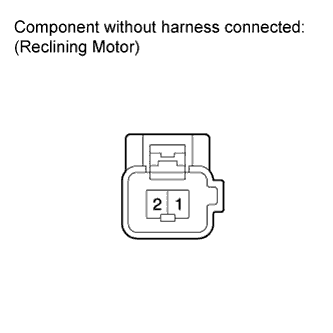
Check operation of the reclining motor.
-
Check if the seat moves smoothly when the battery is connected to the reclining motor connector terminals.
OK Measurement Condition Specified Condition Battery positive (+) → 2
Battery negative (-) → 1
Forward Battery positive (+) → 1
Battery negative (-) → 2
Rearward
Result Result Proceed to OK A NG (for LHD) B NG (for RHD) C -
B
REPLACE FRONT SEAT ASSEMBLY LH Click here
C
REPLACE FRONT SEAT ASSEMBLY RH
A
-
-
CHECK HARNESS AND CONNECTOR (POSITION CONTROL ECU AND SWITCH - POWER SEAT MOTOR)
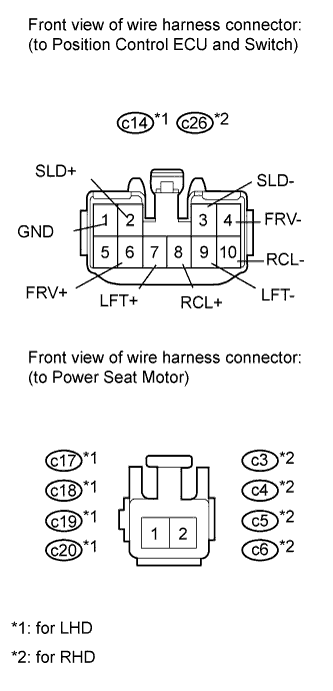
-
Disconnect the c14*1 or c26*2 switch connector.
-
Disconnect the c17*1, c18*1, c19*1, c20*1 or c3*2, c4*2, c5*2, c6*2 motor connectors.
Tech Tips
*1: for LHD
*2: for RHD
-
Measure the resistance according to the value(s) in the table below.
Standard Resistance for LHD Tester Connection Condition Specified Condition c14-3 (SLD-) - c17-2 Always Below 1 Ω c14-2 (SLD+) - c17-1 Always Below 1 Ω c14-4 (FRV-) - c19-2 Always Below 1 Ω c14-6 (FRV+) - c19-1 Always Below 1 Ω c14-9 (LFT-) - c18-1 Always Below 1 Ω c14-7 (LFT+) - c18-2 Always Below 1 Ω c14-10 (RCL-) - c20-1 Always Below 1 Ω c14-8 (RCL+) - c20-2 Always Below 1 Ω c14-1 (GND) - Body ground Always Below 1 Ω c14-3 (SLD-) or c17-2 - Body ground Always 10 kΩ or higher c14-2 (SLD+) or c17-1 - Body ground Always 10 kΩ or higher c14-4 (FRV-) or c19-2 - Body ground Always 10 kΩ or higher c14-6 (FRV+) or c19-1 - Body ground Always 10 kΩ or higher c14-9 (LFT-) or c18-1 - Body ground Always 10 kΩ or higher c14-7 (LFT+) or c18-2 - Body ground Always 10 kΩ or higher c14-10 (RCL-) or c20-1 - Body ground Always 10 kΩ or higher c14-8 (RCL+) or c20-2 - Body ground Always 10 kΩ or higher for RHD Tester Connection Condition Specified Condition c26-3 (SLD-) - c3-1 Always Below 1 Ω c26-2 (SLD+) - c3-2 Always Below 1 Ω c26-4 (FRV-) - c5-1 Always Below 1 Ω c26-6 (FRV+) - c5-2 Always Below 1 Ω c26-9 (LFT-) - c4-2 Always Below 1 Ω c26-7 (LFT+) - c4-1 Always Below 1 Ω c26-10 (RCL-) - c6-1 Always Below 1 Ω c26-8 (RCL+) - c6-2 Always Below 1 Ω c26-1 (GND) - Body ground Always Below 1 Ω c26-3 (SLD-) or c3-1 - Body ground Always 10 kΩ or higher c26-2 (SLD+) or c3-2 - Body ground Always 10 kΩ or higher c26-4 (FRV-) or c5-1 - Body ground Always 10 kΩ or higher c26-6 (FRV+) or c5-2 - Body ground Always 10 kΩ or higher c26-9 (LFT-) or c4-2 - Body ground Always 10 kΩ or higher c26-7 (LFT+) or c4-1 - Body ground Always 10 kΩ or higher c26-10 (RCL-) or c6-1 - Body ground Always 10 kΩ or higher c26-8 (RCL+) or c6-2 - Body ground Always 10 kΩ or higher
NG
REPAIR OR REPLACE HARNESS OR CONNECTOR
OK
REPLACE POSITION CONTROL ECU AND SWITCH Click here
-
-
INSPECT LUMBAR SUPPORT SWITCH
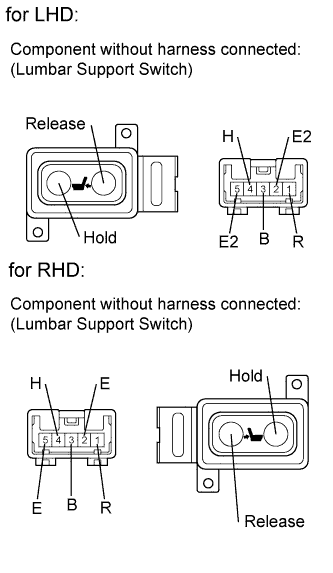
-
Remove the lumbar support switch Click here.
-
Measure the resistance according to the value(s) in the table below.
Standard Resistance for LHD Tester Connection Switch Condition Specified Condition 3 (B) - 4 (H) Hold Below 1 Ω 1 (R) - 2 (E2) 4 (H) - 5 (E2) Off 1 (R) - 2 (E2) 4 (H) - 5 (E2) Release 1 (R) - 3 (B) for RHD Tester Connection Switch Condition Specified Condition 3 (B) - 4 (H) Hold Below 1 Ω 1 (R) - 2 (E) 4 (H) - 5 (E) Off 1 (R) - 2 (E) 4 (H) - 5 (E) Release 1 (R) - 3 (B)
NG
REPLACE LUMBAR SUPPORT SWITCH Click here
OK
-
-
INSPECT LUMBAR SUPPORT ADJUSTER ASSEMBLY
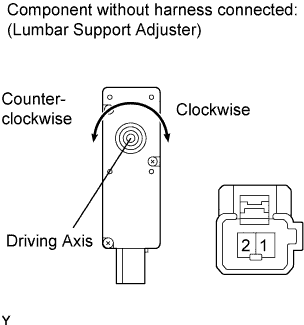
-
Remove the lumbar support adjuster Click here.
-
Check operation of the lumbar support adjuster.
-
Check that the lumbar support adjuster moves smoothly when the battery is connected to the lumbar support adjuster motor connector terminals.
OK for LHD Measurement Condition Specified Condition Battery positive (+) → 1
Battery negative (-) → 2
Clockwise Battery positive (+) → 2
Battery negative (-) → 1
Counterclockwise for RHD Measurement Condition Specified Condition Battery positive (+) → 2
Battery negative (-) → 1
Clockwise Battery positive (+) → 1
Battery negative (-) → 2
Counterclockwise
-
NG
REPLACE LUMBAR SUPPORT ADJUSTER ASSEMBLY Click here
OK
-
-
CHECK HARNESS AND CONNECTOR (LUMBAR SUPPORT SWITCH - BATTERY AND BODY GROUND)
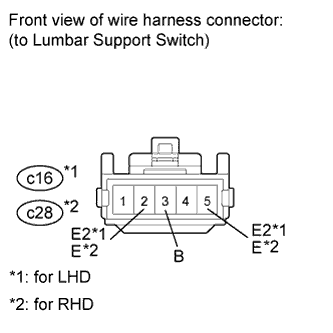
-
Disconnect the c16*1 or c28*2 switch connector.
Tech Tips
*1: for LHD
*2: for RHD
-
Measure the voltage according to the value(s) in the table below.
Standard Voltage for LHD Tester Connection Condition Specified Condition c16-3 (B) - Body ground Always 11 to 14 V for RHD Tester Connection Condition Specified Condition c28-3 (B) - Body ground Always 11 to 14 V -
Measure the resistance according to the value(s) in the table below.
Standard Resistance for LHD Tester Connection Condition Specified Condition c16-5 (E2) - Body ground Always Below 1 Ω c16-2 (E2) - Body ground for RHD Tester Connection Condition Specified Condition c28-5 (E) - Body ground Always Below 1 Ω c28-2 (E) - Body ground
NG
REPAIR OR REPLACE HARNESS OR CONNECTOR
OK
REPAIR OR REPLACE HARNESS OR CONNECTOR (LUMBAR SUPPORT SWITCH - LUMBAR SUPPORT ADJUSTER ASSEMBLY)
-