IMMOBILISER SYSTEM TERMINALS OF ECU

-
CHECK ENGINE SWITCH

-
Measure the resistance and voltage according to the value(s) in the table below.
Terminal No. (Symbol) Input/Output Wiring Color Terminal Description Condition Specified Condition Related Data List Item/DTC H44-6 (AGND) - Body ground - R - Body ground Transponder key amplifier ground Always Below 1 Ω - H44-7 (TXCT) - H44-6 (AGND) Input GR - R Immobiliser communication input Engine switch off, brake pedal not depressed, 30 seconds or more elapsed after driver door opened and then closed Below 1 V - H44-8 (CODE) - H44-6 (AGND) Output L - R Immobiliser communication output Engine switch off, brake pedal not depressed, 30 seconds or more elapsed after driver door opened and then closed Below 1 V - H44-10 (VC5) - H44-6 (AGND) Input P - R Transponder key amplifier power supply Engine switch off, brake pedal not depressed, 30 seconds or more elapsed after driver door opened and then closed Below 1 V - -
Check for pulses according to the value(s) in the table below.
Terminal No. (Symbol) Input/Output Wiring Color Terminal Description Condition Specified Condition Related Data List Item/DTC H44-7 (TXCT) - H44-6 (AGND) Input GR - R Signal input from certification ECU (smart key ECU assembly)
(Code sent from certification ECU (smart key ECU assembly) to transponder key amplifier built into engine switch, and then transmitted by transponder key amplifier antenna as radio waves)
Engine switch off, key not in cabin, within 30 seconds after engine switch pressed Pulse generation
(See waveform 1)
-
BCC Malfunction
-
Abnormal Status
-
Different Encrypt Code
-
Different Serial Number
-
Frame Error
-
Response
Tech Tips
If immobiliser key code certification communication is not performed correctly, the malfunction may be indicated by one or more of the Data List items listed above
H44-8 (CODE) - H44-6 (AGND) Output L - R Signal output to certification ECU (smart key ECU assembly)
(Radio waves from transponder key amplifier built into engine switch used to detect key information. Key information then sent to certification ECU (smart key ECU assembly))
Engine switch off, engine switch pressed with key held near engine switch* Pulse generation
(See waveform 2)
H44-10 (VC5) - H44-6 (AGND) Input P - R Transponder key amplifier power supply
(Power supplied from certification ECU (smart key ECU assembly) when transponder key amplifier built into engine switch activated)
Engine switch off, key not in cabin, within 30 seconds after engine switch pressed Pulse generation
(See waveform 3)
If the result is not as specified, the engine switch may have a malfunction.
Tech Tips
*: Remove the key battery before performing this inspection.
-
-
Inspect using an oscilloscope.
Note
The waveform shown in the illustration is an example for reference only. Noise, chattering, etc. are not shown.
-
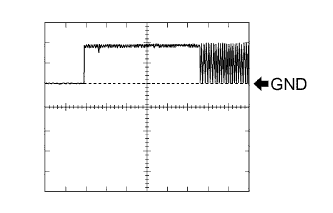
Waveform 1 (Reference)
Measurement Condition Item Content Tester Connection H44-7 (TXCT) - H44-6 (AGND) Tool Setting 2 V/DIV., 20 ms./DIV. Condition Engine switch off, key not in cabin, within 30 seconds after engine switch pressed -
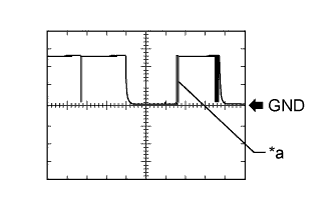
Text in Illustration *a Key held against engine switch Waveform 2 (Reference)
Measurement Condition Item Content Tester Connection H44-8 (CODE) - H44-6 (AGND) Tool Setting 1 V/DIV., 200 ms./DIV. Condition Engine switch off, engine switch pressed with key held near engine switch* Tech Tips
*: Remove the key battery before performing this inspection.
-
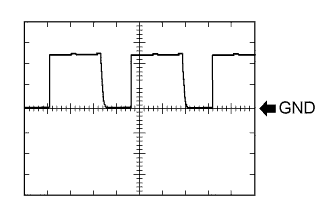
Waveform 3 (Reference)
Measurement Condition Item Content Tester Connection H44-10 (VC5) - H44-6 (AGND) Tool Setting 2 V/DIV., 200 ms./DIV. Condition Engine switch off, key not in cabin, within 30 seconds after engine switch pressed
-
-
-
CHECK CERTIFICATION ECU (SMART KEY ECU ASSEMBLY)
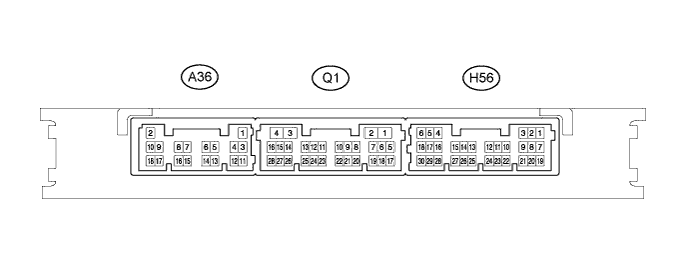
-
Disconnect the A36 certification ECU (smart key ECU assembly) connector.
-
Measure the resistance and voltage according to the value(s) in the table below.
Terminal No. (Symbol) Input/Output Wiring Color Terminal Description Condition Specified Condition Related Data List Item/DTC A36-2 (+B) - A36-11 (E) Input W - W-B +B power supply Always 11 to 14 V - A36-10 (CUTB) - A36-11 (E) Input L - W-B Stand-by power Always 11 to 14 V - A36-11 (E) - Body ground - W-B - Body ground Ground Always Below 1 Ω - -
Reconnect the A36 certification ECU (smart key ECU assembly) connector.
-
Measure the resistance and voltage according to the value(s) in the table below.
Terminal No. (Symbol) Input/Output Wiring Color Terminal Description Condition Specified Condition Related Data List Item/DTC H56-5 (IG) - A36-11 (E) Input LG - W-B Ignition power supply Engine switch off → on (IG) Below 1 V → 11 to 14 V Ignition Switch H56-18 (IND) - A36-11 (E) Output SB - W-B Security indicator output Engine switch off → on (IG) Pulse generation
→ Below 2 V
- H56-9 (TXCT) - H56-24 (AGND) Output GR - R Signal output to transponder key amplifier Engine switch off, brake pedal not depressed, 30 seconds or more elapsed after driver door opened and then closed Below 1 V
-
BCC Malfunction
-
Abnormal Status
-
Different Encrypt Code
-
Different Serial Number
-
Frame Error
-
Response
H56-7 (CODE) - H56-24 (AGND) Input L - R Signal input from transponder key amplifier Engine switch off, brake pedal not depressed, 30 seconds or more elapsed after driver door opened and then closed Below 1 V H56-1 (VC5) - H56-24 (AGND) Output P - R Transponder key amplifier power supply Engine switch off, brake pedal not depressed, 30 seconds or more elapsed after driver door opened and then closed Below 1 V H56-24 (AGND) - Body ground - R - Body ground Transponder key amplifier ground Always Below 1 Ω -
-
Check for pulses according to the value(s) in the table below.
Terminal No. (Symbol) Input/Output Wiring Color Terminal Description Condition Specified Condition Related Data List Item/DTC H56-9 (TXCT) - H56-24 (AGND) Output GR - R Signal output to transponder key amplifier
(Code sent from certification ECU (smart key ECU assembly) to transponder key amplifier built into engine switch, and then transmitted by transponder key amplifier antenna as radio waves)
Engine switch off, key not in cabin, within 30 seconds after engine switch pressed Pulse generation
(See waveform 1)
-
BCC Malfunction
-
Abnormal Status
-
Different Encrypt Code
-
Different Serial Number
-
Frame Error
-
Response
H56-7 (CODE) - H56-24 (AGND) Input L - R Signal input from transponder key amplifier
(Radio waves from transponder key amplifier built into engine switch used to detect key information. Key information then sent to certification ECU (smart key ECU assembly))
Engine switch off, engine switch pressed with key held near engine switch* Pulse generation
(See waveform 2)
H56-1 (VC5) - H56-24 (AGND) Output P - R Transponder key amplifier power supply
(Power supplied from certification ECU (smart key ECU assembly) when transponder key amplifier built into engine switch activated)
Engine switch off, key not in cabin, within 30 seconds after engine switch pressed Pulse generation
(See waveform 3)
If the result is not as specified, the certification ECU (smart key ECU assembly) may have a malfunction.
Tech Tips
*: Remove the key battery before performing this inspection.
-
-
Inspect using an oscilloscope.
Note
The waveform shown in the illustration is an example for reference only. Noise, chattering, etc. are not shown.
-
Waveform 1 (Reference)
Measurement Condition Item Content Tester Connection H56-9 (TXCT) - H56-24 (AGND) Tool Setting 2 V/DIV., 20 ms./DIV. Condition Engine switch off, key not in cabin, within 30 seconds after engine switch pressed -
Text in Illustration *a Key held against engine switch Waveform 2 (Reference)
Measurement Condition Item Content Tester Connection H56-7 (CODE) - H56-24 (AGND) Tool Setting 1 V/DIV., 200 ms./DIV. Condition Engine switch off, engine switch pressed with key held near engine switch* Tech Tips
*: Remove the key battery before performing this inspection.
-
Waveform 3 (Reference)
Measurement Condition Item Content Tester Connection H56-1 (VC5) - H56-24 (AGND) Tool Setting 2 V/DIV., 200 ms./DIV. Condition Engine switch off, key not in cabin, within 30 seconds after engine switch pressed
-
-
-
CHECK STEERING LOCK ECU (STEERING LOCK ACTUATOR ASSEMBLY)

-
Measure the voltage and resistance according to the value(s) in the table below.
Terminal No. (Symbol) Input/Output Wiring Color Terminal Description Condition Specified Condition Related Data List Item/DTC H18-1 (GND) - Body ground - W-B - Body ground Ground Always Below 1 Ω - H18-3 (IGE) - H18-1 (GND) Input L - W-B Steering lock motor operation permission signal (motor operation permission signal supplied by certification ECU (smart key ECU assembly)) Steering lock motor operates when both conditions met, and then door opened:
-
Shift lever in P
-
Key carried, engine switch turned on (IG), steering unlocked, and then engine switch turned off
Pulse generation
(See waveform 1)
-
Power Supply Short
-
Unlock Request Receive
-
Lock Request Receive
H18-4 (SLP1) - H18-1 (GND) Output P - W-B Steering lock bar position signal (signal output from steering unlock sensor) Steering locked → unlocked*1 11 to 14 V → Below 1.2 V
-
Push Start Error
-
Sensor Value
H18-6 (IG2) - H18-1 (GND) Input LG - W-B IG signal (IG2 power supply input for steering lock motor) Engine switch off → on (IG) Below 1 V → 11 to 14 V
-
B2788
-
Ignition Switch
H18-7 (B) - Body ground Output B - Body ground Constant power supply Always 11 to 14 V B2788 If the result is not as specified, the steering lock ECU (steering lock actuator assembly) may have a malfunction.
Tech Tips
*1: The steering locks when any door is opened with the shift lever in P and the engine switch off. The steering unlocks when the engine switch is turned on (ACC).
-
-
Inspect using an oscilloscope.
Note
The waveform shown in the illustration is an example for reference only. Noise, chattering, etc. are not shown.
-
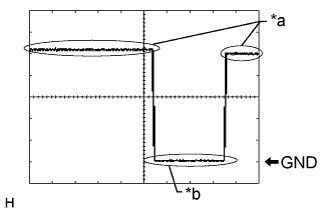
Text in Illustration *a Steering lock motor not operating *b Steering lock motor operating Waveform 1 (Reference)
Measurement Condition Item Content Tester Connection H18-3 (IGE) - H18-1 (GND) Tool Setting 2 V/DIV., 20 ms./DIV. Condition Steering lock motor operates when both conditions met, and then door opened:
-
Shift lever in P
-
Key carried, engine switch turned on (IG), steering unlocked, and then engine switch turned off
-
-
-
-
CHECK ID CODE BOX (IMMOBILISER CODE ECU)

-
Disconnect the H15 ID code box (immobiliser code ECU) connector.
-
Measure the resistance and voltage according to the value(s) in the table below.
Terminal No. (Symbol) Input/Output Wiring Color Terminal Description Condition Specified Condition Related Data List Item/DTC H15-1 (+B) - H15-5 (GND) Input R - W-B +B power supply Always 11 to 14 V B2789 H15-5 (GND) - Body ground - W-B - Body ground Ground Always Below 1 Ω B2789 If the result is not as specified, there may be a malfunction on the wire harness side.
-
Reconnect the H15 ID code box (immobiliser code ECU) connector.
-
Measure the voltage according to the value(s) in the table below.
Terminal No. (Symbol) Input/Output Wiring Color Terminal Description Condition Specified Condition Related Data List Item/DTC H15-3 (EFII) - H15-5 (GND) Input LG - W-B EFI communication input
(Signal input from ECM to ID code box (immobiliser code ECU))
Engine switch off 11 to 14 V
-
B2799
-
B279A
-
Engine Start Request
-
EFI Code Receive
H15-3 (EFII) - H15-5 (GND) Input LG - W-B EFI communication input
(Signal input from ECM to ID code box (immobiliser code ECU))
Within 3 seconds of engine start or within 3 seconds of engine switch turned on (IG) after battery cable disconnected and reconnected Pulse generation
(See waveform 1)
H15-4 (EFIO) - H15-5 (GND) Output SB - W-B EFI communication output
(Signal output from ID code box (immobiliser code ECU) to ECM)
Engine switch off Below 1 V H15-4 (EFIO) - H15-5 (GND) Output SB - W-B EFI communication output
(Signal output from ID code box (immobiliser code ECU) to ECM)
Within 3 seconds of engine start or within 3 seconds of engine switch turned on (IG) after battery cable disconnected and reconnected Pulse generation
(See waveform 2)
-
If the result is not as specified, the ID code box (immobiliser code ECU) may have a malfunction.
-
-
Inspect using an oscilloscope.
Note
The waveform shown in the illustration is an example for reference only. Noise, chattering, etc. are not shown.
-
Waveform 1 (Reference)
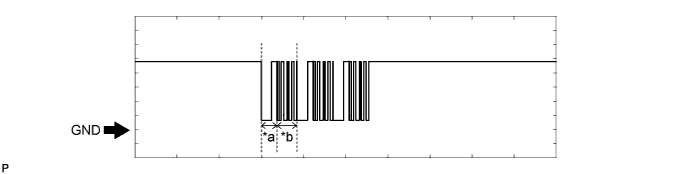
Text in Illustration *a Approximately 160 ms *b Approximately 270 ms Measurement Condition Item Content Tester Connection H15-3 (EFII) - H15-5 (GND) Tool Setting 2 V/DIV., 500 ms./DIV. Condition Within 3 seconds of engine start or within 3 seconds of engine switch turned on (IG) after battery cable disconnected and reconnected -
Waveform 2 (Reference)
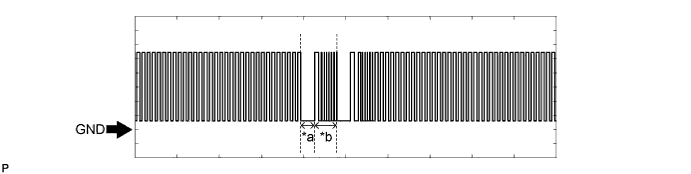
Text in Illustration *a Approximately 160 ms *b Approximately 270 ms Measurement Condition Item Content Tester Connection H15-4 (EFIO) - H15-5 (GND) Tool Setting 2 V/DIV., 500 ms./DIV. Condition Within 3 seconds of engine start or within 3 seconds of engine switch turned on (IG) after battery cable disconnected and reconnected
-
-
-
CHECK ECM (for 2GR-FE)
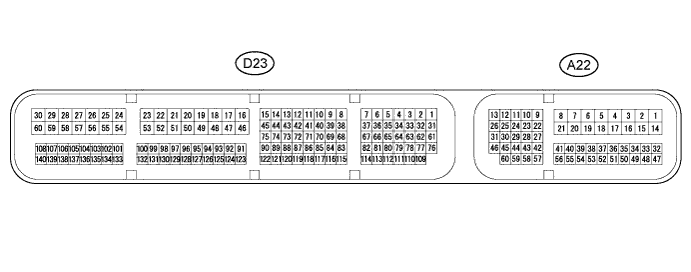
Tech Tips
The standard voltage between each pair of ECM terminals is shown in the table below. The appropriate conditions for checking each pair of terminals are also indicated. The result of checks should be compared with the standard voltage for that pair of terminals, displayed in the "Specified Condition" column. The illustration above can be used as a reference to identify the ECM terminal locations.
Terminal No. (Symbol) Input/Output Wiring Color Terminal Description Condition Specified Condition Related Data List Item/DTC D23-49 (E1) - Body ground - BR - Body ground Ground Always Below 1 Ω - A22-1 (BATT) - D23-49 (E1) Input GR - BR +B power supply Always 11 to 14 V - A22-2 (+B) - D23-49 (E1) Input P - BR +B power supply Engine switch on (IG) 11 to 14 V - A22-3 (+B2) - D23-49 (E1) Input LG - BR +B power supply Engine switch on (IG) 11 to 14 V - A22-30 (IMO) - D23-49 (E1) Input G - BR ID code box (immobiliser code ECU) communication input Engine switch off 11 to 14 V - A22-30 (IMO) - D23-49 (E1) Input G - BR ID code box (immobiliser code ECU) communication input Within 3 seconds of engine start or within 3 seconds of engine switch turned on (IG) after battery cable disconnected and reconnected Pulse generation
(See waveform 1)
- A22-31 (IMI) - D23-49 (E1) Output Y - BR ID code box (immobiliser code ECU) communication output Engine switch off Below 1 V - A22-31 (IMI) - D23-49 (E1) Output Y - BR ID code box (immobiliser code ECU) communication output Within 3 seconds of engine start or within 3 seconds of engine switch turned on (IG) after battery cable disconnected and reconnected Pulse generation
(See waveform 2)
-
-
Inspect using an oscilloscope.
Note
The waveform shown in the illustration is an example for reference only. Noise, chattering, etc. are not shown.
-
Waveform 1 (Reference)
Text in Illustration *a Approximately 160 ms *b Approximately 270 ms Measurement Condition Item Content Tester Connection A22-30 (IMO) - D23-49 (E1) Tool Setting 2 V/DIV., 500 ms./DIV. Condition Within 3 seconds of engine start or within 3 seconds of engine switch turned on (IG) after battery cable disconnected and reconnected -
Waveform 2 (Reference)
Text in Illustration *a Approximately 160 ms *b Approximately 270 ms Measurement Condition Item Content Tester Connection A22-31 (IMI) - D23-49 (E1) Tool Setting 2 V/DIV., 500 ms./DIV. Condition Within 3 seconds of engine start or within 3 seconds of engine switch turned on (IG) after battery cable disconnected and reconnected
-
-
-
CHECK ECM (for 2AR-FE)
Tech Tips
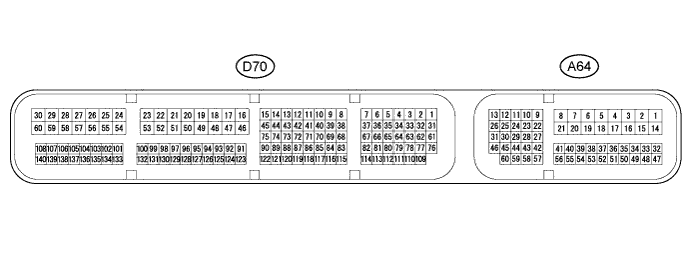
The standard voltage between each pair of ECM terminals is shown in the table below. The appropriate conditions for checking each pair of terminals are also indicated. The result of checks should be compared with the standard voltage for that pair of terminals, displayed in the "Specified Condition" column. The illustration above can be used as a reference to identify the ECM terminal locations.
Terminal No. (Symbol) Input/Output Wiring Color Terminal Description Condition Specified Condition Related Data List Item/DTC D70-16 (E1) - Body ground - BR - Body ground Ground Always Below 1 Ω - A64-1 (BATT) - D70-16 (E1) Input GR - BR +B power supply Always 11 to 14 V - A64-2 (+B) - D70-16 (E1) Input P - BR +B power supply Engine switch on (IG) 11 to 14 V - A64-3 (+B2) - D70-16 (E1) Input LG - BR +B power supply Engine switch on (IG) 11 to 14 V - A64-29 (IMO) - D70-16 (E1) Input G - BR ID code box (immobiliser code ECU) communication input Engine switch off 11 to 14 V - A64-29 (IMO) - D70-16 (E1) Input G - BR ID code box (immobiliser code ECU) communication input Within 3 seconds of engine start or within 3 seconds of engine switch turned on (IG) after battery cable disconnected and reconnected Pulse generation
(See waveform 1)
- A64-28 (IMI) - D70-16 (E1) Output Y - BR ID code box (immobiliser code ECU) communication output Engine switch off Below 1 V - A64-28 (IMI) - D70-16 (E1) Output Y - BR ID code box (immobiliser code ECU) communication output Within 3 seconds of engine start or within 3 seconds of engine switch turned on (IG) after battery cable disconnected and reconnected Pulse generation
(See waveform 2)
-
-
Inspect using an oscilloscope.
Note
The waveform shown in the illustration is an example for reference only. Noise, chattering, etc. are not shown.
-
Waveform 1 (Reference)
Text in Illustration *a Approximately 160 ms *b Approximately 270 ms Measurement Condition Item Content Tester Connection A64-29 (IMO) - D70-16 (E1) Tool Setting 2 V/DIV., 500 ms./DIV. Condition Within 3 seconds of engine start or within 3 seconds of engine switch turned on (IG) after battery cable disconnected and reconnected -
Waveform 2 (Reference)
Text in Illustration *a Approximately 160 ms *b Approximately 270 ms Measurement Condition Item Content Tester Connection A64-28 (IMI) - D70-16 (E1) Tool Setting 2 V/DIV., 500 ms./DIV. Condition Within 3 seconds of engine start or within 3 seconds of engine switch turned on (IG) after battery cable disconnected and reconnected
-
-
-
MULTI-MEDIA MODULE RECEIVER ASSEMBLY (w/ Multi-display)
-
Disconnect the H97 multi-media module receiver assembly connector.

-
Measure the voltage and resistance according to the value(s) in the table below.
Tech Tips
Measure the values on the wire harness side with connector disconnected.
Terminal No. (Symbol) Wiring Color Terminal Description Condition Specified Condition H97-17 (+B1) - Body ground R - Body ground Battery Engine switch off 11 to 14 V H97-12 (GND1) - Body ground W-B - Body ground Ground Always Below 1 Ω
-
If the result is not as specified, there may be a malfunction in the wire harness.
-
-
Reconnect the H97 multi-media module receiver assembly connector.
-
Measure the voltage according to the value(s) in the table below.
Tester Connection Wiring Color Terminal Description Condition Specified Condition H97-37 (SEUC) - Body ground SB - Body ground Security indicator light signal
-
Engine switch on (IG)
-
Security indicator light off
Below 2 V H97-37 (SEUC) - Body ground SB - Body ground Security indicator light signal
-
Engine switch off
-
Security indicator light blinks
Pulse generation If the result is not as specified, the multi-media module receiver assembly may have a malfunction.
-
-
-
RADIO RECEIVER ASSEMBLY (w/o Multi-display)
-
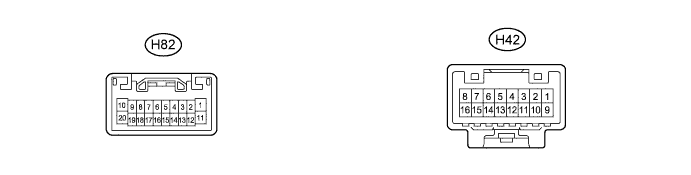
Disconnect the H82 and H42 radio receiver assembly connectors.
-
Measure the voltage and resistance according to the value(s) in the table below.
Tech Tips
Measure the values on the wire harness side with connector disconnected.
Terminal No. (Symbol) Wiring Color Terminal Description Condition Specified Condition H82-1 (B) - Body ground R - Body ground Battery Engine switch off 11 to 14 V H42-9 (GND) - Body ground W-B - Body ground Ground Always Below 1 Ω
-
If the result is not as specified, there may be a malfunction in the wire harness.
-
-
Reconnect the H82 and H42 radio receiver assembly connectors.
-
Measure the voltage according to the value(s) in the table below.
Terminal No. (Symbol) Wiring Color Terminal Description Condition Specified Condition H42-7 (LP) - Body ground SB - Body ground Security indicator light signal
-
Engine switch on (IG)
-
Security indicator light off
Below 2 V H42-7 (LP) - Body ground SB - Body ground Security indicator light signal
-
Engine switch off
-
Security indicator light blinks
Pulse generation If the result is not as specified, the radio receiver assembly may have a malfunction.
-
-