SMART ENTRY AND START SYSTEM (for Entry Function) All Door Entry Lock/Unlock Functions and Wireless Functions do not Operate
DESCRIPTION
When the entry operation and wireless operation of the door lock functions do not operate, a malfunction or wave interference may be occurring in either of the following: 1) the signal communication line between the door control receiver and certification ECU (smart key ECU assembly) (the line used for entry and wireless operations); or 2) the electrical key transmitter sub-assembly. If the entry lock and wireless lock operations cannot be performed, there may be electrical key transmitter sub-assembly malfunctions, wave interference or problems in the communication which is used for the entry and wireless function between the door control receiver and certification ECU (smart key ECU assembly).
WIRING DIAGRAM
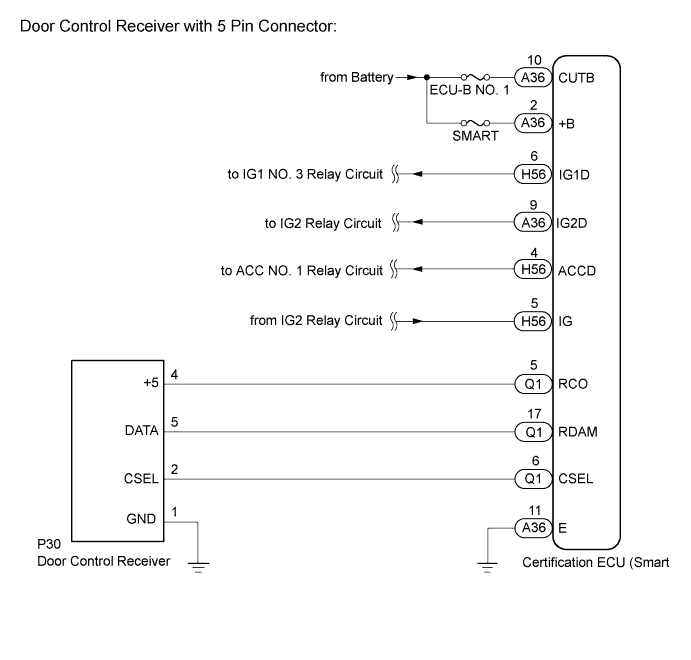
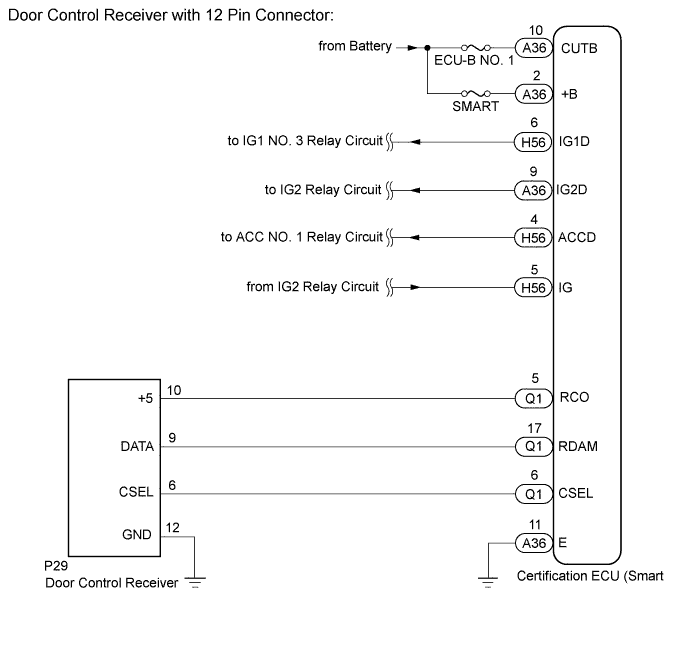
INSPECTION PROCEDURE
Note
-
The smart entry and start system (for Entry Function) uses the CAN communication system and LIN communication system. First inspect the communication systems by following How to Proceed with Troubleshooting Click here. Troubleshoot the smart entry and start system (for Entry Function) after confirming that the communication systems are functioning properly.
-
When using the GTS with the vehicle engine switch off, connect the GTS to the vehicle and turn a courtesy light switch on and off at intervals of 1.5 seconds or less until communication between the GTS and the vehicle begins. Then select the Model Code "KEY REGIST" under manual mode and enter the following menus: Body Electrical / Entry&Start(CAN). While using the GTS, periodically turn a courtesy light switch on and off at intervals of 1.5 seconds or less to maintain communication between the GTS and the vehicle.
-
Check that there are no electrical key transmitter sub-assemblies in the vehicle.
-
Before performing the inspection, check that DTC B1242 (wireless door lock control) is not output Click here.
-
Inspect the fuses for circuits related to this system before performing the following inspection procedure.
-
Recognition code registration is necessary when replacing the certification ECU (smart key ECU assembly) or main body ECU (multiplex network body ECU).
-
Before replacing the certification ECU (smart key ECU assembly), refer to the smart entry and start system (for Entry Function) precaution Click here.
-
After repair, confirm that no DTCs are output by performing the "DTC Output Confirmation Operation".
-
The door control receiver has a constant voltage (5 V) supply circuit connected to terminal "+5".
-
When replacing the door control receiver, read the transmitter IDs (tire pressure warning system) stored in the old ECU using the GTS and write them down before removal Click here.*
-
It is necessary to perform initialization Click here after registration Click here of the transmitter IDs into the door control receiver if the door control receiver has been replaced.*
*: w/ Tire Pressure Warning System
PROCEDURE
-
INSPECT BATTERY VOLTAGE
-
Measure the voltage of the vehicle battery.
Standard voltage 11 to 14 V Tech Tips
It may be possible to tell whether the vehicle battery is discharged by operating the horn.
-
If the voltage is below 11 V, recharge or replace the vehicle battery before proceeding.
-
NEXT 
-
-
CHECK FOR DTC
-
Open the driver door using the mechanical key built into the electrical key transmitter sub-assembly.
-
Connect the GTS and check for DTCs Click here.
Tech Tips
When using the GTS with the vehicle engine switch off, connect the GTS to the vehicle and turn a courtesy light switch on and off at intervals of 1.5 seconds or less until communication between the GTS and the vehicle begins. Then select the Model Code "KEY REGIST" under manual mode and enter the following menus: Body Electrical / Entry&Start(CAN). While using the GTS, periodically turn a courtesy light switch on and off at intervals of 1.5 seconds or less to maintain communication between the GTS and the vehicle.
OK DTC is not output.
NG 
GO TO DIAGNOSTIC TROUBLE CODE CHART Click here
OK
-
-
CHECK POWER DOOR LOCK CONTROL SYSTEM
-
When the door control switch on the multiplex network master switch assembly on the driver door is operated, check that the doors unlock and lock according to the switch operation Click here.
OK Door locks operate normally.
NG
GO TO POWER DOOR LOCK CONTROL SYSTEM Click here
OK
-
-
SYSTEM CHECK
-
Check the system provided.
Result Result Proceed to for China and Taiwan A except China and Taiwan B
B 
CHECK ELECTRICAL KEY TRANSMITTER SUB-ASSEMBLY Click here
A
-
-
CHECK KEY DIAGNOSTIC MODE
-
Check the following antennas in the key diagnostic mode Click here.
-
Select either channel 1 or channel 2 and inspect the key diagnostic mode for each channel.
Tech Tips
If the buzzer sounds with [CH1] displayed but not with [CH2], the electrical key transmitter cannot be detected by channel 2 due to a malfunction, such as wave interference.
-
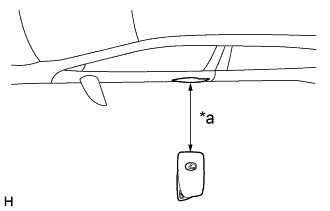
Text in Illustration *a 0.7 to 1 m (2.30 to 3.28 ft.) Check the electrical key antenna (for driver door):
When the electrical key transmitter sub-assembly is brought within 0.7 to 1 m (2.30 to 3.28 ft.) of the front door outside handle assembly (for driver door), check that the wireless door lock buzzer sounds.
-
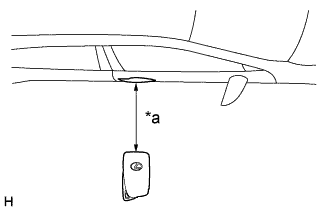
Text in Illustration *a 0.7 to 1 m (2.30 to 3.28 ft.) Check the electrical key antenna (for front passenger door):
When the electrical key transmitter sub-assembly is brought within 0.7 to 1 m (2.30 to 3.28 ft.) of the front door outside handle assembly (for front passenger door), check that the wireless door lock buzzer sounds.
-
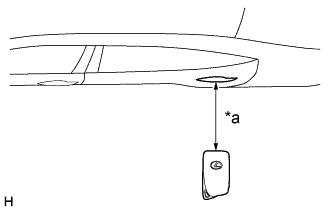
Text in Illustration *a 0.7 to 1 m (2.30 to 3.28 ft.) Check the electrical key antenna (for rear door LH):
When the electrical key transmitter sub-assembly is brought within 0.7 to 1 m (2.30 to 3.28 ft.) of the rear door outside handle assembly (for rear door LH), check that the wireless door lock buzzer sounds.
-
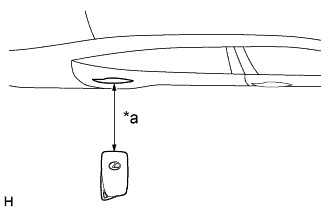
Text in Illustration *a 0.7 to 1 m (2.30 to 3.28 ft.) Check the electrical key antenna (for rear door RH):
When the electrical key transmitter sub-assembly is brought within 0.7 to 1 m (2.30 to 3.28 ft.) of the rear door outside handle assembly (for rear door RH), check that the wireless door lock buzzer sounds.
-
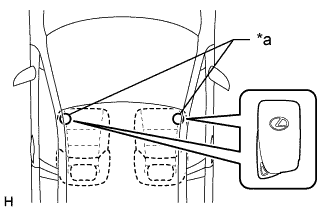
Text in Illustration *a Inspection Point Check the NO. 1 indoor electrical key antenna assembly (front floor):
When the electrical key transmitter sub-assembly is at the inspection point, check that the wireless door lock buzzer sounds.
-
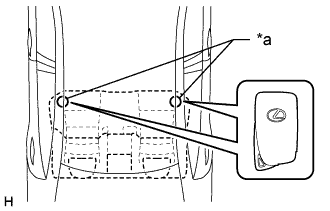
Text in Illustration *a Inspection Point Check the NO. 1 indoor electrical key antenna assembly (rear floor):
When the electrical key transmitter sub-assembly is at the inspection point, check that the wireless door lock buzzer sounds.
-
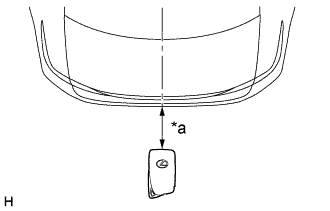
Text in Illustration *a 0.7 to 1 m (2.30 to 3.28 ft.) Check the electrical key antenna (outside luggage):
When the electrical key transmitter sub-assembly is brought within 0.7 to 1 m (2.30 to 3.28 ft.) of the electrical key antenna (outside luggage), check that the wireless door lock buzzer sounds.
OK Wireless door lock buzzer sounds. Result Result Proceed to Diagnostic mode inspections fail for both channels A Diagnostic mode inspections succeed for both channels B Diagnostic mode inspection succeeds for only one of the channels C
-
B
B CODE REGISTRATION Click here
C
CHECK WAVE ENVIRONMENT Click here
A
-
-
CHECK ELECTRICAL KEY TRANSMITTER SUB-ASSEMBLY
-
Check if there are any other registered electrical key transmitter sub-assemblies.
Result Result Proceed to There are no other registered electrical key transmitter sub-assemblies A There is another registered electrical key transmitter sub-assemblies B
B
CHECK ENTRY DOOR LOCK OPERATION Click here
A
-
-
ELECTRICAL KEY TRANSMITTER SUB-ASSEMBLY REGISTRATION (NEW ELECTRICAL KEY TRANSMITTER SUB-ASSEMBLY)
-
Register a new electrical key transmitter sub-assembly.
Tech Tips
Refer to the Service Bulletin.
NEXT
-
-
CHECK ENTRY DOOR LOCK OPERATION
-
Using another registered electrical key transmitter sub-assembly, check if an entry lock/unlock operation can be performed twice in succession.
OK Entry lock/unlock operate normally.
NG
CHECK WAVE ENVIRONMENT Click here
OK
-
-
CHECK TRANSMITTER BATTERY
-
Check the transmitter battery level of the electrical key transmitter sub-assembly that was checked first.
-
Press and hold the lock switch of the transmitter for 5 seconds and check the number of times that the transmitter LED illuminates.
Result Result Proceed to Transmitter LED does not illuminate when switch is pressed and held A Transmitter LED illuminates 3 times or more when switch is pressed and held B Transmitter LED illuminates once or twice but not a third time C Tech Tips
-
The electrical key transmitter sub-assembly sends voltage information to the certification ECU (smart key ECU assembly) when it is being used. The certification ECU (smart key ECU assembly) displays "Yes" for the "Key Low Battery" item of the Data List when this voltage information indicates 2.2 V or less Click here.
-
Even if the transmitter battery is depleted, it is still possible to start the engine by holding the electrical key transmitter sub-assembly against the engine switch, depressing the brake pedal and pressing the engine switch.
-
-
B
REPLACE ELECTRICAL KEY TRANSMITTER SUB-ASSEMBLY
C
REPLACE TRANSMITTER BATTERY Click here
A
-
-
INSPECT TRANSMITTER BATTERY (VOLTAGE)
-
Inspect the transmitter battery
-
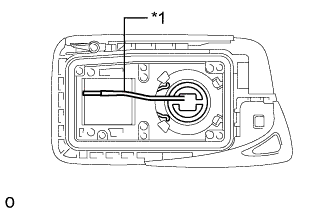
Text in Illustration *1 Lead Wire Remove the transmitter battery from the electrical key transmitter sub-assembly that does not operate Click here.
-
Attach a lead wire (0.60 mm (0.0236 in.) in diameter or less including wire sheath) with tape or equivalent to the negative terminal.
Note
Do not wrap the lead wire around a terminal, wedge it between terminals, or solder it. The terminal may be deformed or damaged, and the transmitter battery will not be able to be installed correctly.
-
Carefully pull the lead wire out from the position shown in the illustration and install the previously removed transmitter battery.
-
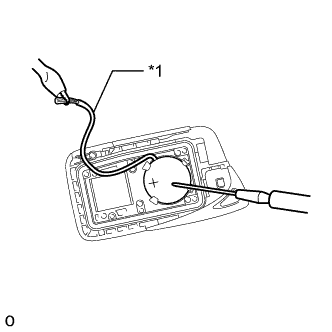
Text in Illustration *1 GND Measure the voltage of the transmitter battery.
Tech Tips
-
When measuring the transmitter battery voltage, bring the electrical key transmitter sub-assembly within the lock entry operating range while operating the lock sensor of a door handle to perform the measurement.
-
Perform the measurement when the electrical key transmitter sub-assembly is at room temperature.
-
The electrical key transmitter sub-assembly sends voltage information to the certification ECU (smart key ECU assembly) when it is transmitting. When this voltage is 2.2 V or less the Data List item "Key Low Battery" displays "Yes". Click here
Standard Voltage Tester Connection Condition Specified Condition Transmitter battery positive (+) - Transmitter battery negative (-) Engine switch off, all doors closed and lock sensor touched 2.3 to 3.2 V -
-
NG
REPLACE TRANSMITTER BATTERY Click here
OK 
REPLACE ELECTRICAL KEY TRANSMITTER SUB-ASSEMBLY
-
-
B CODE REGISTRATION
-
Perform registration for the B code.
Note
In order to register the B code, confirm the smart entry and start system (for Entry Function) precaution Click here and refer to Service Bulletin.
NEXT
-
-
CHECK ENTRY DOOR LOCK OPERATION
-
Check the entry lock/unlock operation can be performed twice in succession Click here.
OK Entry lock/unlock operate normally.
NG
READ VALUE USING GTS Click here
OK
END (B CODE WAS NOT REGISTERED)
-
-
READ VALUE USING GTS
-
Connect the GTS to the DLC3.
-
Turn the engine switch on (IG).
-
Turn the GTS on.
-
Enter the following menus: Body Electrical / Entry&Start / Data List.
-
Read the Data List according to the display on the GTS.
Entry&Start Tester Display Measurement Item/Range Normal Condition Diagnostic Note B Code Difference B code mismatch / No or Yes No: Communication normal
Yes: Communication malfunction
- B Code B code registration status / No Regd or Regd No Regd: B code not registered correctly
Regd: B code registered correctly
- Result Result Proceed to "No" and "No Regd" are displayed on the GTS screen A "Yes" is displayed on the GTS screen B "Yes" and "No Regd" are displayed on the GTS screen C
B
REPLACE MAIN BODY ECU (MULTIPLEX NETWORK BODY ECU) Click here
C
REPLACE CERTIFICATION ECU (SMART KEY ECU ASSEMBLY)
A
-
-
CHECK WAVE ENVIRONMENT
-
Bring the electrical key transmitter sub-assembly near the door control receiver and perform a wireless and entry function operation check.
Tech Tips
-
When the electrical key transmitter sub-assembly is brought near the door control receiver, the possibility of wave interference decreases, and it can be determined if wave interference is causing the problem symptom.
-
If the inspection result is that the problem only occurs in certain locations or at certain times of day, the possibility of wave interference is high. Also, added vehicle components may cause wave interference. If installed, remove them and perform the operation check.
-
There may be wave interference if the vehicle is near broadcasting antennas, large video displays, wireless garage door opener systems, wireless security cameras, home security systems, etc. In this case, move the vehicle to a different location and check if there is any improvement.
-
If a tool for checking electric waves, such as a signal strength meter, is available, move around the area while observing both the LF band (used by the vehicle antenna to form the detection area) and RF band (used by the electrical key transmitter sub-assembly for transmission) to check for locations where there is wave interference.
OK Wireless and entry functions operate normally. Result Result Proceed to OK A NG (Door Control Receiver with 12 Pin Connector) B NG (Door Control Receiver with 5 Pin Connector) C -
B
CHECK CERITIFICATION ECU (SMART KEY ECU ASSEMBLY) Click here
C
READ VALUE USING GTS Click here
A
AFFECTED BY WAVE INTERFERENCE
-
-
CHECK CERITIFICATION ECU (SMART KEY ECU ASSEMBLY)
-
Measure the voltage according to the value(s) in the table below.
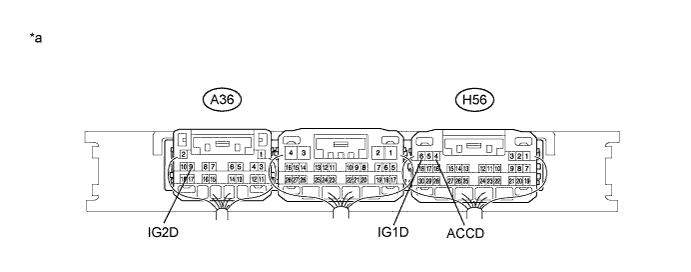
Text in Illustration *a Component with harness connected
(Certification ECU (Smart Key ECU Assembly))
- - -
Connect the GTS to the DLC3.
-
Turn the engine switch on (IG).
-
Turn the GTS on.
-
Enter the following menus: Body Electrical / Power Source Control / Data List.
-
Read the Data List according to the display on the GTS.
Power Source Control Tester Display Measurement Item/Range Normal Condition Diagnostic Note Power Supply Condition Power supply state/IG2 ON, ST ON, All OFF, IG1 ON or ACC ON ALL OFF: Engine switch off (ACC and IG)
ACC ON: Engine switch on (ACC) (ACC relay on)
IG1 ON: Engine switch on (IG) (IG1 relay on)
IG2 ON: Engine switch on (IG) (IG2 relay on)
ST ON: Sending engine start request signal
Since the IG1 and IG2 relays turn on at approximately the same time, IG1 ON may not be displayed (the IG1 relay turns on for a very short time). -
Measure the voltage while checking the Data List on the GTS.
Standard Voltage Tester Connection Condition Specified Condition H56-6 (IG1D) - Body ground Engine switch off Below 1 V Engine switch on (ACC) Below 1 V Engine switch on (IG) 9 V or higher A36-9 (IG2D) - Body ground Engine switch off Below 1 V Engine switch on (ACC) Below 1 V Engine switch on (IG) 9 V or higher H56-4 (ACCD) - Body ground Engine switch off Below 1 V Engine switch on (IG) 9 V or higher Engine switch on (ACC) 9 V or higher Tech Tips
Using the GTS, measure the voltage while confirming the power source mode on the Data List.
NG
REPLACE CERTIFICATION ECU (SMART KEY ECU ASSEMBLY)
OK
-
-
READ VALUE USING GTS
-
Connect the GTS to the DLC3.
-
Turn the engine switch on (IG).
-
Turn the GTS on.
-
Enter the following menus: Body Electrical / Entry&Start / Data List.
-
Read the Data List according to the display on the GTS.
Entry&Start Tester Display Measurement Item/Range Normal Condition Diagnostic Note Ignition Switch Engine switch on (IG) / ON or OFF ON: Engine switch on (IG)
OFF: Engine switch off
-
Displays whether the IG power source signal input is on or off.
-
Use this Data List item to help determine the cause when all smart entry and start system/wireless functions do not operate.
-
If the electrical key transmitter sub-assembly is brought inside the vehicle and the engine switch is pressed twice without depressing the brake pedal, the engine switch will turn on (IG). At this time, the key ID code transmitted from the electrical key transmitter sub-assembly and the key ID code stored in the certification ECU (smart key ECU assembly) are compared, and the S code stored in the certification ECU (smart key ECU assembly) and the code stored in the ID code box (immobiliser code ECU) are compared, and if all codes match, the power source mode is considered on (IG) at that time.
-
NG
CHECK RELAY CONTACT SIDE CIRCUIT
OK
-
-
READ VALUE USING GTS
-
Connect the GTS to the DLC3.
-
Turn the engine switch on (IG).
-
Turn the GTS on.
-
Enter the following menus: Body Electrical / Main Body / Data List.
-
Read the Data List according to the display on the GTS.
Main Body Tester Display Measurement Item/Range Normal Condition Diagnostic Note ACC SW Engine switch status / ON or OFF ON: Engine switch on (ACC)
OFF: Engine switch off
- IG SW Engine switch status / ON or OFF ON: Engine switch to on (IG)
OFF: Engine switch off
-
NG
TROUBLESHOOT MAIN BODY ECU (MULTIPLEX NETWORK BODY ECU) Click here
OK
-
-
CHECK HARNESS AND CONNECTOR (CERTIFICATION ECU - BATTERY AND BODY GROUND)
-
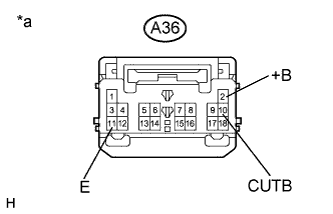
Text in Illustration *a Front view of wire harness connector
(to Certification ECU (Smart Key ECU Assembly))
Disconnect the A36 certification ECU (smart key ECU assembly) connector.
-
Measure the resistance according to the value(s) in the table below.
Standard Resistance Tester Connection Condition Specified Condition A36-11 (E) - Body ground Always Below 1 Ω -
Measure the voltage according to the value(s) in the table below.
Standard Voltage Tester Connection Condition Specified Condition A36-10 (CUTB) - Body ground Always 11 to 14 V A36-2 (+B) - Body ground Always 11 to 14 V
NG
REPAIR OR REPLACE HARNESS OR CONNECTOR
OK
-
-
CHECK HARNESS AND CONNECTOR (CERTIFICATION ECU - DOOR CONTROL RECEIVER)
-
Door Control Receiver with 5 Pin Connector:
-
Disconnect the Q1 certification ECU (smart key ECU assembly) connector.
-
Disconnect the P30 door control receiver connector.
-
Measure the resistance according to the value(s) in the table below.
Standard Resistance Tester Connection Condition Specified Condition Q1-5 (RCO) - P30-4 (+5) Always Below 1 Ω Q1-17 (RDAM) - P30-5 (DATA) Always Below 1 Ω Q1-6 (CSEL) - P30-2 (CSEL) Always Below 1 Ω Q1-5 (RCO) or P30-4 (+5) - Body ground Always 10 kΩ or higher Q1-17 (RDAM) or P30-5 (DATA) - Body ground Always 10 kΩ or higher Q1-6 (CSEL) or P30-2 (CSEL) - Body ground Always 10 kΩ or higher
-
-
Door Control Receiver with 12 Pin Connector:
-
Disconnect the Q1 certification ECU (smart key ECU assembly) connector.
-
Disconnect the P29 door control receiver connector.
-
Measure the resistance according to the value(s) in the table below.
Standard Resistance Tester Connection Condition Specified Condition Q1-5 (RCO) - P29-10 (+5) Always Below 1 Ω Q1-17 (RDAM) - P29-9 (DATA) Always Below 1 Ω Q1-6 (CSEL) - P29-6 (CSEL) Always Below 1 Ω Q1-5 (RCO) or P29-10 (+5) - Body ground Always 10 kΩ or higher Q1-17 (RDAM) or P29-9 (DATA) - Body ground Always 10 kΩ or higher Q1-6 (CSEL) or P29-6 (CSEL) - Body ground Always 10 kΩ or higher
-
NG
REPAIR OR REPLACE HARNESS OR CONNECTOR
OK
-
-
CHECK DOOR CONTROL RECEIVER
-
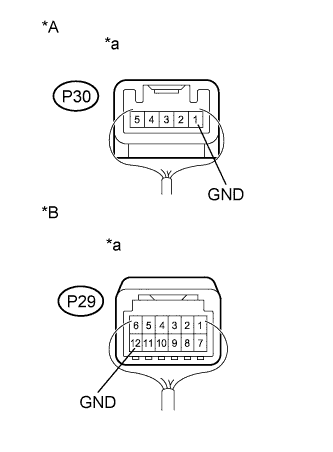
Text in Illustration *A Door Control Receiver with 5 Pin Connector *B Door Control Receiver with 12 Pin Connector *a Component with harness connected
(Door Control Receiver)
Connect the P30*1 or P29*2 door control receiver connector.
-
Connect the Q1 certification ECU (smart key ECU assembly) connector.
-
Measure the resistance according to the value(s) in the table below.
Standard Resistance Tester Connection Condition Specified Condition P30-1 (GND)*1 - Body ground Always Below 1 Ω P29-12 (GND)*2 - Body ground
-
*1: Door Control Receiver with 5 Pin Connector
-
*2: Door Control Receiver with 12 Pin Connector
Result Result Proceed to OK A NG (Door Control Receiver with 5 Pin Connector) B NG (Door Control Receiver with 5 Pin Connector) C NG (Door Control Receiver with 12 Pin Connector) D -
B
REPLACE DOOR CONTROL RECEIVER (for Quarter) Click here
C
REPLACE DOOR CONTROL RECEIVER (for Rear) Click here
D
REPLACE DOOR CONTROL AND TIRE PRESSURE MONITORING SYSTEM RECEIVER ASSEMBLY Click here
A
-
-
CHECK CERTIFICATION ECU (SMART KEY ECU ASSEMBLY)
-
Door Control Receiver with 5 Pin Connector:
-
Connect the Q1 certification ECU (smart key ECU assembly) connector.
-
Connect the P30 door control receiver connector.
-
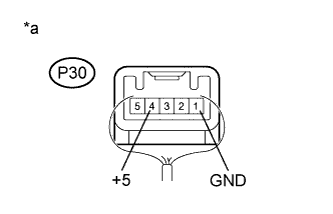
Text in Illustration *a Component with harness connected
(Door Control Receiver)
Measure the voltage according to the value(s) in the table below.
Standard Voltage Tester Connection Condition Specified Condition P30-4 (+5) - P30-1 (GND) Procedure:
-
Engine switch off
-
Electrical key transmitter sub-assembly switch not pressed
Below 1 V Procedure:
-
Engine switch off
-
Electrical key transmitter sub-assembly switch pressed
4.5 to 5.5 V -
-
-
Door Control Receiver with 12 Pin Connector:
-
Connect the Q1 certification ECU (smart key ECU assembly) connector.
-
Connect the P29 door control receiver connector.
-
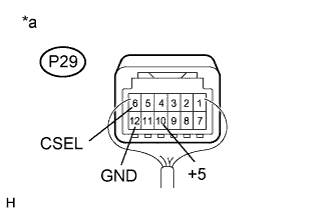
Text in Illustration *a Component with harness connected
(Door Control Receiver)
Measure the voltage according to the value(s) in the table below.
Standard Voltage Tester Connection Condition Specified Condition P29-10 (+5) - P29-12 (GND) Procedure:
-
Engine switch off
-
Electrical key transmitter sub-assembly switch not pressed
Below 1 V Procedure:
-
Engine switch off
-
Electrical key transmitter sub-assembly switch pressed
4.5 to 5.5 V P29-6 (CSEL) - P29-12 (GND) Engine switch off and all doors closed Below 1 V → 4.4 to 6.5 V → Below 1 V -
-
NG
REPLACE CERTIFICATION ECU (SMART KEY ECU ASSEMBLY)
OK
-
-
CHECK DOOR CONTROL RECEIVER
-
Door Control Receiver with 5 Pin Connector:
-
Connect the Q1 certification ECU (smart key ECU assembly) connector.
-
Connect the P30 door control receiver connector.
-
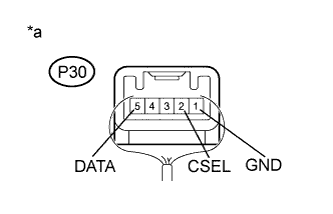
Text in Illustration *a Component with harness connected
(Door Control Receiver)
Measure the voltage according to the value(s) in the table below.
Standard Voltage Tester Connection Condition Specified Condition P30-5 (DATA) - P30-1 (GND) Procedure:
-
All doors closed
-
All doors locked
-
Electrical key transmitter sub-assembly switch pressed
Below 1 V → 11 to 14 V → Below 1 V P30-2 (CSEL) - P30-1 (GND) Procedure:
-
Engine switch off
-
All doors closed
Below 1 V → 4.4 to 6.5 V → Below 1 V -
-
-
Door Control Receiver with 12 Pin Connector:
-
Connect the Q1 certification ECU (smart key ECU assembly) connector.
-
Connect the P29 door control receiver connector.
-
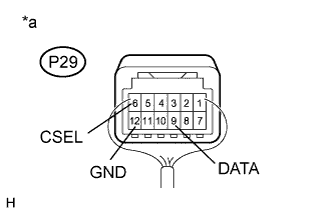
Text in Illustration *a Component with harness connected
(Door Control Receiver)
Measure the voltage according to the value(s) in the table below.
Standard Voltage Tester Connection Condition Specified Condition P29-9 (DATA) - P29-12 (GND) Procedure:
-
All doors closed
-
All doors locked
-
Electrical key transmitter sub-assembly switch pressed
Below 1 V → 10 to 16 V → Below 1 V P29-6 (CSEL) - P29-12 (GND) Procedure:
-
Engine switch off
-
All doors closed
Below 1 V → 4.5 to 6 V → Below 1 V Result Result Proceed to OK A NG (Door Control Receiver with 5 Pin Connector) B NG (Door Control Receiver with 5 Pin Connector) C NG (Door Control Receiver with 12 Pin Connector) D -
-
B
REPLACE DOOR CONTROL RECEIVER (for Quarter) Click here
C
REPLACE DOOR CONTROL RECEIVER (for Rear) Click here
D
REPLACE DOOR CONTROL AND TIRE PRESSURE MONITORING SYSTEM RECEIVER ASSEMBLY Click here
A
-
-
REPLACE CERTIFICATION ECU (SMART KEY ECU ASSEMBLY)
-
Temporarily replace the certification ECU (smart key ECU assembly) with a new one.
Tech Tips
Refer to the Service Bulletin.
NEXT
-
-
CHECK WIRELESS DOOR LOCK CONTROL SYSTEM
-
Check that the wireless door lock functions operate normally Click here.
OK Wireless door lock functions operate normally.
NG
REPLACE MAIN BODY ECU (MULTIPLEX NETWORK BODY ECU) Click here
OK
END (CERTIFICATION ECU (SMART KEY ECU ASSEMBLY) WAS DEFECTIVE)
-
-
CHECK WAVE ENVIRONMENT
-
Bring the electrical key transmitter sub-assembly that was checked first near the door control receiver and select the failed channel (the channel in which the buzzer did not sound) to recheck the key diagnostic mode Click here.
Tech Tips
-
When the electrical key transmitter sub-assembly is brought near the door control receiver, the possibility of wave interference decreases, and it can be determined if wave interference is causing the problem symptom.
-
If the inspection result is that the problem only occurs in certain locations or at certain times of day, the possibility of wave interference is high. Also, added vehicle components may cause wave interference. If installed, remove them and perform the operation check.
-
There may be wave interference if the vehicle is near broadcasting antennas, large video displays, wireless garage door opener systems, wireless security cameras, home security systems, etc. In this case, move the vehicle to a different location and check if there is any improvement.
-
If a tool for checking electric waves, such as a signal strength meter, is available, move around the area while observing both the LF band (used by the vehicle antenna to form the detection area) and RF band (used by the electrical key transmitter sub-assembly for transmission) to check for locations where there is wave interference.
OK Wireless door lock buzzer sounds. -
NG
CHECK ELECTRICAL KEY TRANSMITTER SUB-ASSEMBLY Click here
OK
AFFECTED BY WAVE INTERFERENCE
-
-
CHECK ELECTRICAL KEY TRANSMITTER SUB-ASSEMBLY
-
Check if there are any other registered electrical key transmitter sub-assemblies.
Result Result Proceed to There are no other registered electrical key transmitter sub-assemblies A There is another registered electrical key transmitter sub-assemblies B
B
CHECK KEY DIAGNOSTIC MODE Click here
A
-
-
ELECTRICAL KEY TRANSMITTER SUB-ASSEMBLY REGISTRATION (NEW ELECTRICAL KEY TRANSMITTER SUB-ASSEMBLY)
-
Register a new electrical key transmitter sub-assembly.
Tech Tips
Refer to the Service Bulletin.
NEXT
-
-
CHECK KEY DIAGNOSTIC MODE
-
Bring another registered electrical key transmitter sub-assembly near the door control receiver and select the failed channel (the channel in which the buzzer did not sound) to recheck the key diagnostic mode Click here.
OK Wireless door lock buzzer sounds.
NG
CHECK HARNESS AND CONNECTOR (CERTIFICATION ECU - DOOR CONTROL RECEIVER) Click here
OK
END (ELECTRICAL KEY TRANSMITTER SUB-ASSEMBLY THAT WAS INSPECTED FIRST WAS DEFECTIVE)
-
-
CHECK HARNESS AND CONNECTOR (CERTIFICATION ECU - DOOR CONTROL RECEIVER)
-
Disconnect the Q1 certification ECU (smart key ECU assembly) connector.
-
Disconnect the P29 door control receiver connector.
-
Measure the resistance according to the value(s) in the table below.
Standard Resistance Tester Connection Condition Specified Condition Q1-6 (CSEL) - P29-6 (CSEL) Always Below 1 Ω Q1-6 (CSEL) or P29-6 (CSEL) - Body ground Always 10 kΩ or higher
NG
REPAIR OR REPLACE HARNESS OR CONNECTOR
OK
-
-
CHECK CERTIFICATION ECU (SMART KEY ECU ASSEMBLY)
-
Connect the Q1 certification ECU (smart key ECU assembly) connector.
-
Connect the P29 door control receiver connector.
-
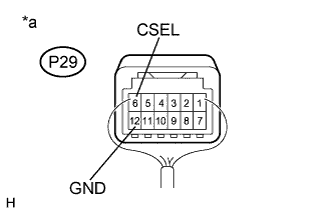
Text in Illustration *a Component with harness connected
(Door Control Receiver)
Measure the voltage according to the value(s) in the table below.
Standard Voltage Tester Connection Condition Specified Condition P29-6 (CSEL) - P29-12 (GND) Engine switch off and all doors closed Below 1 V → 4.5 to 6 V → Below 1 V
NG
REPLACE CERTIFICATION ECU (SMART KEY ECU ASSEMBLY)
OK
-
-
CHECK DOOR CONTROL RECEIVER
-
Connect the Q1 certification ECU (smart key ECU assembly) connector.
-
Connect the P29 door control receiver connector.
-
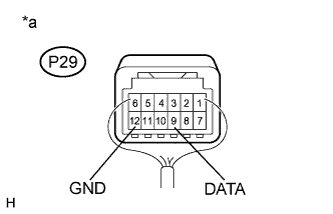
Text in Illustration *a Component with harness connected
(Door Control Receiver)
Measure the voltage according to the value(s) in the table below.
Tech Tips
Inspection should be performed while the electrical key antenna check in key diagnostic mode is being performed on the failed channel (the channel in which the buzzer did not sound).
Standard Voltage Tester Connection Condition Specified Condition P29-9 (DATA) - P29-12 (GND) Procedure:
-
All doors closed
-
All doors locked
-
Electrical key transmitter sub-assembly switch pressed*
Below 1 V → 10 to 16 V → Below 1 V
-
*: While the electrical key antennas are being inspected in key diagnostic mode Click here.
-
NG
REPLACE DOOR CONTROL AND TIRE PRESSURE MONITORING SYSTEM RECEIVER ASSEMBLY Click here
OK
-
-
REPLACE CERTIFICATION ECU (SMART KEY ECU ASSEMBLY)
-
Temporarily replace the certification ECU (smart key ECU assembly) with a new one.
Tech Tips
Refer to the Service Bulletin.
NEXT
-
-
CHECK WIRELESS DOOR LOCK CONTROL SYSTEM
-
Check that the wireless door lock functions operate normally Click here.
OK Wireless door lock functions operate normally.
NG
REPLACE MAIN BODY ECU (MULTIPLEX NETWORK BODY ECU) Click here
OK
END (CERTIFICATION ECU (SMART KEY ECU ASSEMBLY) WAS DEFECTIVE)
-